Within Strange Greece
Were Ancient Greek Robots Real or Reconstructed?
Working automata and mechanical models reveal genuine ancient engineering while showing where reconstruction ends and original evidence begins.
On this page
- The machines recreated from ancient texts and archaeology
- What visitors can operate and observe
- How to separate engineering evidence from mystery claims
Page outline Jump by section
Introduction
Were ancient Greek robots real? The short answer is yes and no. Ancient Greek engineers genuinely designed remarkable automatic machines powered by water, air, gravity and carefully arranged weights. However, almost everything visitors see operating today is a modern reconstruction rather than an original surviving machine. That distinction is central to understanding Greece’s technology museums. They showcase evidence-based working models built from ancient texts, archaeological remains and engineering research, while making clear where the historical evidence ends and informed reconstruction begins.[Kotsanas Museum]collection.kotsanasmuseum.comKotsanas Museum HomepageKotsanas MuseumHomepage - Kotsanas Museum…
This balance between archaeology and demonstration makes these collections unusual within Greece’s wider landscape of curious museums. Instead of displaying mysterious artefacts as unexplained marvels, they invite visitors to test mechanisms for themselves and compare ancient evidence with modern engineering interpretation.
The machines recreated from ancient texts and archaeology
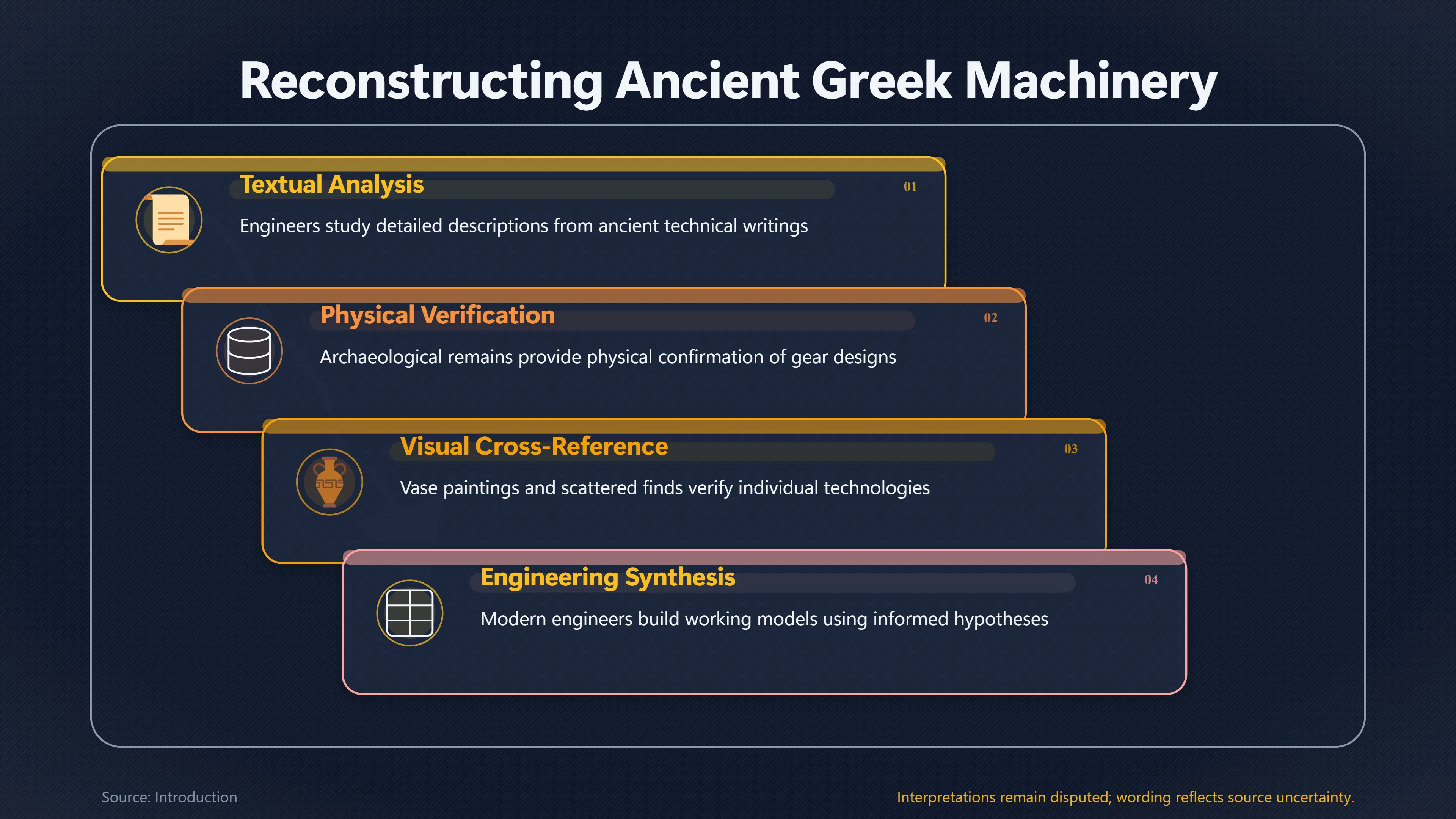
Most functioning ancient Greek machines on public display are reconstructions based on three different kinds of evidence rather than complete surviving originals.
Ancient technical writings provide the richest source. Engineers including Hero of Alexandria, Philo of Byzantium and Ctesibius described valves, siphons, gears, pulleys, pneumatic devices and automatic theatres in surprising technical detail. These descriptions allow modern engineers to build working models that closely follow the ancient instructions.[Kotsanas Museum]collection.kotsanasmuseum.comKotsanas Museum HomepageKotsanas MuseumHomepage - Kotsanas Museum…
Archaeological remains supply physical confirmation. The most famous example is the Antikythera Mechanism, whose surviving bronze fragments preserve genuine gears, inscriptions and structural components. Modern reconstructions begin with these original pieces before filling unavoidable gaps with carefully argued engineering hypotheses.[Popular Mechanics]popularmechanics.comBelieved to be constructed between the 3rd and 1st century B.C.E., the device is widely considered the world's earliest known analog comp…
Ancient art and scattered finds help verify individual technologies. Vase paintings, fragments of machinery and construction techniques provide additional clues about cranes, pumps and measuring instruments. These sources rarely produce a complete design on their own, but they strengthen or challenge interpretations drawn from texts.
Because every reconstruction combines these sources differently, museums increasingly explain not only how a machine works but also how confident researchers are about each feature.
What visitors can operate and observe
The most distinctive experience at Greece’s technology museums is that many exhibits are designed to move. Rather than looking through glass at fragile originals, visitors turn handles, release water, operate levers and watch mechanical sequences unfold. The aim is to demonstrate engineering principles that can be difficult to understand from ancient texts alone.[Kotsanas Museum]kotsanas.comMuseum Museums in GreeceKotsanas MuseumMuseums in Greece - Kotsanas Museum of Ancient Greek Technology…
Common reconstructed machines include:
- Automatic temple doors, opened by hidden pneumatic systems activated by heat.
- Coin-operated holy water dispensers, demonstrating controlled valves and measured flow.
- Mechanical theatres, where ropes, drums and weights automatically stage miniature performances.
- Water clocks, showing sophisticated ancient timekeeping.
- The robot servant of Philo, which could automatically pour measured quantities of wine and water.
- Hero’s moving automata, powered by falling weights, twisted cords or compressed air rather than electricity.
- Reconstructions of the Antikythera Mechanism, allowing visitors to rotate the gears and watch astronomical cycles appear on multiple dials.[Kotsanas Museum]kotsanas.comMuseum Kotsanas Museum of Ancient Greek TechnologyKotsanas MuseumKotsanas Museum of Ancient Greek Technology…
Institutions associated with the Kotsanas Museum of Ancient Greek Technology present hundreds of operating reconstructions across several Greek locations. Their displays emphasise interaction, arguing that ancient engineering is best understood by seeing mechanisms function rather than by viewing isolated components.[Kotsanas Museum]kotsanas.comMuseum Ancient Greek Technology Museum | Kotsanas MuseumKotsanas MuseumAncient Greek Technology Museum | Kotsanas Museum…
Were ancient Greek robots actually robots?
Modern publicity often describes these machines as “robots”, but that word needs careful interpretation.
Ancient automata were genuine self-operating mechanisms. Once activated, they could complete complex sequences without further human intervention. Some opened doors, others dispensed liquids, while theatrical devices could produce surprisingly elaborate performances using timed mechanical movements.
They were not programmable computers or intelligent machines in the modern sense. Their behaviour depended entirely on carefully designed mechanical systems involving weights, water pressure, air pressure, ropes, cams and gears. They could appear lifelike without making decisions.
This distinction matters because sensational claims sometimes blur the line between ancient automation and modern robotics. The historical achievement is impressive enough without exaggeration: Hellenistic engineers mastered sophisticated mechanical control systems more than two thousand years ago.[Live Science]livescience.comLive Science'Artificial intelligence' myths have existed for centuriesWhile current AI technologies are statistical data-crunchers—not truly intelligent systems—society’s fascination with AI taps into ancien…
The Antikythera Mechanism: where evidence is strongest
The Antikythera Mechanism occupies a unique position because it survives as an actual ancient object rather than only as a written description.
Recovered from a shipwreck near Antikythera in 1900, the corroded bronze fragments preserve dozens of precision gear wheels together with inscriptions explaining aspects of their operation. Modern imaging techniques have revealed internal structures invisible for decades, allowing increasingly accurate reconstructions of the mechanism’s astronomical functions.[Popular Mechanics]popularmechanics.comBelieved to be constructed between the 3rd and 1st century B.C.E., the device is widely considered the world's earliest known analog comp…
Yet even here, reconstruction remains necessary.
Large portions of the original machine are missing, so every complete working model contains hypothetical elements. Researchers continue debating details including missing indicators, dial arrangements and some gear relationships. New proposals appear regularly as scholars reinterpret inscriptions, X-ray scans and mechanical constraints.[arXiv]arxiv.orgThe reconstruction of the Antikythera Mechanism Instruction Manual after a diligent study and analysis of the Back cover inscription…
For visitors, this makes the Antikythera Mechanism especially valuable because museums can display both the authentic fragments and the reasoning behind different reconstructions. The process of historical investigation becomes part of the exhibition rather than remaining hidden behind a finished model.
How to separate engineering evidence from mystery claims
Ancient Greek technology often attracts sensational stories about lost super-civilisations or impossible knowledge. The museum evidence points in a more interesting direction.
A useful way to judge claims is to ask three questions:
- Does the original artefact survive? The Antikythera Mechanism does; many other devices survive only in written descriptions.
- Is the reconstruction based on identifiable ancient sources? Credible museums explain which texts, archaeological remains or images support each design.
- Are uncertain features identified openly? Responsible reconstructions distinguish confirmed components from necessary modern interpretation instead of presenting every detail as certain.
This evidence-based approach explains why technology museums differ from attractions built around historical mysteries. Their purpose is not to suggest hidden civilisations or impossible inventions but to demonstrate how much can be recovered through archaeology, philology and experimental engineering working together.
Why these reconstructions matter within Greece’s curiosity culture
Working reconstructions occupy a distinctive place among Greece’s unusual collections because they preserve something that original artefacts often cannot: movement.
The surviving archaeological record usually consists of broken bronze fragments, inscriptions or scattered components. Reconstruction transforms those remains into operating machines that reveal principles invisible in static displays. Visitors can see gears mesh, valves regulate water, weights drive automata and astronomical calculations unfold mechanically.
The result is an unusual museum experience that combines archaeology, engineering and experimental history. Rather than asking visitors simply to admire ancient objects, these collections encourage them to understand how ancient inventors solved practical mechanical problems—and where modern scholarship must still bridge the gap between surviving evidence and informed reconstruction.
Amazon book picks
Further Reading
Books and field guides related to Were Ancient Greek Robots Real or Reconstructed?. Use these as the next step if you want deeper reading beyond the article.
The Greek Myths
Endymion, Pelops, Daedalus, Pygmalion – what are the stories behind these and the hundreds of other familiar names from Greek mythology –...
The Birth of the Museum
In a series of richly detailed case studies from Britian, Australia and North America, Tony Bennett investigates how nineteenth- and twen...
Ancient Inventions
"We in the twentieth century tend to assume that our era has a monopoly on the inventions of clever machines, labor-saving devices, feats...
eBay marketplace picks
Marketplace Samples
Live-tested eBay searches with available results related to this page.
Selected fromrobotics kit oneBay.co.uk.



Endnotes
1.
Source: kotsanas.com
Title: Museum Kotsanas Museum of Ancient Greek Technology
Link:https://kotsanas.com/ekthemata/
Source snippet
Kotsanas MuseumKotsanas Museum of Ancient Greek Technology...
2.
Source: arxiv.org
Link:https://arxiv.org/abs/2207.12009
Source snippet
The reconstruction of the Antikythera Mechanism Instruction Manual after a diligent study and analysis of the Back cover inscription...
3.
Source: kotsanas.com
Title: Museum Museums in Greece
Link:https://kotsanas.com/museum/
Source snippet
Kotsanas MuseumMuseums in Greece - Kotsanas Museum of Ancient Greek Technology...
4.
Source: kotsanas.com
Title: Museum Ancient Greek Technology Museum | Kotsanas Museum
Link:https://kotsanas.com/
Source snippet
Kotsanas MuseumAncient Greek Technology Museum | Kotsanas Museum...
5.
Source: arxiv.org
Link:https://arxiv.org/abs/2407.15858
6.
Source: kotsanas.com
Title: Ancient Greek Technology Museum | Kotsanas Museum
Link:https://kotsanas.com/en/author/kotsadmin/page/11/
7.
Source: kotsanas.com
Title: Ancient Greek Technology Museum | Kotsanas Museum
Link:https://kotsanas.com/en/the-eratosthenes-mesolabio-mean-taker/feed/
8.
Source: kotsanas.com
Title: Ancient Greek Technology Museum | Kotsanas Museum
Link:https://kotsanas.com/en/method-of-checking-the-purity-of-gold-3rd-c-b-c/feed/
9.
Source: kotsanas.com
Title: Museum of Ancient Greek Technology
Link:https://kotsanas.com/en/author/kotsadmin/page/15/
10.
Source: kotsanas.com
Title: The Antikythera Mechanism: The First Computer in History
Link:https://kotsanas.com/news/the-antikythera-mechanism-the-first-computer-in-history/
11.
Source: collection.kotsanasmuseum.com
Title: Kotsanas Museum Homepage
Link:https://collection.kotsanasmuseum.com/en/
Source snippet
Kotsanas MuseumHomepage - Kotsanas Museum...
12.
Source: collection.kotsanasmuseum.com
Title: Kotsanas Museum The Antikythera calculating mechanism
Link:https://collection.kotsanasmuseum.com/en/exhibits/106052/
Source snippet
Kotsanas MuseumThe Antikythera calculating mechanism - Kotsanas Museum...
13.
Source: popularmechanics.com
Link:https://www.popularmechanics.com/science/archaeology/a69554155/antikythera-mechanism-worlds-first-computer/
Source snippet
Believed to be constructed between the 3rd and 1st century B.C.E., the device is widely considered the world's earliest known analog comp...
14.
Source: livescience.com
Title: Live Science’Artificial intelligence’ myths have existed for centuries
Link:https://www.livescience.com/archaeology/artificial-intelligence-myths-have-existed-for-centuries-from-the-ancient-greeks-to-a-popes-chatbot
Source snippet
While current AI technologies are statistical data-crunchers—not truly intelligent systems—society’s fascination with AI taps into ancien...
15.
Source: popularmechanics.com
Title: Popular Mechanics The World’s First Computer Sank 2,000 Years Ago
Link:https://www.popularmechanics.com/science/archaeology/a70963756/hidden-computer-roman-empire-secret-study/
Source snippet
Science Finally Solved One of Its Biggest Mysteries.The article recounts a groundbreaking scientific development in understanding the Ant...
16.
Source: uqantiquitiesonlineexhibitions.omeka.net
Link:https://uqantiquitiesonlineexhibitions.omeka.net/exhibits/show/wondrous-machines/introduction
Additional References
17.
Source: nature.com
Link:https://www.nature.com/articles/nature05357
18.
Source: nature.com
Link:https://www.nature.com/articles/s41598-021-84310-w
19.
Source: youtube.com
Title: Inside the Polybolos: The Ancient Machine Gun of Greece
Link:https://www.youtube.com/watch?v=3s96-PZxZqw
Source snippet
31 Obscure Inventions from Ancient Greece That Transformed the World...
20.
Source: nature.com
Title: Our current knowledge of the Antikythera Mechanism | Nature Astronomy
Link:https://www.nature.com/articles/s41550
21.
Source: youtube.com
Title: Antikythera Mechanism: The Ancient Greek Computer
Link:https://www.youtube.com/watch?v=ML4tw_UzqZE
Source snippet
Inside the Polybolos: The Ancient Machine Gun of Greece...
22.
Source: themadmuseum.co.uk
Link:https://themadmuseum.co.uk/history-of-automata/automata-in-greek-mythology/
23.
Source: herakleidon-gr.org
Link:https://www.herakleidon-gr.org/collection
24.
Source: ancientgreektechnology.gr
Link:https://www.ancientgreektechnology.gr/en/the-museum/exhibits
25.
Source: satyori.com
Link:https://satyori.com/ancient-sciences/heros-automata/
26.
Source: sciencedirect.com
Link:https://www.sciencedirect.com/science/article/pii/S2590123025046766