Where Malta Keeps Its Strangest Stories
Malta does not have a single grand museum of witchcraft, monsters or occult objects.
Page outline Jump by section
Introduction
The result is not a conventional weird-museum circuit. Malta’s most unusual collections are distributed among archaeological sites, churches, state museums, private displays, bunkers and historic buildings. Visitors therefore need to distinguish carefully between documented objects, devotional tradition, scholarly interpretation and attractions designed chiefly for atmosphere.[heritagemalta.mt]heritagemalta.mtHeritage MaltaHeritage MaltaHeritage Malta we proudly manage over 90 museums and landmarks, national monuments and underwater sites. From…
Where Malta’s strangest collections are found
Malta’s curiosity culture reflects the islands’ unusually dense layers of occupation. Prehistoric burial places, Roman and early Christian catacombs, the institutions of the Order of St John, the Roman Inquisition and the military infrastructure of British rule all survive within a small geographical area. Objects that might elsewhere be separated into archaeological, religious, ethnographic and military museums frequently appear here inside the buildings or underground spaces where their histories unfolded.
For visitors, the most rewarding sites fall into four broad groups:
- Archaeological mysteries, especially the underground burial complex at Ħal Saflieni and the skulls, figurines and human remains associated with it.
- Death, punishment and belief, represented by catacombs, reliquaries, inquisitorial rooms, prisons and commercially staged dungeon displays.
- Private cabinets and personal collections, including the toy museum on Gozo and the eclectic museum at St Agatha’s.
- Subterranean military heritage, where preserved plotting rooms and civilian shelters feel closer to abandoned command centres than to ordinary galleries.
This mixture matters because “strange” does not always mean supernatural. In Malta, the most uncanny experiences often come from seeing familiar museum categories in their original physical setting: bones in a rock-cut burial complex, prisoner drawings inside cells, or wartime maps in rooms built to survive aerial attack.[heritagemalta.mt]heritagemalta.mthal saflieni hypogeumHeritage MaltaĦal Saflieni HypogeumIt was in use between 4000 BC and 1500BC. Covering a remarkable 500 square metres, it was amongst the…
The Hypogeum: archaeology surrounded by modern myth
The Ħal Saflieni Hypogeum is Malta’s most extraordinary preserved site and the centre of many of its modern mystery stories. Cut into limestone on three underground levels, it served as a burial complex and ritual space during Malta’s prehistoric period. Archaeologists recovered human bones, pottery, ornaments, animal carvings and figurines from its chambers. The architecture imitates features found in Malta’s above-ground megalithic buildings, but recreates them underground in carved stone, sometimes beneath painted red-ochre patterns.[Heritage Malta]heritagemalta.mthal saflieni hypogeumHeritage MaltaĦal Saflieni HypogeumIt was in use between 4000 BC and 1500BC. Covering a remarkable 500 square metres, it was amongst the…
The site is genuinely mysterious in the ordinary archaeological sense: no written testimony survives from the community that made it, so the precise meaning of its chambers, decoration and rituals cannot be reconstructed with certainty. Its acoustic properties are also unusual. Experimental research has identified strong resonant frequencies and argued that the geometry may have been deliberately shaped to reinforce sound, although claims about exactly how prehistoric people used those effects remain interpretative rather than settled fact.[arXiv]arxiv.orgOpen source on arxiv.org.
The Hypogeum has also attracted claims about lost races, vanished giants and extraterrestrial beings. Much of this folklore focuses on skulls recovered during the early excavations. Archaeologist Temi Zammit described some as belonging to a “long-headed type”, wording later transformed online into claims that hundreds or thousands of non-human skulls had disappeared into museum stores. Heritage Malta has directly addressed this mythology through an exhibition whose title, “Alien Headaches? The Hypogeum Skulls Enigma”, deliberately contrasted popular speculation with the surviving archaeological evidence.[Heritage Malta]heritagemalta.mtOpen source on heritagemalta.mt.
The important distinction is that unusually proportioned human skulls are real objects, while the extraterrestrial narrative is a modern interpretation imposed upon them. Heritage Malta acknowledges the history of public fascination but does not treat the remains as proof of aliens or an unknown species. The episode is a useful example of how Malta’s archaeological collections are commercialised and retold: authentic uncertainty becomes the starting point for much less cautious mystery literature.[Heritage Malta]heritagemalta.mtOpen source on heritagemalta.mt.
Catacombs, crocodiles and sacred remains
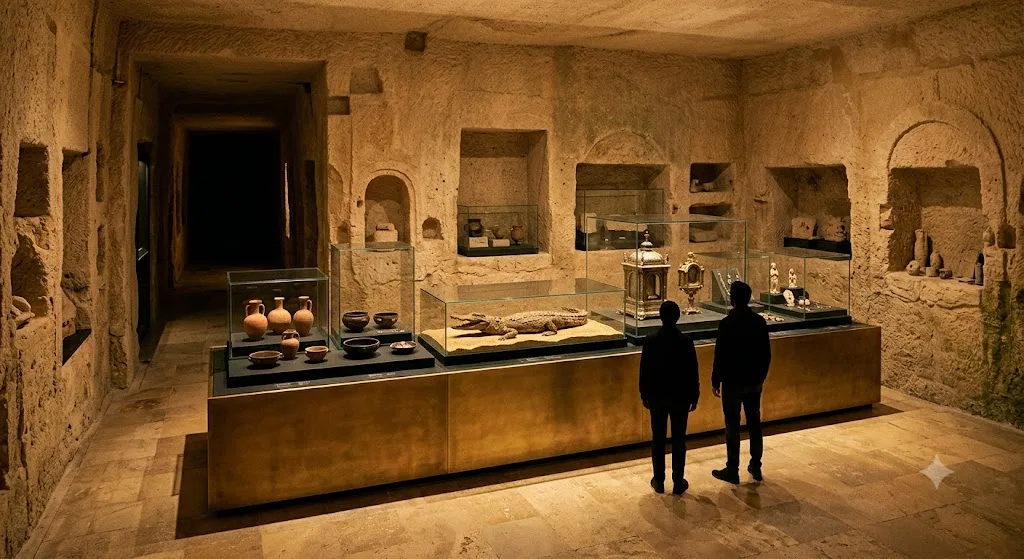
St Agatha’s Crypt, Catacombs and Museum in Rabat brings several kinds of curiosity together in one institution. The underground complex preserves evidence of Roman-period burial and early Christian worship, while its museum contains religious art, coins, archaeological material and natural-history specimens. The object most likely to surprise visitors is a mummified crocodile from the Nile, displayed in the main hall among items with no obvious connection to an Egyptian animal cult.[stagathamalta.com]stagathamalta.comSt. Agatha, MaltaA mummified crocodile from the Nile can also be found in the main hall. Exhibited in … are various religious paintings…
That crocodile makes the museum feel like an older cabinet of curiosities rather than a tightly themed modern display. Its presence is documented by the institution itself, but the museum’s online description offers little detailed provenance. It is therefore safer to regard it as an authentic historic specimen in an eclectic collection, not as evidence of a direct ancient Egyptian connection to the catacombs. The oddity lies largely in the juxtaposition: a preserved Nile animal, Christian burial chambers, minerals and ecclesiastical objects gathered under one roof.[stagathamalta.com]stagathamalta.comSt. Agatha, MaltaA mummified crocodile from the Nile can also be found in the main hall. Exhibited in … are various religious paintings…
Human remains elsewhere in Malta are usually presented archaeologically or devotionally rather than as macabre entertainment. The Hypogeum treats bones as evidence of prehistoric burial practice, while Catholic museums and churches preserve relics as sacred objects associated with saints. Wignacourt Museum in Rabat, for example, has documented a collection of relics and reliquaries that once included eight sculpted busts. A gilt and painted wooden bust identified with St Matthew remains among its notable exhibits.[wignacourtmuseum.com]wignacourtmuseum.comRelics and ReliquariesRelics and Reliquaries
To a secular visitor, such reliquaries can resemble ornate containers for fragments of the dead. Within Catholic practice, however, they belong to a devotional system in which bodily remains or objects associated with saints act as material links to holy lives. Malta’s Baroque churches acquired and displayed such relics as part of public worship, ceremony and institutional prestige. They should therefore be understood as active or historic religious heritage, not merely as gothic curiosities.[L-Università ta' Malta]um.edu.mtOpen source on edu.mt.
Witchcraft and the Inquisition without the fantasy
Malta’s strongest witchcraft connection is not a museum filled with spell books or magical apparatus. It is the documentary and architectural legacy of the Roman Inquisition. The Inquisitor’s Palace in Birgu served as a tribunal and residence during more than two centuries of inquisitorial activity. Today it operates as both a historic house and Malta’s national ethnography museum, with the building itself—including tribunal spaces and prison areas—forming a central part of the visitor experience.[Heritage Malta]heritagemalta.mtHeritage Malta Inquisitor's Palace A power-house of the Holy Roman Inquisition that dominated Malta for over 224 years. Built in around tHeritage MaltaInquisitor's PalaceA power-house of the Holy Roman Inquisition that dominated Malta for over 224 years. Built in around the…
Surviving records reveal a society in which accusations of sorcery, healing magic, divination, love spells and superstition could be investigated as offences against Catholic teaching. Witchcraft was an important category in the Maltese tribunal’s work, but Malta did not experience a Salem-style outbreak of mass executions. Cases more often involved everyday attempts to influence relationships, illness, fortune or personal conflict within a deeply religious culture. The archive is valuable precisely because it preserves ordinary voices, including the testimony of people who would otherwise be almost absent from written history.[com.mt]yellow.com.mtYellow Malta The Maltese Witch Trials: What the Inquisition RecordsYellow Malta The Maltese Witch Trials: What the Inquisition Records
Visitors expecting a theatrical witch museum may therefore find something subtler. The palace is an official, research-based heritage institution, not an occult attraction. Its importance lies in showing how belief, fear and authority worked together: magical practices were not displayed as proof that supernatural powers existed, but investigated because people believed such practices could threaten souls, marriages, reputations and religious order.
The inquisitorial archives themselves are associated with the Mdina cathedral institutions rather than presented as a walk-through horror collection. Their survival gives Malta one of the richest documentary foundations in Europe for studying early modern popular belief. This creates a valuable contrast with the island’s commercial dark-history attractions: the most credible source for Maltese witchcraft is a paper archive of depositions and trials, not a room of torture instruments.[Vassallo History]vassallohistory.wordpress.cominquisition in maltainquisition in malta
Prison walls that became an archive
The Old Prison in Gozo’s Citadel is one of Malta’s most distinctive unusual collections because its principal exhibits were not assembled by a curator. They were scratched directly into the limestone by prisoners. Cells and corridors preserve ships, crosses, dates, names, hands and other marks, forming what Heritage Malta describes as the largest known concentration of historic graffiti in the Maltese Islands.[Heritage Malta]heritagemalta.mtHeritage Malta The Old PrisonSite, Dark History… Heritage Malta Members: FREE… Answers to the most common questions about the Gozo Old Prison…
The prison was used from the period of the Order of St John into the twentieth century. Its inmates included disorderly members of the Order; Jean Parisot de Valette, later Grand Master, was reportedly confined there for several months in 1538 after attacking a man. Yet the real fascination is not the presence of one famous prisoner. It is the survival of anonymous images made by people with time, frustration and very limited means of expression.[Google Arts & Culture]artsandculture.google.comOpen source on google.com.
Ship carvings are especially evocative on islands shaped by seafaring, naval employment and migration. Some may record vessels prisoners knew, imagined or hoped to board after release. Others could simply be habitual motifs. Interpretation must remain cautious because most carvings are unsigned or lack explanatory context, but collectively they form an involuntary social archive—part art collection, part testimony and part material evidence of confinement.
The Old Prison is an official public museum rather than an immersive horror attraction. Its restraint strengthens the experience. Empty cells, worn stone and original inscriptions communicate more about imprisonment than reconstructed scenes of screaming mannequins could do.[Heritage Malta]heritagemalta.mtHeritage Malta The Old PrisonSite, Dark History… Heritage Malta Members: FREE… Answers to the most common questions about the Gozo Old Prison…

Mdina Dungeons: history staged as horror
The Mdina Dungeons Museum represents the commercial end of Malta’s strange-history landscape. Located in underground rooms near Mdina’s main entrance, it advertises itself as Malta’s “dark walk” attraction. Visitors encounter life-sized figures, recreated cells, torture scenes and episodes drawn from Malta’s long history of conflict, punishment, disease and religious authority.[mdinadungeons.com]mdinadungeons.comOpen source on mdinadungeons.com.
Its appeal is immediate: low ceilings, stone chambers and dramatic tableaux create the atmosphere of a historical ghost train. It is also more accessible to casual visitors than an archive-based exhibition. The limitation is that theatrical displays can blur several periods together and make exceptional violence seem representative of everyday medieval life. Claims about particular devices or punishments should not automatically be treated as equivalent to evidence from court records, archaeology or an official museum catalogue.
This does not make the attraction worthless. It preserves and commercialises Malta’s popular image as a place of knights, dungeons, plague and inquisitorial menace. It can work as an introduction to themes explored more rigorously at the Inquisitor’s Palace or Old Prison. Visitors should simply recognise the difference in genre: the Dungeons are a privately operated, atmosphere-led historical attraction, while Heritage Malta’s sites place greater emphasis on documented buildings, objects and research.[Heritage Malta]heritagemalta.mtHeritage Malta Inquisitor's Palace A power-house of the Holy Roman Inquisition that dominated Malta for over 224 years. Built in around tHeritage MaltaInquisitor's PalaceA power-house of the Holy Roman Inquisition that dominated Malta for over 224 years. Built in around the…
Private cabinets and eccentric collecting
The Pomskizillious Museum of Toys in Xagħra, Gozo, is strange in a gentler way. Founded from the private collection of Susan and Edwin Lowe, it grew from a single doll into an international assortment of dolls’ houses, toy soldiers, vehicles, bears and childhood objects dating back to the eighteenth century. The collection moved from England to Gozo and remains a personal museum rather than a national institution.[Visit Gozo]visitgozo.comOpen source on visitgozo.com.
Its name comes from a fanciful word used by the nineteenth-century artist and writer Edward Lear when describing Gozo. That linguistic oddity suits the museum’s character: packed display cases, handmade pieces and objects carrying the emotional histories of former owners. Some visitors may find antique dolls unsettling, but the museum is not presented as paranormal or deliberately frightening. Its curiosity value comes from accumulation, rarity and the strongly personal logic of the collectors.[jet2holidays.com]jet2holidays.compomskizillious museum of toyspomskizillious museum of toys
Malta’s National Museum of Natural History offers a more formal version of the cabinet tradition. Its repository includes more than 10,000 geological and mineral items, around 12,000 bird and mammal specimens, and much larger holdings of insects, molluscs and fossils. Only part of this material is on public view; much of it functions as a scientific reference collection rather than spectacle.[Heritage Malta]heritagemalta.mtOpen source on heritagemalta.mt.
The museum is relevant to strange-collection culture because preserved animals and historic specimens often move between two meanings. To the public, they can appear as taxidermic oddities. To researchers, they are records of species, habitats and environmental change. Recent programming on nature in Maltese folklore has also explored how plants and animals become associated with omens, healing, protection and superstition, connecting scientific collections to intangible belief without treating folklore as zoological fact.[Heritage Malta]heritagemalta.mtOpen source on heritagemalta.mt.
Malta beneath the surface
Underground military museums form another major branch of Maltese curiosity culture. The Lascaris War Rooms in Valletta preserve the subterranean headquarters from which the defence of Malta was coordinated during the Second World War. Plotting rooms, communications areas, maps and operational spaces survive within tunnels created to protect command staff from bombing. The complex was later used by NATO to track Soviet submarine activity in the Mediterranean until 1977.[Lascaris War Rooms]lascariswarrooms.comLascaris War RoomsLascaris War Rooms: HomeThis complex housed the Fighter Sector Operations Room used during the Battle for Malta 1940-43…
This is not a collection of mysterious objects so much as a preserved system. Its strangeness comes from entering an environment designed to be secret, enclosed and functional. Unlike reconstructed bunkers, the War Rooms retain a direct relationship between place and purpose: information arrived, was plotted and informed military decisions inside these chambers.
Other public underground sites show the civilian side of siege. The Malta at War Museum incorporates air-raid shelters, while the Mellieħa shelters preserve tunnels used by residents during bombing. These spaces turn beds, domestic niches, religious images and rough-cut chambers into evidence of how ordinary life continued below ground. They are officially or locally managed heritage attractions rather than “haunted bunkers”, although their confined settings naturally attract dark-tourism interest.[maltaatwarmuseum.com]maltaatwarmuseum.comOpen source on maltaatwarmuseum.com.
The distinction between war museum and dark attraction is important. Lascaris explains command and strategy; civilian shelters convey fear, improvisation and survival. Together they demonstrate how Malta’s unusual collections are often inseparable from architecture. The exhibit is not simply the object in a case but the entire underground environment.
What is credible, contested or tourist-led?
Malta’s strange museums are best approached on a spectrum rather than divided into “real” and “fake”.
Official archaeological and state museums provide the strongest documentation. Heritage Malta’s Hypogeum, National Museum of Archaeology, Natural History Museum, Inquisitor’s Palace and Old Prison are curated as research and heritage institutions. Their interpretations can change as scholarship develops, but they distinguish physical evidence from speculation.
Religious museums and collections preserve objects whose importance depends partly on faith and tradition. A reliquary can be unquestionably authentic as a historic artwork even when the identity or history of the material inside it cannot be independently demonstrated. Its cultural significance does not depend solely on laboratory verification.
Private collections such as the toy museum or St Agatha’s museum may contain genuine and unusual objects but offer varying levels of catalogue detail. Their eclecticism is part of their appeal, although researchers seeking precise provenance may find less information than in a national collection.
Commercial dark-history attractions use history as raw material for atmosphere. The Mdina Dungeons contain historical themes and an authentic underground setting, but their mannequins and recreated torture scenes should be read as interpretation and entertainment, not as primary evidence.
Mystery claims require the greatest caution. Malta’s prehistoric sites are sufficiently unusual without aliens, giants or lost super-civilisations. The Hypogeum skull controversy shows how an old archaeological description can be detached from its context, multiplied online and converted into a claim that museum authorities are hiding impossible remains. The responsible approach is to separate the surviving objects and excavation records from later storytelling.[heritagemalta.mt]heritagemalta.mtOpen source on heritagemalta.mt.
Why Malta’s curiosity culture matters
Malta’s unusual collections reveal a country where history has repeatedly been preserved in confined spaces: tombs, crypts, cells, cabinets, shelters and command rooms. This gives its museums a distinctive physical intensity. Visitors do not merely look at objects associated with death, belief, punishment or secrecy; they often enter the chamber where burial, interrogation, imprisonment or military planning took place.
The country also demonstrates how different institutions turn strangeness into public culture. Archaeologists confront sensational myths about prehistoric remains. Churches retain bodily relics within systems of devotion. Private collectors arrange toys and natural specimens according to personal fascination. Commercial operators transform punishment into spectacle. Former prisoners unintentionally leave behind a collection no museum could have commissioned.
For the curious traveller, the strongest route through Malta is therefore not a hunt for one definitive “museum of the weird”. It is a movement between different ways of preserving and interpreting unsettling material. The mummified crocodile, the Hypogeum skulls, the carved prison ships and the underground plotting rooms are memorable for different reasons—but together they show how evidence, belief, memory and tourism compete to decide what counts as Malta’s strange past.
Amazon book picks
Further Reading
Books and field guides related to Where Malta Keeps Its Strangest Stories. Use these as the next step if you want deeper reading beyond the article.
The Knights of Malta
First published 1994. Subjects: Grand Sovereign Dynastic Hospitaller Order of Saint John, History, Knights of Malta, Catholicism, Religio...
Malta: An Archaeological Guide
First published 2005. Subjects: Antiquities, Excavations (Archaeology), Phoenicians, Carthaginians, Romans.
eBay marketplace picks
Marketplace Samples
Live-tested eBay searches with available results related to this page.
Selected fromMalta map print oneBay.co.uk.
Endnotes
1.
Source: stagathamalta.com
Link:https://stagathamalta.com/museum.html
Source snippet
St. Agatha, MaltaA mummified crocodile from the Nile can also be found in the main hall. Exhibited in … are various religious paintings...
2.
Source: arxiv.org
Link:https://arxiv.org/abs/2010.13697
3.
Source: wignacourtmuseum.com
Title: Relics and Reliquaries
Link:https://www.wignacourtmuseum.com/info/relics_and_reliquaries.html
4.
Source: artsandculture.google.com
Link:https://artsandculture.google.com/partner/the-old-prison-of-gozo
5.
Source: jet2holidays.com
Title: pomskizillious museum of toys
Link:https://www.jet2holidays.com/poi/malta-and-gozo/pomskizillious-museum-of-toys
6.
Source: guidememalta.com
Link:https://www.guidememalta.com/en/must-visit-this-week-pomskizillious-museum-of-toys-gozo
7.
Source: dark-tourism.com
Link:https://www.dark-tourism.com/index.php/1299-maltaatwarmuseum
8.
Source: malta.com
Title: The Old Prison
Link:https://www.malta.com/en/attraction/culture/museum/the-old-prison
9.
Source: malta.com
Title: The Folklore Museum
Link:https://www.malta.com/en/attraction/culture/museum/folklore-museum
10.
Source: malta.com
Title: National Museum of Archaeology
Link:https://www.malta.com/en/attraction/culture/museum/national-museum-of-archaeology
11.
Source: malta.com
Title: National Museum of Natural History
Link:https://www.malta.com/en/attraction/culture/museum/national-museum-of-natural-history
12.
Source: malta.com
Title: Toy Museum
Link:https://www.malta.com/en/attraction/culture/museum/malta-toy-museum
13.
Source: guidememalta.com
Title: must visit this week 8 unusual museums in malta for museum haters
Link:https://www.guidememalta.com/en/must-visit-this-week-8-unusual-museums-in-malta-for-museum-haters
14.
Source: guidememalta.com
Link:https://www.guidememalta.com/en/attraction/pomskizillious-museum-of-toys
15.
Source: stagathamalta.com
Link:https://stagathamalta.com/exhib.html
16.
Source: stagathamalta.com
Link:https://stagathamalta.com/books.html
17.
Source: stagathamalta.com
Title: Contact Us
Link:https://stagathamalta.com/contact.html
18.
Source: stagathamalta.com
Link:https://stagathamalta.com/catacombs.html
19.
Source: heritagemalta.mt
Link:https://heritagemalta.mt/
Source snippet
Heritage MaltaHeritage MaltaHeritage Malta we proudly manage over 90 museums and landmarks, national monuments and underwater sites. From...
20.
Source: heritagemalta.mt
Title: Heritage Malta The Old Prison
Link:https://heritagemalta.mt/explore/the-old-prison/
Source snippet
Site, Dark History... Heritage Malta Members: FREE... Answers to the most common questions about the Gozo Old Prison...
21.
Source: heritagemalta.mt
Link:https://heritagemalta.mt/explore/the-[inquisitors-palace
Source snippet
Heritage MaltaInquisitor's PalaceA power-house of the Holy Roman Inquisition that dominated Malta for over 224 years. Built in around the...
22.
Source: heritagemalta.mt
Title: hal saflieni hypogeum
Link:https://heritagemalta.mt/explore/hal-saflieni-hypogeum/
Source snippet
Heritage MaltaĦal Saflieni HypogeumIt was in use between 4000 BC and 1500BC. Covering a remarkable 500 square metres, it was amongst the...
23.
Source: visitmalta.com
Link:https://www.visitmalta.com/en/attraction/St-Agatha-s-Catacombs
Source snippet
Visit MaltaSt Agatha's CatacombsProviding the earliest evidence of Christian worship on the Maltese Islands, the catacombs served as a pl...
24.
Source: lascariswarrooms.com
Link:https://www.lascariswarrooms.com/
Source snippet
Lascaris War RoomsLascaris War Rooms: HomeThis complex housed the Fighter Sector Operations Room used during the Battle for Malta 1940-43...
25.
Source: heritagemalta.mt
Link:https://heritagemalta.mt/news/the-hypogeum-skulls-on-display-at-the-national-museum-of-archaeology/
26.
Source: heritagemalta.mt
Link:https://heritagemalta.mt/news/hypogeum-skulls-exhibition-extended-till-end-of-october/
27.
Source: um.edu.mt
Link:https://www.um.edu.mt/library/oar/handle/123456789/8914
28.
Source: yellow.com.mt
Title: Yellow Malta The Maltese Witch Trials: What the Inquisition Records
Link:https://www.yellow.com.mt/news/all/the-maltese-witch-trials-what-the-inquisition-records-actually-show/
29.
Source: um.edu.mt
Title: L-Università ta’ Malta Study-Unit Description
Link:https://www.um.edu.mt/courses/studyunit/LIA5027
30.
Source: vassallohistory.wordpress.com
Title: inquisition in malta
Link:https://vassallohistory.wordpress.com/inquisition-in-malta/
31.
Source: visitgozo.com
Title: Visit Gozo Old Prison
Link:https://visitgozo.com/places/old-prison/
32.
Source: maltashipgraffiti.org
Title: Old Prison
Link:https://maltashipgraffiti.org/location/old-prison/
33.
Source: um.edu.mt
Link:https://www.um.edu.mt/library/oar/handle/123456789/42024
34.
Source: mdinadungeons.com
Link:https://www.mdinadungeons.com/
35.
Source: visitmalta.com
Link:https://www.visitmalta.com/en/attraction/mdina-dungeons-malta
36.
Source: visitgozo.com
Link:https://visitgozo.com/places/pomskizillious-museum-of-toys/
37.
Source: heritagemalta.mt
Link:https://heritagemalta.mt/explore/national-museum-of-natural-history/
38.
Source: um.edu.mt
Link:https://www.um.edu.mt/library/oar/handle/123456789/125980
39.
Source: heritagemalta.mt
Link:https://heritagemalta.mt/news/people-and-natures-deep-connection-explored-in-new-heritage-malta-exhibition/
40.
Source: heritagemalta.mt
Link:https://heritagemalta.mt/whats-on/nature-in-maltese-folklore-the-supernatural-in-the-natural/
41.
Source: maltaatwarmuseum.com
Link:https://www.maltaatwarmuseum.com/
42.
Source: heritagemalta.mt
Title: Nature in Maltese Folklore
Link:https://heritagemalta.mt/whats-on/nature-in-maltese-folklore/
43.
Source: heritagemalta.mt
Title: Gradual Closure And New Roles For Two Museums In Gozo
Link:https://heritagemalta.mt/news/gradual-closure-and-new-roles-for-two-museums-in-gozo/
44.
Source: emuseum.heritagemalta.mt
Title: mt Bighi Hospital – Objects – Heritage Malta
Link:https://emuseum.heritagemalta.mt/objects/599/bighi-hospital
45.
Source: visitgozo.com
Link:https://visitgozo.com/gozo/
46.
Source: visitgozo.com
Title: Museums Archives
Link:https://visitgozo.com/place_category/museums/
47.
Source: Wikipedia
Link:https://en.wikipedia.org/wiki/Mdina
48.
Source: Wikipedia
Title: Lascaris War Rooms
Link:https://en.wikipedia.org/wiki/Lascaris_War_Rooms
49.
Source: Wikipedia
Title: Ħal Saflieni Hypogeum
Link:https://en.wikipedia.org/wiki/%C4%A6al_Saflieni_Hypogeum
50.
Source: tripadvisor.co.uk
Link:https://www.tripadvisor.co.uk/Attraction_Review-g190328-d2087295-Reviews-Lascaris_War_Rooms-Valletta_Island_of_Malta.html
51.
Source: tripadvisor.com
Title: Mdina Dungeons
Link:https://www.tripadvisor.com/Attraction_Review-g190324-d3332315-Reviews-Mdina_Dungeons-Mdina_Island_of_Malta.html
52.
Source: um.edu.mt
Link:https://www.um.edu.mt/library/oar/handle/123456789/10101
53.
Source: um.edu.mt
Title: cart ruts comprehensive study
Link:https://www.um.edu.mt/newspoint/news/2020/04/cart-ruts-comprehensive-study
54.
Source: youtube.com
Title: Heritage Malta
Link:https://www.youtube.com/watch?v=7DtLlA95Has
55.
Source: youtube.com
Link:https://www.youtube.com/watch?v=HwrUp1hANQE
56.
Source: visitmalta.com
Title: Pomskizillious Museum of Toys
Link:https://www.visitmalta.com/en/attraction/museum-of-toys-xaghra/
57.
Source: www2.visitmalta.com
Title: museum of toys xaghra
Link:https://www2.visitmalta.com/en/attraction/museum-of-toys-xaghra
58.
Source: visitmalta.com
Title: Visit Malta
Link:https://www.visitmalta.com/en/
60.
Source: visitmalta.com
Link:https://www.visitmalta.com/hu/attraction/national-museum-natural-history-malta
61.
Source: visitmalta.com
Link:https://www.visitmalta.com/en/attraction/lascaris-war-rooms-malta
62.
Source: heritagemalta.mt
Title: Free admission to Heritage Malta Citadel museums during Notte Gozitana
Link:https://heritagemalta.mt/news/free-admission-to-heritage-malta-citadel-museums-during-notte-gozitana/
63.
Source: heritagemalta.mt
Title: National Museum of Archaeology
Link:https://heritagemalta.mt/explore/national-museum-of-archaeology/
64.
Source: heritagemalta.mt
Title: National Museum of Archaeology
Link:https://heritagemalta.mt/mt/explore/national-museum-of-archaeology/
65.
Source: heritagemalta.mt
Title: Gozo Museum of Archaeology
Link:https://heritagemalta.mt/explore/gozo-museum-of-archaeology/
66.
Source: culture-malta.info
Title: National Museum of Natural History
Link:https://www.culture-malta.info/kultur/malta/aussstellungen/naturgeschichtliches.museum.html
67.
Source: global-geography.org
Title: The Mdina Dungeons Museum
Link:https://global-geography.org/af/Geography/Europe/Malta/Pictures/Mdina_North/The_Mdina_Dungeons_Museum_-_Method_of_Torture
68.
Source: gpsmycity.com
Link:https://www.gpsmycity.com/attractions/mdina-dungeons-museum-61950.html
69.
Source: shutterstock.com
Title: mdina dungeon
Link:https://www.shutterstock.com/search/mdina-dungeon
70.
Source: stagatha.mt
Link:https://stagatha.mt/
71.
Source: islandofgozo.org
Link:https://www.islandofgozo.org/what-to-see/museums/
Additional References
72.
Source: youtube.com
Title: The 6,000-Year-Old Underground Labyrinth: The Ħal Saflieni Hypogeum of Malta
Link:https://www.youtube.com/watch?v=x4jnrhRc-0U
Source snippet
Hal Saflieni Hypogeum Heritage Malta The 6,000-Year-Old Underground Labyrinth: The Ħal Saflieni Hypogeum of Malta | Ancient Architects An...
73.
Source: youtube.com
Title: St Agatha Complex in Rabat, Malta
Link:https://www.youtube.com/watch?v=NsyEiDjw7E8
Source snippet
The 6,000-Year-Old Underground Labyrinth: The Ħal Saflieni Hypogeum of Malta...
74.
Source: atlasobscura.com
Link:https://www.atlasobscura.com/things-to-do/mdina-malta/torture-museums
75.
Source: atlasobscura.com
Link:https://www.atlasobscura.com/things-to-do/malta/museums
76.
Source: facebook.com
Link:https://www.facebook.com/nationalmuseumofnaturalhistory/videos/bringing-fossils-to-lifeone-of-the-most-important-specimens-in-the-fossil-collec/337638221554976/
77.
Source: instagram.com
Link:https://www.instagram.com/reel/DVrE7BKiqSE/?hl=en
78.
Source: bathmedicalmuseum.org
Link:https://bathmedicalmuseum.org/cabinet-of-curiosities/
79.
Source: medicalmuseum.org.uk
Link:https://medicalmuseum.org.uk/george-marshall
80.
Source: nhm.ac.uk
Link:https://www.nhm.ac.uk/our-science/services/collections.html
81.
Source: metropolitanchapter.com
Link:https://www.metropolitanchapter.com/wp-content/uploads/2022/04/Archives_Categories_AIM_ProcCrim_database_1_introduction.pdf