Within Strange Ghana
Who Truly Owns the Asante Royal Treasures?
Manhyia Palace reveals why Asante gold is both royal heritage and the centre of an unresolved restitution debate.
On this page
- How regalia carries political and spiritual authority
- The return of looted objects to Kumasi
- Loans, permanent restitution and disputed ownership
Page outline Jump by section
Introduction
The royal treasures displayed at Manhyia Palace Museum are not simply beautiful examples of goldsmithing. For the Asante Kingdom, they are living symbols of political legitimacy, ancestral continuity and sacred authority. That distinction explains why debates over their ownership have become some of the most significant restitution discussions in the museum world. While many visitors see dazzling gold ornaments, ceremonial swords and royal insignia, the Asante court sees objects that continue to belong within an active royal institution rather than a vanished historical civilisation.
This makes Manhyia Palace Museum unusual within Ghana’s museum landscape. It is not only interpreting the history of the regalia; it is doing so from inside the institution that created, used and continues to invest these objects with meaning. The result is a museum where questions of heritage, law, spirituality and colonial history remain very much alive.
How regalia carries political and spiritual authority
To understand the ownership debate, it is necessary to understand what Asante regalia actually represents.
Gold has long symbolised wealth in the Asante Kingdom, but royal regalia carries a deeper significance than its material value. Ceremonial swords, state umbrellas, necklaces, badges of office, stools, staffs and ornaments identify legitimate political authority. Many are regarded as “stool property”—belonging not to an individual ruler but to the office, the kingdom and its continuing institutions. Successive rulers become custodians rather than personal owners of these objects.[The Metropolitan Museum of Art]metmuseum.orgThe Metropolitan Museum of Art Asante-Akan artistThe Metropolitan Museum of ArtAsante-Akan artist - Ȯkyeame poma (royal spokesperson's staff) with stool, chain, and crossed swords - Asa…
The most famous example is the Golden Stool, which Asante tradition holds descended from heaven during the kingdom’s foundation. Although it is not normally displayed publicly and is absent from ordinary museum collections, it illustrates how royal objects are understood within Asante political philosophy. The stool is believed to embody the nation itself rather than functioning as a ceremonial seat. Its importance helps explain why other pieces of royal regalia are also treated as extensions of state authority rather than decorative artworks.[Manhyia Palace]manhyiapalacemuseum.orgManhyia Palace A history of Asante gold at the V&A – Manhyia PalaceManhyia Palace A history of Asante gold at the V&A – Manhyia Palace
Within palace ceremonies, regalia also regulates hierarchy. Specific swords, staffs, ornaments and insignia may only be carried by particular office holders. Their use signals constitutional roles inside the traditional kingdom, not simply ceremonial costume. Even today, the Asantehene has publicly criticised chiefs who improperly adopt regalia associated with higher offices, demonstrating that these objects continue to govern living traditions rather than existing solely as museum exhibits.[Manhyia Palace]manhyiapalace.orgManhyia PalaceAsantehene Warns Chiefs Against Misuse of Traditional Regalia – Manhyia PalaceOctober 16, 2025…
For visitors, this creates an important difference in interpretation. A gold sword ornament displayed in London may appear as an exquisite work of metalwork. Displayed at Manhyia Palace, it is presented as one component within an enduring political and spiritual system.
The return of looted objects to Kumasi
Many of the most celebrated Asante treasures left Ghana during Britain’s military campaigns against the Asante Kingdom in the nineteenth century.
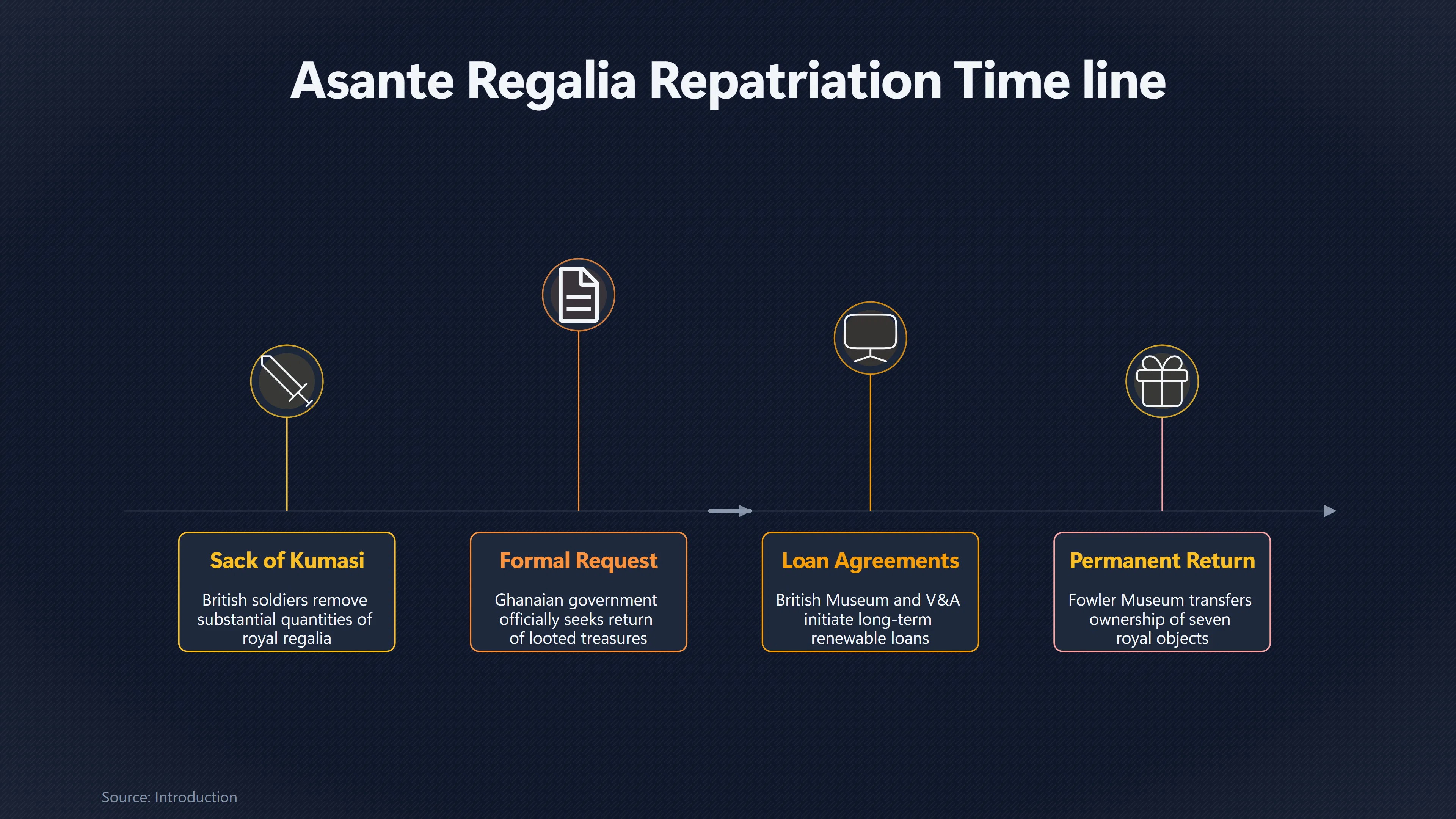
Following the Anglo-Asante Wars—particularly the sack of Kumasi in 1874, and later campaigns in 1896 and 1900—British soldiers removed substantial quantities of royal regalia. Some objects entered military collections as war trophies. Others were sold through dealers or acquired by museums, including the British Museum and the Victoria and Albert Museum (V&A). Additional pieces eventually reached collections elsewhere, including the Fowler Museum in California.[British Museum]britishmuseum.orgBritish Museum Asante Gold Regalia | British MuseumBritish Museum Asante Gold Regalia | British Museum
For decades the Asante Kingdom sought their return. A formal request was made through the Ghanaian government as early as 1974, but British legislation governing national museum collections prevented permanent deaccessioning of many objects. Instead, collaboration gradually shifted towards museum partnerships, conservation training and discussions about future loans.[British Museum]britishmuseum.orgBritish Museum Asante Gold Regalia | British MuseumBritish Museum Asante Gold Regalia | British Museum
A major breakthrough came in 2024.
To coincide with commemorations marking both the 150th anniversary of the 1874 conflict and the Silver Jubilee of Asantehene Otumfuo Osei Tutu II, seventeen objects from the V&A and fifteen from the British Museum travelled to Manhyia Palace Museum under renewable long-term loan agreements. At roughly the same time, seven royal objects from the Fowler Museum were permanently returned to the Asante Kingdom.[vam.ac.uk]vam.ac.ukVictoria and Albert Museum A history of Asante gold at the V&A · V&AVictoria and Albert Museum A history of Asante gold at the V&A · V&A
For visitors to Kumasi, this changed the museum experience dramatically. Objects absent from the palace for around 150 years could once again be viewed within the royal institution that originally commissioned and used them.

Loans, permanent restitution and disputed ownership
The arrival of the regalia in Kumasi did not end the ownership debate. Instead, it highlighted competing understandings of what “return” actually means.
From the perspective of British museums, renewable loans represent a practical solution that allows important objects to be displayed in their place of origin while remaining consistent with legislation that restricts permanent disposal from national collections. Both the British Museum and the V&A describe the agreements as partnerships built around conservation, research and shared access. The V&A loans are structured in renewable three-year periods, subject to regulatory approval.[Victoria and Albert Museum]vam.ac.ukVictoria and Albert Museum A history of Asante gold at the V&A · V&AVictoria and Albert Museum A history of Asante gold at the V&A · V&A
Many Ghanaian commentators, however, argue that objects removed through colonial violence should not remain legally owned by institutions that acquired them after military campaigns. From this perspective, calling the arrangement a “loan” implies that the original owners must borrow back their own cultural heritage. Critics therefore distinguish sharply between physical return and legal restitution.[AP News]apnews.comThis collaboration serves as a workaround to U.K. laws that prohibit the repatriation of cultural treasures. The artifacts, including Asa…
The permanent return of the Fowler Museum objects demonstrates another possible model. Unlike the British loans, ownership was transferred outright, meaning the regalia became part of the Asante royal collection once again rather than remaining the legal property of a foreign museum.[AP News]apnews.comThis repatriation marks a significant event for the Asante kingdom with the returned items including a gold necklace, two bracelets, a go…
The disagreement is therefore not simply about where the objects are displayed. It concerns several separate questions:
- Legal ownership: Which institution or community should hold title to the objects?
- Moral ownership: Does colonial acquisition invalidate later legal ownership?
- Spiritual ownership: Can sacred regalia truly belong outside the political system that gives it meaning?
- Public access: Should globally significant collections remain internationally distributed or be reunited where they originated?
Each question has different answers depending on whether the discussion is framed in museum law, international ethics or Asante tradition.
Why Manhyia Palace Museum changes the debate
Many restitution disputes are discussed in distant museums or courtrooms. Manhyia Palace Museum offers something different: visitors can see how the objects function within the culture that continues to recognise their authority.
Rather than presenting the regalia primarily as archaeological treasures, the museum interprets them through royal history, ceremonial practice and the continuity of the Asante Kingdom. This reinforces the Asante argument that these are not relics from an extinct civilisation but components of a living constitutional and cultural system.[Manhyia Palace]manhyiapalacemuseum.orgManhyia Palace A history of Asante gold at the V&A – Manhyia PalaceManhyia Palace A history of Asante gold at the V&A – Manhyia Palace
The museum therefore occupies an unusual position. It is simultaneously:
- a public museum welcoming visitors;
- part of an active royal palace complex;
- a centre for interpreting Asante political history;
- and an important participant in international restitution negotiations.
That combination makes it one of Ghana’s most distinctive heritage institutions.

Why this matters beyond Ghana
The Asante regalia dispute has become a prominent example in wider debates over colonial collections.
Unlike arguments centred solely on artistic masterpieces, the Asante case emphasises that some museum objects continue to possess constitutional, ceremonial and spiritual functions for the communities from which they came. Their significance cannot be measured only by age, rarity or market value.
The current arrangement also illustrates a compromise increasingly discussed in international museum practice. Long-term renewable loans allow important objects to return physically while legal ownership remains unresolved. Supporters see this as a pragmatic route towards cultural reconnection. Critics regard it as an incomplete response that leaves colonial-era ownership structures fundamentally unchanged.[vam.ac.uk]vam.ac.ukVictoria and Albert Museum A history of Asante gold at the V&A · V&AVictoria and Albert Museum A history of Asante gold at the V&A · V&A
For visitors to Manhyia Palace Museum, the experience is therefore about far more than viewing remarkable gold objects. It offers a rare opportunity to encounter royal regalia where its creators believe it belongs, while witnessing an international debate over history, justice and cultural authority that is still unfolding.
Amazon book picks
Further Reading
Books and field guides related to Who Truly Owns the Asante Royal Treasures?. Use these as the next step if you want deeper reading beyond the article.
The Scramble For Africa
In 1880 the continent of Africa was largely unexplored by Europeans. Less than thirty years later, only Liberia and Ethiopia remained unc...
The Brutish Museums: The Benin Bronzes, Colonial Violence and...
New York Times 'Best Art Books' 2020 'Essential' – Sunday Times 'Brilliantly enraged' - New York Review of Books 'A real game-changer'– E...
African Kings and Queens
Presents profiles of African royalty, from Menes (fl. c. 3100 B.C.-3038 B.C.) to Menelik II (1889-1913).
eBay marketplace picks
Marketplace Samples
Live-tested eBay searches with available results related to this page.
Selected fromAsante art print oneBay.co.uk.

Endnotes
1.
Source: metmuseum.org
Title: The Metropolitan Museum of Art Asante-Akan artist
Link:https://www.metmuseum.org/art/collection/search/315887
Source snippet
The Metropolitan Museum of ArtAsante-Akan artist - Ȯkyeame poma (royal spokesperson's staff) with stool, chain, and crossed swords - Asa...
2.
Source: manhyiapalacemuseum.org
Title: Manhyia Palace A history of Asante gold at the V&A – Manhyia Palace
Link:https://manhyiapalacemuseum.org/a-history-of-asante-gold-at-the-va/
3.
Source: britishmuseum.org
Title: British Museum Asante Gold Regalia | British Museum
Link:https://www.britishmuseum.org/about-us/british-museum-story/contested-objects-collection/asante-gold-regalia
4.
Source: manhyiapalace.org
Link:https://manhyiapalace.org/asantehene-warns-chiefs-against-misuse-of-traditional-regalia/
Source snippet
Manhyia PalaceAsantehene Warns Chiefs Against Misuse of Traditional Regalia – Manhyia PalaceOctober 16, 2025...
Published: October 16, 2025
5.
Source: vam.ac.uk
Title: Victoria and Albert Museum A history of Asante gold at the V&A · V&A
Link:https://www.vam.ac.uk/articles/a-history-of-asante-gold-at-the-vanda
6.
Source: apnews.com
Link:https://apnews.com/article/d4165d0364c59aaadb1a4f4dfdab9dbb
Source snippet
This repatriation marks a significant event for the Asante kingdom with the returned items including a gold necklace, two bracelets, a go...
7.
Source: apnews.com
Link:https://apnews.com/article/e5aa77f9c07ab8952e507dd01e983c76
Source snippet
This collaboration serves as a workaround to U.K. laws that prohibit the repatriation of cultural treasures. The artifacts, including Asa...
8.
Source: vam.ac.uk
Title: While the V&A has never systematically collected West African metalw
Link:https://www.vam.ac.uk/articles/unity-artistic-collaboration-between-artist-goldsmith-emefa-cole-and-asante-royal-goldsmith
Source snippet
Unity: a collaboration between artist goldsmith Emefa Cole and the Asante royal goldsmith · V&AOctober 29, 2025 — A NEW SPIRIT OF COOPERA...
Published: October 29, 2025
9.
Source: visitghana.com
Title: Manhyia Palace Museum – Visit Ghana
Link:https://visitghana.com/manhyia-palace-museum-2/
10.
Source: visitghana.com
Title: Manhyia Palace Museum – Visit Ghana
Link:https://visitghana.com/manhyia-palace-museum/
11.
Source: manhyiapalace.org
Title: Otumfuo@25: Golden Stool Takes Centre Stage – Manhyia Palace
Link:https://manhyiapalace.org/otumfuo25-golden-stool-takes-centre-stage/
12.
Source: manhyiapalacemuseum.org
Title: Come Visit and See Returned Artefacts- Asantehene – Manhyia Palace
Link:https://manhyiapalacemuseum.org/come-visit-and-see-returned-artefacts-asantehene/
13.
Source: vam.ac.uk
Link:https://www.vam.ac.uk/blog/news/homecoming-exhibition-of-asante-gold-regalia-at-manhiya-palace-museum-kumasi
14.
Source: manhyiapalace.org
Title: Asantehene Receives Looted Artefacts from UK Museums – Manhyia Palace
Link:https://manhyiapalace.org/asantehene-receives-looted-artefacts-from-uk-museums-2/
15.
Source: manhyiapalacemuseum.org
Title: Stolen Asante Artefacts From British and V&A Museums Now Home – Manhyia Palace
Link:https://manhyiapalacemuseum.org/stolen-asante-artefacts-from-british-and-va-museums-now-home/
16.
Source: theartnewspaper.com
Title: British Museum and V&A to lend looted gold objects to Ghana
Link:https://www.theartnewspaper.com/2024/01/25/british-museum-and-va-set-important-precedent-with-loans-to-ghana
17.
Source: theguardian.com
Link:https://www.theguardian.com/culture/2024/jan/25/british-museum-and-victoria-and-albert-to-loan-ghana-looted-gold-and-silver
18.
Source: manhyiapalacemuseum.org
Title: gold ix
Link:https://manhyiapalacemuseum.org/portfolio/gold-ix/
Additional References
19.
Source: theguardian.com
Link:https://www.theguardian.com/world/2024/jan/26/first-edition-ghana-asante-gold
Source snippet
These items, stolen by British soldiers over 150 years ago, hold significant cultural and spiritual value for Ghana. This agreement, foll...
20.
Source: youtube.com
Title: Asante king displays returned looted treasures in Kumasi
Link:https://www.youtube.com/watch?v=YwC4T1rLOLE
Source snippet
These videos provide critical context regarding the spiritual significance of Asante regalia, the history of its colonial looting, and th...
21.
Source: youtube.com
Title: Ghana’s looted royal artefacts returned by California museum
Link:https://www.youtube.com/watch?v=Wk9FfR0ujhg
Source snippet
Asante king displays returned looted treasures in Kumasi...
22.
Source: youtube.com
Title: The British Empire and the Looting of The Ashanti Palace
Link:https://www.youtube.com/watch?v=hCQf1KxwI2Y
Source snippet
Ghana Returned Gold looted from Asante Kingdom...
23.
Source: youtube.com
Title: Ghana Returned Gold looted from Asante Kingdom
Link:https://www.youtube.com/watch?v=eNLsi-2Ic9k
Source snippet
Ghana's looted royal artefacts returned by California museum...
24.
Source: youtube.com
Title: The Golden Stool of the Asante people
Link:https://www.youtube.com/watch?v=xn10_9rXHNY
Source snippet
The British Empire and the Looting of The Ashanti Palace...
25.
Source: museumsassociation.org
Title: V&A and British Museum to loan Asante gold to Ghana
Link:https://www.museumsassociation.org/museums-journal/news/2024/01/va-and-british-museum-to-loan-asante-gold-to-ghana/
26.
Source: ir.knust.edu.gh
Title: knust.edu.gh Stools in Asante Culture
Link:https://ir.knust.edu.gh/items/049e94e2-3dbe-4ceb-9be2-11e79f980e68
27.
Source: storymaps.arcgis.com
Link:https://storymaps.arcgis.com/stories/d3447a044bfc48c6aa244f0473ad2279
28.
Source: theartnewspaper.com
Title: Looted Asante treasures find a new palace home in Ghana
Link:https://www.theartnewspaper.com/2024/07/10/looted-asante-treasures-find-a-new-palace-home-in-ghana