Where Lesotho Keeps Its Strangest Heritage
Lesotho does not have a large circuit of purpose-built oddity museums. Its most distinctive curiosity culture is scattered across a small archival museum, cave houses, rock shelters, fossil displays and exposed dinosaur trackways.
Page outline Jump by section
Introduction
The best starting point is Morija Museum and Archives, whose collections range from dinosaur remains to nineteenth-century documents. The most memorable individual attraction is Masitise Cave House, a former missionary dwelling built into a rock shelter with a dinosaur footprint overhead. Beyond these institutions, Liphofung, Ha Baroana and the Maloti-Drakensberg landscape function as open-air galleries of archaeology, sacred imagery and contested interpretation. Evidence for a dedicated Lesotho museum of witchcraft, cryptids, UFOs or medical oddities is extremely thin; the country’s unusual collections are instead rooted in fossils, caves, rock art, oral history and the complicated meeting of indigenous knowledge with missionary scholarship.

Morija is Lesotho’s main cabinet of curiosity
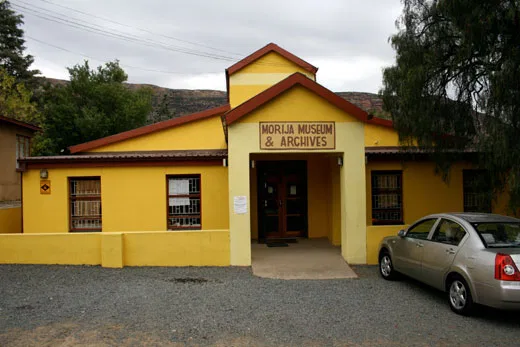
Morija Museum and Archives is the country’s strongest conventional museum and the clearest introduction to its unusual material heritage. Established in 1956, it grew from two very different bodies of material: ethnographic and historical objects assembled by the Dieterlen missionary family, and geological and palaeontological collections formed by the Ellenberger brothers. The institution describes itself as Lesotho’s oldest surviving museum and archives, while its ownership by the Lesotho Evangelical Church in Southern Africa places it somewhere between a national research centre, a church-linked historical collection and a community cultural organisation.[Museum]morijamuseum.orgAs an institution with both extensive archival and museum…Read more…
For the curious visitor, the palaeontology section is the principal attraction. Morija holds fossilised plants, dinosaur bones and footprints collected from around Lesotho. These are not merely imported specimens assembled to illustrate prehistory: they are physical evidence from a country whose sandstone formations preserve an exceptional number of tracks. The museum therefore acts as an indoor index to a much larger fossil landscape outside its walls.[Museum]morijamuseum.orgMuseumCollection | Morija MuseumPalaeontology Morija Museum also boasts a treasure trove of fossilized plants as well as dinosaur bones a…
The archives add a different kind of strangeness. They preserve a substantial collection of nineteenth-century documents assembled by David-Frédéric Ellenberger, the first missionary at Masitise, and later enlarged by successive custodians. Letters, church records, early publications, photographs and research papers document the making of modern Lesotho as seen through missionary, colonial and Basotho perspectives. This is not a sensational attraction, but it is an unusually dense memory store for a small country, particularly valuable for tracing how folklore, religion, natural history and European scholarship became entangled.[Museum]morijamuseum.orgMuseumArchival Collection | Morija MuseumThe Morija Archives hosts a unique collection of 19th-century documents, consolidated by the fir…
Morija’s credibility is higher than that of a commercial oddity museum. It conducts research, publishes historical works and provides professional services in heritage management, intangible culture and exhibition design. At the same time, visitors should expect a modest institution rather than a vast national museum. Its importance lies in the concentration and provenance of its holdings, not in theatrical presentation.[Museum]morijamuseum.orgMuseumResearch & PublicationsMorija Museum & Archives is dedicated to preserving Lesotho's rich history and culture through extensive res…
One recent project shows how Morija can make inaccessible heritage visible. The Frobenius Institute supplied the museum with reproductions of historical rock-art copies, including a life-sized facsimile of the Ha Baroana panel measuring more than ten metres across. Such copies occupy an intriguing middle ground: they are not ancient objects, yet they preserve records of paintings that may have faded, deteriorated or become difficult to visit.[frobenius-institut.de]frobenius-institut.deOpen source on frobenius-institut.de.
A missionary house with a fossil in its ceiling
Masitise Cave House Museum, in the Quthing area, is Lesotho’s most compelling small curiosity museum. David-Frédéric Ellenberger built the dwelling in 1866 by closing off part of a natural sandstone overhang with a stone frontage. The result is neither an ordinary cave nor an ordinary house, but a hybrid domestic space in which natural geology became part of the architecture. Lesotho’s tourism authority identifies it as a museum and highlights an eccentric stone piano made by Ellenberger.[Visit Lesotho]stage.visitlesotho.org.lsVisit Lesotho Fort HartleyVisit Lesotho Fort Hartley
Its defining object is not in a display case. A three-toed dinosaur track is visible in the cave-house ceiling, effectively presenting the underside of a footprint-bearing layer. Palaeontological research associates the print with Paul Ellenberger, who grew up within a family deeply involved in recording Lesotho’s fossils. He later gave the track a scientific name derived from a phrase meaning “Cave Footprint of the Kitchen”, a rare case in which domestic space, local language and formal fossil classification meet in one specimen.[ResearchGate]researchgate.netOpen source on researchgate.net.
The museum’s collection has been described as an eclectic mixture of family photographs, clothing, taxidermied animals and missionary memorabilia. Reports also repeat the claim that a member of the Ellenberger family was buried within a wall. That detail should be treated cautiously: it is a persistent part of visitor-facing accounts, but the readily available tourism material does not provide strong documentary proof of the burial story.[Atlas Obscura]atlasobscura.comAtlas Obscura Masitise Cave House Museum in QuthingAtlas Obscura Masitise Cave House Museum in Quthing
Masitise matters because it preserves an entire historical atmosphere rather than a single polished exhibition. The cave records earlier shelter use, the building represents nineteenth-century missionary settlement, the objects document one family’s life, and the ceiling preserves evidence of animals that crossed the same landscape millions of years earlier. Few museums compress geological, domestic and religious history so literally into the same room.
Dinosaur tracks turn Lesotho into an open-air museum
Lesotho’s fossil attractions are often better understood as open-air palaeontological museums. Trackways occur around Quthing, Morija, Roma, Leribe, Subeng and Maphutseng, although accessibility and visitor infrastructure vary sharply. Near Quthing, an official tourism listing describes a small building protecting ancient footprints and incorporating a craft shop. Elsewhere, prints remain exposed in sandstone slabs, streambeds or upland outcrops.[Visit Lesotho]visitlesotho.org.lsVisit Lesotho MOHALE’S HOEK TO MAPHUTSENGVisit Lesotho MOHALE’S HOEK TO MAPHUTSENG
This scattered presentation has advantages and risks. Seeing a footprint where it formed can be far more affecting than viewing a removed slab in a museum. The rock surface preserves direction, stride and relationship to the surrounding terrain. Yet open sites may have limited signs, uncertain access arrangements and little protection against weathering or accidental damage. A local guide is often more useful than relying on map applications, particularly where a route crosses village land or rough mountain ground.
The footprints are scientifically important rather than merely picturesque. Research at Maphutseng has examined three-toed, bird-like tracks around 210 million years old, substantially older than the earliest recognised bird body fossils. The tracks do not prove that modern birds existed at that date; instead, they show that bird-like foot shapes evolved in other dinosaur-line animals earlier than the avian fossil record once suggested.[Sci.News: Breaking Science News]sci.newsBreaking Science News210-Million-Year-Old Bird-Like Footprints Found in LesothoBreaking Science News210-Million-Year-Old Bird-Like Footprints Found in Lesotho
At Morija, fossils also connect directly to the history of collecting. Paul Ellenberger and his collaborators documented large numbers of track-bearing slabs and built the foundations of Lesotho’s palaeontological record. That legacy is now divided between museum specimens, archival notes and tracks still fixed in the landscape. It makes the country unusual not simply for possessing fossils, but for preserving evidence of how local discoveries were translated into formal scientific knowledge.[ResearchGate]researchgate.netResearch Gate Mokhali Cave revisited – dinosaur rock art in LesothoResearch Gate Mokhali Cave revisited – dinosaur rock art in Lesotho
Visitors should be wary of confident species labels attached to isolated footprints. A track records the shape and movement of a foot, not a complete skeleton, and palaeontologists commonly classify fossil tracks separately from the animals that may have made them. Claims that a particular print unquestionably belongs to a named dinosaur can therefore be more definite than the evidence permits.
Rock shelters are galleries, archives and disputed sacred spaces
Liphofung is one of the most accessible places to understand how Lesotho’s natural shelters operate as public heritage collections. The protected site centres on a large sandstone overhang associated with Late Stone Age occupation, San rock painting and later Basotho history. A visitor centre provides cultural interpretation, while guided access connects the displayed material to the archaeological shelter itself.[visitlesotho.org.ls]visitlesotho.org.lsOpen source on visitlesotho.org.ls.
What makes Liphofung unusual is the layering of evidence. The rock surface carries paintings; archaeological material survives beneath the shelter floor; later tradition associates the place with King Moshoeshoe I; and modern cultural displays explain Basotho life to school groups and travellers. It is therefore not a frozen “prehistoric cave”. It is a reused place whose meaning changed as different communities occupied, remembered and interpreted it.
Ha Baroana, near Nazareth east of Maseru, offers a less museum-like experience. Its painted sandstone shelter contains human figures, animals and scenes commonly described as hunting or dancing. Access can involve a steep or awkward journey, and journalistic accounts warn that digital mapping may direct visitors towards unsuitable tracks. The reward is an encounter with art still attached to its original rock face rather than detached and reframed as an isolated art object.[Atlas Obscura]atlasobscura.comAtlas Obscura Ha Baroana Cave Paintings in MetolongAtlas Obscura Ha Baroana Cave Paintings in Metolong
Interpretation requires care. Older tourism writing often treats San paintings as straightforward pictures of everyday life. Rock-art scholarship has instead emphasised that animals, dances and altered human figures may also encode ritual experience, healing practices and relationships with the spirit world. Even where a guide offers a clear explanation, it is better to regard it as an informed reading rather than a literal caption written by the original artist.
At the grandest scale, Sehlabathebe National Park forms the Lesotho portion of the transboundary Maloti-Drakensberg World Heritage Site. UNESCO describes the wider property as containing a major body of San rock art created over roughly four millennia and recording aspects of San life and belief. The organisation has also supported documentation, oral-history work and conservation planning within the Lesotho portion, recognising that interpretation cannot rely on visual recording alone.[UNESCO World Heritage Centre]whc.unesco.orgWorld Heritage Centre Maloti-Drakensberg ParkWorld Heritage Centre Maloti-Drakensberg Park
These sites are best approached as vulnerable cultural archives, not adventure props. Touching painted surfaces, applying water to make pigments appear brighter or removing loose material can cause irreversible damage. Photography rules and access conditions may vary, while remoteness means that practical arrangements should be confirmed locally before travel.

Did ancient artists paint dinosaurs?
Mokhali Cave introduces Lesotho’s most genuinely Fortean museum question: did African artists recognise and depict creatures known only from fossil tracks and bones?
The shelter contains a painted outline resembling a three-toed dinosaur footprint, accompanied by figures that some researchers interpret as reconstructions of the track-making animals. Because fossil footprints and bones occur in the surrounding sandstone landscape, the proposal is not inherently fanciful. Indigenous hunters and herders were highly skilled readers of tracks, and there is no reason to assume that they ignored unusually large prints preserved in stone.[PMC]pmc.ncbi.nlm.nih.govPMCA possible later stone age painting of a dicynodontPMCA possible later stone age painting of a dicynodont
Recent research has argued that the Mokhali images may constitute evidence of indigenous palaeontological reasoning: people encountered fossil tracks, understood them as traces of vanished animals and incorporated their interpretation into art or storytelling. One study has even proposed that the paintings could pre-date nineteenth-century European reconstructions of bipedal dinosaurs.[Springer Link]link.springer.comOpen source on springer.com.
The most dramatic version of the claim remains contested, however. Dating rock paintings can be difficult, the identity of the artists is not always secure, and a footprint-like image is easier to connect with a real track than a stylised animal figure is to identify as a dinosaur. Researchers have noted the presence of painting traditions associated with both San communities and later Bantu-speaking inhabitants in the area, complicating simple attribution.[rockartblog.blogspot.com]rockartblog.blogspot.coma painted dinosaur footprint in lesothoa painted dinosaur footprint in lesotho
The credible takeaway is not that Mokhali proves a lost scientific theory of dinosaurs. It is that fossil landscapes were noticed and interpreted long before professional palaeontology arrived. The paintings preserve a meeting between observation, imagination and belief—exactly the kind of material that conventional natural-history displays frequently omit.
What Lesotho does not have
There is no well-documented, established visitor attraction in Lesotho devoted specifically to witchcraft, occult objects, cryptids, UFOs, crime, torture instruments or medical anomalies. Claims for such a museum should be treated sceptically unless supported by a current institution, verified address and independent documentation.
That absence does not mean magic, ancestral belief or supernatural tradition are absent from Basotho culture. Rather, these subjects are more likely to survive through oral histories, ritual practice, sacred landscapes and broader ethnographic collections than through a commercial “museum of the macabre”. Morija’s research remit explicitly includes spirituality and intangible cultural heritage, but it does not market itself as an occult museum.[Museum]morijamuseum.orgMuseumResearch & PublicationsMorija Museum & Archives is dedicated to preserving Lesotho's rich history and culture through extensive res…
Lesotho’s curiosity culture is consequently less theatrical than that of countries with private cabinets of taxidermy, paranormal attractions or horror museums. Its oddities are usually real geological or historical anomalies: a fossil track in a kitchen ceiling, copied rock paintings displayed far from their original shelter, missionary documents recording indigenous knowledge, or ancient artists apparently responding to petrified footprints.
How to explore Lesotho’s unusual collections
A practical curiosity route divides naturally into three clusters.
Morija and the central lowlands offer the museum and archives, nearby fossil-track hikes and access towards Ha Baroana. This is the strongest choice for travellers who want interpretation as well as unusual objects.
Quthing and Masitise combine the cave-house museum, the protected Quthing footprint display and further fossil sites around the southern lowlands. The appeal is the direct overlap of domestic history, missionary collecting and palaeontology.
Liphofung and the highlands place the emphasis on rock shelters, landscape and community-guided heritage. Sehlabathebe extends that experience into a remote World Heritage setting where rock art is part of a much larger mountain environment.[Visit Lesotho]visitlesotho.org.lsVisit Lesotho Maloti Drakensberg Transfrontier ParkVisit Lesotho Maloti Drakensberg Transfrontier Park
Visitors should confirm opening arrangements directly, especially for small museums and locally managed sites. Published hours, entry fees and guide availability can change, and some attractions depend on finding a custodian rather than arriving at a staffed ticket desk. Carrying cash, allowing extra travel time and arranging a knowledgeable local guide are more important here than building a tightly timed museum itinerary.
Why Lesotho’s strange heritage matters
Lesotho’s unusual collections challenge the idea that a museum must be a sealed building filled with classified objects. Here, the most important “collection” may be a sequence of tracks across exposed sandstone, a shelter whose walls have accumulated different histories, or an archive that allows fossil discoveries and oral traditions to be reconstructed generations later.
They also reveal a deeper issue of authority. Missionaries and European-trained researchers played major roles in preserving documents and naming fossils, yet the objects and sites were already embedded in local landscapes and systems of knowledge. Mokhali Cave is especially important because it shifts attention from who formally described a fossil to who first noticed it, imagined its maker and gave it cultural meaning.
For travellers interested in strange museums, Lesotho’s value lies in this tension between collection and landscape. Its curiosities have not been fully separated from the places that produced them. The dinosaur footprint remains above the kitchen, the rock painting remains beneath the overhang, and much of the country’s most unusual heritage still requires a guide, a walk and a willingness to distinguish firm evidence from an irresistible story.
Amazon book picks
Further Reading
Books and field guides related to Where Lesotho Keeps Its Strangest Heritage. Use these as the next step if you want deeper reading beyond the article.
The Atlas of Archaeology
First published 1998. Subjects: Ancient Civilization, Antigüedades, Antiquities, Archaeology, Arqueología.
eBay marketplace picks
Marketplace Samples
Live-tested eBay searches with available results related to this page.
Selected fromafrica art print oneBay.co.uk.



Endnotes
1.
Source: frobenius-institut.de
Link:https://www.frobenius-institut.de/en/aktuelles/frankfurt-lesotho-felsbildausstellung-im-morija-museum-eroeffnet-2
2.
Source: researchgate.net
Link:https://www.researchgate.net/figure/Pictures-of-the-Masitise-Cave-House-Top-left-corner-a-tridactyl-dinosaur-footprint-in_fig2_397696115
3.
Source: researchgate.net
Link:https://www.researchgate.net/publication/397696115_Paleontological_Knowledge_among_the_Basotho_and_San_of_Lesotho_A_Review_Including_Insights_from_Paul_Ellenberger%27s_Archives
4.
Source: sci.news
Title: Breaking Science News210-Million-Year-Old Bird-Like Footprints Found in Lesotho
Link:https://www.sci.news/paleontology/trisauropodiscus-12495.html
5.
Source: researchgate.net
Title: Research Gate Mokhali Cave revisited – dinosaur rock art in Lesotho
Link:https://www.researchgate.net/publication/258838712Mokhali_Cave_revisited-_dinosaur_rock_art_in_Lesotho
6.
Source: link.springer.com
Link:https://link.springer.com/article/10.1007/s12371-025-01191-5
7.
Source: environment.gov.ls
Link:https://environment.gov.ls/protected-places/liphofung-cave-and-cultural-heritage-site/
8.
Source: whc.unesco.org
Title: World Heritage Centre Maloti-Drakensberg Park
Link:https://whc.unesco.org/en/list/985
9.
Source: whc.unesco.org
Title: World Heritage Centre UNESCO World Heritage Centre
Link:https://whc.unesco.org/en/decisions/5133
10.
Source: whc.unesco.org
Title: World Heritage Centre UNESCO World Heritage Centre
Link:https://whc.unesco.org/en/decisions/6288/
11.
Source: rockartblog.blogspot.com
Title: a painted dinosaur footprint in lesotho
Link:https://rockartblog.blogspot.com/2025/03/a-painted-dinosaur-footprint-in-lesotho.html
12.
Source: whc.unesco.org
Link:https://whc.unesco.org/en/intassistance/3420/
13.
Source: lena.gov.ls
Title: nanabolele blanket exhibition returns
Link:https://www.lena.gov.ls/nanabolele-blanket-exhibition-returns/
14.
Source: lena.gov.ls
Title: News Archives
Link:https://www.lena.gov.ls/category/news/page/57/
15.
Source: unesdoc.unesco.org
Link:https://unesdoc.unesco.org/ark%3A/48223/pf0000069631
17.
Source: whc.unesco.org
Link:https://whc.unesco.org/en/activities/982
18.
Source: whc.unesco.org
Link:https://whc.unesco.org/en/decisions/2438/
19.
Source: whc.unesco.org
Link:https://whc.unesco.org/ru/list/985
20.
Source: whc.unesco.org
Link:https://whc.unesco.org/en/decisions/7015
21.
Source: whc.unesco.org
Link:https://whc.unesco.org/en/decisions/7886/
22.
Source: whc.unesco.org
Link:https://whc.unesco.org/en/statesparties/ls/assistance
23.
Source: whc.unesco.org
Link:https://whc.unesco.org/en/list/985/assistance/
24.
Source: socialdevelopment.gov.ls
Link:https://www.socialdevelopment.gov.ls/docs/documents/PSLP_ENVIRONMENTAL_AND_SOCIAL_MANAGEMENT_FRAMEWORK_%28ESMF%29%28iii%29_WB_Sibekile%28CLEAN_COPY%29.pdf
25.
Source: africa.com
Title: museums of eswatini
Link:https://africa.com/museums-of-eswatini
26.
Source: morijamuseum.org
Link:https://www.morijamuseum.org/
Source snippet
As an institution with both extensive archival and museum...Read more...
27.
Source: morijamuseum.org
Title: museum history
Link:https://www.morijamuseum.org/museum-history
Source snippet
MuseumMuseum HistoryEstablished in 1956, the Morija Museum in Lesotho houses ethnographic and historical collections from the Dieterlen f...
28.
Source: morijamuseum.org
Link:https://www.morijamuseum.org/organisation
Source snippet
MuseumBoard & PartnersMorija Museum & Archives (MMA) is dedicated to developing programmes and activities related to history, heritage, a...
29.
Source: morijamuseum.org
Link:https://www.morijamuseum.org/collection
Source snippet
MuseumCollection | Morija MuseumPalaeontology Morija Museum also boasts a treasure trove of fossilized plants as well as dinosaur bones a...
30.
Source: morijamuseum.org
Link:https://www.morijamuseum.org/archivalcollection
Source snippet
MuseumArchival Collection | Morija MuseumThe Morija Archives hosts a unique collection of 19th-century documents, consolidated by the fir...
31.
Source: morijamuseum.org
Link:https://www.morijamuseum.org/reasearch-publications
Source snippet
MuseumResearch & PublicationsMorija Museum & Archives is dedicated to preserving Lesotho's rich history and culture through extensive res...
32.
Source: morijamuseum.org
Link:https://www.morijamuseum.org/consultancies
33.
Source: stage.visitlesotho.org.ls
Title: Visit Lesotho Fort Hartley
Link:https://stage.visitlesotho.org.ls/place-to-visit/masitise-and-moyeni-to-fort-hartley
34.
Source: stage.visitlesotho.org.ls
Title: Visit Lesotho Southern Rustic Route
Link:https://stage.visitlesotho.org.ls/place-to-visit/southern-rustic-route
35.
Source: atlasobscura.com
Title: Atlas Obscura Masitise Cave House Museum in Quthing
Link:https://www.atlasobscura.com/places/masitise-cave-house-museum
36.
Source: modernoverland.com
Title: Masitise Cave House Museum | Quthing
Link:https://www.modernoverland.com/lesotho/quthing/masitise-cave-house-museum/
37.
Source: visitlesotho.org.ls
Title: Visit Lesotho MOHALE’S HOEK TO MAPHUTSENG
Link:https://www.visitlesotho.org.ls/place-to-visit/mohales-hoek-to-maphutseng/
38.
Source: visitlesotho.org.ls
Title: Visit Lesotho Quthing Dinosaur Footprint
Link:https://www.visitlesotho.org.ls/place-to-visit/quthing-dinosaur-footprint
39.
Source: visitlesotho.org.ls
Title: Visit Lesotho Lowlands Self Drive
Link:https://www.visitlesotho.org.ls/place-to-visit/lowlands-self-drive
40.
Source: visitlesotho.org.ls
Link:https://www.visitlesotho.org.ls/place-to-visit/liphoofung-nature-reserve
41.
Source: atlasobscura.com
Title: Atlas Obscura Ha Baroana Cave Paintings in Metolong
Link:https://www.atlasobscura.com/places/ha-baroana-cave-paintings
42.
Source: pmc.ncbi.nlm.nih.gov
Title: PMCA possible later stone age painting of a dicynodont
Link:https://pmc.ncbi.nlm.nih.gov/articles/PMC11410247/
43.
Source: visitlesotho.org.ls
Title: Visit Lesotho Maloti Drakensberg Transfrontier Park
Link:https://www.visitlesotho.org.ls/place-to-visit/a-drive-to-the-maloti-dankensberg-trans-frontier-park
44.
Source: thekingdomofeswatini.com
Title: museums history
Link:https://www.thekingdomofeswatini.com/eswatini-experiences/culture/museums-history/
45.
Source: morijamuseum.org
Link:https://www.morijamuseum.org/stragicplan
46.
Source: morijamuseum.org
Link:https://www.morijamuseum.org/team-4
47.
Source: morijamuseum.org
Link:https://www.morijamuseum.org/_files/ugd/eedfa1_dd243f2a08bf4fe7a6ef58f6e3b78e6f.pdf?index=true
48.
Source: morijamuseum.org
Link:https://www.morijamuseum.org/indigenousmusicresearch
49.
Source: museumofwitchcraftandmagic.co.uk
Link:https://museumofwitchcraftandmagic.co.uk/
50.
Source: tripadvisor.com
Link:https://www.tripadvisor.com/Attractions-g293836-Activities-c49-Eswatini_Swaziland.html
51.
Source: stage.visitlesotho.org.ls
Title: visitlesotho.org.ls Lowlands Self Drive
Link:https://stage.visitlesotho.org.ls/place-to-visit/lowlands-self-drive
52.
Source: visitlesotho.org.ls
Title: Places To Visit Archive
Link:https://www.visitlesotho.org.ls/place-to-visit/page/3
53.
Source: visitlesotho.org.ls
Title: Fort Hartley
Link:https://www.visitlesotho.org.ls/place-to-visit/masitise-and-moyeni-to-fort-hartley
54.
Source: visitlesotho.org.ls
Title: Places To Visit Archive
Link:https://www.visitlesotho.org.ls/place-to-visit
55.
Source: visitlesotho.org.ls
Title: hotel mount maluti
Link:https://www.visitlesotho.org.ls/places-to-stay/hotel-mount-maluti
56.
Source: visitlesotho.org.ls
Title: Attraction Archives
Link:https://www.visitlesotho.org.ls/category/places-to-visit/attraction
57.
Source: stage.visitlesotho.org.ls
Title: visitlesotho.org.ls Attraction Archives
Link:https://stage.visitlesotho.org.ls/category/places-to-visit/attraction
58.
Source: stage.visitlesotho.org.ls
Title: visitlesotho.org.ls Quthing Dinosaur Footprint
Link:https://stage.visitlesotho.org.ls/place-to-visit/quthing-dinosaur-footprint
59.
Source: visitlesotho.org.ls
Title: Places To Stay Archive
Link:https://www.visitlesotho.org.ls/places-to-stay/page/2
60.
Source: visitlesotho.org.ls
Title: Places To Visit
Link:https://www.visitlesotho.org.ls/places-to-visit
61.
Source: stage.visitlesotho.org.ls
Title: visitlesotho.org.ls Maloti Drakensberg Transfrontier Park
Link:https://stage.visitlesotho.org.ls/place-to-visit/a-drive-to-the-maloti-dankensberg-trans-frontier-park
62.
Source: stage.visitlesotho.org.ls
Title: visitlesotho.org.ls Liphofung Nature Reserve
Link:https://stage.visitlesotho.org.ls/place-to-visit/liphoofung-nature-reserve
63.
Source: stage.visitlesotho.org.ls
Title: visitlesotho.org.ls Places To Visit Archive
Link:https://stage.visitlesotho.org.ls/place-to-visit
64.
Source: visitlesotho.org.ls
Title: THAB A BOSIU MONUMENT
Link:https://www.visitlesotho.org.ls/place-to-visit/thaba-bosiu-monument
65.
Source: africa-press.net
Title: Masitise Cave House Museum
Link:https://www.africa-press.net/lesotho/all-news/masitise-cave-house-museum-2
66.
Source: atlasobscura.com
Link:https://www.atlasobscura.com/things-to-do/south-africa/museums
67.
Source: Wikipedia
Title: Museum of Witchcraft and Magic
Link:https://en.wikipedia.org/wiki/Museum_of_Witchcraft_and_Magic
68.
Source: Wikipedia
Title: Ha Baroana
Link:https://en.wikipedia.org/wiki/Ha_Baroana
Additional References
69.
Source: kanaga-at.com
Link:https://www.kanaga-at.com/en/trip-info/lesotho-en/dinosaur-footprints-and-san-rock-paintings/
Source snippet
Kanaga Africa ToursDinosaur footprints and San rock paintingsSome of Lesotho's most impressive footprint sites can be reached by trekking...
70.
Source: facebook.com
Link:https://www.facebook.com/SkyAlphaHD/posts/%F0%9D%90%91%F0%9D%90%80%F0%9D%90%8C%F0%9D%90%80%F0%9D%90%93%C5%A1%F0%9D%90%84%F0%9D%90%80%F0%9D%90%93%F0%9D%90%92%F0%9D%90%80%F0%9D%90%8D%F0%9D%90%80-%F0%9D%90%87%F0%9D%90%8E%F0%9D%90%94%F0%9D%90%92%F0%9D%90%84-%F0%9D%90%8E%F0%9D%90%8F%F0%9D%90%84%F0%9D%90%8D%F0%9D%90%92-%F0%9D%90%93%F0%9D%90%8E-%F0%9D%90%92%F0%9D%90%80%F0%9D%90%85%F0%9D%90%84%F0%9D%90%86%F0%9D%90%94%F0%9D%90%80%F0%9D%90%91%F0%9D%90%83-%F0%9D%90%8B%F0%9D%90%84%F0%9D%90%92%F0%9D%90%8E%F0%9D%90%93%F0%9D%90%87%F0%9D%90%8E%F0%9D%90%92-%F0%9D%90%82%F0%9D%90%94%F0%9D%90%8B%F0%9D%90%93%F0%9D%90%94%F0%9D%90%91%F0%9D%90%80%F0%9D%90%8B-%F0%9D%90%8B%F0%9D%90%84%F0%9D%90%86%F0%9D%90%80%F0%9D%90%82%F0%9D%90%98by-rorisang-moilo/1143354051140284/
71.
Source: tijer.org
Link:https://tijer.org/tijer/papers/TIJER2308170.pdf
72.
Source: afdb.org
Link:https://www.afdb.org/sites/default/files/lhwp-volume_3_archaeology_and_cultural_heritage_report.pdf
73.
Source: facebook.com
Link:https://www.facebook.com/Wodemaya/posts/dinosaur-footprint-bones-found-in-lesotho-/1155447455942336/
74.
Source: malealeatours.com
Link:https://www.malealeatours.com/activities/dinosaur-footprints
75.
Source: mapnook.com
Link:https://mapnook.com/map/d/ha-baroana-cave-paintings
76.
Source: facebook.com
Link:https://www.facebook.com/tselatours/posts/ha-baroana-rock-paintings-site-is-at-nazareth-is-one-of-lesothos-most-important-/3036722063278445/
77.
Source: facebook.com
Link:https://www.facebook.com/edp24/posts/have-you-visited-one-of-the-most-unusual-museums-in-the-uk-/10159927609834485/
78.
Source: tripadvisor.com
Link:https://www.tripadvisor.com/Attraction_Review-g479197-d3983505-Reviews-Khama_III_Memorial_Museum-Serowe_Central_District.html