Where Guatemala Keeps Its Strangest Sacred Objects
Guatemala does not have a well-documented national museum devoted solely to witchcraft, cryptids, UFOs or sideshow oddities. Its strange-collection culture is more deeply embedded in archaeology, devotional art, ceremonial masks, funerary objects, historic medicine and living shrines.
Page outline Jump by section
Introduction
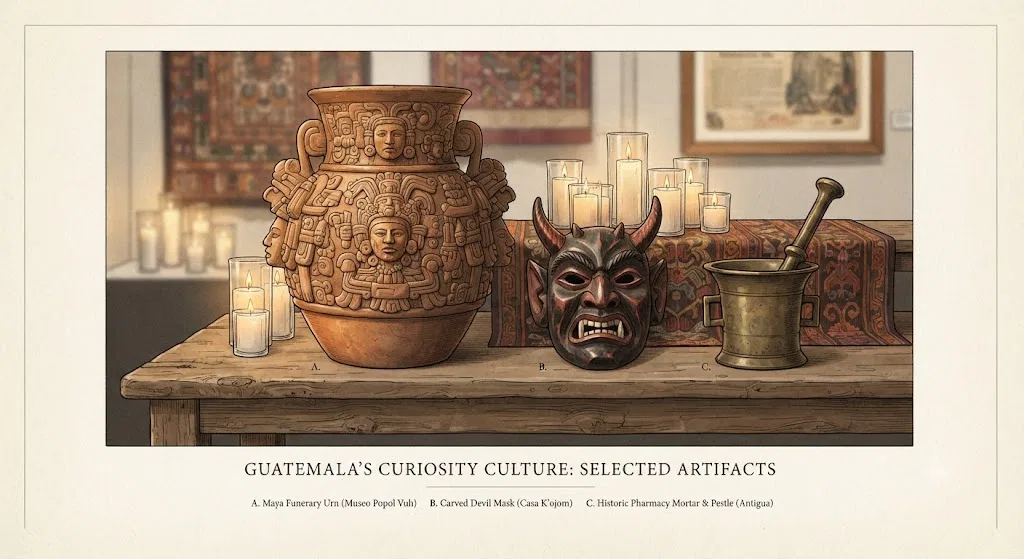
The strongest examples include the Museo Popol Vuh’s monumental funerary urns, Casa K’ojom’s masks and ritual instruments, Antigua Guatemala’s old pharmacy and religious museums, and the shifting household shrine of Maximón at Santiago Atitlán. Together they reveal something important: Guatemala’s uncanny heritage is not chiefly presented as entertainment. It sits at the boundary between scholarship, tourism, community memory and continuing belief.
Where Guatemala’s strangest collections are found
Guatemala’s museum network is shaped by the country’s exceptionally rich Maya archaeological heritage, its colonial Catholic institutions and its diverse living Indigenous traditions. As a result, unusual material often appears inside otherwise respectable archaeological, ethnographic or religious museums rather than in attractions explicitly marketed as macabre.
This produces several overlapping forms of curiosity culture:
- Archaeological collections preserve funerary vessels, incense burners, supernatural beings and objects recovered from sacred landscapes.
- Folklore and music museums display masks, costumes and ritual instruments that were made to perform, frighten, teach or transform their wearers.
- Religious museums contain carved saints, miracle-related offerings, clerical garments and dramatic images of suffering, death and the afterlife.
- Living devotional sites display powerful figures that still receive tobacco, alcohol, candles, money and petitions.
- Historic scientific collections preserve obsolete medical equipment, animal specimens and the material remains of earlier systems of knowledge.
This is a less theatrical landscape than the commercial oddity museums found in parts of Europe or North America. Yet it is arguably stranger because many of its objects have not lost their ritual, political or emotional force.
The funerary urns of the Museo Popol Vuh
The Museo Popol Vuh in Guatemala City offers the country’s clearest museum encounter with death, rebirth and supernatural imagery. Its pre-Hispanic collection includes painted ceramics, whistles, sculptures, incense burners recovered from Lake Amatitlán and an outstanding group of funerary urns from north-western Guatemala. The museum says that it holds Guatemala’s largest collection of pre-Columbian funerary urns.[Museo Popol Vuh]popolvuh.ufm.eduMuseo Popol Vuh Quiénes somosEl museo toma su nombre del Popol Vuh, libro escrito poco después de la conquista española de Guatemala, que narra los mitos y la histori…
These are not plain containers for the dead. Many are large ceramic constructions covered with faces, gods, animals and composite monsters. Examples associate jaguar beings with fire, warfare, night and death, while other vessels show maize gods, aged deities and figures connected with regeneration. The imagery places burial within a wider cycle of decay, fertility and renewed life rather than treating death as a simple ending.[Museo Popol Vuh]popolvuh.ufm.eduMuseo Popol Vuh Clásico Tardío (600Las urnas ostentan representaciones de varios dioses, entre los que destacan el dios jaguar, el dios del maíz, dioses viejos, y otras fig…
For visitors interested in the uncanny, the fascination lies in the clash between familiar museum order and objects designed for a very different purpose. They now stand cleanly labelled and illuminated, but their imagery belongs to tombs, ancestral identities and sacred narratives. The institution presents them archaeologically rather than sensationally, making this one of Guatemala’s most credible and carefully interpreted unusual collections.
The museum’s name comes from the Popol Vuh, a major Indigenous text recording creation stories, heroic narratives and the origins of ruling lineages in the Guatemalan highlands. The museum stresses that these accounts are connected not only with ancient art but also with oral traditions that survived into later communities.[Museo Popol Vuh]popolvuh.ufm.eduMuseo Popol Vuh El Popol VuhLa segunda parte del texto se concentra en los orígenes de los linajes gobernantes del reino quiché, su migración hacia el altiplano de G… This makes the collection especially useful for resisting the “mysterious vanished Maya” stereotype: the mythology is historic, but Maya cultures remain living cultures.
Masks that turn people into devils, conquerors and animals
Casa K’ojom, within the La Azotea cultural complex near Antigua Guatemala, is ostensibly a museum of Maya music. Its collections, however, extend well beyond instruments. They include masks, costumes, textiles, domestic objects and ritual material from pre-Hispanic and later periods. Visitor-facing descriptions also identify statues and ceremonial objects among its displays.[Tripadvisor]tripadvisor.comCasa K'OjomCasa K'Ojom - All You SHOULD Know Before Going 2026…There are many musical instruments, of course, but also costumes, statu…
The masks are especially important to Guatemala’s strange-history landscape. Guatemalan dance masks may represent devils, wild animals, Europeans, historical characters or grotesque social types. They belong to performances combining theatre, music, costume, religious instruction and satire. Once removed from a dancer and placed in a cabinet, a horned or grimacing face may resemble a piece of outsider horror art. In performance, however, it is part of a structured communal drama.
Some devil dances developed from morality plays introduced after the Spanish conquest. The British Museum notes that the Dance of the Legion of Twenty-Four Devils uses individual devils to personify particular sins, turning frightening imagery into Christian instruction. Other masks exaggerate facial features to parody outsiders and neighbouring peoples.[Google Arts & Culture]artsandculture.google.comOpen source on google.com.
Casa K’ojom therefore works best as an archive of performance rather than a gallery of monsters. Instruments, costumes and masks explain one another: the strange face was meant to move to music, interact with other characters and become temporarily alive.
The collection also demonstrates the practical difficulties faced by small specialist museums. A conservation study warned that many wooden masks and instruments had spent decades on display in a tropical environment where termites and changing conditions threatened their survival. The issue matters because these institutions often depend heavily on private initiative, tourism income and limited conservation resources.[Avanet]cdn-kb.avanet.nlOpen source on avanet.nl.
Maximón: a shrine that is not a museum
The most famous uncanny “display” in Guatemala may be Maximón, particularly the figure maintained at Santiago Atitlán. It should not be treated as a quirky museum exhibit. It is a living devotional presence whose meaning varies by place, community and worshipper.
At Santiago Atitlán, the effigy is traditionally housed by a different local custodial group or household. Visitors may find a wooden figure dressed in a suit, scarves and a broad-brimmed hat, surrounded by candles, flowers, bottles, cigarettes and other offerings. People petition him for protection, health, business success, justice or help with personal conflicts. A virtual shrine associated with Santiago Atitlán also accepts offerings and identifies the figure by a local title, reflecting the fact that “Maximón” is not the only name or interpretation attached to him.[Santiago Atitlán]santiagoatitlan.comOpen source on santiagoatitlan.com.
Travel accounts often emphasise the spectacle of attendants placing cigarettes in the figure’s mouth or offering him alcohol. Those details are real, but they can reduce a complex tradition to exotic theatre. One detailed account from Santiago describes the shrine as a candlelit household space where petitioners requested a blessing for a new business, while guardians supplied the figure with tobacco and drink.[Condé Nast Traveler]cntraveler.comThe narrative describes luxurious eco-retreats such as Francis Ford Coppola’s Cassa Zenda and La Lancha, experiences like sulfur baths an…
Maximón is frequently explained as a fusion of Maya ancestral or protective figures, Catholic saints and later popular religious traditions. No single origin story accounts for every local form. Nor should all shrines, souvenir figures and urban commercial representations be assumed to carry the same authority.
For the curious traveller, the essential distinction is between observation and consumption. This is not an animatronic attraction or a reconstructed folklore tableau. Photography, entrance payments and visitor behaviour are governed locally and may change. A guide familiar with the community can help prevent the shrine from being approached as a human curiosity cabinet.
Antigua’s medicine and sacred art
The old pharmacy
The Museo de la Farmacia in Antigua Guatemala preserves the equipment of an earlier pharmaceutical world. Its displays include bronze implements, scales, marble mortars, autoclaves and objects formerly used by a local pharmacy.[Inguat]inguat.gob.gtDirectorio de MuseosDirectorio de Museos
To a modern visitor, historic pharmacies can look halfway between laboratories and magical workshops. Mortars, jars, balances and metal devices belong to systems in which botanical remedies, imported drugs, chemical preparations and inherited medical practices overlapped. The museum is not a cabinet of medical horrors, but it makes visible the tools through which illness was measured, compounded and treated before mass-produced medicines became standard.
Its value lies in material specificity. Rather than presenting vague claims about “ancient healing”, it preserves recognisable working equipment. The broader history is also more complicated than a simple passage from superstition to science: Guatemala had long-established Indigenous botanical knowledge, while colonial and later pharmacies combined local materials with European medical regulation and trade. A historical account of Guatemalan pharmacies notes the sophistication of pre-Columbian medical knowledge while tracing the rise of formal apothecaries and druggists.[Prensa Libre]prensalibre.comPrensa Libre Sobre las antiguas boticas y sus sabios boticariosPrensa Libre Sobre las antiguas boticas y sus sabios boticarios
Saints, suffering and miracles
Antigua’s collections of colonial religious art are another major source of unsettling imagery. The Museo de Arte Colonial holds paintings, sculptures and sacred objects dating largely from the sixteenth to nineteenth centuries. Many pieces came from churches and convents abandoned or dismantled after the destructive earthquake of 1773.[Si Cultura]sicultura.gob.gtSi Cultura Museo de Arte Colonial de La Antigua GuatemalaSi Cultura Museo de Arte Colonial de La Antigua Guatemala
Polychrome wooden sculpture can be startlingly lifelike. Carefully painted skin, wounds, glass eyes and elaborate clothing were intended to make sacred figures emotionally immediate. Images of martyrs, sorrowful virgins, souls and the crucified Christ were devotional technologies, not merely decorations. Their intensity helped viewers contemplate pain, sacrifice, judgement and salvation.
Casa Santo Domingo’s museum complex, housed amid the remains of a former monastery, similarly displays saints, angels, cherubs, virgins and representations of souls alongside archaeological and colonial material. Because it operates as part of a hotel and cultural attraction, it illustrates how Guatemala’s sacred and archaeological heritage can also be packaged within high-end tourism.[casasantodomingo.com.gt]casasantodomingo.com.gtOpen source on com.gt.
The Museo de Arte Religioso del Santo Hermano Pedro adds a more explicitly devotional layer. Its rooms include colonial religious objects, old documents, priestly garments and a seventeenth-century altarpiece, as well as a “Passage of Miracles”.[Si Cultura]sicultura.gob.gtSi Cultura Museo de Arte Religioso del Santo Hermano PedroSi Cultura Museo de Arte Religioso del Santo Hermano Pedro Here the boundary between historic collection and continuing faith is particularly thin: objects may be valued as evidence of religious history, but also as traces of sanctity and answered prayer.
Natural history and the older cabinet tradition
The National Museum of Natural History in Guatemala City is not primarily an oddities museum, yet natural-history institutions descend from the same collecting impulse that produced European cabinets of curiosity. Animals, minerals and ecological specimens are removed from their original settings, classified and rearranged to represent the natural world.
The museum’s official mission combines scientific information, recreation and environmental education, with a particular emphasis on Guatemala’s biodiversity and conservation.[Ministerio de Cultura y Deportes]mcd.gob.gtOpen source on gob.gt. For visitors seeking curiosities, the interest is less in any single “monster” than in the older museum experience of confronting preserved life at close quarters.
Such displays need to be read differently from folklore collections. A ceremonial animal mask may embody a supernatural or dramatic being, whereas a zoological specimen is intended as biological evidence. Confusing the two encourages poor interpretations — particularly claims that an unfamiliar skeleton, taxidermied animal or archaeological image proves the existence of a cryptid.
What is missing — and why that matters
There is little reliable evidence for a permanent, professionally curated Guatemalan museum devoted specifically to UFOs, occultism, cryptids or witchcraft. Guatemala has certainly produced UFO enthusiasm: a widely reported wave of sightings and public fascination occurred in the late 1980s, accompanied by claims linking extraterrestrials with the ancient Maya.[Los Angeles Times]latimes.comLos Angeles Times UFO Mania Sweeps Guatemala, Keeping Eyes FixedLos Angeles Times UFO Mania Sweeps Guatemala, Keeping Eyes Fixed The theme has also appeared in contemporary art and performance, including a project about UFO stories in the eastern department of Zacapa.[Queens Museum]queensmuseum.orgovnis en zacapa ufos in zacapaovnis en zacapa ufos in zacapa
That cultural presence should not be mistaken for proof of a stable public collection. Online material about “alien Maya artefacts” is especially unreliable, frequently recycling unproven objects, decontextualised carvings or modern replicas. Genuine archaeological interpretation depends on excavation history, material analysis, comparison and documented provenance — the recorded chain of ownership and discovery.
The absence of a large commercial paranormal museum is itself revealing. Guatemala’s unusual heritage has not been neatly separated into “supernatural entertainment”. Strange-looking objects remain distributed among archaeology museums, churches, household shrines, dance traditions and community collections. The categories overlap because the country’s past is not divided cleanly into religion, folklore, art and material culture.
How to visit responsibly
Guatemala’s curiosity collections range from national museums to private cultural centres and active sacred spaces. Their status can change, so opening arrangements should be checked directly rather than assumed from old travel listings.
A few principles make these visits more rewarding:
- Treat funerary material as evidence of beliefs and people, not simply as spooky decoration.
- Ask before photographing shrines, ceremonies, worshippers or miracle offerings.
- Distinguish an object’s museum label from a guide’s legend or a seller’s marketing story.
- Do not buy objects represented as excavated antiquities. Replicas are common, while genuine unregistered artefacts raise serious legal and ethical concerns.
- Remember that a mask in a display case may still belong to a living dance tradition.
- Check current travel advice, transport conditions and local guidance, particularly outside established visitor centres. As of June 2026, the UK Foreign, Commonwealth and Development Office advised against all but essential travel to some parts of Guatemala.[GOV.UK]GOV.UKGuatemala travel adviceGuatemala travel advice
Why Guatemala’s curiosity culture is distinctive
Guatemala’s strangest collections are not united by a taste for freakishness. They are united by transformation. Funerary urns turn death into rebirth imagery; masks turn dancers into devils, animals and colonial characters; carved saints turn wood into emotionally powerful bodies; pharmacy tools turn plants and minerals into remedies; and a dressed wooden effigy becomes the centre of continuing petitions and obligations.
The most credible museums explain these transformations through archaeology, conservation and documented history. Living shrines require another kind of understanding, because their objects cannot be reduced to specimens. Between them lies Guatemala’s real cabinet of curiosities: not one building filled with oddities, but a national landscape in which extraordinary objects remain entangled with memory, performance, faith and power.
Amazon book picks
Further Reading
Books and field guides related to Where Guatemala Keeps Its Strangest Sacred Objects. Use these as the next step if you want deeper reading beyond the article.
Maya Art and Architecture
“In addition to serving as an introduction to Maya art, the book communicates enthusiasm for the art’s aesthetic power and grace.” —Choic...
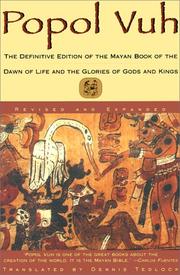
Popol Vuh: The Definitive Edition of the Mayan Book of the Da...
First published 1985. Subjects: Popol vuh, Quiché Indians, Quiché mythology, Religion, Maya literature.
eBay marketplace picks
Marketplace Samples
Live-tested eBay searches with available results related to this page.
Selected fromMaya art print oneBay.co.uk.



Endnotes
1.
Source: tripadvisor.com
Title: Casa K’Ojom
Link:https://www.tripadvisor.com/Attraction_Review-g295366-d313641-Reviews-Casa_K_Ojom-Antigua_Sacatepequez_Department.html
Source snippet
Casa K'Ojom - All You SHOULD Know Before Going 2026...There are many musical instruments, of course, but also costumes, statu...
2.
Source: artsandculture.google.com
Link:https://artsandculture.google.com/story/guatemalan-masks-the-british-museum/vwUxWmZyU4NhKA?hl=en
3.
Source: cdn-kb.avanet.nl
Link:https://cdn-kb.avanet.nl/wp-content/uploads/2019/07/25144913/03_SOIMA_Arce.pdf
4.
Source: casasantodomingo.com.gt
Link:https://www.casasantodomingo.com.gt/es/museos/museo-colonial
5.
Source: casasantodomingo.com.gt
Link:https://www.casasantodomingo.com.gt/museums/colonial-museum
6.
Source: GOV.UK
Title: Guatemala travel advice
Link:https://www.gov.uk/foreign-travel-advice/guatemala
7.
Source: guatemala.com
Title: Museo Casa K’ojom, un sitio cultural rodeado de naturaleza en Jocotenango
Link:https://www.guatemala.com/guias/cultura/casa-kojom-un-sitio-cultural-rodeado-de-naturaleza-en-jocotenango/
8.
Source: guatemala.com
Title: Directorio de museos en Antigua Guatemala
Link:https://www.guatemala.com/guias/cultura/directorio-de-los-museos-en-antigua-guatemala-que-destacan-por-su-historia/
9.
Source: guatemala.com
Title: Museo de música maya Casa K’ojom en Sacatepéquez | Aprende Guatemala
Link:https://www.guatemala.com/aprende/cultura-guatemalteca/patrimonios/museo-musica-maya-casa-kojom-sacatepequez
10.
Source: casasantodomingo.com.gt
Link:https://www.casasantodomingo.com.gt/es/museos
11.
Source: books.google.com
Title: Museo de la Farmacia de Guatemala
Link:https://books.google.com/books/about/Museo_de_la_Farmacia_de_Guatemala.html?id=4tFfAAAAMAAJ
12.
Source: youtube.com
Title: Museo Popol Vuh, Universidad Francisco Marroquín
Link:http://www.youtube.com/watch?v=J4gOogCV3Wg
Source snippet
Santiago Atitlan Ceremonia Ritual Maya Maximon Guatemala...
13.
Source: youtube.com
Link:http://www.youtube.com/watch?v=lN5VvCMhqug
Source snippet
Museo Popol Vuh Guatemala Maya art Museo Popol Vuh, Universidad Francisco Marroquín Museo Popol Vuh...
14.
Source: popolvuh.ufm.edu
Title: Museo Popol Vuh Quiénes somos
Link:https://popolvuh.ufm.edu/el-museo/quienes-somos/
Source snippet
El museo toma su nombre del Popol Vuh, libro escrito poco después de la conquista española de Guatemala, que narra los mitos y la histori...
15.
Source: popolvuh.ufm.edu
Title: Museo Popol Vuh Taller digital de urnas funerarias
Link:https://popolvuh.ufm.edu/actividad/taller-digital-urna-funeraria/
Source snippet
Museo Popol VuhTaller digital de urnas funerarias - Museo Popol VuhEl Museo Popol Vuh alberga la colección más grande en Guatemala de urn...
16.
Source: popolvuh.ufm.edu
Title: Museo Popol Vuh Clásico Tardío (600
Link:https://popolvuh.ufm.edu/periodo/clasico-tardio-600-900-dc/
Source snippet
Las urnas ostentan representaciones de varios dioses, entre los que destacan el dios jaguar, el dios del maíz, dioses viejos, y otras fig...
17.
Source: popolvuh.ufm.edu
Title: Museo Popol Vuh Urna Funeraria con Jaguar
Link:https://popolvuh.ufm.edu/pieza/urna-funeraria-con-jaguar/
Source snippet
Museo Popol VuhUrna Funeraria con Jaguar - Museo Popol VuhDescripción: | La urna presenta una cara, posiblemente del dios jaguar, que eme...
18.
Source: popolvuh.ufm.edu
Title: Museo Popol Vuh Urna Funeraria
Link:https://popolvuh.ufm.edu/tipo/urna-funeraria-1/
Source snippet
Museo Popol VuhUrna Funeraria - Museo Popol VuhRepresenta al dios jaguar, asociado con la guerra, el fuego, la noche y la muerte...
19.
Source: popolvuh.ufm.edu
Title: Museo Popol Vuh El Popol Vuh
Link:https://popolvuh.ufm.edu/el-museo/el-popol-vuh/
Source snippet
La segunda parte del texto se concentra en los orígenes de los linajes gobernantes del reino quiché, su migración hacia el altiplano de G...
20.
Source: santiagoatitlan.com
Link:https://www.santiagoatitlan.com/Shrine/shrine.html
21.
Source: cntraveler.com
Link:https://www.cntraveler.com/story/guatemala-eco-retreats-arts-collectives
Source snippet
The narrative describes luxurious eco-retreats such as Francis Ford Coppola’s Cassa Zenda and La Lancha, experiences like sulfur baths an...
22.
Source: inguat.gob.gt
Title: Directorio de Museos
Link:https://inguat.gob.gt/phocadownload/Directorios/Directorio_de_Museos.pdf
23.
Source: prensalibre.com
Title: Prensa Libre Sobre las antiguas boticas y sus sabios boticarios
Link:https://www.prensalibre.com/revista-d/boticas-farmacias-droguerias-boticarios-medicina-protomedicato-maese_francisco-medicos-cirujanos-barberos-farmacopea_0_1311469004/
24.
Source: sicultura.gob.gt
Title: Si Cultura Museo de Arte Colonial de La Antigua Guatemala
Link:https://www.sicultura.gob.gt/directory-directorio_c/listing/museo-de-arte-colonial-la-antigua-guatemala/
25.
Source: sicultura.gob.gt
Title: Si Cultura Museo de Arte Religioso del Santo Hermano Pedro
Link:https://www.sicultura.gob.gt/directory-directorio_c/listing/museo-del-santo-hermano-pedro/
26.
Source: mcd.gob.gt
Link:https://mcd.gob.gt/museo-nacional-de-historia-natural/
27.
Source: latimes.com
Title: Los Angeles Times UFO Mania Sweeps Guatemala, Keeping Eyes Fixed
Link:https://www.latimes.com/archives/la-xpm-1989-03-05-mn-184-story.html
28.
Source: queensmuseum.org
Title: ovnis en zacapa ufos in zacapa
Link:https://queensmuseum.org/event/ovnis-en-zacapa-ufos-in-zacapa/
29.
Source: noticias.mcd.gob.gt
Title: mcd.gob.gt Museos preservan la memoria y la identidad de Guatemala
Link:https://noticias.mcd.gob.gt/2026/05/18/museos-preservan-la-memoria-y-la-identidad-de-guatemala/
30.
Source: noticias.mcd.gob.gt
Link:https://noticias.mcd.gob.gt/2026/05/17/museos-del-mcd-celebran-primera-jornada-del-dia-internacional-de-los-museos-con-arte-historia-y-tradicion/
31.
Source: noticias.mcd.gob.gt
Title: mcd.gob.gt La naturaleza también forma parte de nuestra identidad cultural
Link:https://noticias.mcd.gob.gt/2026/05/14/la-naturaleza-tambien-forma-parte-de-nuestra-identidad-cultural/
32.
Source: sicultura.gob.gt
Title: Museo de Arte Colonial (La Antigua Guatemala)
Link:https://www.sicultura.gob.gt/museo-de-arte-colonial-la-antigua-guatemala/
33.
Source: noticias.mcd.gob.gt
Link:https://noticias.mcd.gob.gt/2026/03/30/museo-nacional-de-historia-honra-el-paso-de-jesus-de-las-palmas-en-el-centro-historico/
34.
Source: sicultura.gob.gt
Title: Museo Arquidiocesano de Santiago de Guatemala
Link:https://www.sicultura.gob.gt/directory-directorio_c/listing/museo-arquidiocesano-de-santiago-de-guatemala/
35.
Source: guatemala.gob.gt
Link:https://guatemala.gob.gt/caso-museo-de-arte-colonial-mcd-traslada-tres-obras-hacia-el-palacio-nacional-de-la-cultura/
36.
Source: guatemala.gob.gt
Link:https://guatemala.gob.gt/caso-museo-de-arte-colonial-mcd-coordina-traslado-de-obras-de-gran-formato-al-munag/
37.
Source: noticias.mcd.gob.gt
Title: mcd.gob.gt¿Qué es el IDAEH y cuál es su importancia para el patrimonio del país?
Link:https://noticias.mcd.gob.gt/2026/02/20/que-es-el-idaeh-y-cual-es-su-importancia-para-el-patrimonio-del-pais/
38.
Source: noticias.mcd.gob.gt
Link:https://noticias.mcd.gob.gt/2026/02/03/un-viaje-al-corazon-de-la-civilizacion-maya-en-el-museo-sylvanus-g-morley/
39.
Source: noticias.mcd.gob.gt
Title: mcd.gob.gt Explora el pasado prehispánico en el Museo Regional Mundo Maya
Link:https://noticias.mcd.gob.gt/2026/02/02/explora-el-pasado-prehispanico-en-el-museo-regional-mundo-maya/
40.
Source: guatemala.gob.gt
Title: Conoce al Museo Regional del Sureste de Petén Dr. Juan Pedro Laporte Molina
Link:https://guatemala.gob.gt/conoce-al-museo-regional-del-sureste-de-peten-dr-juan-pedro-laporte-molina/
41.
Source: noticias.mcd.gob.gt
Link:https://noticias.mcd.gob.gt/2026/01/06/exposicion-temporal-recorre-los-94-anos-de-historia-del-museo-nacional-de-arqueologia-y-etnologia/
42.
Source: guatemala.gob.gt
Title: El Museo de Arte Colonial de La Antigua Guatemala celebra 89 Años de historia
Link:https://guatemala.gob.gt/el-museo-de-arte-colonial-de-la-antigua-guatemala-celebra-89-anos-de-historia/
43.
Source: noticias.mcd.gob.gt
Title: mcd.gob.gt Museo Nacional de Historia: Un recorrido por la memoria de Guatemala
Link:https://noticias.mcd.gob.gt/2025/09/30/museo-nacional-de-historia-un-recorrido-por-la-memoria-de-guatemala/
44.
Source: noticias.mcd.gob.gt
Link:https://noticias.mcd.gob.gt/2025/09/26/museo-nacional-de-historia-un-recorrido-por-la-memoria-historica-de-guatemala/
45.
Source: ceceg.usac.edu.gt
Title: museo de la farmacia de guatemala
Link:https://ceceg.usac.edu.gt/index.php/2025/09/22/museo-de-la-farmacia-de-guatemala/
46.
Source: noticias.mcd.gob.gt
Link:https://noticias.mcd.gob.gt/2025/09/10/huellas-en-el-tiempo-94-anos-de-historia-un-recorrido-por-el-origen-del-museo-nacional-de-arqueologia-y-etnologia/
47.
Source: guatemala.gob.gt
Link:https://guatemala.gob.gt/huellas-en-el-tiempo-94-anos-de-historia-un-recorrido-por-el-origen-del-museo-nacional-de-arqueologia-y-etnologia/
48.
Source: guategt.com
Title: Museo de La Farmacia
Link:https://guategt.com/museo-de-la-farmacia/
49.
Source: noticias.mcd.gob.gt
Title: mcd.gob.gt“Museo Nacional de Arqueología y Etnología” recupera su nombre
Link:https://noticias.mcd.gob.gt/2024/05/31/museo-nacional-de-arqueologia-y-etnologiarecupera-su-nombre/
50.
Source: prensalibre.com
Title: Maximón y la Semana Santa de Santiago Atitlán
Link:https://www.prensalibre.com/hemeroteca/maximon-y-la-semana-santa-de-santiago-atitlan/
51.
Source: popolvuh.ufm.edu
Title: urna funeraria
Link:https://popolvuh.ufm.edu/pieza/urna-funeraria/
52.
Source: popolvuh.ufm.edu
Title: arte prehispanico
Link:https://popolvuh.ufm.edu/coleccion/arte-prehispanico/
53.
Source: popolvuh.ufm.edu
Title: urna funeraria 25
Link:https://popolvuh.ufm.edu/inventario/urna-funeraria-25/
54.
Source: popolvuh.ufm.edu
Title: urna funeraria
Link:https://popolvuh.ufm.edu/elemento/urna-funeraria/
55.
Source: popolvuh.ufm.edu
Link:https://popolvuh.ufm.edu/el-museo/historia/
56.
Source: popolvuh.ufm.edu
Title: urna funeraria 6
Link:https://popolvuh.ufm.edu/inventario/urna-funeraria-6/
57.
Source: tripadvisor.co.uk
Title: Attractions g294307 Activities c49 t33 Ecuador
Link:https://www.tripadvisor.co.uk/Attractions-g294307-Activities-c49-t33-Ecuador.html
58.
Source: tripadvisor.co.uk
Link:https://www.tripadvisor.co.uk/Attractions-g147288-Activities-c49-t161-Dominican_Republic.html
59.
Source: tripadvisor.co.uk
Title: Attractions g292002 Activities c49 Guatemala
Link:https://www.tripadvisor.co.uk/Attractions-g292002-Activities-c49-Guatemala.html
60.
Source: tripadvisor.co.uk
Title: Tourism g292002 Guatemala Vacations
Link:https://www.tripadvisor.co.uk/Tourism-g292002-Guatemala-Vacations.html
61.
Source: mcd.gob.gt
Title: museo nacional de historia
Link:https://mcd.gob.gt/museo-nacional-de-historia/
62.
Source: mcd.gob.gt
Link:https://mcd.gob.gt/museo-nacional-de-arte-moderno-carlos-merida/
63.
Source: mcd.gob.gt
Link:https://mcd.gob.gt/?page_id=1431
64.
Source: Wikipedia
Link:https://en.wikipedia.org/wiki/Guatemala
65.
Source: Wikipedia
Title: Guatemala City
Link:https://en.wikipedia.org/wiki/Guatemala_City
66.
Source: ucm.es
Link:https://www.ucm.es/museofarmaciahispana/historia
67.
Source: sicultura.gob.gt
Title: Museo del Parque Arqueológico Zaculeu
Link:https://www.sicultura.gob.gt/directory-directorio_c/listing/museo-de-zaculeu/
68.
Source: worldbank.org
Link:https://www.worldbank.org/ext/en/country/guatemala
69.
Source: ceceg.usac.edu.gt
Title: usac.edu.gt Folkloric Masks of Guatemala
Link:https://ceceg.usac.edu.gt/wp-content/uploads/2025/09/booklet-no.-122.pdf
70.
Source: culturaguate.gob.gt
Link:https://culturaguate.gob.gt/munag_/
71.
Source: latimes.com
Title: la xpm 1992 12 10 ol 2616 story
Link:https://www.latimes.com/archives/la-xpm-1992-12-10-ol-2616-story.html
72.
Source: inguat.gob.gt
Link:https://inguat.gob.gt/es/?catid=64&id=1785%3Amuseo-de-paleontologia-y-arqueologia-de-estanzuela-2&view=article
73.
Source: kids.nationalgeographic.com
Link:https://kids.nationalgeographic.com/geography/countries/article/guatemala
74.
Source: atitlangt.com
Link:https://atitlangt.com/en/pages/santiago-atitlan
75.
Source: atitlangt.com
Link:https://atitlangt.com/pages/santiago-atitlan
76.
Source: santiagoatitlan.com
Link:https://www.santiagoatitlan.com/Religion/Maximon/maximon.html
77.
Source: santiagoatitlan.com
Link:https://www.santiagoatitlan.com/Religion/Maximon/maximones.html
Additional References
78.
Source: youtube.com
Title: Santiago Atitlan Ceremonia Ritual Maya Maximon Guatemala
Link:http://www.youtube.com/watch?v=P4jgVyEk50k
Source snippet
El Cuenco Castillo: iconografía y textos...
79.
Source: atlasobscura.com
Link:https://www.atlasobscura.com/things-to-do/el-salvador/museums
80.
Source: atlasobscura.com
Link:https://www.atlasobscura.com/things-to-do/el-salvador
81.
Source: gpsmycity.com
Link:https://www.gpsmycity.com/tours/antigua-museums-4113.html
82.
Source: superstock.com
Link:https://www.superstock.com/asset/antique-instruments-museum-music-maya-people-casa-ojom-jocatenago-jocatenago/1848-61700947?srsltid=AfmBOoquQ08lksZxZONpwu1KxTjPgv9RxNag5Q-p2YE12qcJ3NEZqkzH
83.
Source: instagram.com
Link:https://www.instagram.com/reel/DNv2WWQQqrS/
84.
Source: cambridge.org
Link:https://www.cambridge.org/core/journals/latin-american-antiquity/article/abs/bioarchaeological-analysis-of-sacrificial-victims-from-a-postclassic-maya-temple-from-ixlu-el-peten-guatemala/63E5B536EACE129F9B8C638FB5E8AE25
85.
Source: facebook.com
Link:https://www.facebook.com/CantorArts/posts/a-little-under-one-month-to-see-the-bewitching-exhibition-cunning-folk-before-it/1479854540806308/
86.
Source: vidaantigua.com
Link:https://www.vidaantigua.com/attractions/casa-kojom/
87.
Source: museu.ms
Link:https://museu.ms/museum/details/16620