What Makes Argentina's Strangest Museums Matter?
Argentina’s strange-museum landscape is less a tidy circuit of novelty attractions than a revealing mixture of archaeology, medicine, imprisonment, folklore and popular belief.
Page outline Jump by section
Introduction
The strongest sites are not necessarily the most sensational. Argentina’s unusual collections matter because they repeatedly force visitors to ask who has the authority to preserve human remains, interpret suffering, classify abnormality or transform belief into tourism. Some are professionally curated public museums; others require advance arrangements, retain an academic purpose or present material whose provenance and interpretation demand caution.
The Inca children who changed a museum
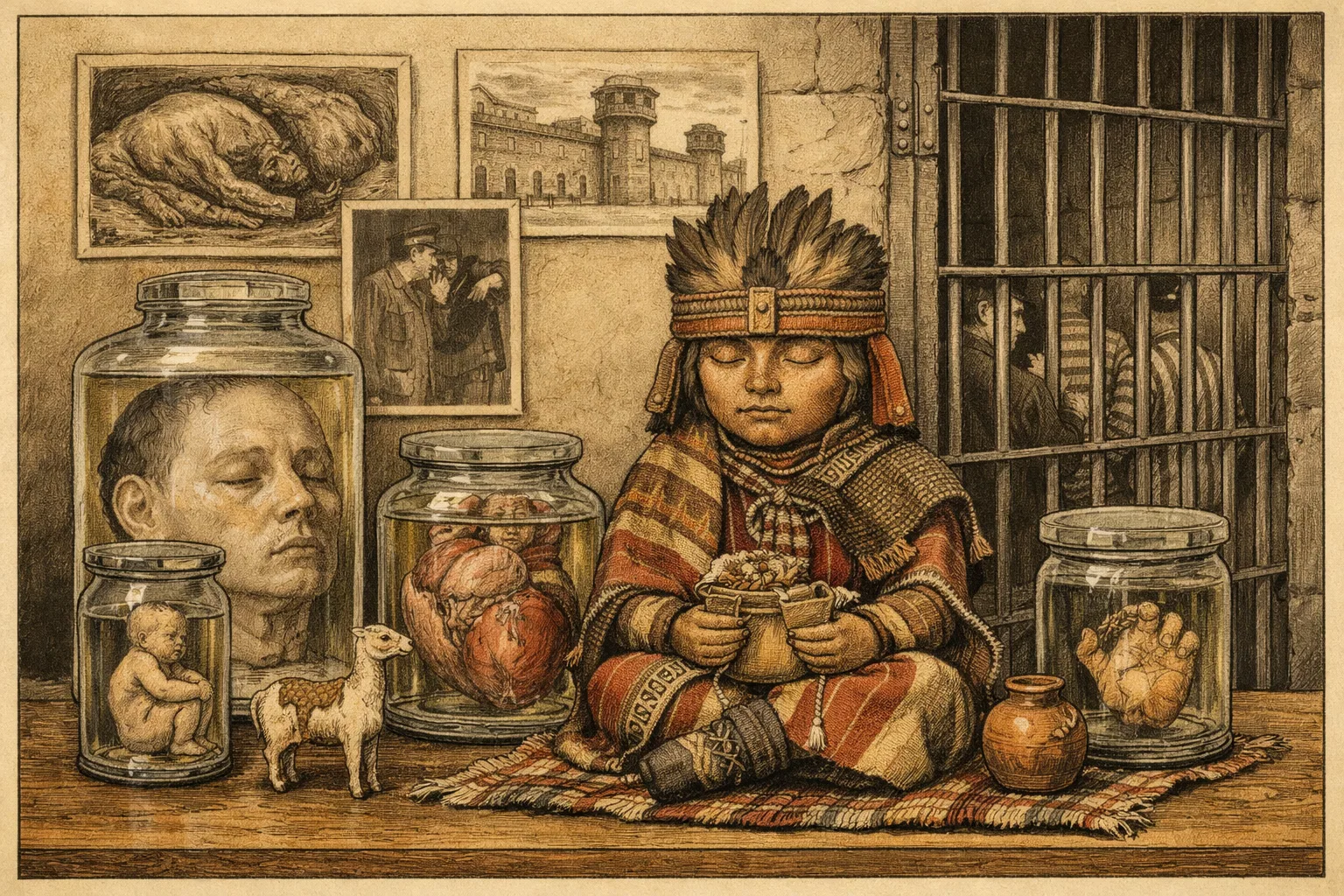
The Museum of High-Altitude Archaeology in Salta contains Argentina’s most internationally significant—and ethically difficult—unusual collection. Its central holdings come from the summit of Llullaillaco volcano, where archaeologists excavated three naturally frozen Inca children in 1999, alongside miniature figures, textiles, food and ceremonial objects. The burials date from more than five centuries ago and are associated with an Inca state ceremony in which selected children were offered at high mountain sanctuaries.[maam.gob.ar]maam.gob.arMuseo de Arqueología de Alta Montaña The MuseumIts main collection features the archaeological heritage discovered in 1999 at the summit…
The museum is unusual not simply because the bodies are exceptionally well preserved. Their hair, clothing and facial features make them look disconcertingly recent, collapsing the emotional distance that normally separates visitors from archaeological remains. Special environmental systems maintain the low temperatures and controlled conditions required for preservation, while the museum generally displays one child at a time rather than treating all three as a permanent spectacle. The accompanying objects help explain that the summit deposit was a carefully organised religious event, not an accidental death or ordinary burial.[maam.gob.ar]maam.gob.arMuseo de Arqueología de Alta Montaña The MuseumIts main collection features the archaeological heritage discovered in 1999 at the summit…
Yet the display cannot be understood as a neutral scientific achievement. Indigenous representatives have objected to the excavation and public exhibition of the children, arguing that the mountain remains sacred and that human ancestors should not be displayed for paying visitors. Other Indigenous participants have supported research and public interpretation as a means of communicating Andean history. The dispute therefore involves more than a simple division between science and religion: it concerns consent, cultural ownership, economic benefit and whether preservation justifies removing bodies from a sacred landscape.[The Guardian]theguardian.comThe Guardian Protest over child mummies | World newsThe GuardianProtest over child mummies | World newsSeptember 21, 2005 — 20 Sept 2005 — "Today it is no longer considered ethical to put h…
For visitors, this is the clearest example of why Argentina’s “curiosity culture” should not be reduced to the macabre. The children are not museum monsters, medical oddities or mysterious objects. They were people placed within a specific political and religious system. The museum is most credible when it keeps that human identity, and the continuing disagreement around it, at the centre of the experience.

Medical collections behind institutional doors
Buenos Aires has several collections in which the strange and disturbing emerged from teaching, diagnosis and forensic investigation rather than entertainment. These museums can feel more like historic laboratories than conventional attractions, and public access may depend on guided visits or prior arrangements.
The University of Buenos Aires Museum of Pathology holds roughly 2,000 displayed specimens, with a comparable number reportedly kept in storage. Its holdings include human anatomical material organised around diseases and pathological processes, as well as obstetric pathology, congenital conditions and animal specimens. Diseases now rare or eradicated in Argentina, including smallpox and yellow fever, are represented alongside more familiar conditions.[fmed.uba.ar]fmed.uba.arMuseo de PatologíaPosee una importante colección sobre teratología y patología obstétrica como también piezas anatomopatológicas de orige…
The collection dates back to the establishment of the university’s pathological anatomy teaching tradition in the late nineteenth century. Its jars and preserved organs were created primarily to train doctors by allowing them to compare the physical effects of illness. That academic origin distinguishes it from a commercial “museum of horrors”, although modern visitors may still find the material confronting. The most useful way to approach it is as evidence of how medicine learned through direct observation before scans, digital imaging and contemporary simulation became standard.[psi.uba.ar]psi.uba.arPonencias - XVIII Congreso Internacional de InvestigaciónDecember 6, 2018 — Pertenencia institucional: Museo de Patología - Facultad de M…
The Forensic Museum within Argentina’s Judicial Morgue offers an even less ordinary encounter. Operated under the national forensic medical body, it is housed in a working medico-legal institution and advertises guided visits arranged in advance. Its collection is connected to forensic anatomy, violent or unexplained death and the practical development of legal medicine. This makes it a scientific and judicial collection rather than an open-access tourist attraction, despite its obvious appeal to readers interested in crime history.[csjn.gov.ar]csjn.gov.arCuerpo Medico ForenseCuerpo Medico Forense
The setting raises questions that crime exhibitions often avoid. Human material in a forensic museum does not begin as memorabilia: it comes from real investigations and from people whose deaths required legal examination. A responsible visit should therefore focus on evidence, historical techniques and professional practice rather than treating the displays as gruesome trophies. Current reports describe the museum as unsuitable for children and potentially distressing for sensitive visitors, while the institution itself advises arranging guided access beforehand.[csjn.gov.ar]csjn.gov.arCuerpo Medico ForenseCuerpo Medico Forense
Prisons preserved as museums
Argentina’s two most important prison collections offer sharply different experiences. In Ushuaia, an entire former penal complex survives at the edge of Patagonia. In Buenos Aires, the Antonio Ballvé Penitentiary Museum preserves the documentary and material history of imprisonment within a much older urban building.
The former Ushuaia prison was built partly through convict labour, with construction beginning in 1902. It later absorbed the military prison and the institution for repeat offenders, becoming inseparable from Argentina’s effort to establish a permanent state presence in Tierra del Fuego. The prison closed in 1947; its building was subsequently declared a National Historic Monument and now contains several museums, including displays on the prison, maritime history and Antarctic exploration.[MUSEO MARÍTIMO DE USHUAIA]museomaritimo.commuseum of the prison of ushuaiamuseum of the prison of ushuaia
What visitors encounter is not a reconstructed dungeon but an enormous radial institution whose long wings, iron galleries and small cells still communicate the physical logic of confinement. Displays use photographs, documents, objects and figures representing prisoners and guards. Some restored sections feel theatrical, while less restored areas preserve a colder and more convincing sense of abandonment. The combination of mannequins, notorious inmates and empty cell blocks has encouraged ghost stories, but the documented history of isolation, harsh climate and coerced labour is more disturbing than any paranormal claim.[Condé Nast Traveler]cntraveler.comCondé Nast Traveler A Prison at the End of the PlanetCondé Nast Traveler A Prison at the End of the Planet
The complex is also unusual because the prison narrative overlaps with maritime settlement, Indigenous history, Antarctic expeditions and myths of southern gold seekers. That breadth can enrich a visit, although it can also turn a site of punishment into a general-purpose attraction. The best interpretation connects the exhibits: the prison was part of the same national project that mapped seas, claimed territory and attempted to populate a distant frontier.[MUSEO MARÍTIMO DE USHUAIA]museomaritimo.comOpen source on museomaritimo.com.
The Antonio Ballvé museum in San Telmo is smaller and more archival. It occupies an eighteenth-century complex associated at different times with religious, correctional and women’s institutions, and it houses material relating to Argentina’s penitentiary system. Documents, uniforms, restraints, weapons, photographs and prison-made objects allow visitors to trace changing theories of discipline and rehabilitation. Its institutional archive is especially valuable because it preserves records rather than merely recreating notorious crimes.[whichmuseum.co.uk]whichmuseum.co.ukWhich Museum Prison Museum Antonio Ballvé (Buenos AiresWhich Museum Prison Museum Antonio Ballvé (Buenos Aires
The museum has experienced periods of closure and restoration, so older travel accounts are unreliable guides to current access. Recent institutional publicity indicates that visits have resumed on limited days and around guided time slots. This is a recurring practical lesson for Argentina’s smaller specialist museums: check directly before travelling, especially where a collection is managed by a government service rather than a mainstream tourism body.[tripadvisor.com]tripadvisor.comMuseo Penitenciario Argentino Antonio BallveMuseo Penitenciario Argentino Antonio Ballve
UFO museums, belief and tourism
Argentina has a particularly visible UFO culture, but its most interesting feature is not a single persuasive artefact. It is the way private research groups, alleged sightings, local identity and tourism have been assembled into visitor experiences.
The UFO Museum in Victoria, Entre Ríos, was founded by researcher Silvia Pérez Simondini and is associated with the Visión Ovni organisation. The collection grew out of decades of reports concerning unusual lights around Victoria and nearby wetlands. Its displays have included photographs, witness accounts, documents, fragments said to be connected with aerospace events and miscellaneous objects interpreted within UFO research. Unlike a science museum, it is a belief-led and investigator-led collection: its purpose is to preserve testimony and argue that unexplained reports deserve attention.[infobae]infobae.comAsegura que tuvo una experiencia cercana con OVNIS yAsegura que tuvo una experiencia cercana con OVNIS y
That distinction matters. A witness statement may be culturally valuable without proving an extraterrestrial encounter. A piece of metal may be genuinely connected to a spacecraft without establishing that it came from an alien vehicle. Visitors should expect a collection shaped by the assumptions of its founders rather than a neutral survey of atmospheric science, misidentification, folklore and competing explanations.
Provenance has become a particularly serious issue. In April 2024, federal cultural-property investigators recovered more than 60 archaeological pieces from the Victoria museum after an alert involving Peruvian heritage. Reports stated that the seized material included objects believed to be of Peruvian origin. The operation did not by itself settle the truth or falsehood of the museum’s UFO claims, but it demonstrated why extraordinary-looking artefacts require documentation, lawful ownership and specialist identification before they can serve as evidence.[maracodigital.net]maracodigital.netAllanaron un museo ovni en entre rios y secuestraron piezas de origen peruanoAllanaron un museo ovni en entre rios y secuestraron piezas de origen peruano
Farther west, Capilla del Monte in Córdoba has turned UFO folklore into a broader tourist economy. Its modern reputation developed after a reported 1986 incident near the Pajarillo hills, where a large mark on vegetation was attributed by believers to a landing craft. The story helped make nearby Cerro Uritorco a destination for UFO enthusiasts, spiritual seekers and alternative-tour operators. Alien-themed festivals, shops, lectures and night excursions have since converted the town’s supernatural identity into a recognisable tourism brand.[apnews.com]apnews.comAP News Argentine alien festival soars at UFO sighting site hotspotAP News Argentine alien festival soars at UFO sighting site hotspot
Capilla del Monte is therefore best understood as a living folklore environment rather than a place where extraterrestrial visitation has been demonstrated. Its importance lies in how a disputed incident can reorganise a town’s image, commerce and storytelling. The festival atmosphere can be playful, while researchers and believers may regard the same landscape with deep seriousness. This mixture of entertainment, spirituality and claimed investigation is central to Argentina’s modern curiosity culture.
Folklore without a witchcraft museum
Argentina does not have a nationally prominent public museum of witchcraft comparable with specialist occult museums in parts of Europe. Its uncanny traditions are more often distributed among regional folklore collections, religious sites, archaeological landscapes, private archives and tourist storytelling.
That dispersed pattern reflects the country’s cultural geography. Beliefs about harmful magic, miraculous saints, Indigenous sacred landscapes, spirits of the dead and rural supernatural beings differ by region. They appear in oral history and devotional practice rather than in one authoritative cabinet of “witch objects”. A visitor looking only for a labelled occult museum may therefore miss the more meaningful places where folklore remains socially active.
The so-called Witches’ Cave in Mendoza illustrates the danger of taking a name too literally. It is a protected limestone cave, not a museum of magic. Guided access leads through stalactites, stalagmites and chambers created by geological processes, while its supernatural name belongs to local storytelling and tourist interpretation. It is relevant to strange heritage because natural formations invite legends, but the site’s evidential foundation is geology, conservation and controlled exploration rather than proof of witchcraft.[Wikipedia]WikipediaWitches' CaveWitches' Cave
Cemeteries provide another form of public folklore collection. Buenos Aires’ Recoleta Cemetery preserves monumental tombs, political memory and family mythology in a dense architectural landscape. Stories of apparitions, premature burial and tragic young women circulate alongside documented biographies. These tales should be treated as cemetery folklore rather than established events, yet they reveal how funerary monuments become stages on which later generations retell anxieties about death, status and unfinished lives.[Wikipedia]WikipediaList of reportedly haunted locationsList of reportedly haunted locations

How credible are Argentina’s strange collections?
Credibility varies because these institutions are trying to do different things. Judging all of them by a single standard would be misleading.
- Archaeological museums such as the Salta museum rely on excavation records, conservation science and specialist interpretation, but can still face serious ethical challenges concerning human remains and Indigenous authority.
- University medical museums preserve scientifically important specimens, although historic terminology and collection practices may require modern explanation.
- Forensic collections are grounded in legal medicine but demand unusually careful treatment of dignity, privacy and the circumstances in which specimens were obtained.
- Prison museums have strong buildings, archives and documentary evidence, yet can drift towards theatrical displays of notorious criminals or simplified accounts of punishment.
- UFO museums may preserve genuine testimonies and local cultural history, but their exhibits do not automatically validate extraterrestrial explanations.
- Folklore sites can be culturally authentic even when the supernatural events associated with them cannot be verified.
A useful visitor question is not simply, “Is this real?” It is, “What exactly is being claimed?” A preserved body can be authentic while its display remains contested. A witness can sincerely report a light without knowing its cause. A prison cell can be original while a mannequin scene is speculative. A legend can be historically important without being literally true.
What Argentina’s odd museums reveal
Argentina’s unusual collections repeatedly place the human body at the centre of public curiosity: sacrificed children preserved by mountain cold, organs transformed into medical teaching aids, forensic specimens linked to judicial investigation and prisoners represented through cells, records and institutional objects. Even its UFO culture revolves around bodies—alien bodies imagined, witnesses examined and disputed fragments presented as material proof.
This gives the country’s strange-museum landscape a more serious character than a conventional list of quirky attractions might suggest. The central tension is between preservation and possession. Museums preserve things that might otherwise disappear, but preservation also grants institutions power over bodies, objects, evidence and stories.
The most rewarding visits are therefore those that leave room for uncertainty. Salta’s mountain archaeology is scientifically exceptional but ethically disputed. Ushuaia’s prison is both a major historic monument and a tourist experience shaped by selective reconstruction. Medical museums offer rare evidence of past disease while confronting visitors with earlier attitudes towards consent and abnormality. UFO collections document a real culture of belief, although their extraordinary interpretations remain unproven.
Argentina’s curiosity culture is strongest not where a display promises a solved mystery, but where it exposes the difficult border between evidence, memory, faith and spectacle.
Amazon book picks
Further Reading
Books and field guides related to What Makes Argentina's Strangest Museums Matter?. Use these as the next step if you want deeper reading beyond the article.
Cabinets of Curiosities
"Maurie`s' tour of strange objects is entertaining and fascinating." --Antiques And The Arts Weekly
Stiff: The Curious Lives of Human Cadavers
A NEW YORK TIMES BESTSELLER AND THE PERFECT READ FOR FANS OF UNNATURAL CAUSES What happens to your body after you have died? Fertilizer?...
eBay marketplace picks
Marketplace Samples
Live-tested eBay searches with available results related to this page.
Selected fromArgentina map print oneBay.co.uk.
Current eBay listing
Old Map of Buenos Aires 1888 - Vintage Argentina Art Wall De
Current eBay listing
Old Map of Buenos Aires 1950 - Vintage Argentina Art Wall De
Current eBay listing
Old Map of Buenos Aires 1884 - Vintage Argentina Art Wall De
Current eBay listing
Old Map of Buenos Aires 1880 - Vintage Argentina Art Wall De
Endnotes
1.
Source: maam.gob.ar
Link:https://maam.gob.ar/en/el-museo/
Source snippet
Museo de Arqueología de Alta Montaña The MuseumIts main collection features the archaeological heritage discovered in 1999 at the summit...
2.
Source: maam.gob.ar
Link:https://maam.gob.ar/
Source snippet
Museo de Arqueología de Alta MontañaMuseo de Arqueología de Alta Montaña … domingos de 11:00 a 19:00 hrs. Bartolomé Mitre 77 Salta, Argen...
3.
Source: Wikipedia
Title: Children of Llullaillaco
Link:https://en.wikipedia.org/wiki/Children_of_Llullaillaco
4.
Source: fmed.uba.ar
Link:https://www.fmed.uba.ar/departamentos_y_catedras/museo-de-patologia/patrimonio
Source snippet
Museo de PatologíaPosee una importante colección sobre teratología y patología obstétrica como también piezas anatomopatológicas de orige...
5.
Source: psi.uba.ar
Link:https://www.psi.uba.ar/museo/segundo_congreso_sudamericano/ponencias_congreso_museo_2018.pdf
Source snippet
Ponencias - XVIII Congreso Internacional de InvestigaciónDecember 6, 2018 — Pertenencia institucional: Museo de Patología - Facultad de M...
Published: December 6, 2018
6.
Source: psi.uba.ar
Link:https://www.psi.uba.ar/museo/tercer_congreso_sudamericano/ponencias_congreso_2023.pdf
7.
Source: csjn.gov.ar
Title: Cuerpo Medico Forense
Link:https://www.csjn.gov.ar/cmfcs/files/museo.htm
8.
Source: clarin.com
Title: visita exclusiva apta sensibles museo forense lugar muerte ficcion 0 YFMb Ah1vzg
Link:https://www.clarin.com/cultura/visita-exclusiva-apta-sensibles-museo-forense-lugar-muerte-ficcion_0_YFMbAh1vzg.html
9.
Source: museomaritimo.com
Title: museum of the prison of ushuaia
Link:https://museomaritimo.com/en/museum-of-the-prison-of-ushuaia
10.
Source: museomaritimo.com
Link:https://museomaritimo.com/en/acerca-del-museo-martimo-de-ushuaia-eng
11.
Source: museomaritimo.com
Title: maritime museum of ushuaia
Link:https://museomaritimo.com/en/maritime-museum-of-ushuaia
12.
Source: museomaritimo.com
Link:https://museomaritimo.com/folleto-eng
13.
Source: museomaritimo.com
Link:https://museomaritimo.com/en/historic-shelters
14.
Source: youtube.com
Link:https://www.youtube.com/channel/UCW7yZ473u985BLLIrcVx5Gg/about
15.
Source: tripadvisor.com
Title: Museo Penitenciario Argentino Antonio Ballve
Link:https://www.tripadvisor.com/Attraction_Review-g312741-d532271-Reviews-Museo_Penitenciario_Argentino_Antonio_Ballve-Buenos_Aires_Capital_Federal_District.html
16.
Source: instagram.com
Link:https://www.instagram.com/reel/DCKMYv7xrLF/
17.
Source: instagram.com
Link:https://www.instagram.com/museopenitenciarioab/?hl=en
18.
Source: infobae.com
Title: Asegura que tuvo una experiencia cercana con OVNIS y
Link:https://www.infobae.com/salud/ciencia/2026/06/18/asegura-que-tuvo-una-experiencia-cercana-con-ovnis-y-creo-un-museo-para-contarla/
19.
Source: Wikipedia
Title: Visión Ovni
Link:https://en.wikipedia.org/wiki/Visi%C3%B3n_Ovni
20.
Source: maracodigital.net
Title: Allanaron un museo ovni en entre rios y secuestraron piezas de origen peruano
Link:https://www.maracodigital.net/Allanaron-un-museo-ovni-en-entre-rios-y-secuestraron-piezas-de-origen-peruano.html
21.
Source: vice.com
Title: aliens argentina capilla del monte ufo
Link:https://www.vice.com/en/article/aliens-argentina-capilla-del-monte-ufo/
22.
Source: Wikipedia
Title: Witches’ Cave
Link:https://en.wikipedia.org/wiki/Witches%27_Cave
23.
Source: Wikipedia
Title: List of reportedly haunted locations
Link:https://en.wikipedia.org/wiki/List_of_reportedly_haunted_locations
24.
Source: tripadvisor.com
Title: Museo del Ovni
Link:https://www.tripadvisor.com/Attraction_Review-g1198452-d3927141-Reviews-Museo_del_Ovni-Victoria_Province_of_Entre_Rios_Litoral.html
25.
Source: tripadvisor.com
Title: Museo de la Policía Federal Argentina
Link:https://www.tripadvisor.com/Attraction_Review-g312741-d4206706-Reviews-Museo_de_la_Policia_Federal_Argentina-Buenos_Aires_Capital_Federal_District.html
26.
Source: instagram.com
Title: museum of witchcraft and magic
Link:https://www.instagram.com/museum_of_witchcraft_and_magic/?hl=en
27.
Source: instagram.com
Link:https://www.instagram.com/p/DHEHXynRxjc/
28.
Source: instagram.com
Link:https://www.instagram.com/reel/DOUebBmDO3D/?hl=en
29.
Source: instagram.com
Title: DZw I1OVIM0P
Link:https://www.instagram.com/p/DZwI1OVIM0P/?hl=en
30.
Source: instagram.com
Link:https://www.instagram.com/p/DHWV2V2RuP-/?hl=en
31.
Source: instagram.com
Title: DM qwl IM172
Link:https://www.instagram.com/reel/DM_qwlIM172/
32.
Source: instagram.com
Link:https://www.instagram.com/popular/museo-de-la-morgue/
33.
Source: instagram.com
Link:https://www.instagram.com/reel/DUiWtSLje5z/
34.
Source: Wikipedia
Title: UFO sightings in Argentina
Link:https://en.wikipedia.org/wiki/UFO_sightings_in_Argentina
35.
Source: Wikipedia
Title: Museum of Witchcraft and Magic
Link:https://en.wikipedia.org/wiki/Museum_of_Witchcraft_and_Magic
36.
Source: psi.uba.ar
Title: ar Ponencias
Link:https://www.psi.uba.ar/museo/segundo_congreso_sudamericano/ponencias_congreso_2021.pdf
37.
Source: repositoriouba.sisbi.uba.ar
Title: Revista del Museo Nº 44 Facultad de Odontología Universidad de
Link:https://repositoriouba.sisbi.uba.ar/gsdl/collect/museo/Revista%20del%20Museo%20N%C2%BA%2044%20-%20Facultad%20de%20Odontolog%C3%ADa%20-%20Universidad%20de%20….pdf
38.
Source: revistascientificas.filo.uba.ar
Link:https://revistascientificas.filo.uba.ar/index.php/CAS/article/download/2802/2432
39.
Source: repositorio.filo.uba.ar
Link:https://repositorio.filo.uba.ar/bitstreams/43cbda3a-c81c-47cb-bd50-432fa06b9e98/download
40.
Source: psi.uba.ar
Title: instituto frenopatico
Link:https://www.psi.uba.ar/institucional/historia/instituciones/instituto_frenopatico/instituto_frenopatico.pdf
41.
Source: uba.ar
Link:https://www.uba.ar/busqueda/1/b?page=63
42.
Source: whichmuseum.com
Title: forensic museum of the judicial morgue buenos aires 20998
Link:https://whichmuseum.com/museum/forensic-museum-of-the-judicial-morgue-buenos-aires-20998
43.
Source: youtube.com
Link:https://www.youtube.com/watch?v=P60gR8uqPd0
44.
Source: youtube.com
Title: SILVI A PEREZ SIMONDINI
Link:https://www.youtube.com/watch?v=ipMqdFafMD0
45.
Source: youtube.com
Link:https://www.youtube.com/watch?v=O_Qgp2J6_4o
46.
Source: youtube.com
Link:https://www.youtube.com/watch?v=zq8On3H94xc
47.
Source: turismo.buenosaires.gob.ar
Title: antonio ballvé prison museum
Link:https://turismo.buenosaires.gob.ar/en/atractivo/antonio-ballv%C3%A9-prison-museum
48.
Source: youtube.com
Title: Virtual Tour Guide to the Museum of High Altitude Archaeology (MAAM)
Link:https://www.youtube.com/watch?v=YPMzMB01_P0
Source snippet
Expedition to Llullaillaco - The World's Highest Archaeological Site (Argentina) (1999)...
49.
Source: youtube.com
Title: Expedition to Llullaillaco
Link:https://www.youtube.com/watch?v=PM6hux_MRXM
Source snippet
Child Mummies Found Hidden in Argentina Mountain | Secrets In The Ice...
50.
Source: youtube.com
Title: Child Mummies Found Hidden in Argentina Mountain | Secrets In The Ice
Link:https://www.youtube.com/watch?v=R8fGhiM1xWQ
Source snippet
This is the Prison at the End of the World in Ushuaia | Full tour...
51.
Source: youtube.com
Title: This is the Prison at the End of the World in Ushuaia | Full tour
Link:https://www.youtube.com/watch?v=YiRqb7pk20g
Source snippet
Argentinian UFO | The Unexplained Files...
52.
Source: youtube.com
Title: Argentinian UFO | The Unexplained Files
Link:https://www.youtube.com/watch?v=h8G4C2WI6lQ
53.
Source: theguardian.com
Title: The Guardian Protest over child mummies | World news
Link:https://www.theguardian.com/world/2005/sep/21/argentina.mainsection
Source snippet
The GuardianProtest over child mummies | World newsSeptember 21, 2005 — 20 Sept 2005 — "Today it is no longer considered ethical to put h...
Published: September 21, 2005
54.
Source: cntraveler.com
Title: Condé Nast Traveler A Prison at the End of the Planet
Link:https://www.cntraveler.com/stories/2011-12-22/a-prison-at-the-end-of-the-planet
55.
Source: museomaritimo.com
Link:https://museomaritimo.com/en/visits
56.
Source: whichmuseum.co.uk
Title: Which Museum Prison Museum Antonio Ballvé (Buenos Aires)
Link:https://whichmuseum.co.uk/museum/prison-museum-antonio-ballve-buenos-aires-20919
57.
Source: flickr.com
Title: Buenos Aires
Link:https://www.flickr.com/photos/wallyg/8012561268/
58.
Source: apnews.com
Title: AP News Argentine alien festival soars at UFO sighting site hotspot
Link:https://apnews.com/general-news-71a2e81bfd8f4485bb276742802480cd
59.
Source: atlasobscura.com
Link:https://www.atlasobscura.com/things-to-do/united-states/museums
60.
Source: museomaritimo.com
Link:https://museomaritimo.com/en/el-presidio-militar-de-isla-de-los-estados-1
61.
Source: museomaritimo.com
Title: islas malvinas
Link:https://museomaritimo.com/en/islas-malvinas
62.
Source: museomaritimo.com
Title: ehal eng
Link:https://museomaritimo.com/en/ehal-eng
63.
Source: museomaritimo.com
Title: antarctic expeditions
Link:https://museomaritimo.com/en/antarctic-expeditions
64.
Source: whichmuseum.co.uk
Title: Museum of Witchcraft & Magic (Boscastle)
Link:https://whichmuseum.co.uk/museum/museum-of-witchcraft-magic-boscastle-2842
65.
Source: humbo.com
Title: Capilla del Monte
Link:https://humbo.com/ar/capilla-del-monte
Additional References
66.
Source: pdfs.semanticscholar.org
Link:https://pdfs.semanticscholar.org/0e10/300790937eb0b727bed4c184aa788209cc33.pdf
Source snippet
nts were found at an elevation of 6.715 meters (22,100 ft.) above sea level, on the summit of...Read more...
67.
Source: facebook.com
Link:https://www.facebook.com/drewbinsky/videos/10-most-bizarre-museums-in-usa/1217103620602281/
68.
Source: researchgate.net
Link:https://www.researchgate.net/publication/390021822POLITICAL_AND_ETHICAL_CHALLENGES_OF_SCIENTIFIC_BIOBANKS_CASE_STUDY-ARGENTINA-_MAAM_BIOBANK_-_CHAPTER_PHD_Liliana_Virginia_Siede
69.
Source: riseart.com
Link:https://www.riseart.com/guide/2314/art-world-news-6-of-the-world-s-weirdest-museums?srsltid=AfmBOooM9xE-pUIjCfMateSg9REaMcjRM1oHrKst15s-Kwp_JQ0dWZyF
70.
Source: everydaytourist.ca
Link:https://everydaytourist.ca/globe-trekking-international-travel/around-the-world-in-25-weird-museums
71.
Source: facebook.com
Link:https://www.facebook.com/RevistaElPato/posts/el-museo-del-ovni-es-%C3%BAnico-en-argentina-y-un-referente-internacional-en-el-estud/1170775208419165/
72.
Source: facebook.com
Link:https://www.facebook.com/groups/aiartuniverse/posts/853682736396962/
73.
Source: mundonow.com
Link:https://www.mundonow.com/ufo-sightings-in-argentina-locations/
74.
Source: petitfute.de
Link:https://www.petitfute.de/v41327-buenos-aires/c1173-visites-points-d-interet/c958-musee/c962-histoire-naturelle-sciences/1694090-museo-forense-de-la-morgue-judicial-institut-medico-legal.html
75.
Source: wanderlog.com
Link:https://wanderlog.com/es/place/details/5293401/museo-forense-de-la-morgue-judicial