Within Mexico Curiosities
Why Mexican Death Imagery Means More Than Horror
The National Museum of Death shows how Mexican skulls and skeletons can express devotion, satire, mourning, memory and political criticism.
On this page
- From private collection to university museum
- Skulls and skeletons across Mexican history
- How context changes the meaning of death
Page outline Jump by section
Introduction
Mexico’s best-known images of death are often misunderstood outside the country as simply spooky or Halloween-like. The National Museum of Death in Aguascalientes offers a very different interpretation. Rather than presenting skulls and skeletons as objects of fear, it explains how they have expressed memory, faith, humour, political criticism and artistic identity across more than five centuries of Mexican history. Housed and managed by the Autonomous University of Aguascalientes, the museum is one of the country’s most distinctive cultural institutions because it treats death imagery as a changing visual language rather than a collection of macabre curiosities.[Museo Nacional de la Muerte]museonacionaldelamuerte.uaa.mxOpen source on uaa.mx.
For visitors exploring Mexico’s unusual museums, this approach is important. The galleries show that the same skull motif can mean remembrance in one context, satire in another, religious devotion elsewhere, and contemporary artistic experimentation in yet another. Understanding those shifts in meaning is the museum’s central achievement.
Why Mexican Death Imagery Means More Than Horror
Many museums displaying skeletons or funerary objects focus on mortality itself. The National Museum of Death instead asks why societies repeatedly reinvent the image of death.
Its permanent displays trace changing interpretations from pre-Hispanic cultures through the colonial era, the nineteenth century and contemporary Mexico. Instead of suggesting one continuous tradition, the museum shows how Indigenous beliefs, Catholic symbolism, popular printmaking, folk craft and modern visual culture have all contributed different ideas about death.[Museo Nacional de la Muerte]museonacionaldelamuerte.uaa.mxOpen source on uaa.mx.
Visitors therefore encounter objects that may appear visually similar but serve very different purposes:
- ceremonial and funerary artefacts connected with pre-Hispanic beliefs;
- colonial religious art emphasising mortality and salvation;
- satirical prints mocking social inequality;
- sugar skulls, decorative paper art and festival objects linked with remembrance;
- modern paintings, prints and installations exploring personal or political themes.[Visit Mexico]visitmexico.comVisit Mexico National Museum of DeathVisit Mexico National Museum of Death
The museum’s message is that skull imagery is not automatically cheerful, tragic or frightening. Its meaning depends on who created it, when it was made and the community that uses it.
From Private Collection to University Museum
The museum opened in 2007 after engraver Octavio Bajonero Gil donated his personal collection to the Autonomous University of Aguascalientes. Rather than creating a cabinet of curiosities, the university developed an educational museum dedicated to the history of death imagery in Mexico. In 2014 the exhibition narrative was significantly expanded through additional collections and a redesigned interpretation covering the evolution of funerary art across Mexican history. A major refurbishment completed in 2023 introduced more interactive displays while retaining the historical focus.[uaa.mx]museonacionaldelamuerte.uaa.mxOpen source on uaa.mx.
The museum occupies several historic university buildings in Aguascalientes’ city centre, itself a reminder that this is an academic institution rather than a commercial horror attraction. Temporary exhibitions continue to explore how contemporary artists reinterpret mortality alongside the permanent historical displays.[Aguascalientes City Council]ags.gob.mxOpen source on gob.mx.
Skulls and Skeletons Across Mexican History
One of the museum’s strengths is showing that the familiar skeleton figure has repeatedly acquired new meanings.
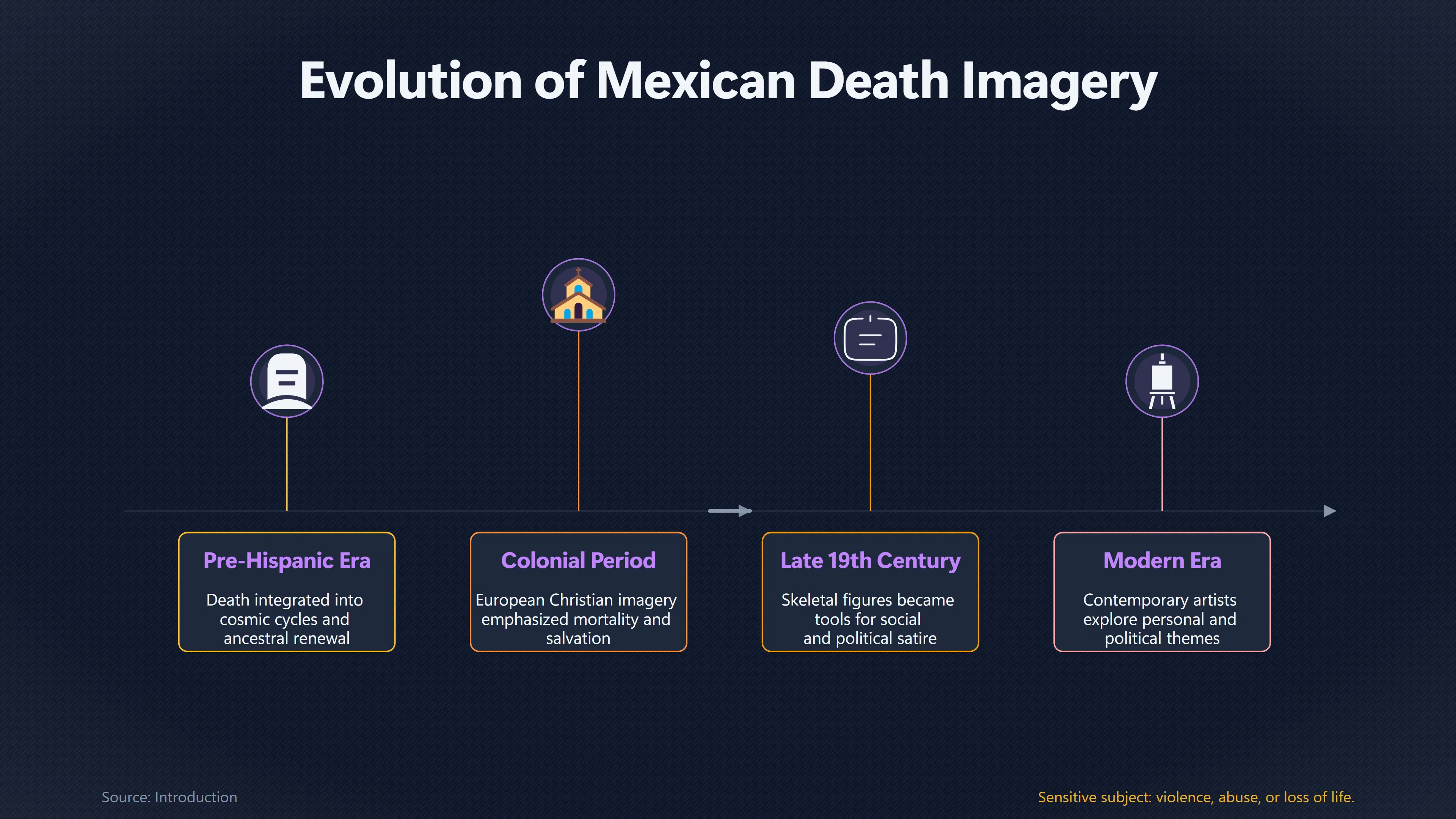
Pre-Hispanic societies incorporated death into broader ideas about cosmic cycles, ancestors and renewal. Colonial religious art then introduced European Christian imagery concerned with mortality, judgement and salvation. Rather than replacing earlier traditions completely, these visual languages gradually overlapped, producing distinctive forms of Mexican funerary art.[Visit Mexico]visitmexico.comVisit Mexico National Museum of DeathVisit Mexico National Museum of Death
By the late nineteenth and early twentieth centuries, skeletal figures had also become powerful tools of satire. The engravings of José Guadalupe Posada, born in Aguascalientes, transformed skeletons into recognisably human characters who mocked politicians, fashionable elites and social pretensions. His famous elegant female skeleton, later known as La Catrina, originally criticised people who attempted to imitate European high society rather than celebrating death itself. Over time, artists including Diego Rivera helped turn the figure into one of the most recognisable symbols associated with Mexican visual culture.[The Library of Congress]loc.govThe Library of Congress Calaveras del montón, número 1The Library of CongressCalaveras del montón, número 1 - digital file from original | Library of CongressJanuary 1, 1910…
Seen in the museum, these prints are presented less as isolated masterpieces than as evidence that death imagery could become journalism, political commentary and popular entertainment simultaneously.
How Context Changes the Meaning of Death
Perhaps the museum’s most valuable lesson is that identical symbols can communicate entirely different ideas.
A sugar skull displayed during family remembrance is not equivalent to a satirical newspaper print. A carved skeleton in folk art serves a different purpose from a colonial religious painting of death, even though both employ skeletal imagery. Likewise, contemporary artists often use skulls to explore violence, identity, migration or environmental concerns rather than traditional ritual.
By arranging collections chronologically and thematically, the museum encourages visitors to ask questions before assuming a meaning:
- Was the object devotional or satirical?
- Was it intended for ritual, public education or artistic expression?
- Does it commemorate specific people, criticise society or reflect religious belief?
- How would its original audience have understood it?[Museo Nacional de la Muerte]museonacionaldelamuerte.uaa.mxOpen source on uaa.mx.
This approach distinguishes the museum from attractions that present skulls simply as exotic decoration or frightening spectacle.
Why the Museum Matters Within Mexico’s Curiosity Culture
Within Mexico’s wider landscape of unusual museums, the National Museum of Death occupies a distinctive position. Unlike collections built around preserved human remains or sensational stories, its subject is representation rather than physical death. The exhibits explore how artists, craftspeople, printers and communities have repeatedly transformed mortality into images that express humour, remembrance, protest, spirituality and national identity.
That makes it an important companion to other unusual Mexican collections. Where museums such as those displaying naturally preserved bodies raise ethical questions about exhibiting the dead, the Museum of Death asks a different question: why people continue to create images of death at all.
Its answer is that Mexican death imagery has never had a single meaning. Across changing historical periods, skulls and skeletons have become visual shorthand for equality before death, criticism of power, remembrance of loved ones, artistic invention and cultural continuity. Understanding that complexity reveals why these familiar images belong as much to art history and social history as they do to the country’s reputation for the macabre.

Amazon book picks
Further Reading
Books and field guides related to Why Mexican Death Imagery Means More Than Horror. Use these as the next step if you want deeper reading beyond the article.
The Labyrinth of Solitude
"One of the major poets of our time here probes and defines Mexican character and culture in a series of essays. Silence, irony, the form...
eBay marketplace picks
Marketplace Samples
Live-tested eBay searches with available results related to this page.
Selected fromMexican skull art oneBay.co.uk.
Endnotes
1.
Source: museonacionaldelamuerte.uaa.mx
Link:https://museonacionaldelamuerte.uaa.mx/
2.
Source: sic.cultura.gob.mx
Link:https://sic.cultura.gob.mx/ficha.php?table=museo&table_id=1169
3.
Source: ags.gob.mx
Link:https://www.ags.gob.mx/turismo/conocemas/museodelamuerte/index.html
4.
Source: visitmexico.com
Title: Visit Mexico National Museum of Death
Link:https://visitmexico.com/en/destino/18411/ennational-museum-of-deathesmuseo-nacional-de-la-muerte
5.
Source: uaa.mx
Title: Celebración de la muerte. Arte, tradición y memoria en el Museo de la UAA
Link:https://www.uaa.mx/portal/noticias/celebracion-de-la-muerte-arte-tradicion-y-memoria-en-el-museo-de-la-uaa/
Source snippet
Arte, tradición y memoria en el Museo de la UAA - UAA | Universidad Autónoma de Aguascalientes | UAA | Universidad Autónoma de Aguascalie...
6.
Source: cultura.gob.mx
Title: Cultura La Muerte en la Historia de México
Link:https://www.cultura.gob.mx/regiones_de_mexico/centro/detalle.php?act=162800
7.
Source: loc.gov
Title: The Library of Congress Calaveras del montón, número 1
Link:https://www.loc.gov/resource/ppmsc.03450/
Source snippet
The Library of CongressCalaveras del montón, número 1 - digital file from original | Library of CongressJanuary 1, 1910...
Published: January 1, 1910
8.
Source: gob.mx
Link:https://www.gob.mx/cultura/prensa/tzompantli-simbolo-de-muerte-arte-y-eternidad?idiom=es-MX
Source snippet
www.gob.mxTZOMPANTLI: SÍMBOLO DE MUERTE, ARTE Y ETERNIDAD | Secretaría de Cultura | Gobierno | gob.mxOctober 30, 2025 — TZOMPANTLI: SÍMBO...
Published: October 30, 2025
9.
Source: en.uaa.mx
Title: mx The National Museum of Death is Renovated
Link:https://en.uaa.mx/portal/gaceta_uaa/el-museo-nacional-de-la-muerte-se-renueva/
10.
Source: inba.gob.mx
Title: José Guadalupe Posada, referente visual del imaginario mexicano | Prensa INBA
Link:https://inba.gob.mx/prensa/17234/jos-eacute-guadalupe-posada-referente-visual-del-imaginario-mexicano
11.
Source: aguascalientes.top
Title: Museo Nacional de la Muerte de Aguascalientes
Link:https://aguascalientes.top/museo-nacional-de-la-muerte-de-aguascalientes/
12.
Source: atlasobscura.com
Title: National Museum of Death in Aguascalientes
Link:https://www.atlasobscura.com/places/national-museum-of-death
13.
Source: en.uaa.mx
Title: mx Commemorating Our Dead
Link:https://en.uaa.mx/portal/gaceta_uaa/cnm2024/
14.
Source: artsandculture.google.com
Title: museo nacional de la muerte
Link:https://artsandculture.google.com/partner/museo-nacional-de-la-muerte
15.
Source: visitmexico.com
Link:https://visitmexico.com/en/destino/2587/museo-nacional-de-la-muerte
16.
Source: visitmexico.com
Link:https://visitmexico.com/es/destino/18411/ennational-museum-of-deathesmuseo-nacional-de-la-muerte
17.
Source: ciudaddeaguascalientes.com
Title: Museo Nacional de la Muerte: un umbral simbólico entre cultura, arte y eternidad
Link:https://ciudaddeaguascalientes.com/museo-nacional-de-la-muerte/
18.
Source: loc.gov
Link:https://www.loc.gov/pictures/item/99615942/
19.
Source: templomayor.inah.gob.mx
Link:https://www.templomayor.inah.gob.mx/salas-del-museo/sala-2-ritual-y-sacrificio
Additional References
20.
Source: youtube.com
Title: Museum in Mexico seeks to show the funny side of death
Link:https://www.youtube.com/watch?v=QrhrPqJQ6aY
Source snippet
History of La Catrina Skull-icon of Día de Muertos & Revolution by Jose Guadalupe Posada...
21.
Source: mfah.org
Link:https://www.mfah.org/press/calaveras-mexicanas-art-and-influence-jose-guadalupe-posada
22.
Source: moma.org
Link:https://www.moma.org/collection/works/69392
23.
Source: moma.org
Link:https://www.moma.org/collection/works/69116
24.
Source: britishmuseum.org
Link:https://www.britishmuseum.org/collection/object/P
25.
Source: youtube.com
Link:https://www.youtube.com/watch?v=dISi0bhGfNw
Source snippet
The Indigenous Festivity dedicated to the Dead...
26.
Source: youtube.com
Link:https://www.youtube.com/watch?v=YN-jTDR2spY
Source snippet
Mexican Day of the Dead...
27.
Source: mfah.org
Link:https://www.mfah.org/art/exhibitions/calaveras-mexicanas-art-and-influence-jose-guadalu
28.
Source: youtube.com
Title: Mexican Day of the Dead
Link:https://www.youtube.com/watch?v=8FHrhH9k-PY
Source snippet
Art Talk 75 | José Guadalupe Posada | 4 Nov 2021...
29.
Source: youtube.com
Title: The Indigenous Festivity dedicated to the Dead
Link:https://www.youtube.com/watch?v=GwXMaxfI4As