Within Antigua Curiosities
What Do Antigua's Archaeological Fragments Reveal?
Thousands of modest finds turn Antigua's national museum into an archaeological cabinet for reconstructing trade, diet, migration and daily life.
On this page
- Inside the national archaeological collection
- How ordinary objects become historical evidence
- What visitors can see and researchers can access
Page outline Jump by section
Introduction
Antigua’s most revealing museum collection is not built around spectacular treasures but around thousands of ordinary archaeological fragments. The Museum of Antigua and Barbuda serves as the country’s principal archaeological repository, preserving ceramics, shell tools, stone implements, tobacco pipes, glass, animal bones, metal objects and countless other excavated finds from across the islands. Individually these objects often appear unremarkable. Together they allow archaeologists to reconstruct trade networks, Indigenous settlement, colonial expansion, foodways, migration and everyday life over many centuries. Rather than functioning as a cabinet of curiosities filled with rare masterpieces, the collection demonstrates how careful accumulation, cataloguing and comparison can transform broken objects into evidence about an entire society.[antiguamuseums.net]antiguamuseums.netResearch ‹ Museum of Antigua and BarbudaResearch ‹ Museum of Antigua and Barbuda
What Do Antigua’s Archaeological Fragments Reveal?
Unlike countries known for monumental ruins or lavish royal collections, Antigua’s archaeological record survives largely in dispersed fragments recovered from settlements, plantations, coastal sites and Indigenous villages. The importance of the national museum lies in bringing these scattered discoveries together under one institution, where they can be studied as connected evidence rather than isolated finds. The museum reports that its archaeological collections contain tens of thousands of artefacts from Antigua’s historical and archaeological sites, supplemented by comparative material from elsewhere in the Caribbean. Its research library adds excavation reports, maps, photographs and unpublished studies that help place the physical objects into historical context.[antiguamuseums.net]antiguamuseums.netResearch ‹ Museum of Antigua and BarbudaResearch ‹ Museum of Antigua and Barbuda
This cumulative approach allows researchers to ask questions that no single artefact could answer. Hundreds of pottery fragments can reveal changing cooking traditions. Imported ceramics indicate commercial links with Europe or neighbouring Caribbean islands. Shell remains and animal bones help reconstruct diet, while stone tools and worked shell illustrate technologies used before European colonisation. Even broken clay tobacco pipes become chronological markers because manufacturing styles changed over time. Together these modest objects build a layered picture of Antigua’s past.
Inside the National Archaeological Collection
The museum’s archaeological holdings cover both the pre-Columbian and historical periods, reflecting the islands’ long sequence of Indigenous occupation, colonial settlement and plantation society. Public displays showcase representative examples, but the majority of the collection is stored for research, conservation and future exhibitions rather than permanent display.[antiguamuseums.net]antiguamuseums.netResearch ‹ Museum of Antigua and BarbudaResearch ‹ Museum of Antigua and Barbuda
Visitors typically encounter:
- Indigenous pottery illustrating local manufacture and cultural traditions.
- Stone and shell tools showing practical technologies before European settlement.
- European ceramics and glass documenting changing trade patterns.
- Clay tobacco pipes that help date colonial deposits.
- Domestic objects recovered from plantations and towns.
- Industrial remains linked to sugar production.
- Geological and environmental specimens that provide context for human settlement.[antiguamuseums.net]antiguamuseums.netMuseum of Antigua and BarbudaMuseum of Antigua and Barbuda
The displays deliberately combine individual objects with explanatory panels, models and reconstructions. The emphasis is not on rarity but on interpretation: why an object matters, where it was found and what it contributes to understanding Antigua’s history.
How Ordinary Objects Become Historical Evidence
Archaeology depends less on spectacular discoveries than on patterns. A single pottery sherd says little by itself, but hundreds recovered from carefully recorded excavations reveal changes in technology, trade and daily behaviour.
Researchers working with Antigua’s collections examine several kinds of evidence simultaneously:
- Distribution: Where objects are found can identify settlements, specialised activity areas or trading centres.
- Material: Imported stone, glass or ceramics reveal overseas connections and commercial exchange.
- Association: Objects discovered together can reconstruct households, workshops or plantation buildings.
- Dating: Manufacturing techniques and decoration help establish when deposits were created.
- Environmental remains: Animal bones, shells and plant remains contribute evidence about diet, farming and changing landscapes.
Because the museum preserves material from numerous excavations rather than only famous sites, it supports broad comparisons across different parts of the island instead of isolated case studies.[antiguamuseums.net]antiguamuseums.netResearch ‹ Museum of Antigua and BarbudaResearch ‹ Museum of Antigua and Barbuda
From Excavation to Research Collection
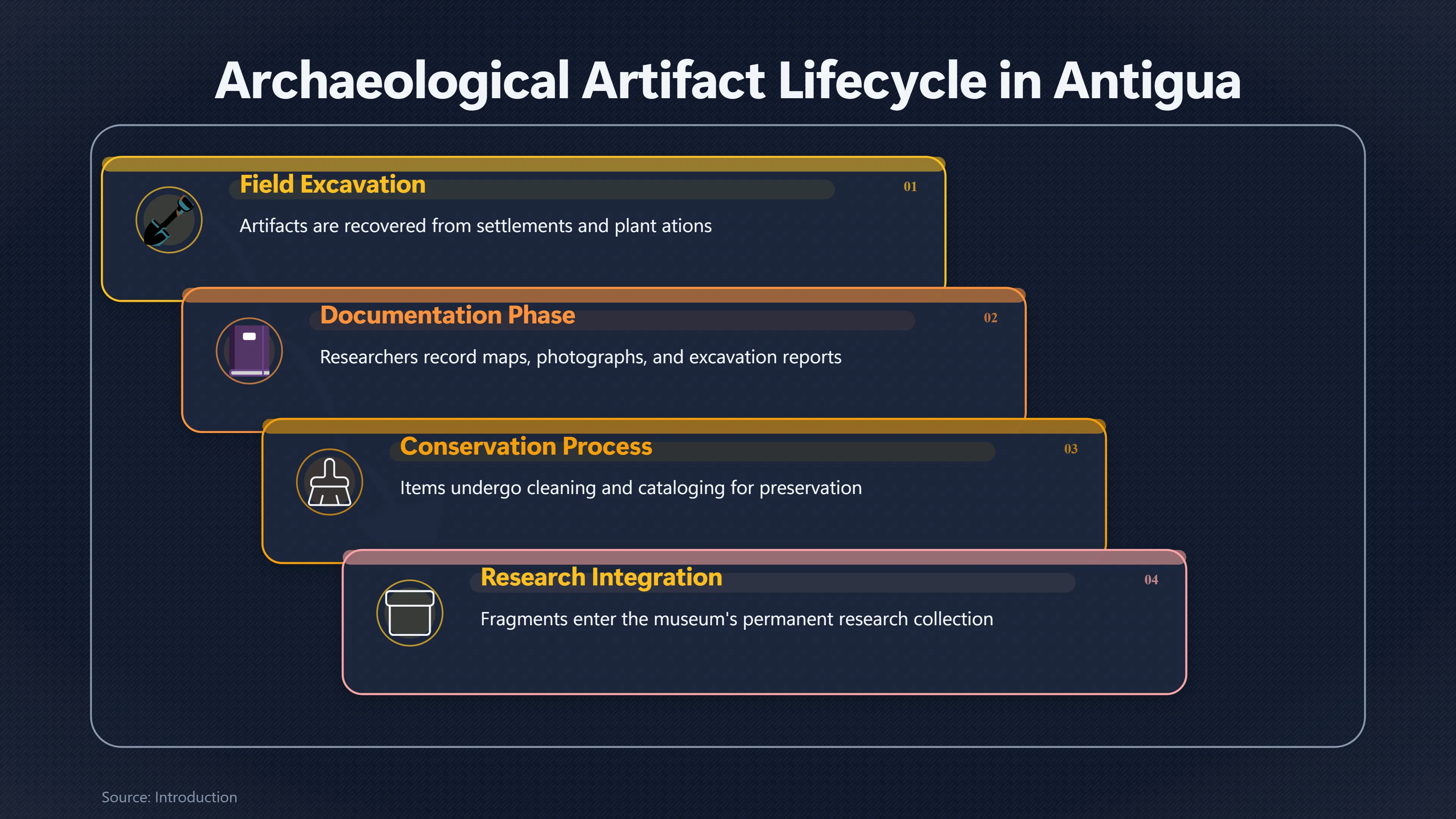
The museum’s archaeological collection is closely connected with Antigua’s wider research infrastructure. The Field Research Centre, established through collaboration between the Historical and Archaeological Society and Antigua’s National Parks, provides facilities for curating excavated collections, supporting archaeological projects and encouraging publication of research. It works with university researchers on excavation, mapping, climate studies and forensic archaeology while helping ensure that newly recovered material is properly documented and preserved.[archaeologyantigua.org]archaeologyantigua.orgField Research CentreField Research Centre
This relationship means that the museum is not simply a display space. It is part of an active system in which artefacts move from excavation, through conservation and cataloguing, into long-term research collections that remain available for future study as new techniques and new historical questions emerge.

What Visitors Can See and What Researchers Can Access
For most visitors, the museum offers a concise introduction to Antigua’s long history through carefully selected objects that illustrate major themes rather than attempting to display every artefact. The galleries explain geology, Indigenous occupation, European colonisation, slavery, plantation agriculture and modern cultural life using representative material from the much larger collections behind the scenes.[antiguamuseums.net]antiguamuseums.netMuseum of Antigua and BarbudaMuseum of Antigua and Barbuda
Researchers have broader access. According to the museum, its public research library includes books, monographs, maps, photographs and historical resources, while staff assist visitors interested in archaeological or historical research. The archaeological collections themselves support specialist study alongside the documentary resources that help interpret them.[antiguamuseums.net]antiguamuseums.netResearch ‹ Museum of Antigua and BarbudaResearch ‹ Museum of Antigua and Barbuda
This combination of public exhibition and research access makes the institution unusual within Antigua and Barbuda’s heritage landscape. It functions simultaneously as a local history museum, archaeological archive and research centre.
Why the Collection Matters
The museum’s archaeological holdings are unusual not because they contain famous relics but because they preserve the physical evidence from which Antigua’s history is continually reconstructed. Coastal erosion, urban development and agricultural change threaten archaeological sites across small Caribbean islands, making curated collections increasingly valuable as permanent records of places that may later be altered or lost.
Within Antigua and Barbuda’s wider landscape of heritage attractions, the archaeological collection occupies a distinctive place. Nearby plantation sites, dockyards and historic buildings provide the landscapes where history unfolded, while the museum preserves the portable evidence recovered from those landscapes. Its thousands of fragments demonstrate that understanding the past often depends less on extraordinary discoveries than on the patient collection of ordinary objects whose combined evidence reveals how generations of people lived, traded, worked and adapted across the islands.[antiguamuseums.net]antiguamuseums.netResearch ‹ Museum of Antigua and BarbudaResearch ‹ Museum of Antigua and Barbuda
Amazon book picks
Further Reading
Books and field guides related to What Do Antigua's Archaeological Fragments Reveal?. Use these as the next step if you want deeper reading beyond the article.
The Caribbean before Columbus
The islands of the Caribbean are remarkably diverse, environmentally and culturally. They range from low limestone islands barely above s...
Archaeology: Theories, Methods and Practice
The most authoritative and up-to-date archaeology textbook, revised and updated, and now in full color.
Island Lives: Historical Archaeologies of the Caribbean
This comprehensive study of the historical archaeology of the Caribbean provides sociopolitical context for the ongoing development of na...
The Oxford Handbook of Caribbean Archaeology
This title provides an overview of archaeological investigations in the insular Caribbean, understood here as the islands whose shores su...
eBay marketplace picks
Marketplace Samples
Example marketplace items related to this page. Use the search link to explore similar finds on eBay.
Selected frommuseum replica artifact oneBay.co.uk.
Endnotes
1.
Source: antiguamuseums.net
Title: Research ‹ Museum of Antigua and Barbuda
Link:https://www.antiguamuseums.net/portfolios/research/
2.
Source: antiguamuseums.net
Title: Museum of Antigua and Barbuda
Link:https://www.antiguamuseums.net/
3.
Source: archaeologyantigua.org
Title: Field Research Centre
Link:https://archaeologyantigua.org/index.php/current-research/field-research-centre
4.
Source: antiguamuseums.net
Title: Staff and Board ‹ Museum of Antigua and Barbuda
Link:https://www.antiguamuseums.net/portfolios/staff/
5.
Source: antiguamuseums.net
Title: about the museum
Link:https://www.antiguamuseums.net/portfolios/about-the-museum/
6.
Source: archaeologyantigua.org
Title: current research
Link:https://archaeologyantigua.org/index.php/current-research/current-research
7.
Source: archaeologyantigua.org
Link:https://www.archaeologyantigua.org/index.php/archaeological-background/historical-period/plantation-archaeology
8.
Source: archaeologyantigua.org
Title: current research
Link:https://archaeologyantigua.org/index.php/current-research
9.
Source: archaeologyantigua.org
Title: historical period
Link:https://www.archaeologyantigua.org/index.php/archaeological-background/historical-period
10.
Source: archaeologyantigua.org
Link:https://www.archaeologyantigua.org/index.php/8-background
11.
Source: archaeologyantigua.org
Title: mill reef
Link:https://www.archaeologyantigua.org/index.php/mill-reef
Additional References
12.
Source: archaeologydataservice.ac.uk
Link:https://archaeologydataservice.ac.uk/archives/view/assemblage/html/6/Cessford_text_web.html
Source snippet
August 14, 2001 — The archaeology of the clay pipe and the study of smoking by Craig Cessford Abstract Studies of clay pipes represent on...
Published: August 14, 2001
13.
Source: londonmuseum.org.uk
Title: Tobacco smoking took off despite its initial high cost and the effort
Link:https://www.londonmuseum.org.uk/blog/mudlarking-clay-tobacco-pipes-thames-foreshore/
Source snippet
Mudlarking clay tobacco pipes on the Thames foreshore | London MuseumMay 21, 2025 — PIPE SMOKING COMES TO BRITAIN Tobacco was introduced...
Published: May 21, 2025
14.
Source: alexandriava.gov
Title: collections at the alexandria archaeology museum
Link:https://www.alexandriava.gov/archaeology/collections-at-the-alexandria-archaeology-museum
Source snippet
City of Alexandria, VAMarch 10, 2025 — COLLECTIONS AT THE ALEXANDRIA ARCHAEOLOGY MUSEUM The Alexandria Archaeology Museum has an extraord...
Published: March 10, 2025
15.
Source: cambridge.org
Title: Jones Show author details * * * Alick R. Jones* Affiliation
Link:https://www.cambridge.org/core/journals/american-antiquity/article/dietary-change-and-human-population-at-indian-creek-antigua/6EAA3F7255E38D1E89641CA1663C6D3E
Source snippet
Dietary Change and Human Population at Indian Creek, Antigua | American Antiquity | Cambridge CoreJanuary 20, 2017 — DIETARY CHANGE AND H...
Published: January 20, 2017
16.
Source: history.ac.uk
Title: We collect reports and journals about medieval
Link:https://www.history.ac.uk/library/collections/archaeology-collections
Source snippet
Archaeology Collections | Institute of Historical ResearchARCHAEOLOGY COLLECTIONS Image: A_hoard_of_Iron_Age_coins_from_Beverly.jpg Find...
17.
Source: youtube.com
Link:https://www.youtube.com/watch?v=BZw3D9guYog
Source snippet
Nelson's Caribbean Hellhole - An 18th Century Navy Graveyard Uncovered (BBC)...
18.
Source: youtube.com
Title: Nelson’s Caribbean Hellhole
Link:https://www.youtube.com/watch?v=k9wGp6padJo
Source snippet
Historic Nelson's Dockyard | UNESCO Heritage Site | Archaeology Tour...
19.
Source: youtube.com
Title: A visit to the Museum of Antigua and Barbuda
Link:https://www.youtube.com/watch?v=4TT6Fj6wTjE
Source snippet
Grace Hayden explores the Museum of Antigua & Barbuda...
20.
Source: youtube.com
Title: Grace Hayden explores the Museum of Antigua & Barbuda
Link:https://www.youtube.com/watch?v=dDAtK_y0U-A
Source snippet
The West Indian Soldier Travelling Exhibition at the National Museum of Antigua and Barbuda...
21.
Source: britishmuseum.org
Link:https://www.britishmuseum.org/our-work/departments/africa-oceania-and-americas/americas