Where Greece Keeps Its Strangest Stories
Greece does not have a single, nationally famous museum of witchcraft, cryptids or paranormal investigation.
Page outline Jump by section
Introduction
The best unusual collections in Greece therefore require careful distinctions. Some are conventional public attractions; others are university teaching collections with restricted access. Some interpret documented history, while others use theatrical reconstruction, devotional tradition or local memory. Together they reveal a country where the extraordinary is usually embedded in archaeology, religion, medicine and political history rather than packaged as a separate “weird museum” category.
Where Greece’s strangest collections are found
Greek curiosity culture is shaped by the country’s unusually dense historical landscape. Ancient objects, sacred remains, military ruins and regional customs are commonly preserved within archaeological museums, monasteries, universities and local historical societies. This means that many of the most memorable oddities appear inside institutions whose official purpose sounds entirely conventional.
A visitor looking specifically for monsters, magic or supernatural lore may initially find less than in countries with dedicated witchcraft or paranormal museums. Greece’s folklore is certainly rich in protective charms, dangerous spirits and legendary creatures, but museums generally interpret these through archaeology, religious art or everyday custom. Protective images such as glaring faces and eye motifs, for example, were widely used in the ancient Mediterranean to repel harmful forces; scholarship treats them as part of accepted religious and protective practice rather than evidence of a secret cult.[Athens Journals]athensjournals.grAthens JournalsThe Gorgoneion and the Evil Eye: Cultural Importance and…October 16, 2025 — by GRA Lopez — The use of apotropaic iconog…
The result is a network of very different collection types:
- Public commercial museums, including reconstructed machines and immersive wax displays.
- Academic collections, where human remains and forensic evidence serve teaching and research.
- Museums inside historic places, such as execution sites, tunnels and former detention cells.
- Preserved institutions of confinement, including Spinalonga’s former leprosy settlement.
- Folklore and devotional collections, where protective customs, relics and ritual objects remain connected to living communities.
This mixture matters because the label “museum” does not guarantee the same kind of experience. A polished ticketed attraction may use replicas, while a difficult-to-access university room may contain genuine human material. A religious treasury may preserve objects considered sacred rather than merely historical. A military tunnel may be part exhibition, part surviving battlefield infrastructure.
Crime, anatomy and uncomfortable evidence
The Criminology Museum of the National and Kapodistrian University of Athens is probably the closest Greece comes to a classic medical-oddities or crime museum. It belongs to the university’s medical school and preserves roughly 1,500 objects connected with forensic science and the history of crime in Greece. Its principal groups include forensic material, human remains and objects associated with criminal cases.[NKUA]en.uoa.grcriminology museumNKUACriminology MuseumThe Museum houses 1500 exhibited objects of significant historic value related to the history and practice of foren…
The collection grew from the work of forensic specialists and from material supplied by institutions including the police and military. Its significance is not simply that some exhibits are disturbing. It records how bodies, weapons, poisons and physical traces were turned into scientific evidence during the development of modern Greek forensic medicine. The museum’s specimens reportedly concentrate particularly on cases from the nineteenth and early twentieth centuries, making it both a crime archive and a record of changing medical practice.[Academia]academia.eduAcademia(PDF) The Criminology Museum at University of AthensThe Criminology Museum showcases 1,500 significant historical forensic object…
Visitors should not treat it as an ordinary walk-in attraction. Its primary audience is academic, and access has historically been limited or arranged rather than maintained as regular public admission. That distinction is important: travel articles sometimes present it as Athens’s “creepiest museum”, but its curatorial purpose is professional education, not horror entertainment.[travel.gr]travel.gr8 Lesser-Known Yet Fascinating Museums in GreeceNovember 9, 2021 — 9 Nov 2021 — By far the creepiest museum institution in Greece, the Criminology Museum of the Kapodistrian University…
Athens University also maintains older anatomical and natural-history collections. University records trace the Anatomy Museum to 1877 and note historic anatomical teaching material, while its zoological holdings include specimens collected from the early nineteenth century onwards. Some animals represent species no longer found in the areas where they were collected, including a lynx from Mount Parnitha and a lammergeier from Mount Parnassus.[Synergasia]synergasia.uoa.grSELF PORTRAIT english 2025 ONLINE (1SELF PORTRAIT english 2025 ONLINE (1 These collections have genuine cabinet-of-curiosity appeal, but they belong to an academic heritage system whose public availability can vary. Prospective visitors should confirm access directly rather than assuming normal museum hours.
Ancient machines that appear impossibly modern
The Kotsanas Museum of Ancient Greek Technology offers a less macabre but equally unusual experience. Instead of presenting rows of excavated fragments, it builds functioning models of machines described in ancient texts. Its wider collection encompasses hundreds of reconstructions, with public branches in Athens, Ancient Olympia, Katakolo and Heraklion.[Kotsanas Museum]kotsanas.comKotsanas MuseumKotsanas Museum: Ancient Greek Technology MuseumDISCOVER ANCIENT GREEK TECHNOLOGY THROUGH OVER 500 WORKING INVENTIONS, INC…
Visitors encounter devices that can feel startlingly modern: automatic theatres, alarm systems, lifting machinery, water clocks, mechanical servants and other early forms of automation. The displays also explain the Antikythera Mechanism, the complex geared astronomical calculator recovered from a shipwreck and now preserved in the National Archaeological Museum. The original object is an archaeological artefact; the working versions at Kotsanas are reconstructions designed to demonstrate principles that corroded remains alone cannot easily communicate.
That difference between original and replica is central to assessing the museum. Its displays are not a newly uncovered cache of complete ancient robots. They are interpretive machines constructed from surviving descriptions, diagrams, archaeological evidence and engineering research. The museum describes more than 500 operating models across its collection, while the Athens branch presents over 100 reconstructions.[collection.kotsanasmuseum.com]collection.kotsanasmuseum.comOpen source on kotsanasmuseum.com.
The approach is theatrical, hands-on and visitor-friendly, but it is not inherently pseudo-archaeological. Ancient Greek and Hellenistic engineers genuinely developed sophisticated automata, hydraulic systems and mechanical devices. The danger comes when such achievements are exaggerated into claims of lost super-civilisations or technologies beyond historical explanation. A responsible visit separates the remarkable evidence for ancient engineering from modern “ancient mystery” marketing.
For travellers interested in mystery objects, the ideal pairing is the Kotsanas Museum with the National Archaeological Museum, where the surviving Antikythera fragments can be seen in their archaeological setting. The national museum holds more than 11,000 exhibits across its collections, so the mechanism forms part of a far broader account of ancient material culture rather than standing alone as an unexplained marvel.[Namuseum]namuseum.grOpen source on namuseum.gr.
Wax deaths, assassinations and theatrical history
Near Ioannina, the Pavlos Vrellis Museum of Greek History uses life-sized wax figures and purpose-built interiors to turn national history into an immersive sequence of scenes. It is privately operated and was created by sculptor Pavlos Vrellis, who designed not only the figures but also the fortress-like building and atmospheric settings.[Vrellis Museum]vrellis.grMuseum Information | Paul Vrellis MuseumMuseum Information | Paul Vrellis Museum
The museum is unusual because it sits somewhere between history museum, waxwork theatre and personal artistic project. Its tableaux include episodes from the years before the Greek War of Independence, the revolution itself and the Second World War. Among its darker scenes are torture, executions and the violent death of Ali Pasha. The figures are not relics from the events they depict; they are sculpted interpretations intended to place visitors emotionally inside a national historical narrative.
This makes the Vrellis Museum vivid but not neutral. Wax museums compress uncertain or complicated events into frozen dramatic moments. Costume, lighting and facial expression can make one interpretation appear definitive even when historians debate motives, identities or details. The museum is best understood as a major work of historical popularisation by an individual artist rather than as an archaeological collection.
A complementary and more site-specific account of Ali Pasha appears on the island in Lake Ioannina. The Ali Pasha and Revolutionary Period Museum occupies the monastery complex where he was killed in 1822. Its collection includes weapons, jewellery, ceramics, domestic objects, ethnographic displays and a representation of the drowning of Kyra Frosini, whose execution has become one of the region’s most enduring stories of power, injustice and romanticised memory.[Μουσείο Αλη Πασά]museumalipasha.grΜουσείο Αλη ΠασάMuseum Ali PashaΜουσείο Αλη ΠασάMuseum Ali Pasha
The location gives this museum a strong sense of authenticity, but visitors should still distinguish between the documented assassination site, genuine period objects, later representations and stories reshaped through literature and local legend. In Ioannina, history is not merely displayed; it has been repeatedly dramatised, moralised and turned into regional identity.
Tunnels, cells and landscapes of confinement
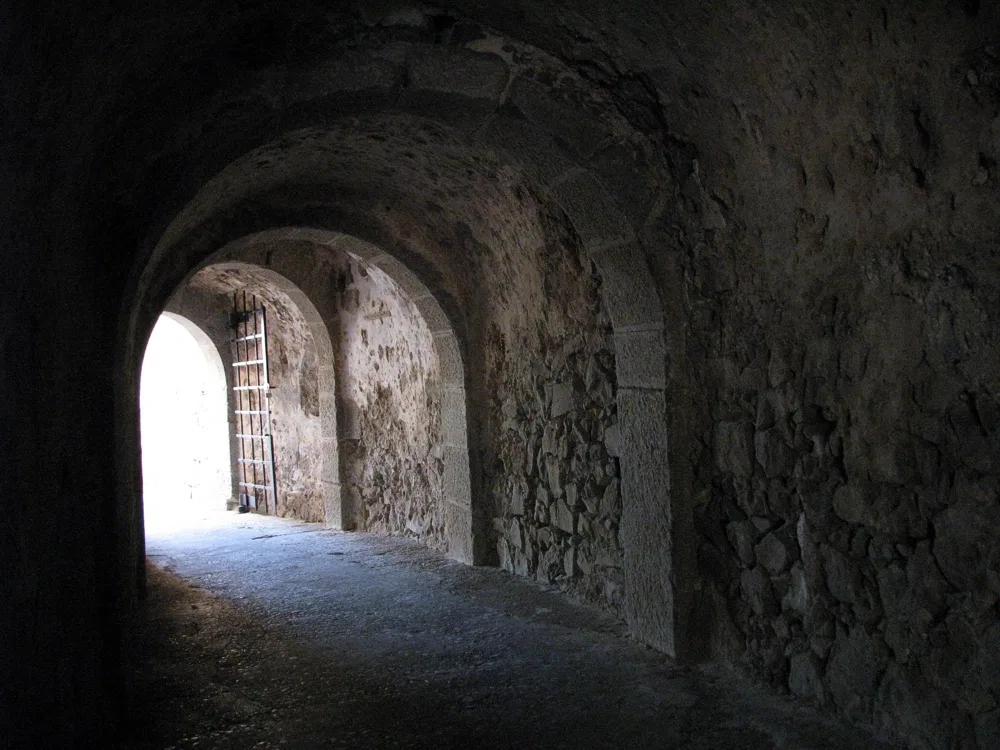
Some of Greece’s most unsettling “collections” are inseparable from the buildings that contain them. Their force comes less from rare objects than from standing where imprisonment, bombardment or enforced isolation occurred.
The Leros war tunnel
On Leros, the War Museum at Merikia occupies a restored military tunnel constructed during the Italian occupation of the Dodecanese. The island became an important naval and air base, and its extensive military infrastructure was drawn into the Battle of Leros in 1943. The tunnel museum combines surviving underground space with weapons, uniforms, photographs, vehicles and battlefield remains. Greece’s official tourism site describes it as a renovated former military tunnel and notes that it shows a documentary about the battle.[Visit Greece]visitgreece.grOpen source on visitgreece.gr.
This is not a polished bunker attraction built to imitate wartime conditions. The tunnel itself belongs to the island’s militarised landscape. That gives scattered shell casings, machinery and salvaged equipment a stronger context than they would have in a conventional display hall. At the same time, private and local war collections can vary in documentation. Labels may explain what an object is without fully establishing where it was recovered or how securely it can be tied to a particular incident.
Leros is especially revealing because the museum is only one part of a much larger landscape of Italian architecture, gun positions, tunnels and wartime remains. The municipality identifies the Merikia tunnel among the island’s principal cultural facilities, while local accounts describe the surviving network as a defining feature of Leros’s twentieth-century heritage.[Leros]leros.grOpen source on leros.gr.
The cells beneath Korai Street
In central Athens, the Korai 4 Memorial Site preserves basement detention areas used during the German occupation. The walls retain inscriptions and drawings made by prisoners. Here the “collection” is the fabric of the cells themselves: scratched names, dates, messages and images left by people held before transfer, forced labour or execution.
The site requires more restraint than an ordinary prison museum. Graffiti is direct historical evidence, but individual marks may be difficult to date or attribute precisely. The known institutional history provides the framework; it does not automatically explain every inscription. Greek authorities announced in 2023 that responsibility for the site would pass to the Ministry of Culture and the Municipality of Athens, underlining its status as a formal place of historical memory rather than an abandoned curiosity.[Ministry of Culture]culture.gov.grOpen source on culture.gov.gr.
Korai 4 is valuable because it resists the clean visual order of a conventional gallery. The surviving cells expose how occupation history was written by detainees in hurried, fragmentary form. Their marks are both evidence and acts of self-preservation.

Spinalonga beyond the ghost-island story
Spinalonga, off Crete, is often marketed as a “ghost island” or abandoned leper colony. That description is memorable but incomplete. The fortified islet has Venetian, Ottoman and modern phases, and its best-known twentieth-century role began when the Cretan State established a public leprosy settlement in 1903. People with Hansen’s disease were sent there from Crete and later from elsewhere in Greece.[Hellenic Heritage]hh.grHellenic Heritage Spinalonga: A tiny islet with a storied pastHellenic Heritage Spinalonga: A tiny islet with a storied past
What survives is a whole institutional landscape: streets, houses, service buildings, fortifications and structures associated with the confined community. It is therefore more than a museum and more than a picturesque ruin. Its principal “collection” is the built environment through which residents tried to create social life under compulsory segregation.
Modern interpretation needs to avoid two distortions. The first is horror tourism, which reduces residents to faceless sufferers in an eerie abandoned setting. The second is romanticisation, which turns forced isolation into a reassuring story of communal resilience. Both belonging and coercion were present. The site matters because it exposes how disease, fear, public health and citizenship were negotiated before effective treatment transformed the outlook for Hansen’s disease.
Spinalonga is now an organised archaeological attraction reached by boat, with official visitor information and ticketing.[ΥΠΠΟΑ - Εφορεία Αρχαιοτήτων Λασιθίου]spinalonga-island.grOpen source on spinalonga-island.gr. Its public accessibility makes it one of Greece’s most significant unusual heritage sites, but visitors should approach it as the former home of a marginalised community rather than as a supernatural ruin.
Folklore, protective objects and sacred remains
Greece’s uncanny traditions are rarely gathered into a single museum devoted to magic. Instead, fragments survive across archaeological cases, folklore rooms, church treasuries, household displays and living religious practice.
The protective eye is a useful example. Modern souvenir stalls may sell blue eye charms as decorative shorthand for Greece, but the underlying belief belongs to a far older and geographically wider Mediterranean tradition. Ancient protective images—including glaring eyes, frightening faces and representations of the Gorgon—were intended to repel dangerous attention or malignant influence. Their meanings changed across time and context, so it is misleading to label every example “witchcraft”.[Athens Journals]athensjournals.grAthens JournalsThe Gorgoneion and the Evil Eye: Cultural Importance and…October 16, 2025 — by GRA Lopez — The use of apotropaic iconog…
Regional folklore museums can preserve the domestic setting in which such beliefs made sense, although most concentrate on tools, costume, craft and agricultural life. The value of these collections lies in showing that supernatural protection was not necessarily a separate, secret activity. It could coexist with bread-making, weaving, animal husbandry, family religion and the organisation of the home.
The limitations are equally important. Many small folklore museums were formed from local donations, and the documentation of individual objects may be modest. An iron object, charm, embroidered sign or ritual vessel may have several possible uses. Later collectors can also assign magical meanings that the original owners never recorded. Good interpretation should distinguish a demonstrable ritual function from a plausible local association.
Orthodox monasteries and churches add another category: collections of relics, reliquaries, icons and votive offerings. These can look like cabinets of extraordinary objects to a secular visitor, but they remain part of devotional life. Bones or fragments associated with saints are not displayed as medical specimens; believers may understand them as sacred presences capable of intercession. Silver body parts and other votive forms commemorate prayers, illness or gratitude rather than functioning as anatomical curiosities.
Such displays require a different visitor etiquette from commercial oddity museums. Photography may be restricted, worshippers may be using the same space, and the institution’s account of an object’s identity may rest on ecclesiastical tradition rather than modern archaeological provenance. That does not make the collection fraudulent, but it means “authenticity” is being claimed within a religious framework as well as a historical one.
How credible are Greece’s unusual museums?
The strongest Greek collections are generally credible when judged according to their actual purpose. Problems arise when visitors apply the wrong test or accept tourist language too literally.
Original sites and material evidence: Korai 4, the Leros tunnel and Spinalonga preserve authentic environments. Their buildings are primary evidence, although individual stories attached to particular rooms or marks may remain uncertain.
Academic collections: The Criminology Museum and university anatomy or zoology holdings have strong institutional provenance. Their displays may be old-fashioned or access-limited, but they were assembled for teaching and research rather than paranormal entertainment.
Reconstructions: Kotsanas presents modern working models, not a room of intact ancient machinery. Its value lies in making technical ideas visible. Claims should be checked against ancient sources and archaeological scholarship, especially when publicity uses phrases such as “first robot” or “first computer”.
Artistic interpretation: The Vrellis wax museum openly depends on sculpted scenes. It can be historically informative while still expressing a dramatic, patriotic and highly personal vision.
Private and regional collections: These often preserve material that national institutions would overlook, but object histories may be incomplete. A striking weapon or domestic relic is not automatically connected to the famous person named on its label unless provenance supports the claim.
Devotional collections: Reliquaries and votive objects operate within religious tradition. Historical analysis can examine their materials, inscriptions and recorded movement, but it cannot treat faith claims as though they were laboratory findings.
The most useful question is therefore not simply “Is it real?” It is “What kind of evidence is being presented?” A genuine building can contain a speculative reconstruction. A replica can accurately demonstrate a documented mechanism. A sacred object can be culturally authentic even when its physical attribution cannot be independently verified.
Planning an unusual museum route
Athens offers the greatest concentration, beginning with the Kotsanas Museum and the original Antikythera Mechanism at the National Archaeological Museum. Korai 4 adds occupation history, while university collections may be possible only through prior enquiry. The Criminology Museum should never be treated as guaranteed walk-in sightseeing.
Ioannina and its surroundings form the strongest route for theatrical and violent historical memory. The Vrellis Museum presents immersive wax scenes, while the Ali Pasha Museum connects objects and representations to the actual location of his death.
Leros suits visitors interested in bunkers, battlefield archaeology and privately preserved military material. The Merikia tunnel is the main formal museum, but the wider island landscape supplies much of its meaning.
Spinalonga is the clearest choice for medical and institutional history, provided it is approached as a former community under segregation rather than as a “haunted island”. Boat services and site arrangements are seasonal, and official information should be checked before travel.
Across Greece, smaller museums and religious collections frequently have limited hours, seasonal opening or locally arranged admission. Even apparently current listings can be unreliable outside major cities. A telephone call or confirmation through the institution, municipality or Ministry of Culture platform is more dependable than assuming that map listings reflect actual access.
Why Greece’s curiosity culture matters
Greece’s unusual collections challenge the idea that strange museums must be devoted to obvious novelties. The country’s most powerful oddities are often embedded in respectable institutions: a corroded calculator among classical sculpture, crime specimens inside a medical faculty, prisoner graffiti beneath an office building or sacred remains within a working monastery.
They also show how different authorities preserve the past. Archaeologists classify objects by date and context. Doctors retain specimens as evidence of bodies and injuries. Religious communities maintain relics through inherited belief. Local collectors rescue weapons, household goods and memories that may otherwise disappear. Artists such as Pavlos Vrellis rebuild history as emotional theatre.
For the curious traveller, this produces a richer landscape than a simple list of “weird museums”. Greece’s strangest collections are about the boundaries between artefact and reconstruction, evidence and legend, memorial and attraction, sacred body and scientific specimen. The unusual object matters, but so does the institution that decided what it meant—and why it should be kept.
Amazon book picks
Further Reading
Books and field guides related to Where Greece Keeps Its Strangest Stories. Use these as the next step if you want deeper reading beyond the article.
The Greek Myths
Endymion, Pelops, Daedalus, Pygmalion – what are the stories behind these and the hundreds of other familiar names from Greek mythology –...

The Birth of the Museum: History, Theory, Politics
In a series of richly detailed case studies from Britian, Australia and North America, Tony Bennett investigates how nineteenth- and twen...
Using Japanese
This book, first published in 2000, is a guide to Japanese usage for students who have already acquired the basics of the language and wi...
eBay marketplace picks
Marketplace Samples
Live-tested eBay searches with available results related to this page.
Selected fromGreek mythology poster oneBay.co.uk.
Endnotes
1.
Source: en.uoa.gr
Title: criminology museum
Link:https://en.uoa.gr/about_us/museums/criminology_museum
Source snippet
NKUACriminology MuseumThe Museum houses 1500 exhibited objects of significant historic value related to the history and practice of foren...
2.
Source: academia.edu
Link:https://www.academia.edu/36712454/The_Criminology_Museum_at_University_of_Athens
Source snippet
Academia(PDF) The Criminology Museum at University of AthensThe Criminology Museum showcases 1,500 significant historical forensic object...
3.
Source: travel.gr
Title: 8 Lesser-Known Yet Fascinating Museums in Greece
Link:https://www.travel.gr/en/experiences-ee/8-less-known-museums-in-greece-fascinate-with-their-exhibits/
Source snippet
November 9, 2021 — 9 Nov 2021 — By far the creepiest museum institution in Greece, the Criminology Museum of the Kapodistrian University...
Published: November 9, 2021
4.
Source: kotsanas.com
Link:https://kotsanas.com/
Source snippet
Kotsanas MuseumKotsanas Museum: Ancient Greek Technology MuseumDISCOVER ANCIENT GREEK TECHNOLOGY THROUGH OVER 500 WORKING INVENTIONS, INC...
5.
Source: kotsanas.com
Link:https://kotsanas.com/athens/
6.
Source: collection.kotsanasmuseum.com
Link:https://collection.kotsanasmuseum.com/en/
7.
Source: namuseum.gr
Link:https://www.namuseum.gr/en/collections/
8.
Source: vrellis.gr
Title: Museum Information | Paul Vrellis Museum
Link:https://www.vrellis.gr/en/information/
9.
Source: vrellis.gr
Title: Museum Home | Paul Vrellis Museum
Link:https://www.vrellis.gr/en/home/
10.
Source: leros.gr
Link:https://www.leros.gr/en/leros-official-tourist-information-leros-municipality/leros-sightseeings-museums-official.html
11.
Source: leros.gr
Title: INFRASTRUCTURES OF LEROS
Link:https://www.leros.gr/en/leros-municipality/infrastructures-of-leros.html
12.
Source: travel.gr
Title: Archaeological Sites and Museums of Lasithi | travel.gr
Link:https://www.travel.gr/en/arts-and-culture-en/archaeological-sites-and-museums-of-lasithi/
13.
Source: vrellis.gr
Title: Contact | Paul Vrellis Museum
Link:https://www.vrellis.gr/en/contact/
14.
Source: vrellis.gr
Title: Πληροφορίες | Paul Vrellis Museum
Link:https://www.vrellis.gr/f-a-q/
15.
Source: vrellis.gr
Title: Επικοινωνία | Paul Vrellis Museum
Link:https://www.vrellis.gr/epikoinonia/
16.
Source: vrellis.gr
Title: Paul Vrellis Museum
Link:https://www.vrellis.gr/
17.
Source: kotsanas.com
Link:https://kotsanas.com/exhibits/
18.
Source: kotsanas.com
Link:https://kotsanas.com/exhibition/ancient-greece-the-origins-of-technology/
19.
Source: leros.gr
Title: Passing through Villages
Link:https://www.leros.gr/en/69-slider-2/198-passing-through-the-villages-of-leros.html
20.
Source: namuseum.gr
Link:https://www.namuseum.gr/en/
21.
Source: namuseum.gr
Link:https://www.namuseum.gr/en/episkepsi/
22.
Source: athensjournals.gr
Link:https://www.athensjournals.gr/mediterranean/2025-6750-AJMS-HIS-Lopez-02.pdf
Source snippet
Athens JournalsThe Gorgoneion and the Evil Eye: Cultural Importance and...October 16, 2025 — by GRA Lopez — The use of apotropaic iconog...
Published: October 16, 2025
23.
Source: synergasia.uoa.gr
Title: SELF PORTRAIT english 2025 ONLINE (1)
Link:https://synergasia.uoa.gr/modules/document/file.php/NOC123/SELF_PORTRAIT_english_2025_ONLINE%20%281%29.pdf
24.
Source: uoa.gr
Link:https://www.uoa.gr/fileadmin/user_upload/PDF-files/anakoinwseis/ekdoseis/2205_universeum-teliko-screen.pdf
Source snippet
They in- clude specimens from the beginning of the 19th century...
25.
Source: museumalipasha.gr
Title: Μουσείο Αλη ΠασάMuseum Ali Pasha
Link:https://museumalipasha.gr/en/museum-ali-pasha/
26.
Source: visitgreece.gr
Link:https://www.visitgreece.gr/islands/dodecanese/leros/
27.
Source: culture.gov.gr
Link:https://www.culture.gov.gr/el/Information/SitePages/view.aspx?nID=4806
28.
Source: hh.gr
Title: Hellenic Heritage Spinalonga: A tiny islet with a storied past
Link:https://www.hh.gr/en/destinations/spinalonga/
29.
Source: spinalonga-island.gr
Link:https://spinalonga-island.gr/?lang=en
30.
Source: spinalonga-island.gr
Link:https://spinalonga-island.gr/
31.
Source: hh.gr
Title: Announcement for Spinalonga
Link:https://www.hh.gr/en/announcements/announcement-for-22-1-2026-7/
32.
Source: digitalculture.gov.gr
Link:https://digitalculture.gov.gr/2023/12/o-choros-istorikis-mnimis-korai-4-pernai-sta-cheria-tou-ipourgiou-politismou-ke-tou-dimou-athineon/?amp=1
33.
Source: digitalculture.gov.gr
Title: Κοραή 4 Archives | H πλατφόρμα πολιτισμού του gov.gr beta
Link:https://digitalculture.gov.gr/tag/korai-4/
34.
Source: estories.uoa.gr
Title: gr Timeline | e Stories.uoa.gr The University Museums of Mineralogy
Link:https://estories.uoa.gr/en/timeline
35.
Source: synergasia.uoa.gr
Link:https://synergasia.uoa.gr/modules/document/file.php/NOC125/SELF_PORTRAIT_english_2021.pdf
36.
Source: synergasia.uoa.gr
Title: self portrait 2022 eng
Link:https://synergasia.uoa.gr/modules/document/file.php/NOC123/self_portrait_2022_eng.pdf
37.
Source: pergamos.lib.uoa.gr
Title: gr Subjects
Link:https://pergamos.lib.uoa.gr/en/browse/subjects
38.
Source: www-en.lib.uoa.gr
Title: gr New items
Link:https://www-en.lib.uoa.gr/fileadmin/user_upload/New_items_Libraries__Oct.-Dec.2022__eng.pdf
39.
Source: users.uoa.gr
Title: EAVP 9 abstracts
Link:https://users.uoa.gr/~glyras/eavp/EAVP-9-abstracts.pdf
40.
Source: pergamos.lib.uoa.gr
Link:https://pergamos.lib.uoa.gr/uoa/dl/object/2947808/file.pdf
41.
Source: users.uoa.gr
Title: 11 2004 Praktika Bolos
Link:https://users.uoa.gr/~pmegalo/papers.pdf/5.%20Synedria/2.%20ELLHNIKA/11_2004_Praktika_Bolos.pdf
42.
Source: facebook.com
Link:https://www.facebook.com/KotsanasMuseumOfAncientGreekTechnology/photos/
43.
Source: hh.gr
Title: Hellenic Heritage
Link:https://www.hh.gr/en/
44.
Source: tripadvisor.com
Title: Pavlos Vrellis Museum of Greek History
Link:https://www.tripadvisor.com/Attraction_Review-g10450519-d3885460-Reviews-Pavlos_Vrellis_Museum_of_Greek_History-Bizani_Ioannina_Region_Epirus.html
45.
Source: tripadvisor.com
Title: Ali Pasha Museum
Link:https://www.tripadvisor.com/Attraction_Review-g189453-d11978017-Reviews-Ali_Pasha_Museum-Ioannina_Ioannina_Region_Epirus.html
46.
Source: Wikipedia
Link:https://en.wikipedia.org/wiki/Greece
47.
Source: atlasobscura.com
Title: korai 4
Link:https://www.atlasobscura.com/places/korai-4
48.
Source: lerosisland.com
Link:https://www.lerosisland.com/war-museum-of-leros.html
49.
Source: allovergreece.com
Link:https://www.allovergreece.com/Museum/Descr/1/en
51.
Source: wondergreece.gr
Title: War Museum
Link:https://www.wondergreece.gr/v1/en/Regions/Leros/Culture/Museums/14390-War_Museum_Merikia_Tunnel
52.
Source: culture.gov.gr
Link:https://www.culture.gov.gr/en/ministry/SitePages/viewyphresia.aspx?iID=1709
53.
Source: archaeologicalmuseums.culture.gov.gr
Link:https://archaeologicalmuseums.culture.gov.gr/en
54.
Source: spinalonga-island.gr
Link:https://spinalonga-island.gr/monuments/spinalonga/?lang=en
55.
Source: spinalonga-island.gr
Title: Tickets & Accessibility
Link:https://spinalonga-island.gr/infos/?lang=en
56.
Source: culturious.net
Link:https://www.culturious.net/en/museums/144
57.
Source: kupi.com
Link:https://www.kupi.com/en/explore/greece/leros/leros-war-museum
58.
Source: kids.nationalgeographic.com
Link:https://kids.nationalgeographic.com/geography/countries/article/greece
59.
Source: lerosinfo.com
Title: War Museum Tunnel
Link:https://www.lerosinfo.com/index.php/en/places-to-go/museums/war-museum-tunnel
60.
Source: lerosisland.gr
Title: War Museum
Link:https://lerosisland.gr/en/listings/polemiko-mouseio/
61.
Source: adrion5senses.eu
Title: Ali Pasha Museum
Link:https://adrion5senses.eu/listing-preview/ali-pasha-museum/
62.
Source: GOV.UK
Link:https://www.gov.uk/foreign-travel-advice/greece
63.
Source: globaledge.msu.edu
Link:https://globaledge.msu.edu/countries/greece
Additional References
64.
Source: youtube.com
Title: The Island of Tears: Spinalonga Leprosy Colony
Link:http://www.youtube.com/watch?v=u0ftJ9TpiUc
Source snippet
"Pavlos Vrellis" wax museum Ioannina ΓΙΑΝΝΕΝΑ-ΜΟΥΣΕΙΟ ''ΠΑΥΛΟΥ ΒΡΕΛΛΗ''-ΕΡΤ 2-1983-(1ο) Sotiris Gorgogetas...
65.
Source: youtube.com
Title: Day trip to Spinalonga: Greece’s Mysterious Leper Island
Link:http://www.youtube.com/watch?v=dp5wULEa1jI
Source snippet
The Island of Tears: Spinalonga Leprosy Colony...
66.
Source: atlasobscura.com
Link:https://www.atlasobscura.com/things-to-do/greece/museums
67.
Source: psahno.com
Link:https://psahno.com/en/places/muzei-ali-pasi
68.
Source: culturious.net
Link:https://www.culturious.net/en/museums/14
69.
Source: krikonis-hotel.gr
Link:https://www.krikonis-hotel.gr/en/sights/ali-pasa-museum
70.
Source: allovergreece.com
Link:https://www.allovergreece.com/Museum/Descr/162/en
71.
Source: facebook.com
Link:https://www.facebook.com/groups/physicsisfun109/posts/507124411966408/
72.
Source: instagram.com
Link:https://www.instagram.com/p/Daf-9oYFmow/
73.
Source: tripadvisor.com
Link:https://www.tripadvisor.com/Attraction_Review-g189417-d28478989-Reviews-Museum_Of_Ancient_Greek_Technology_by_Kotsanas-Heraklion_Crete.html