Within Strange Estonia
Why Estonia Has No Witchcraft Museum
Estonia's ghosts, revenants and magical objects survive mainly in archives and ethnographic collections rather than a single occult museum.
On this page
- What the Folklore Archives preserve
- Revenants, forest beings and supernatural testimony
- How museums interpret magical objects
Page outline Jump by section
Introduction
Estonia has no dedicated national museum of witchcraft or occult artefacts. Instead, its supernatural heritage is preserved through one of Europe’s richest folklore archives and through carefully interpreted ethnographic collections. Rather than displaying supposedly enchanted relics as proof of magic, Estonian institutions document how ordinary people believed, feared and used magical objects in everyday life. This evidence-based approach makes Estonia unusual: the country’s “magical collection” is spread across archives, museums and research collections rather than concentrated in a single attraction. The result is a far deeper record of lived belief, preserving thousands of eyewitness accounts, charms, healing practices and ritual traditions alongside the objects associated with them.[Eesti Kirjandusmuuseum]kirmus.eeEesti Kirjandusmuuseum Estonian Folklore Archives | Eesti KirjandusmuuseumEesti Kirjandusmuuseum Estonian Folklore Archives | Eesti Kirjandusmuuseum
Why Estonia Has No Witchcraft Museum
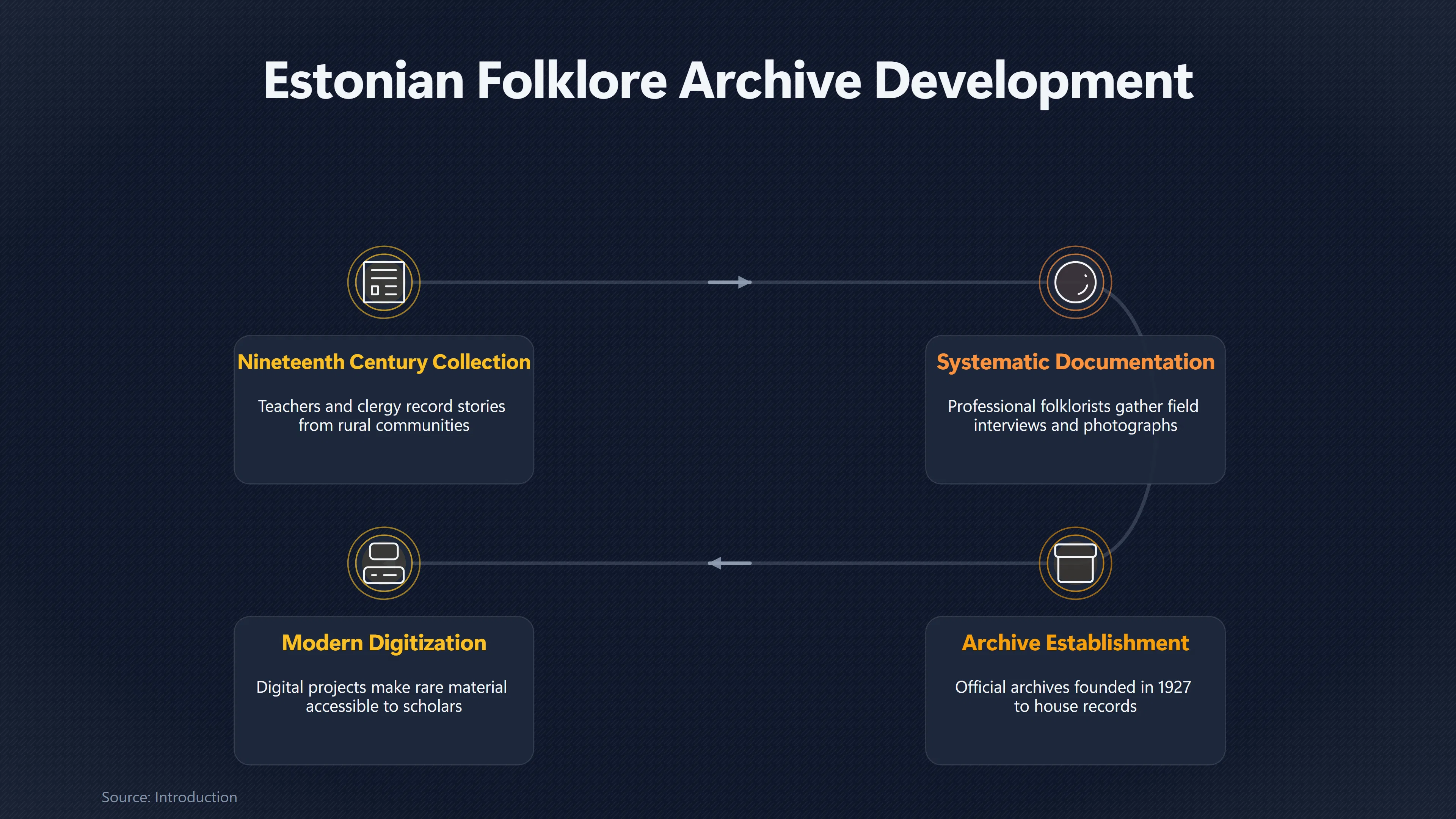
Many European countries have museums devoted to witches, demonology or occult traditions. Estonia developed a different tradition because scholars and collectors concentrated on preserving oral testimony instead of assembling dramatic displays of supernatural objects.
Beginning in the nineteenth century, teachers, clergy, local enthusiasts and later professional folklorists systematically recorded stories from rural communities. Instead of asking whether ghosts, revenants or magical practices were objectively real, they documented what people believed, when such beliefs were invoked and how they shaped daily life. This work culminated in the creation of the Estonian Folklore Archives in 1927, now part of the Estonian Literary Museum in Tartu.[Folklore]folklore.eeE F A…
For visitors interested in strange history, this means Estonia offers something different from theatrical “witch museums”. The emphasis falls on authentic historical evidence: handwritten notebooks, field interviews, photographs, sound recordings and ethnographic objects that reveal how supernatural beliefs functioned within real communities.
What the Folklore Archives Preserve
The Estonian Folklore Archives are the country’s central repository for non-institutional cultural traditions. Their collections extend far beyond fairy tales, preserving an enormous body of material relating directly to supernatural belief.
By the end of 2022 the archives held approximately:
- Around 1.5 million manuscript pages.
- Tens of thousands of photographs.
- More than 188,000 audio recordings.
- Extensive video collections documenting traditions and fieldwork.
- Material collected from Estonia as well as neighbouring Finno-Ugric communities and minority groups.[Folklore]folklore.eeE F A…
Among this material are records of:
- Protective charms and spoken healing formulas.
- Folk medicine intertwined with magical belief.
- Accounts of witches, wise people and local healers.
- Stories of haunted places and revenants.
- Traditions surrounding sacred trees, stones and springs.
- Household rituals intended to protect livestock, crops and families.
- Narratives explaining encounters with mysterious beings or unexplained events.[Eesti Kirjandusmuuseum]kirmus.eeEesti Kirjandusmuuseum Estonian Folklore Archives | Eesti KirjandusmuuseumEesti Kirjandusmuuseum Estonian Folklore Archives | Eesti Kirjandusmuuseum
Unlike many folklore collections assembled mainly from published stories, Estonia’s archive preserves original field documentation. Researchers can often identify who reported a tradition, where it was recorded and when, allowing beliefs to be studied within their historical and regional context.[Folklore]folklore.eeE F A…
Revenants, Forest Beings and Supernatural Testimony
One reason the archives are so valuable is that they preserve supernatural testimony without presenting it as established fact.
Many records describe encounters with revenants—the restless dead believed to return after burial under particular circumstances. These accounts often concern practical concerns such as improper funerals, unresolved disputes or breaches of customary behaviour rather than spectacular horror. Such narratives reveal social values as much as ghost belief.
Equally important are traditions concerning forest beings and other supernatural inhabitants of the landscape. Estonian folklore consistently links mysterious encounters with forests, wetlands, ancient stones and isolated farmsteads. Rather than existing as a single fixed mythology, these stories vary significantly between regions, making the archive valuable for tracing how local environments shaped belief. Researchers at the Estonian Literary Museum continue to study traditions relating to fairies, hidden treasure, werewolves, mythological diseases and other belief narratives using these archival collections.[Folklore]en.folklore.eeFolk Narrative studiesFolk Narrative studies…
The archive therefore serves less as a catalogue of monsters than as evidence of how communities explained danger, illness, bad luck and unfamiliar places before modern scientific explanations became widespread.
How Museums Interpret Magical Objects
Visitors expecting cabinets filled with cursed relics may be surprised. Estonian museums generally interpret magical objects as ethnographic evidence rather than supernatural artefacts.
Objects associated with folk belief commonly include:
- Protective amulets worn by people or animals.
- Ritual textiles and household objects.
- Healing implements used by folk practitioners.
- Containers or bundles prepared for protection.
- Agricultural tools connected with seasonal rituals.
- Personal items associated with blessing or protection.
These objects are usually displayed alongside documentation explaining how they were used, who collected them and what local people believed they accomplished. Museums distinguish between historical belief and demonstrable fact, allowing visitors to understand both the cultural importance of the objects and the limits of what historians can verify.
This approach avoids sensationalism. An amulet is presented as evidence that someone sought protection against misfortune, not as proof that supernatural forces acted upon it.
Why the Evidence Matters More Than the Artefact
In many countries, isolated magical objects have lost much of their meaning because the stories surrounding them disappeared.
Estonia’s archives preserve both sides of the historical record. A protective charm can often be linked with written explanations, regional traditions and comparable examples recorded from different communities. This combination allows researchers to reconstruct patterns of belief instead of treating each object as an isolated curiosity.[Eesti Kirjandusmuuseum]kirmus.eeEesti Kirjandusmuuseum Estonian Folklore Archives | Eesti KirjandusmuuseumEesti Kirjandusmuuseum Estonian Folklore Archives | Eesti Kirjandusmuuseum
The archives have also become increasingly accessible through digitisation projects, enabling scholars to compare thousands of related narratives and making rare material available beyond the reading room in Tartu. Projects have digitised major collections of fairy tales and other folklore while continuing to expand searchable resources for researchers.[Folklore]folklore.eeResearch project “Estonian Fairy Tales”Research project “Estonian Fairy Tales”…
Visiting the Collections Today
The Estonian Folklore Archives themselves are primarily a research institution rather than a conventional tourist attraction. They form part of the Estonian Literary Museum in Tartu, where scholars, students and visitors with research interests can consult collections under archive procedures.[Eesti Kirjandusmuuseum]kirmus.eeEesti Kirjandusmuuseum Info | Eesti KirjandusmuuseumEesti Kirjandusmuuseum Info | Eesti Kirjandusmuuseum
Travellers looking for magical artefacts are therefore better served by combining several institutions:
- The Estonian Literary Museum provides the archival context for supernatural traditions and belief records.
- Ethnographic museums, particularly the Estonian National Museum, interpret ritual and protective objects within everyday rural life rather than presenting them as occult curiosities.
- Exhibitions on folklore, traditional religion and rural culture often incorporate magical objects as part of broader interpretations of historical belief.
Together they present a distinctive model of curiosity culture. Instead of promising evidence for the paranormal, they preserve something arguably more valuable: one of Europe’s most comprehensive documentary records of how ordinary people understood ghosts, magic, healing, sacred landscapes and unseen forces across generations.
Amazon book picks
Further Reading
Books and field guides related to Why Estonia Has No Witchcraft Museum. Use these as the next step if you want deeper reading beyond the article.
The Golden Bough
The work of Sir James G. Frazer (1854-1941) ranged widely across classics, cultural history, folklore and literary criticism as well as a...
The Penguin Book of Witches
Chilling real-life accounts of witches, from medieval Europe through colonial America, compiled by the New York Times bestselling author...
Mythology
Rating: 2.5/5 from 14 Google Books ratings
Greek and Roman myths, with a brief chapter on Norse myths.
eBay marketplace picks
Marketplace Samples
Live-tested eBay searches with available results related to this page.
Selected fromfolklore poster oneBay.co.uk.
Endnotes
1.
Source: folklore.ee
Link:https://www.folklore.ee/era/eng/
Source snippet
E F A...
2.
Source: en.folklore.ee
Title: Folk Narrative studies
Link:https://en.folklore.ee/rl/fo/activ/en_folk_narratives.htm
Source snippet
Folk Narrative studies...
3.
Source: folklore.ee
Title: Humanities and Arts | Natural history anthology
Link:https://folklore.ee/loodus/en/projektist/teadus
Source snippet
Humanities and Arts | Natural history anthology...
4.
Source: folklore.ee
Title: Research project “Estonian Fairy Tales”
Link:https://www.folklore.ee/UTfolkl/mj/eng/index.html
Source snippet
Research project “Estonian Fairy Tales”...
5.
Source: folklore.ee
Link:https://www.folklore.ee/balkan_baltic_yearbook/YBBS/article/view/184
Source snippet
February 6, 2024 — REALITY AS PRESENTED IN ESTONIAN LEGENDS OF HIDDEN TREASURE AUTHORS * Mare Kalda PhD Senior researcher, Deprtment of F...
Published: February 6, 2024
6.
Source: folklore.ee
Link:https://www.folklore.ee/en/inst/
7.
Source: en.folklore.ee
Link:https://en.folklore.ee/inst/
8.
Source: en.folklore.ee
Link:https://en.folklore.ee/rl/fo/activ/legends.htm
9.
Source: en.folklore.ee
Link:https://en.folklore.ee/rl/fo/research/
10.
Source: folklore.ee
Link:https://folklore.ee/loodus/en/projektist/loodus-ja-inimene-rahvaparimuses
11.
Source: folklore.ee
Link:https://folklore.ee/estonka/en/cultural-heritage/history-of-collection/
12.
Source: folklore.ee
Link:https://folklore.ee/estonka/en/cultural-heritage/
13.
Source: folklore.ee
Link:https://folklore.ee/loodus/en/projektist
14.
Source: folklore.ee
Link:https://www.folklore.ee/folklore/vol2/docdoc.htm
15.
Source: folklore.ee
Title: M Tagused 72
Link:https://www.folklore.ee/tagused/nr72/summ.htm
16.
Source: youtube.com
Title: Legends & Folklore of Tallinn | A Walking Tour of Estonia’s Capital 🇪🇪
Link:https://www.youtube.com/watch?v=LLc8vDphMVo
Source snippet
Estonian National Museum - Eesti Rahva Muuseum...
17.
Source: youtube.com
Title: Estonian National Museum
Link:https://www.youtube.com/watch?v=YAvkF4q9Oik
Source snippet
Estonian Earth Belief Maausk...
18.
Source: kirmus.ee
Title: Eesti Kirjandusmuuseum Estonian Folklore Archives | Eesti Kirjandusmuuseum
Link:https://www.kirmus.ee/en/about-us/departments/estonian-folklore-archives
19.
Source: kirmus.ee
Title: Eesti Kirjandusmuuseum Departments | Eesti Kirjandusmuuseum
Link:https://www.kirmus.ee/en/about-us/departments
20.
Source: kirmus.ee
Title: Eesti Kirjandusmuuseum Info | Eesti Kirjandusmuuseum
Link:https://www.kirmus.ee/en/info
21.
Source: kirmus.ee
Link:https://www.kirmus.ee/index.php/en/node/
Additional References
22.
Source: erm.ee
Link:https://www.erm.ee/en/about-us/about-the-museum/the-museum/
Source snippet
The Museum - Eesti Rahva MuuseumFebruary 25, 2026 — THE MUSEUM Image Image Image The Estonian National Museum is a cultural history museu...
Published: February 25, 2026
23.
Source: rongabutiik.ee
Title: Statistically, we are one of the most secular nations in Eur
Link:https://rongabutiik.ee/en/eesti-rahvaparimus-noidus-ja-maagilised-praktikad-taielik-ulevaade/
Source snippet
Estonian Folklore, Witchcraft and Magical Practices: A Complete Overview - RongabutiikMay 7, 2026 — ESTONIAN FOLKLORE, WITCHCRAFT, AND MA...
Published: May 7, 2026
24.
Source: rongabutiik.ee
Title: Spells and word magic in Estonian folk tradition
Link:https://rongabutiik.ee/en/manamine-ja-sonamaagia-eesti-rahvaparimuses/
Source snippet
Father, Son, Holy Spirit. Let the water flow, let the blood stop, just as the Jordan River stops. Amen.” These ar...
25.
Source: youtube.com
Title: Estonian Mythology ~ Kalevipoeg, Linda & Kalev 🇪🇪
Link:https://www.youtube.com/watch?v=1wDl7tuaLZM
Source snippet
Legends & Folklore of Tallinn | A Walking Tour of Estonia's Capital 🇪🇪...
26.
Source: youtube.com
Title: Paganism in Estonia 🇪🇪 | History and Modern Revival @mooselady
Link:https://www.youtube.com/watch?v=mW–lZp3bWs
Source snippet
Estonian Mythology ~ Kalevipoeg, Linda & Kalev 🇪🇪...
27.
Source: youtube.com
Title: Estonian Earth Belief Maausk
Link:https://www.youtube.com/watch?v=JS5PZPPP78w
Source snippet
"Estonian Folklore Archives" Estonian Mythology ~ Kalevipoeg, Linda & Kalev 🇪🇪 The Jolly Reiver...
28.
Source: etis.ee
Link:https://www.etis.ee/Portal/Collections/Display/1e544c21-7bb7-4ecf-bbde-6c07b6ad55a1
29.
Source: loodusmuuseum.ee
Link:https://www.loodusmuuseum.ee/en/historical-collection
30.
Source: erm.ee
Link:https://erm.ee/en
31.
Source: nationalmuseet.dk
Link:https://nationalmuseet.dk/en/exhibitions/the-power-of-amulets-luck-fear-and-magic