Within Curious Cyprus
What the Kyrenia Shipwreck Still Tells US
A preserved merchant vessel and its cargo offer an unusually complete glimpse of Mediterranean trade around 280 BC.
On this page
- Discovery and preservation of the hull
- Amphorae, almonds and the merchant cargo
- Dating the sinking and reconstructing the voyage
Page outline Jump by section
Introduction
The Kyrenia Shipwreck is one of the most important archaeological discoveries ever made in the eastern Mediterranean because it preserves an unusually complete picture of a working merchant voyage from the early Hellenistic period, around 280 BC. Rather than revealing a royal treasure or a military fleet, the wreck captures something far rarer: the everyday mechanics of ancient commerce. Its surviving wooden hull, hundreds of transport amphorae, food remains, tools and personal possessions allow archaeologists to reconstruct how a modest trading vessel operated, what it carried and how Mediterranean exchange networks functioned more than two thousand years ago. Today, the conserved remains are displayed in the Shipwreck Museum within Kyrenia Castle in northern Cyprus, making the vessel one of the island’s most distinctive archaeological attractions. Although the island’s political division affects administration and access, the ship itself remains an exceptional piece of evidence rather than a legend or curiosity.
Discovery and preservation of the hull
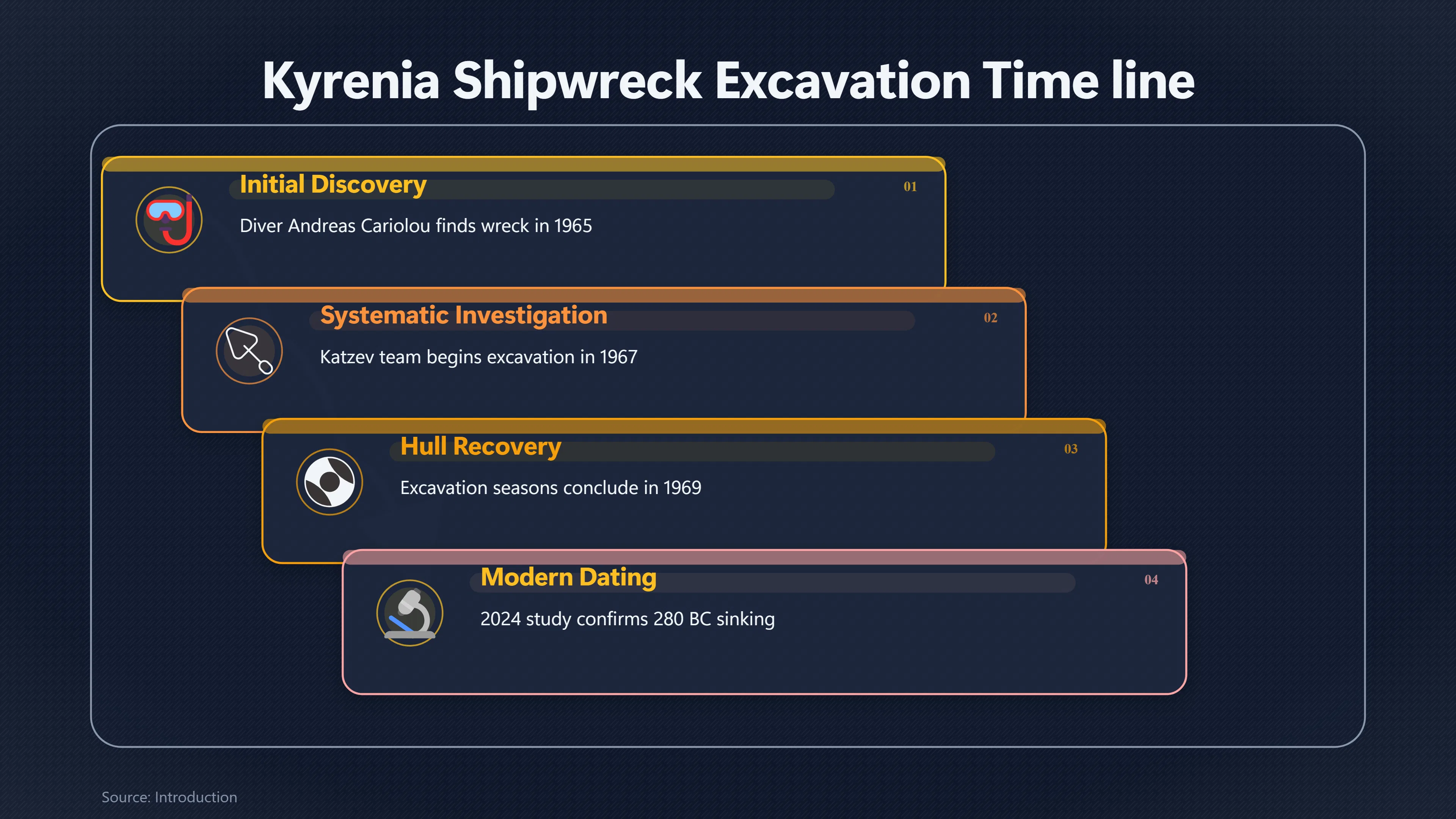
The shipwreck was discovered in 1965 by Cypriot diver Andreas Cariolou while searching beneath the waters off Kyrenia’s harbour. Archaeologists led by Michael and Susan Katzev began systematic investigation in 1967, followed by two excavation seasons in 1968 and 1969. Unlike many underwater discoveries that survive only as scattered cargoes, this wreck retained a substantial section of its timber hull beneath layers of sediment, allowing one of the earliest large-scale scientific excavations of an ancient ship.[Institute of Nautical Archaeology]nauticalarch.orgInstitute of Nautical Archaeology Kyrenia Shipwreck ExcavationInstitute of Nautical ArchaeologyKyrenia Shipwreck Excavation - Institute of Nautical ArchaeologyFebruary 23, 2020…
The preserved hull transformed understanding of Greek shipbuilding. Measuring roughly 14 metres long, the merchant vessel had been built using the shell-first method, in which the outer planking was assembled before the internal framework. Evidence of lead sheathing attached beneath the hull also demonstrated deliberate protection against marine organisms, showing that shipowners invested in extending a vessel’s working life rather than treating coastal traders as disposable craft.[Institute of Nautical Archaeology]nauticalarch.orgInstitute of Nautical Archaeology Kyrenia Shipwreck ExcavationInstitute of Nautical ArchaeologyKyrenia Shipwreck Excavation - Institute of Nautical ArchaeologyFebruary 23, 2020…
Conservation became almost as significant as excavation. After recovery, the timbers underwent lengthy preservation before reconstruction, allowing visitors to see much of the original vessel rather than a speculative model. The surviving hull remains one of the best-preserved examples of an ancient Greek merchant ship and has inspired full-scale sailing replicas that have tested ancient construction techniques and handling at sea.[Institute of Nautical Archaeology]nauticalarch.orgInstitute of Nautical Archaeology Kyrenia Shipwreck ExcavationInstitute of Nautical ArchaeologyKyrenia Shipwreck Excavation - Institute of Nautical ArchaeologyFebruary 23, 2020…
For visitors, this is what makes the display unusual within Cyprus’s wider heritage landscape. The museum does not simply exhibit artefacts removed from a wreck; it presents the physical structure of an ordinary commercial ship whose construction can be examined in remarkable detail.
Amphorae, almonds and the merchant cargo
The cargo explains why the Kyrenia Shipwreck is so valuable for understanding ancient trade. Archaeologists recovered around 400 transport amphorae, most originating from Rhodes, alongside examples from other eastern Mediterranean production centres. Amphorae were the standard shipping containers of the ancient world, carrying commodities such as wine, olive oil and other goods that moved between ports. Their stamps and shapes help identify commercial links across the Aegean and eastern Mediterranean rather than suggesting trade confined to Cyprus alone.[nauticalarch.org]nauticalarch.orgInstitute of Nautical Archaeology Kyrenia Shipwreck ExcavationInstitute of Nautical ArchaeologyKyrenia Shipwreck Excavation - Institute of Nautical ArchaeologyFebruary 23, 2020…
One of the most memorable discoveries was thousands of almonds, many still preserved inside their shells. These organic remains survived because the wreck lay protected beneath the seabed. The almonds are more than a curiosity: they demonstrate that the ship transported food as commercial cargo and later became essential evidence for refining the date of the wreck through modern scientific analysis.[penn.museum]penn.museumMuseum Expedition Magazine | The Kyrenia ShipwreckExpedition Magazine | The Kyrenia ShipwreckJanuary 1, 1969…
The excavation also revealed:
- Heavy hopper millstones stacked along the ship’s centreline, serving both as cargo and ballast.
- Fine tableware and domestic ceramics used by the crew.
- Tools, rigging components and even parts of a sailor’s sandals.
- Animal bones and food remains that illuminate life aboard an ordinary merchant vessel rather than an elite expedition.[Penn Museum]penn.museumMuseum Expedition Magazine | The Kyrenia ShipwreckExpedition Magazine | The Kyrenia ShipwreckJanuary 1, 1969…
Together these finds present a convincing picture of a working coastal trader making repeated commercial journeys. Instead of luxury cargo alone, the ship carried practical goods that connected producers, ports and consumers across the Hellenistic Mediterranean.
Dating the sinking and reconstructing the voyage
Dating the Kyrenia Ship precisely has occupied archaeologists for decades. Early estimates relied mainly on pottery styles, coins and historical interpretation, producing slightly different chronologies. More recent research combined archaeological evidence with radiocarbon dating of ship timbers, preserved almonds and even a small bone gaming piece carried aboard.
A major 2024 study also addressed an unexpected problem: conservation chemicals applied to the wood after excavation complicated radiocarbon dating. Researchers developed methods to remove these contaminants and combined the new results with improvements to the radiocarbon calibration curve for the period. The outcome placed the sinking most probably between about 286 and 272 BC, with around 280 BC representing the strongest estimate.[cornell.edu]news.cornell.eduCornell ChronicleAlmonds, pottery and wood help date famed Kyrenia shipwreck | Cornell Chronicle…
Although the exact route cannot be proven, the cargo provides strong clues. The predominance of Rhodian amphorae suggests extensive commercial connections with Rhodes, while other containers indicate exchange extending across the eastern Mediterranean. Rather than travelling between only two ports, the ship probably participated in a network of relatively short commercial voyages, loading and unloading goods at multiple harbours before its final journey ended off Cyprus.[nauticalarch.org]nauticalarch.orgInstitute of Nautical Archaeology Kyrenia Shipwreck ExcavationInstitute of Nautical ArchaeologyKyrenia Shipwreck Excavation - Institute of Nautical ArchaeologyFebruary 23, 2020…
This distinction matters because the wreck demonstrates how Hellenistic trade actually functioned. Instead of giant fleets carrying uniform cargoes, much commerce relied on comparatively small merchant vessels transporting mixed loads between interconnected regional markets.
Why the Kyrenia Shipwreck still matters
Within Cyprus’s landscape of unusual collections, the Kyrenia Shipwreck stands apart because its importance comes from evidence rather than spectacle. It preserves an entire trading system in miniature: the ship itself, its cargo, its construction methods and traces of everyday life aboard.
The wreck has influenced several fields simultaneously. Maritime archaeologists use it to study ancient shipbuilding; economic historians analyse its cargo to understand commercial networks; conservation scientists continue to refine methods for preserving waterlogged timber; and radiocarbon specialists have used it to improve dating techniques applicable far beyond Cyprus.[wa.gov.au]museum.wa.gov.auOpen source on wa.gov.au.
For visitors to Kyrenia Castle, the surviving vessel offers something few archaeological exhibits can provide: not the possessions of kings or temples, but a remarkably intact snapshot of ordinary Mediterranean commerce. More than two millennia after it sank, the ship continues to reveal how goods, people and ideas travelled across the sea, making it one of Cyprus’s most compelling pieces of archaeological evidence.

Amazon book picks
Further Reading
Books and field guides related to What the Kyrenia Shipwreck Still Tells US. Use these as the next step if you want deeper reading beyond the article.
A Traveller's History of Cyprus
A Traveller’s History of Cyprus offers a complete and authoritative history of the island’s past and also touches on the sensitive presen...
The History of Medicine: A Very Short Introduction
Against the backdrop of unprecedented concern for the future of health care, this i Very Short Introduction/i surveys the history of medi...

The Sea in History: The Ancient World
First published 2017. Subjects: World history, Ocean and civilization, Civilization, History, Ocean.
eBay marketplace picks
Marketplace Samples
Live-tested eBay searches with available results related to this page.
Selected fromancient ship model oneBay.co.uk.
Endnotes
1.
Source: penn.museum
Title: Museum Expedition Magazine | The Kyrenia Shipwreck
Link:https://www.penn.museum/sites/expedition/the-kyrenia-shipwreck/
Source snippet
Expedition Magazine | The Kyrenia ShipwreckJanuary 1, 1969...
Published: January 1, 1969
2.
Source: news.cornell.edu
Link:https://news.cornell.edu/stories/2024/06/almonds-pottery-and-wood-help-date-famed-kyrenia-shipwreck
Source snippet
Cornell ChronicleAlmonds, pottery and wood help date famed Kyrenia shipwreck | Cornell Chronicle...
3.
Source: reuters.com
Link:https://www.reuters.com/science/study-firms-up-date-famous-ancient-shipwreck-off-cyprus-2024-06-27/
Source snippet
Utilizando técnicas avanzadas de análisis de material orgánico, incluyendo la madera del barco, almendras de su cargamento y un astrágalo...
4.
Source: classics.cornell.edu
Title: almonds pottery and wood help date famed kyrenia shipwreck
Link:https://classics.cornell.edu/news/almonds-pottery-and-wood-help-date-famed-kyrenia-shipwreck
5.
Source: penn.museum
Title: Expedition Magazine | Kyrenia
Link:https://www.penn.museum/sites/expedition/kyrenia/
6.
Source: nauticalarch.org
Title: Institute of Nautical Archaeology Kyrenia Shipwreck Excavation
Link:https://nauticalarch.org/projects/kyrenia-shipwreck-excavation/
Source snippet
Institute of Nautical ArchaeologyKyrenia Shipwreck Excavation - Institute of Nautical ArchaeologyFebruary 23, 2020...
Published: February 23, 2020
7.
Source: museum.wa.gov.au
Link:https://museum.wa.gov.au/maritime-archaeology-db/maritime-reports/survey-greek-shipwreck-kyrenia-cyprus
8.
Source: bmcr.brynmawr.edu
Link:https://bmcr.brynmawr.edu/2024/2024.01.20/
Source snippet
Bryn Mawr Classical ReviewThe Kyrenia ship final excavation report, volume I: history of the excavation, amphoras, ceramics, coins and ev...
9.
Source: museum.wa.gov.au
Link:https://museum.wa.gov.au/maritime-archaeology-db/maritime-reports/kyrenia-amphora-project
Additional References
10.
Source: thearchaeologist.org
Title: Ancient Greek Shipwrecks: The Kyrenia Ship and the Wine Trade
Link:https://www.thearchaeologist.org/blog/ancient-greek-shipwrecks-the-kyrenia-ship-and-the-wine-trade
Source snippet
June 2, 2026 — Image ANCIENT GREEK SHIPWRECKS: THE KYRENIA SHIP AND THE WINE TRADE June 2, 2026 The Kyrenia Ship, a Hellenistic merchant...
Published: June 2, 2026
11.
Source: knews.kathimerini.com.cy
Title: accurate dating of kyrenia shipwreck confirmed
Link:https://knews.kathimerini.com.cy/en/news/accurate-dating-of-kyrenia-shipwreck-confirmed
Source snippet
dating of Kyrenia shipwreck confirmed, KNEWSJuly 6, 2024 — ACCURATE DATING OF KYRENIA SHIPWRECK CONFIRMED ANCIENT GREEK MERCHANT SHIP DAT...
Published: July 6, 2024
12.
Source: youtube.com
Title: Combating Looting and Illicit Trafficking of Cultural Heritage in Cyprus
Link:https://www.youtube.com/watch?v=5qJt0JmtI8k
Source snippet
MUNICH CASE - Looted Art From Cypriot Churches Is Returned by Germany...
13.
Source: youtube.com
Title: MUNICH CASE
Link:https://www.youtube.com/watch?v=QNUXFZ5Ysnc
Source snippet
Lessons from the Past: Cyprus, Tasoula Georgiou Hadjitofi...
14.
Source: youtube.com
Title: Tasoula Hadjitofi “The Icon Hunter” (Culturescope) | Cyprus Mail
Link:https://www.youtube.com/watch?v=PMz1Veh8nGo
Source snippet
The Byzantine Museum within the walls Nicosia (Audio Guides)...
15.
Source: youtube.com
Title: Lessons from the Past: Cyprus, Tasoula Georgiou Hadjitofi
Link:https://www.youtube.com/watch?v=0rppcmyS_P8
Source snippet
Tasoula Hadjitofi "The Icon Hunter" (Culturescope) | Cyprus Mail...
16.
Source: hellenicaworld.com
Link:https://www.hellenicaworld.com/Cyprus/History/en/KyreniaShip.html
17.
Source: kyreniamunicipality.com
Link:https://kyreniamunicipality.com/en/history-heritage/to-karavi-tis-keryneias/
18.
Source: kyprioscharacter.eie.gr
Link:https://kyprioscharacter.eie.gr/en/scientific-texts/details/economy-trade/shipwrecks-tracing-role-of-cyprus-in-seaborne-trade-networks-of-eastern-mediterranean
19.
Source: mass.cultureelerfgoed.nl
Link:https://mass.cultureelerfgoed.nl/kyrenia