Where Does Cuba Keep Its Strangest Treasures?
Cuba does not have a large, clearly signposted circuit of “weird museums” in the commercial sense.
Page outline Jump by section
Introduction
The most rewarding places are therefore not necessarily marketed as macabre or eccentric attractions. Their strangeness comes from the survival of complete working environments, the overlap between museum display and living belief, or the unusual collecting habits of individuals and state institutions. Cuba’s economic difficulties and uneven online information also mean that apparent opening hours should be treated cautiously. Some collections are well established but modestly interpreted, and displays may be temporarily inaccessible. What follows concentrates on documented public institutions and visitor-facing heritage rather than rumours of secret collections or invented supernatural attractions.
Where Cuba’s strangest collections begin
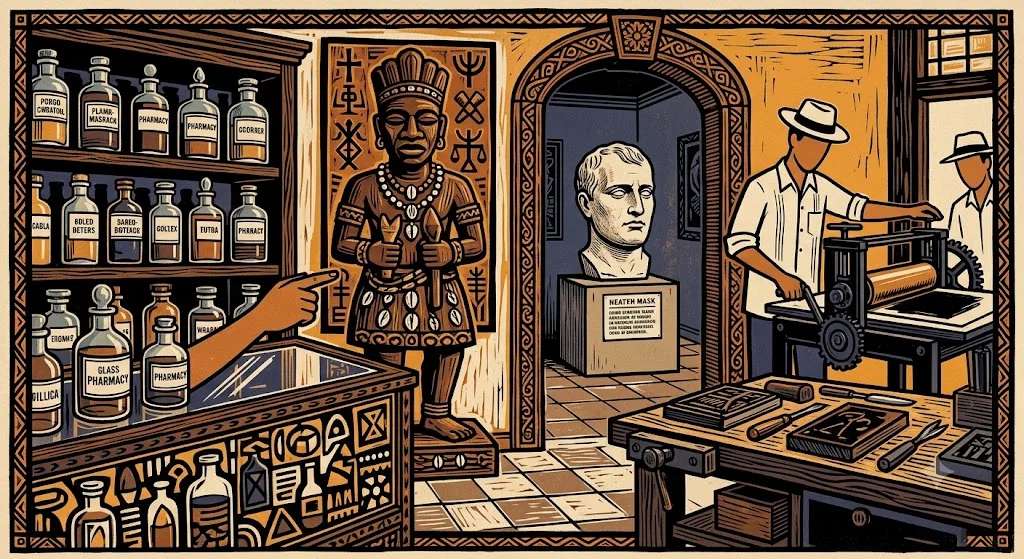
Cuba’s unusual museums reflect three powerful strands of the island’s history. The first is colonial collecting: pharmacies, natural-history specimens, archaeological objects and European art accumulated by wealthy families, civic authorities and learned institutions. The second is revolutionary memorial culture, which preserved prisons, weapons and sites of political struggle. The third is Afro-Cuban religion, where sacred figures, ritual vessels and musical instruments may be displayed in museums even though the traditions they represent remain actively practised.[unesco.org]unesco.orgErnesto Triolet, fundador de la farmaciaErnesto Triolet, fundador de la farmacia
This mixture makes Cuba different from countries where unusual museums are mainly private entertainment businesses. Many Cuban collections are municipal, provincial or attached to cultural associations. They often aim to educate, commemorate or safeguard national heritage rather than merely surprise tourists. The resulting displays can feel old-fashioned, intensely local and occasionally opaque, especially where labels are limited or only available in Spanish.
The pharmacy preserved almost intact
The Pharmaceutical Museum of Matanzas is probably Cuba’s strongest conventional candidate for an internationally significant curiosity museum. It occupies the former French Drugstore, established in the nineteenth century, and preserves its sales room, laboratory, storage areas, furnishings, porcelain containers, stained-glass medicine bottles and documentary archive. Rather than presenting a recreated chemist’s shop assembled from unrelated objects, it retains much of the material world of an actual working pharmacy.[unesco.org]unesco.orgErnesto Triolet, fundador de la farmaciaErnesto Triolet, fundador de la farmacia
Its most extraordinary resource is not a single gruesome instrument but its body of pharmaceutical records. UNESCO describes 61 volumes containing more than half a million prescriptions or formulae associated with three historic pharmacies. These records reveal what doctors prescribed, what ingredients pharmacists compounded and how medical knowledge entered everyday Cuban life. The documentary collection was added to UNESCO’s regional Memory of the World register, while the building itself has also been submitted to Cuba’s tentative list for possible World Heritage status.[unesco.org]unesco.orgErnesto Triolet, fundador de la farmaciaErnesto Triolet, fundador de la farmacia
The smaller objects make the visit memorable. UNESCO’s description notes an early public telephone booth and a pre-1890 delivery bicycle with wooden wheels and solid tyres, used to carry medicines to customers. Shelves of labelled vessels, balances and laboratory equipment give the rooms the appearance of a cabinet of medicinal curiosities, although the museum’s real importance lies in the completeness of the surviving workplace.[UNESCO World Heritage Centre]whc.unesco.orgWorld Heritage Centre Triolet French Drugstore (Pharmacy MuseumMaría Dolores de Figueroa y Marty, owner of the pharmacy for more than 40 years, was the first woman pharmacist in Cuba…. Criterion (i…
Visitors interested in medical oddities should not expect a sensational exhibition of operations, deformities or preserved human remains. This is a museum of pharmacy, chemistry and social history. Its strangeness is quieter: obsolete substances, elaborate containers and handwritten formulae from an era when a pharmacist might prepare a remedy from scratch behind the shop.
Old Havana has a related but distinct attraction, the Havana Pharmacy Museum. The institution occupies a historic pharmacy founded in the 1880s and has reportedly continued to function partly as a working chemist. Its displays include bottles, medical tools and materials recovered during archaeological work in the old city. It is useful as a companion to Matanzas, though the Matanzas collection is the more complete and better documented historic ensemble.[Trip Cuba]tripcuba.orgOpen source on tripcuba.org.
Sacred figures in museums and living religion
Some of Cuba’s most visually unusual collections concern Afro-Cuban religious traditions. These should not be approached as displays of exotic “magic”. The objects represent living systems of worship shaped by West African traditions, slavery, colonial Catholicism and generations of Cuban reinterpretation. Religious diversity remains highly visible on the island, and ceremonies associated with Afro-Cuban faiths continue outside museum walls.[AP News]apnews.comOpen source on apnews.com.
The Museum of the Orishas in Havana is the most immediately theatrical example. Housed at the Cuban Yoruba Cultural Association, it displays large sculptural representations of deities honoured within one of Cuba’s principal Afro-Cuban religious traditions. Visitor accounts describe imposing, sometimes larger-than-life figures arranged with painted settings and symbolic attributes. The atmosphere lies somewhere between cultural interpretation, devotional imagery and staged sacred theatre.[tripadvisor.co.uk]tripadvisor.co.ukTripadvisor MUSEO DE LOS ORISHASTripadvisor MUSEO DE LOS ORISHAS
The distinction between representation and worship matters. The sculptures help visitors identify individual divine figures and their associations, but they do not reduce the religion to a closed historical subject. Ceremonies, drumming and gatherings have taken place at the institution, reinforcing the sense that this is connected to an active community rather than being a repository of abandoned belief.[AP News]apnews.comOpen source on apnews.com.
The Municipal Museum of Guanabacoa offers a more ethnographic and historically grounded route into the same broad cultural landscape. Its collections include objects relating to several Afro-Cuban religious expressions, alongside material about slavery, archaeology, local history and the African contribution to Cuban culture. Guanabacoa has long been closely associated with Afro-Cuban religious practice, so the objects are interpreted within a particular community rather than as decontextualised occult curios.[Slavery and Remembrance]slaveryandremembrance.orgSlavery and RemembranceMunicipal Museum of GuanabacoaThe ethnological collection is dedicated to items that are representative of the mai…
Havana’s House of Africa broadens the picture further through collections concerning African societies, the Atlantic slave trade, cultural exchange and Afro-Cuban identity. Depending on current programming, visitors may encounter masks, sculpture, religious objects, textiles and performances. Together, the House of Africa, Guanabacoa museum and Museum of the Orishas form Cuba’s most important cluster for anyone interested in ritual collections, folklore and the boundary between sacred object and museum exhibit.[tripadvisor.co.uk]tripadvisor.co.ukTripadvisor CASA DE AFRICATripadvisor CASA DE AFRICA
Napoleon’s death mask in Havana
A Napoleonic museum in Cuba is unexpected even before its most macabre object enters the story. Havana’s Napoleonic Museum grew from private collections associated principally with the Cuban sugar magnate Julio Lobo and the politician and collector Orestes Ferrara. It contains paintings, furniture, military objects, books and personal relics connected with Napoleon and his age. Specialist descriptions regard it as one of the most important Napoleonic collections in the Americas.[napoleon.org]napoleon.orgMuseo NapoleonicoThe Napoleonic Museum in Cuba is the happy result of the combination… important Napoleonic collection in Central America…. There ar…
The object most likely to interest a curiosity-minded visitor is a plaster death mask of Napoleon. Death masks were casts taken from, or derived from moulds associated with, a deceased person’s face. They occupied an uneasy position between commemoration, portraiture, scientific record and relic. Napoleon’s masks have particularly complicated histories because multiple versions and later copies survive, and their exact relationships to the original impression have long been debated.[napoleon.org]napoleon.orgMuseo NapoleonicoThe Napoleonic Museum in Cuba is the happy result of the combination… important Napoleonic collection in Central America…. There ar…
Cuba has a direct connection to this history. Francesco Antommarchi, the doctor associated with Napoleon’s final illness and with the production or circulation of death-mask casts, later lived and died in Cuba. Specialist research into the masks warns that not every claimed example has equally secure provenance, so the Havana object is best understood within a larger and disputed family of casts rather than as an uncomplicated imprint taken directly from Napoleon’s face.[napoleon.org]napoleon.orgOpen source on napoleon.org.
The museum is not a chamber of horrors. Its appeal lies in the improbable transplantation of imperial French memory to the Caribbean and in the way a wealthy collector’s obsession became a major public institution. The death mask is the collection’s most uncanny artefact, but it gains meaning from the paintings, weapons, furnishings and books surrounding it.
A collector’s mummy and an early Cuban cabinet
The Emilio Bacardí Moreau Provincial Museum in Santiago de Cuba is one of the island’s most eclectic historical collections. Founded in 1899 through the efforts of Emilio Bacardí Moreau, it is generally described as Cuba’s earliest public museum-library. Its holdings now encompass Cuban history, archaeology, art, ethnographic objects and material acquired through travel and collecting.[cubaplusmagazine.com]cubaplusmagazine.comprovincial museum santiago cuba emilio bacardi moreauprovincial museum santiago cuba emilio bacardi moreau
For readers seeking a classic cabinet-of-curiosity atmosphere, this is one of Cuba’s strongest destinations. Travel descriptions repeatedly single out its varied assemblage, which extends well beyond the normal boundaries of a regional history museum. The collection has been reported to exceed 23,000 objects and documents.[Trip Cuba]tripcuba.orgOpen source on tripcuba.org.
Its most famous curiosity is an Egyptian mummy, accompanied by other Egyptian antiquities. The presence of such material in Santiago reflects an older model of collecting in which civic museums sought to assemble fragments of world civilisation alongside local history. Modern visitors may reasonably ask how the mummy was acquired, whether its provenance is fully documented and how human remains should be displayed. Publicly accessible descriptions provide less detailed provenance information than a contemporary museum audience might expect, making it important not to repeat colourful stories about the individual’s identity as settled fact.
That uncertainty is part of the museum’s significance. It shows how nineteenth- and early twentieth-century collecting practices could turn archaeological human remains into educational trophies far from their place of origin. The Bacardí museum is therefore both an unusual attraction and a case study in the changing ethics of museums.
Inside Cuba’s giant panopticon prison
Presidio Modelo, on the Isle of Youth, is among Cuba’s most unsettling heritage sites. Constructed between 1926 and 1931 under President Gerardo Machado, the complex includes huge circular cell blocks arranged around central observation towers. The design followed the panopticon principle: prisoners could be watched from a central point without knowing precisely when they were under observation.[Atlas Obscura]atlasobscura.comAtlas Obscura Inside an Abandoned Panopticon Prison in CubaAtlas Obscura Inside an Abandoned Panopticon Prison in Cuba
The buildings are visually extraordinary. Tier upon tier of open cells face a central void, producing an architecture that feels more like a machine for surveillance than an ordinary prison. The site was built for thousands of inmates and later became closely associated with political imprisonment, including the detention of Fidel and Raúl Castro after the 1953 attack on the Moncada Barracks.[Atlas Obscura]atlasobscura.comAtlas Obscura Inside an Abandoned Panopticon Prison in CubaAtlas Obscura Inside an Abandoned Panopticon Prison in Cuba
Presidio Modelo ceased operating as a prison in the 1960s and became a national monument. A museum has operated in the former hospital area, while access to the circular blocks has been reported inconsistently. Accounts differ over which structures visitors may enter, and deterioration creates obvious conservation and safety concerns. Travellers should therefore verify access on the island rather than assuming that every photographed interior is routinely open.[Atlas Obscura]atlasobscura.comAtlas Obscura Inside an Abandoned Panopticon Prison in CubaAtlas Obscura Inside an Abandoned Panopticon Prison in Cuba
The interpretation is inseparable from Cuban revolutionary history, but the site has a broader importance. Panopticon prisons embody enduring questions about observation, discipline and institutional power. Here those ideas are not presented through a scale model: visitors confront them in buildings large enough to dominate the landscape.

Playing cards, wax figures and pirate relics
Cuba’s smaller specialist museums offer a lighter form of oddity. Havana’s Playing Cards Museum has been associated with a collection of roughly 2,000 decks, including unusual shapes, themed cards and examples that replace familiar court imagery with celebrities, drinks or political and cultural subjects. It occupies a historic building on Plaza Vieja and has hosted exhibitions treating cards as graphic art, social evidence and objects of play.[tripcuba.org]tripcuba.orgOpen source on tripcuba.org.
Descriptions mention circular cards, tarot-related material and novelty decks, but current visitor information is uneven. Older reports suggest that retail and display arrangements have changed over time. It is a genuine documented institution, not a fabricated attraction, yet its present accessibility and the extent of the collection on view should be checked locally.[Lonely Planet]lonelyplanet.comLonely Planet Museo de Naipes | Habana Vieja, Havana | AttractionsLonely Planet Museo de Naipes | Habana Vieja, Havana | Attractions
Bayamo’s Wax Museum provides a distinctly Cuban version of the waxwork tradition. Rather than concentrating on international film stars or horror tableaux, it presents figures of notable Cuban cultural and historical personalities, including musicians. Recent Cuban cultural coverage continues to describe it as the island’s only wax museum.[Trip Cuba]tripcuba.orgTrip Cuba Museo de Cera Wax Museum, BayamoTrip Cuba Museo de Cera Wax Museum, Bayamo
The figures are valuable less for perfect illusion than for the selection of people judged worthy of preservation. Wax museums turn public memory into artificial bodies: clothing, pose and facial resemblance combine to create an accessible national portrait gallery. Bayamo’s version is small, locally focused and more commemorative than sensational.
At the fortress of San Pedro de la Roca outside Santiago de Cuba, a piracy museum places weapons, maritime material and historical narratives within the fortifications built to defend the coast. The setting is more powerful than any freestanding pirate display: visitors see the Caribbean from walls designed in response to corsairs, imperial rivalry and attacks on Spanish colonial settlements. The museum dates from the 1970s, although individual object claims and dramatic pirate stories should be distinguished from the broader, well-documented military history of the fortress.[cubantravelagency.org]cubantravelagency.orgPiracy Museum, Santiago de CubaPiracy Museum, Santiago de Cuba
When a whole neighbourhood becomes the collection
Fusterlandia, in the Havana neighbourhood of Jaimanitas, is not formally a museum. It is an inhabited environment transformed by the artist José Fuster through ceramic mosaics, sculpture, painted surfaces and architectural additions. Work beginning around the artist’s own home gradually spread across surrounding buildings and public spaces with the involvement or consent of residents.[artsy.net]artsy.netFusterlandia, the Havana Neighborhood ThatFusterlandia, the Havana Neighborhood That
The result is sometimes compared with Antoni Gaudí’s ceramic architecture, but it also belongs to a broader tradition of artist-built environments: places where personal imagery escapes the studio and absorbs houses, walls, streets and found materials. Visitors encounter animals, national symbols, faces and fantastical forms woven into a neighbourhood that continues to function as a community.[Artsy]artsy.netFusterlandia, the Havana Neighborhood ThatFusterlandia, the Havana Neighborhood That
Calling it a “fantasyland” can obscure that social reality. Fusterlandia is neither a conventional gallery nor an empty theme park. Residents live among the artwork, and tourism enters a working district. Its place in Cuba’s curiosity culture comes from that unstable boundary: it is simultaneously a personal artistic universe, community project, visitor attraction and commercial platform for art.
Relics, offerings and a national shrine
The Basilica of Our Lady of Charity at El Cobre is a religious shrine rather than a museum, but its accumulation of offerings makes it relevant to Cuba’s unusual public collections. The small wooden image of Cuba’s patron saint is linked to a centuries-old discovery tradition and has become a symbol shared across political, geographical and, to some extent, religious boundaries.[AP News]apnews.comOpen source on apnews.com.
Pilgrims leave objects in gratitude for perceived help or healing. Reported offerings include crutches, sports memorabilia and personal tokens, while Ernest Hemingway famously donated his Nobel Prize medal to the shrine. Such objects form a living votive collection: unlike museum artefacts chosen primarily by curators, they arrive through acts of devotion and testimony.[AP News]apnews.comOpen source on apnews.com.
The image also carries meaning within Afro-Cuban religious practice, where it is associated with a female deity linked to rivers, love and fertility. That overlap does not mean Catholic and Afro-Cuban beliefs are identical. It shows how one image can support several layers of Cuban identity and sacred interpretation.[AP News]apnews.comOpen source on apnews.com.
For a visitor interested in reliquaries, miraculous objects and pilgrimage culture, El Cobre may be more revealing than a purpose-built museum of religion. The collection is not presented as folklore or historical superstition. It remains embedded in prayer, promises, healing narratives and national memory.
How credible are Cuba’s curiosity displays?
The strongest unusual collections in Cuba are institutionally real and historically important. The Matanzas pharmacy has UNESCO-recognised documentation; Presidio Modelo survives as monumental prison architecture; the Guanabacoa collections are tied to established ethnographic work; and Havana’s Napoleonic holdings are recognised by specialist scholarship. These are not roadside hoaxes.[unesco.org]unesco.orgErnesto Triolet, fundador de la farmaciaErnesto Triolet, fundador de la farmacia
Credibility becomes more complicated at the level of individual stories. Death-mask provenance is disputed. Mummies and archaeological objects may have incomplete publicly available acquisition histories. Pirate museums can blend documented colonial conflict with romantic storytelling. Religious collections may be misunderstood when guides or visitors force complex traditions into simplistic labels such as witchcraft or superstition.
Interpretation quality also varies. Some museums have extensive archives but limited visitor labelling; others are described mainly through tourism websites because their own online presence is weak. A lack of a current official webpage does not prove that an institution has closed, but neither should old opening hours be treated as reliable. Power shortages, maintenance problems and staffing constraints can affect access, so same-day confirmation through accommodation providers, local cultural offices or the venue itself is sensible.
The best approach is to ask four questions while visiting:
- Is this an original object, a reconstruction or a later copy?
- Is the story documented, traditionally believed or mainly repeated for visitors?
- Was the object collected ethically by modern standards?
- Is the display describing a past practice, or a tradition that remains alive?
These questions do not drain the mystery from Cuba’s collections. They reveal why the objects matter.

What makes Cuba distinctive
Cuba’s strange-history landscape is strongest where an entire world has been preserved rather than where a single bizarre object has been isolated. The Matanzas pharmacy retains the machinery and paperwork of nineteenth-century medicine. Presidio Modelo preserves surveillance as architecture. Afro-Cuban museums place sacred imagery beside living practice. The Bacardí museum embodies the global ambitions and ethical blind spots of an early civic collection.
Its curiosity culture is also unusually resistant to neat categories. A shrine can function like an archive of miracles. A neighbourhood can become an artist-built environment. A museum of European empire can owe part of its significance to a doctor who died in Cuba. A deck of cards can be treated as graphic design, political memory and popular entertainment at once.
Visitors looking only for ghosts, monsters or theatrical horror may find the island’s museums understated. Those interested in the stranger ways societies preserve belief, authority, illness, devotion and obsession will find something richer: collections whose oddity is inseparable from Cuba’s colonial past, African heritage, revolutionary state and continuing culture of improvisation.
Amazon book picks
Further Reading
Books and field guides related to Where Does Cuba Keep Its Strangest Treasures?. Use these as the next step if you want deeper reading beyond the article.
Lonely Planet Cuba
#1 best-selling guide to Cuba* Lonely Planet Cuba is your passport to the most relevant, up-to-date advice on what to see and skip, and w...
The Rough Guide to Cuba
From the crumbling colonial architecture of Havana to the vibrant party town of Santiago de Cuba, idiosyncratic Cuba offers limitless opp...
The Afro-Cuban Religions
Regla de Ocha promotes worship of the Orisha (gods), and uses traditional oracles that originated in the old Yoruba city of Ile-Ife. The...
eBay marketplace picks
Marketplace Samples
Live-tested eBay searches with available results related to this page.
Selected fromHavana wall art oneBay.co.uk.

Endnotes
1.
Source: unesco.org
Title: Ernesto Triolet, fundador de la farmacia
Link:https://www.unesco.org/es/articles/museo-farmaceutico-de-matanzas-entra-al-registro-memoria-del-mundo-de-la-unesco
2.
Source: napoleon.org
Title: Museo Napoleonico
Link:https://www.napoleon.org/en/magazine/places/museo-napoleonico-cuba-2/
Source snippet
The Napoleonic Museum in Cuba is the happy result of the combination... important Napoleonic collection in Central America.... There ar...
3.
Source: whc.unesco.org
Title: World Heritage Centre Triolet French Drugstore (Pharmacy Museum)
Link:https://whc.unesco.org/en/tentativelists/6746/
Source snippet
María Dolores de Figueroa y Marty, owner of the pharmacy for more than 40 years, was the first woman pharmacist in Cuba.... Criterion (i...
4.
Source: whc.unesco.org
Title: World Heritage Centre Triolet French Drugstore (Pharmacy Museum)
Link:https://whc.unesco.org/fr/listesindicatives/6746
Source snippet
The first public telephone booth the city of Matanzas had was installed by the doorway of the French Drugstore, where it can be seen toda...
5.
Source: napoleon.org
Link:https://www.napoleon.org/en/history-of-the-two-empires/articles/inventory-principal-plaster-death-masks-napoleon-public-private-collections/
6.
Source: cubaplusmagazine.com
Title: provincial museum santiago cuba emilio bacardi moreau
Link:https://www.cubaplusmagazine.com/en/news/provincial-museum-santiago-cuba-emilio-bacardi-moreau.html
7.
Source: cubaplusmagazine.com
Title: Cuban Wax Museum: True Works of Art
Link:https://www.cubaplusmagazine.com/en/news/cuban-wax-museum-true-works-of-art.html
8.
Source: cubantravelagency.org
Title: Piracy Museum, Santiago de Cuba
Link:https://www.cubantravelagency.org/piracy-museum-santiago-de-cuba
9.
Source: artsy.net
Title: Fusterlandia, the Havana Neighborhood That
Link:https://www.artsy.net/article/artsy-editorial-havana-neighborhood-one-artists-mosaic-masterpiece
10.
Source: tripadvisor.com
Link:https://www.tripadvisor.com/Attraction_Review-g147271-d2461860-Reviews-Fusterlandia-Havana_Ciudad_de_la_Habana_Province_Cuba.html
11.
Source: napoleon.org
Title: The Affair of Napoleon’s Death Masks
Link:https://www.napoleon.org/en/history-of-the-two-empires/articles/the-affair-of-napoleons-death-masks/
12.
Source: napoleon.org
Title: havanas museo napoleonico reopens 30 march 2011
Link:https://www.napoleon.org/en/history-of-the-two-empires/articles/havanas-museo-napoleonico-reopens-30-march-2011/
Published: march 2011
13.
Source: tripadvisor.com
Title: Attractions g147270 Activities c49 t161 Cuba
Link:https://www.tripadvisor.com/Attractions-g147270-Activities-c49-t161-Cuba.html
14.
Source: tripadvisor.com
Title: Wax Museum
Link:https://www.tripadvisor.com/Attraction_Review-g445055-d6571482-Reviews-Wax_Museum-Bayamo_Granma_Province_Cuba.html
15.
Source: tripadvisor.com
Title: Great pirate museum
Link:https://www.tripadvisor.com/ShowUserReviews-g147273-d207870-r208056930-Castillo_de_San_Pedro_de_la_Roca-Santiago_de_Cuba_Santiago_de_Cuba_Province_Cuba.html
16.
Source: cubantravelagency.org
Link:https://www.cubantravelagency.org/playing-cards-museum-in-old-havana
17.
Source: cubantravelagency.org
Link:https://www.cubantravelagency.org/museo-farmaceutico-matanzas
18.
Source: cubantravelagency.org
Link:https://www.cubantravelagency.org/museo-de-historia-natural-santiago-de-cuba
19.
Source: cubantravelagency.org
Link:https://www.cubantravelagency.org/cuban-museum-of-natural-history
20.
Source: tripadvisor.de
Title: Wax Museum
Link:https://www.tripadvisor.de/Attraction_Review-g445055-d6571482-Reviews-Wax_Museum-Bayamo_Granma_Province_Cuba.html
21.
Source: napoleon.org
Title: ‘s death mask
Link:https://www.napoleon.org/en/history-of-the-two-empires/close-up/napoleons-death-mask/
22.
Source: napoleon.org
Title: Museo Napoleonico
Link:https://www.napoleon.org/magazine/lieux/museo-napoleonico-cuba/
23.
Source: tripadvisor.es
Title: MUSE O DE NAIPES MARQUÉS DE PRADO (La Habana)
Link:https://www.tripadvisor.es/Attraction_Review-g147271-d10103792-Reviews-Museo_de_Naipes_Marques_de_Prado-Havana_Ciudad_de_la_Habana_Province_Cuba.html
24.
Source: slaveryandremembrance.org
Link:https://slaveryandremembrance.org/partners/partner/?id=P0079
Source snippet
Slavery and RemembranceMunicipal Museum of GuanabacoaThe ethnological collection is dedicated to items that are representative of the mai...
25.
Source: apnews.com
Link:https://apnews.com/article/7663cc4a316c59261824d0fe176e0713
26.
Source: tripcuba.org
Link:https://www.tripcuba.org/pharmaceutical-museum-matanzas
Source snippet
Take advantage of one of the educational guided tours the museum offers on the floor containing several rooms that used to form part of t...
27.
Source: tripcuba.org
Link:https://www.tripcuba.org/farmacia-habanera-museum
28.
Source: apnews.com
Link:https://apnews.com/article/0919aedc8a60943708057ad3ce4d3970
29.
Source: tripadvisor.co.uk
Title: Tripadvisor MUSEO DE LOS ORISHAS
Link:https://www.tripadvisor.co.uk/Attraction_Review-g147271-d5983893-Reviews-Museo_de_los_Orishas-Havana_Ciudad_de_la_Habana_Province_Cuba.html
30.
Source: smart-guide.org
Title: Smart Guide The temple
Link:https://www.smart-guide.org/destinations/en/havana/?place=The+temple+-+the+Museum+-+los+Orish+%28Museo+de+Los+Orishas%29
31.
Source: tripadvisor.co.uk
Title: Tripadvisor CASA DE AFRICA
Link:https://www.tripadvisor.co.uk/Attraction_Review-g147271-d3281502-Reviews-Casa_de_Africa-Havana_Ciudad_de_la_Habana_Province_Cuba.html
32.
Source: tripcuba.org
Title: Trip Cuba Museo Casa de África House Museum
Link:https://www.tripcuba.org/casa-de-africa-house-museum-havana
33.
Source: tripcuba.org
Link:https://www.tripcuba.org/municipal-museum-emilio-bacardi-moreau-santiago-de-cuba
34.
Source: atlasobscura.com
Title: Atlas Obscura Inside an Abandoned Panopticon Prison in Cuba
Link:https://www.atlasobscura.com/articles/panopticon-prison-cuba
35.
Source: Wikipedia
Title: Presidio Modelo
Link:https://en.wikipedia.org/wiki/Presidio_Modelo
36.
Source: tripcuba.org
Link:https://www.tripcuba.org/cards-museum-havana
37.
Source: havanatimes.org
Title: Havana Times Havana on Playing Cards
Link:https://havanatimes.org/culture/havana-on-playing-cards/
38.
Source: lonelyplanet.com
Title: Lonely Planet Museo de Naipes | Habana Vieja, Havana | Attractions
Link:https://www.lonelyplanet.com/points-of-interest/museo-de-naipes/370273
39.
Source: tripcuba.org
Title: Trip Cuba Museo de Cera Wax Museum, Bayamo
Link:https://www.tripcuba.org/museo-de-cera-wax-museum-bayamo
40.
Source: Wikipedia
Link:https://es.wikipedia.org/wiki/Fusterlandia
41.
Source: atlasobscura.com
Link:https://www.atlasobscura.com/places/fusterlandia
42.
Source: apnews.com
Link:https://apnews.com/article/700d2671ffeeeda6aec25362e943903b
43.
Source: apnews.com
Title: AP News Virgin of Charity unites all Cubans
Link:https://apnews.com/article/69c2632ff4ea2ee7303f067645b96dcc
44.
Source: amnh.org
Link:https://www.amnh.org/exhibitions/cuba
45.
Source: tripcuba.org
Link:https://www.tripcuba.org/museums-in-cuba
46.
Source: tripcuba.org
Link:https://www.tripcuba.org/national-museum-of-natural-history-of-cuba
47.
Source: tripcuba.org
Link:https://www.tripcuba.org/natural-history-museum-holguin
48.
Source: tripcuba.org
Link:https://www.tripcuba.org/museums-in-santiago-de-cuba
49.
Source: tripadvisor.co.uk
Title: Attractions g147270 Activities c49 t30 Cuba
Link:https://www.tripadvisor.co.uk/Attractions-g147270-Activities-c49-t30-Cuba.html
50.
Source: tripadvisor.co.uk
Title: Attractions g147271 Activities c49 t161 Havana Ciudad de la Habana Province Cuba
Link:https://www.tripadvisor.co.uk/Attractions-g147271-Activities-c49-t161-Havana_Ciudad_de_la_Habana_Province_Cuba.html
51.
Source: atlasobscura.com
Link:https://www.atlasobscura.com/things-to-do/cuba/museums
52.
Source: theawkwardtraveller.com
Link:https://theawkwardtraveller.com/fusterlandia-havana-cuba/
53.
Source: britishmuseum.org
Link:https://www.britishmuseum.org/collection/image/1427544001
Additional References
54.
Source: nhm.ac.uk
Link:https://www.nhm.ac.uk/visit/weird-objects-in-the-museum.html
55.
Source: cubamatanzas.com
Link:https://cubamatanzas.com/botica-francesa-dr-e-triolet-matanzas/
56.
Source: thecuban.org
Link:https://thecuban.org/
57.
Source: alamy.com
Link:https://www.alamy.com/stock-photo/cuba-santiago-de-cuba-museum.html
58.
Source: zeerovery.nl
Link:https://zeerovery.nl/history/museum.htm
59.
Source: greatmuseums.org
Link:https://greatmuseums.org/curious-about-cuba-the-great-museums-of-havana/
60.
Source: whichmuseum.co.uk
Link:https://whichmuseum.co.uk/museum/emilio-bacardi-moreau-museum-santiago-de-cuba-21888
61.
Source: amnh.org
Link:https://www.amnh.org/exhibitions/cuba/cubas-caves
62.
Source: jenonajetplane.com
Link:https://jenonajetplane.com/fusterlandia-havana-cuba/
63.
Source: instagram.com
Link:https://www.instagram.com/p/DSGUsb7EqKd/