Within Curious Benin
How Ouidah Turned a City Into a Memorial
Ouidah turns forts, monuments and the Route of Enslaved People into a connected landscape where public history, tourism and commemoration meet.
On this page
- The history museum inside the Portuguese fort
- The Route of Enslaved People and Door of No Return
- When memorial landscapes become tourist attractions
Page outline Jump by section
Introduction
Ouidah does not preserve the history of the Atlantic slave trade inside a single museum. Instead, it has transformed much of the town into a connected memorial landscape where museums, monuments, reconstructed historical sites and public ceremonies together tell the story of enslavement, forced departure and remembrance. This approach makes Ouidah unusual within Benin’s heritage landscape: visitors move through history by walking it rather than simply viewing objects in display cases.

The result is both powerful and complicated. The city’s memorial route combines carefully researched historical interpretation with symbolic reconstructions, public art, religious references and modern commemorative rituals. It is simultaneously a place of education, mourning, national identity and international heritage tourism. That combination has made Ouidah one of the most significant memory sites associated with the Atlantic slave trade, while also raising difficult questions about how traumatic history should be presented to visitors.[unesco.org]unesco.orgThe Routes of Enslaved Peoples: 30 Years of Dedicated Work for PeaceThe Routes of Enslaved Peoples: 30 Years of Dedicated Work for PeaceSeptember 26, 2025…
How Ouidah turned a city into a memorial
Rather than concentrating remembrance in one building, Ouidah links together a sequence of historic locations associated with the Atlantic slave trade. The route follows the final journey made by enslaved Africans from the commercial centre of the town to the Atlantic coast, ending at the celebrated Door of No Return.
Today’s memorial landscape largely emerged during the early 1990s. The Ouidah 92 cultural festival encouraged a new public engagement with slavery, while UNESCO launched its international Slave Route Project in Ouidah in 1994, making the city a symbolic centre for research, education and dialogue about slavery’s global legacy. The monuments visible today therefore represent both historical locations and a modern effort to preserve difficult memory for future generations.[UNESCO]unesco.orgThe Routes of Enslaved Peoples: 30 Years of Dedicated Work for PeaceThe Routes of Enslaved Peoples: 30 Years of Dedicated Work for PeaceSeptember 26, 2025…
Unlike many memorial sites that preserve surviving buildings almost unchanged, Ouidah openly mixes authentic places with commemorative monuments, sculptures and interpretive spaces created decades after the slave trade ended. Visitors should therefore understand that the landscape is designed to communicate historical experience rather than recreate every location exactly as it once appeared.
The history museum inside the Portuguese fort
The former Portuguese Fort of São João Baptista, now known as the Ouidah Museum of History, provides the historical framework that helps visitors understand the rest of the memorial route.
Originally constructed as a European trading post, the fort became closely connected with the commercial systems that supported the Atlantic slave trade. Today its galleries explain Ouidah’s development, the interactions between European powers and the Kingdom of Dahomey, and the mechanisms through which enslaved people were bought, held and transported. Exhibits include historical documents, maps, archaeological material and objects illustrating both local history and international commerce.
The museum deliberately avoids presenting the fort simply as colonial architecture. Instead, it interprets the building as one element within a much larger trading network that transformed Ouidah into one of West Africa’s principal slave ports. By beginning here, visitors are encouraged to see the outdoor memorial route not as an isolated monument but as the final stage of an organised commercial system.[Financial Times]ft.comFinancial Times Restitution, wrangling and renewal in BeninEntre los objetos saqueados se incluyeron cetros, estatuas y puertas ornamentadas que posteriormente fueron exhibidas en el Musée du Quai…
The fort is also changing. Benin has been investing heavily in heritage projects, and plans for the International Museum of Memory and Slavery within the restored Portuguese fort reflect a broader effort to deepen interpretation while connecting Ouidah with the African diaspora and international debates about restitution, memory and reconciliation.[Financial Times]ft.comFinancial Times Restitution, wrangling and renewal in BeninEntre los objetos saqueados se incluyeron cetros, estatuas y puertas ornamentadas que posteriormente fueron exhibidas en el Musée du Quai…
The Route of Enslaved People and the Door of No Return
Leaving the museum, visitors follow the Route of Enslaved People, a walk of several kilometres linking a series of symbolic stations before reaching the Atlantic Ocean.
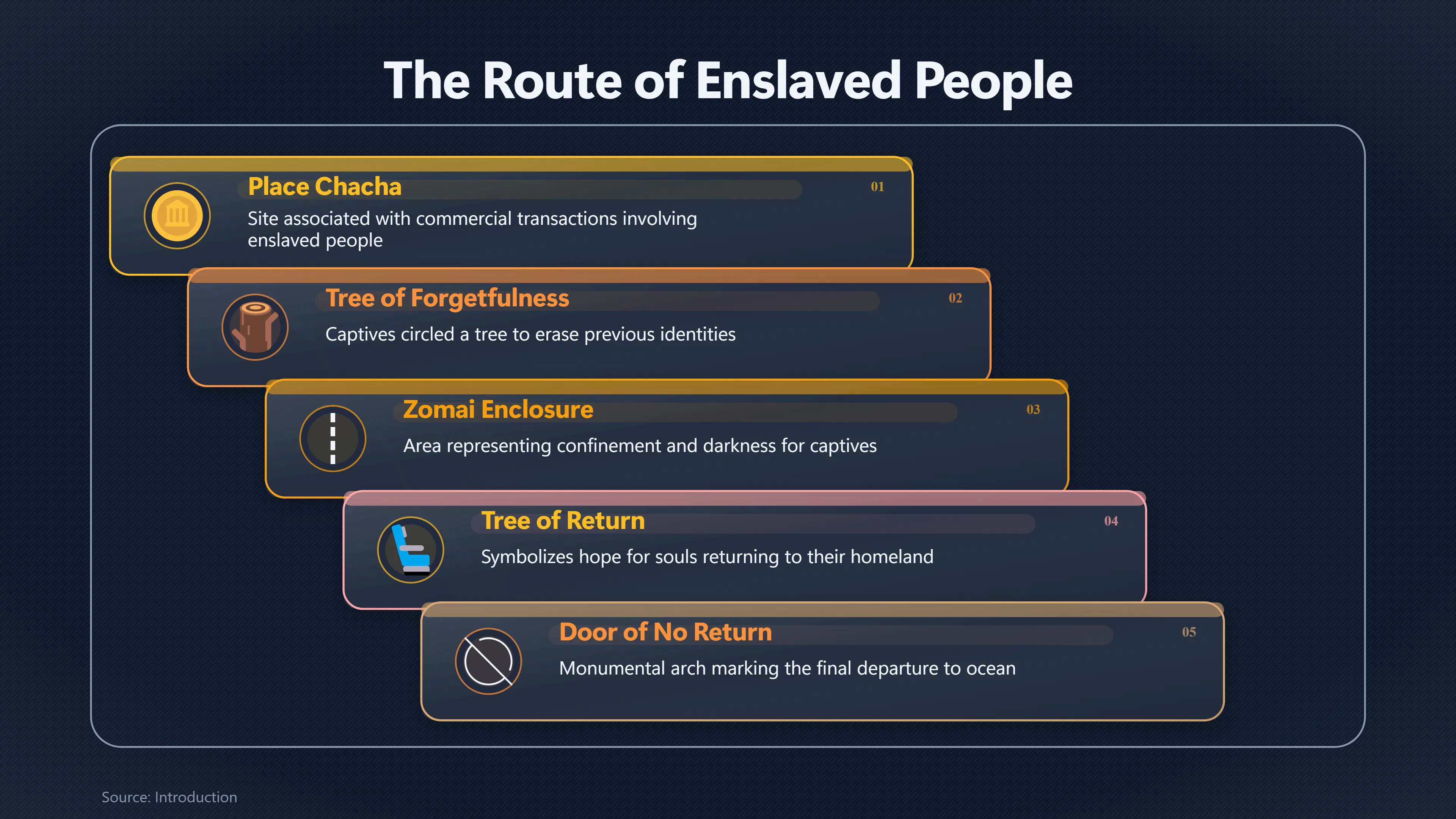
Although the exact appearance of every stop has changed over time, the memorial route presents successive stages in the destruction of personal identity experienced by enslaved people. Among the most recognised locations are:
- Place Chacha, associated with commercial transactions involving enslaved people.
- The Tree of Forgetfulness, where later tradition holds that captives were forced to circle a tree in a symbolic attempt to erase their previous identities.
- Former barracoon areas, recalling holding compounds before embarkation.
- The Zomai enclosure, representing confinement and darkness.
- The Tree of Return, symbolising the hope that souls would eventually return to their homeland.
- The Door of No Return, the monumental arch on the beach that has become the defining image of Ouidah.[Ouidah Origins]ouidahorigins.comOuidah Origins Historical journey slave route in Ouidah | Ouidah OriginsOuidah Origins Historical journey slave route in Ouidah | Ouidah Origins
The Door of No Return itself is a modern monument rather than a surviving historical structure. Built in 1995 as part of UNESCO’s wider remembrance programme, its open arch deliberately contains no physical door. The absence symbolises an irreversible departure while inviting reflection from both directions: towards the Atlantic crossed by enslaved people and back towards the African continent they left behind. Sculptural reliefs depict chained figures moving towards the sea, while symbolic imagery above them emphasises spiritual endurance rather than historical reconstruction alone.[Ouidah Origins]ouidahorigins.comOuidah Origins Guide to visit door of no return Ouidah | Ouidah OriginsOuidah Origins Guide to visit door of no return Ouidah | Ouidah Origins
When memorial landscapes become tourist attractions
Ouidah demonstrates both the strengths and the challenges of presenting traumatic history through cultural tourism.
Walking the route is often more emotionally effective than viewing museum cases because visitors experience physical distance, changing landscapes and repeated moments of reflection. The gradual movement from town to ocean reinforces the irreversible nature of the journey made by enslaved people in a way that static exhibitions rarely achieve.
At the same time, memorial tourism inevitably creates tensions. Souvenir stalls, tour groups and photography coexist with places intended for mourning and remembrance. Some monuments commemorate traditions that survive primarily through oral history rather than archaeological certainty, while others are consciously symbolic artistic creations. Understanding this distinction helps visitors appreciate the route without assuming every feature is an untouched historical survival.[Ouidah Origins]ouidahorigins.comOuidah Origins Historical journey slave route in Ouidah | Ouidah OriginsOuidah Origins Historical journey slave route in Ouidah | Ouidah Origins
Scholars of public history often regard this mixture as part of the site’s value rather than a flaw. Ouidah is not attempting to freeze the past exactly as it was; it is showing how successive generations have chosen to remember, reinterpret and publicly acknowledge one of the defining tragedies of Atlantic history. UNESCO’s own programme has consistently framed the route as a place for education, intercultural dialogue and social justice rather than a conventional archaeological site.[UNESCO]unesco.orgThe Routes of Enslaved Peoples: 30 Years of Dedicated Work for PeaceThe Routes of Enslaved Peoples: 30 Years of Dedicated Work for PeaceSeptember 26, 2025…

Why the route matters within Benin’s unusual heritage
Among Benin’s most distinctive visitor experiences, Ouidah’s memorial landscape stands apart because it transforms an entire urban environment into a museum without walls.
Unlike curiosity museums built around unusual objects, Ouidah’s significance lies in its geography. Roads, beaches, monuments, museums and ceremonial spaces together become the collection. The artefacts are important, but the landscape itself is the principal exhibit.
This approach also links naturally with other parts of Ouidah’s cultural identity. The city’s Vodun traditions, annual ceremonies and growing engagement with descendants of the African diaspora mean that remembrance is not confined to historical interpretation alone. It continues through commemorative events, official ceremonies and personal journeys by visitors tracing ancestral connections across the Atlantic. In that sense, Ouidah functions simultaneously as museum, memorial, pilgrimage destination and living historical landscape.[AP News]apnews.comThis initiative, led by President Patrice Talon, reflects the country's effort to reconcile with its participation in the slave trade. In…
Amazon book picks
Further Reading
Books and field guides related to How Ouidah Turned a City Into a Memorial. Use these as the next step if you want deeper reading beyond the article.
The Slave Trade: The Story of the Atlantic Slave Trade: 1440–...
After many years of research, award-winning historian Hugh Thomas portrays, in a balanced account, the complete history of the slave trad...
Atlas of the Transatlantic Slave Trade
A monumental cartographic history of the African slave trade, updated and expanded in a new edition In the first edition of Atlas of the...
The Door of No Return: The History of Cape Coast Castle and t...
First published 2007. Subjects: Cape Coast Castle (Cape Coast, Ghana), Sociological aspects, Slave trade, Slavery, History.
eBay marketplace picks
Marketplace Samples
Live-tested eBay searches with available results related to this page.
Selected fromAfrican history poster oneBay.co.uk.




Endnotes
1.
Source: unesco.org
Title: The Routes of Enslaved Peoples: 30 Years of Dedicated Work for Peace
Link:https://www.unesco.org/en/articles/routes-enslaved-peoples-30-years-dedicated-work-peace-and-social-justice
Source snippet
The Routes of Enslaved Peoples: 30 Years of Dedicated Work for PeaceSeptember 26, 2025...
Published: September 26, 2025
2.
Source: apnews.com
Link:https://apnews.com/article/8b076652fbaac17761ff002992f2b604
Source snippet
This initiative, led by President Patrice Talon, reflects the country's effort to reconcile with its participation in the slave trade. In...
3.
Source: ouidahorigins.com
Title: Ouidah Origins Historical journey slave route in Ouidah | Ouidah Origins
Link:https://ouidahorigins.com/en/pillars/the-slave-route
4.
Source: ft.com
Title: Financial Times Restitution, wrangling and renewal in Benin
Link:https://www.ft.com/content/af133939-e6da-411b-9404-217d2a6ae6a2
Source snippet
Entre los objetos saqueados se incluyeron cetros, estatuas y puertas ornamentadas que posteriormente fueron exhibidas en el Musée du Quai...
5.
Source: ouidahorigins.com
Title: Ouidah Origins Guide to visit door of no return Ouidah | Ouidah Origins
Link:https://ouidahorigins.com/en/pillars/the-door-of-no-return
6.
Source: ouidahorigins.com
Title: Standing here, you are at the hinge of the entire st
Link:https://ouidahorigins.com/pillars/the-door-of-no-return
Source snippet
Guide to visit door of no return Ouidah | Ouidah OriginsJune 7, 2026 — IF YOU WANT TO GO DEEPER The Door of No Return is the end point of...
Published: June 7, 2026
7.
Source: ouidahorigins.com
Title: MIM E museum: new international slavery memory center | Ouidah Origins
Link:https://ouidahorigins.com/en/journal/mime-museum-slavery-memory-ouidah
8.
Source: ouidahorigins.com
Title: Safeguarding Ouidah’s cultural heritage | Ouidah Origins
Link:https://ouidahorigins.com/en/journal/coastal-erosion-ouidah-heritage-at-risk
9.
Source: ouidahorigins.com
Link:https://ouidahorigins.com/fr/pillars/the-slave-route
10.
Source: ouidahorigins.com
Title: A trágica história da porta do não retorno em Ouidah | Ouidah Origins
Link:https://ouidahorigins.com/pt/pillars/the-door-of-no-return
11.
Source: ouidahorigins.com
Link:https://ouidahorigins.com/en
12.
Source: ouidahorigins.com
Link:https://ouidahorigins.com/en/pillars
13.
Source: cipdh.gob.ar
Title: Slave Route
Link:https://www.cipdh.gob.ar/memorias-situadas/en/lugar-de-memoria/la-ruta-del-esclavo/
14.
Source: en.wikivoyage.org
Link:https://en.wikivoyage.org/wiki/Ouidah
Additional References
15.
Source: visitabomey.com
Title: Ouidah slave route: path of memory and history | Visit Abomey
Link:https://visitabomey.com/en/pillars/ouidah-slave-route
Source snippet
June 15, 2026 — THE OUIDAH SLAVE ROUTE: A PATH OF MEMORY THE OUIDAH SLAVE ROUTE: A PATH OF MEMORY Coordinates 6.3667, 2.0833 history 2026...
Published: June 15, 2026
16.
Source: heritageandroutes.com
Title: Slave Route of Ouidah: 10 Stations, 4 km | Heritage and Routes
Link:https://heritageandroutes.com/en/field-notes/slave-route-ouidah/
Source snippet
Before you visit, hear what the ground holds. THE SLAVE ROUTE OF OUIDAH — WALKING MEMORY ON THE BIGHT OF BENIN COAST, FROM...
17.
Source: youtube.com
Title: Commemorating the slave trade: In Benin, the city of Ouidah’s fight for memory
Link:https://www.youtube.com/watch?v=NjiInlwsNn4
Source snippet
Ouidah's Point of No Return: Exploring Benin's Forgotten Slave Route...
18.
Source: youtube.com
Title: Ouidah’s Point of No Return: Exploring Benin’s Forgotten Slave Route!
Link:https://www.youtube.com/watch?v=la9TOyMgqpY
Source snippet
Journey Through History | The Door of No Return in Ouidah, Benin...
19.
Source: youtube.com
Title: Journey Through History | The Door of No Return in Ouidah, Benin
Link:https://www.youtube.com/watch?v=TKPX5gLTUss
Source snippet
I STOOD WHERE MILLIONS WERE TAKEN– THE DOOR OF NO RETURN...
20.
Source: youtube.com
Title: I STOOD WHERE MILLIONS WERE TAKEN– THE DOOR OF NO RETURN
Link:https://www.youtube.com/watch?v=OitxXzBM4R4
Source snippet
A Tour of Ouidah, Benin | Gate of No Return...
21.
Source: researchgate.net
Link:https://www.researchgate.net/publication/386088163_Impact_socio-economique_et_spatiale_des_attractions_touristiques_dans_la_commune_de_Ouidah_le_cas_de_la_route_de_l%27esclave
22.
Source: tripadvisor.co.uk
Link:https://www.tripadvisor.co.uk/Attraction_Review-g479758-d21401704-Reviews-Route_Des_Esclaves-Ouidah_Atlantique_Department.html
23.
Source: tripadvisor.fr
Link:https://www.tripadvisor.fr/Attraction_Review-g479758-d21401704-Reviews-Route_Des_Esclaves-Ouidah_Atlantique_Department.html
24.
Source: aftervodundays.com
Link:https://www.aftervodundays.com/en/decouvrir/route-esclaves