Where Belarus Keeps Its Strangest Stories
Belarus does not have a large, clearly branded circuit of witchcraft, cryptid or medical-oddity museums.
Page outline Jump by section
Introduction
The most rewarding places are therefore not necessarily those advertised as “weird museums”. They are institutions where folklore, archaeology, devotion, war and private collecting produce unusual encounters with objects. Some are conventional public museums with professional collections. Others are theatrical visitor attractions, personal cabinets of curiosity or digital projects created because the relevant history is difficult to exhibit openly inside Belarus. The central question is not simply whether an object is strange, but who has chosen to preserve it, how it is interpreted and what kind of Belarus it is being used to represent.
Where Belarusian folklore becomes physical
Belarusian mythology is most visible in museums that turn the forest into an inhabited supernatural world. These institutions generally present traditional beliefs as cultural heritage rather than as evidence that supernatural beings literally exist. Their displays often mix ethnography, carved figures, theatrical scenery and family entertainment.
The Children’s Museum of Mythology and Forests in Zaslavl is the clearest visitor-facing example. Part of the town’s historical and cultural museum-reserve, it places representations of mythical beings alongside real forest animals and birds. The route leads through a staged woodland environment to a forester’s hut, where a household spirit guards the stove. The museum describes itself as the only children’s museum of its kind in Belarus and requires visitors to arrange admission through the main museum and exhibition complex in Zaslavl.[zaslaue.by]zaslaue.byion complex at the address 4, Rynochnaya str., Zaslavl.Read more…
What makes the Zaslavl museum unusual is its refusal to separate natural history neatly from supernatural tradition. A bird, a wild animal and a forest spirit occupy the same interpretive landscape because, in traditional rural belief, the forest was both an ecosystem and a morally charged place. The exhibition is therefore closer to an illustrated folklore journey than to an occult museum. Visitors should expect atmosphere and storytelling rather than rare magical artefacts or scholarly displays about historical witchcraft trials.
A second Museum of Mythology operates within the Berezinsky Biosphere Reserve, one of Belarus’s most important protected landscapes. Its location in an old forester’s house gives the exhibition an unusually direct relationship with the woods and wetlands that generated many of the beliefs it explores. The reserve presents the museum as part of its organised ecotourism programme, alongside nature exhibitions, guided tours and mythology-themed activities.[berezinsky.by]berezinsky.byMuseum of MythologyГПУMuseum of Mythology Museum … (2132) 37744 (2132) 37742 (факс) Accepting applications for excursions and tours, Republic of Belarus…
The Berezinsky Reserve has also developed a broader form of “mythological tourism”, including a recurring festival built around Slavic mythology and a Belarusian dragon figure. This is not the survival of an untouched pagan ritual. It is a modern cultural presentation in which folklore is reconstructed through performances, sculpture and tourism programming. The distinction matters: visitors are seeing contemporary heritage-making based on older stories, not an archaeological reconstruction of a single, documented pre-Christian religion.[berezinsky.by]berezinsky.byVideo materials and reportsГПУMuseums and parks of the reserve Ecotours tours into nature Mythological tourism. The most mystical festival of the summer! (2132) 377…
Together, Zaslavl and Berezinsky show how Belarusian curiosity culture often treats folklore as something embedded in landscape. The unusual creature is rarely displayed as an isolated monster specimen. Instead, it belongs to a world of forests, houses, seasonal customs and relationships between people and the non-human environment.
Sacred objects, domestic magic and Old Believer culture
The Vetka Museum of Old Believers and Belarusian Traditions offers a more object-centred encounter with religious strangeness. Vetka became an important refuge and artistic centre for Old Believers, communities that resisted reforms introduced into the Russian Orthodox Church in the seventeenth century. Their distinctive religious culture produced elaborate icons, manuscripts, textiles and domestic devotional objects.
The museum occupies the restored house of a former Old Believer merchant and is one of the most significant places for understanding the artistic world that developed around Vetka. The surrounding town and cemetery add another layer of uncanny interest. Official Belarusian tourism material describes monumental stone graves, eight-pointed crosses and local explanations that crosses were placed at the feet of the dead so that they would have something to lean upon when rising from the other world. That explanation should be read as local funerary folklore, not as a universal Old Believer doctrine.[belarus.by]belarus.byOpen source on belarus.by.
Inside the museum, the interest lies less in sensational occultism than in the intense materiality of belief. Icons were not merely pictures: their coverings, placement and ritual use helped create sacred space within homes and places of worship. Academic work on the Vetka collection has examined how decorated icons functioned within this wider devotional environment, while international exhibitions continue to identify Vetka as an important centre of Old Believer icon painting.[cyberleninka.ru]cyberleninka.ruOpen source on cyberleninka.ru.
The museum also preserves regional weaving traditions. The textile tradition of the village of Negliubka in the Vetka district has been placed on UNESCO’s list of intangible cultural heritage in need of urgent safeguarding, with the Vetka museum involved in its documentation and preservation. The woven patterns are not simply picturesque decoration: they carry local knowledge about technique, identity and ceremonial use.[ICH UNESCO]ich.unesco.orgICH UNESCONegliubka textile tradition of Vetka District Gomel RegionICH UNESCONegliubka textile tradition of Vetka District Gomel Region
For visitors interested in magical or unusual religious collections, Vetka is valuable precisely because it avoids the familiar commercial formula of curses, spell books and theatrical witches. Its strangeness comes from entering a devotional culture in which images, cloth, books, graves and domestic interiors were understood to possess spiritual significance. It is a serious historic and ethnographic museum, although local legends and tourism narratives sometimes sit alongside more careful curatorial interpretation.
A medieval town preserved beneath a roof
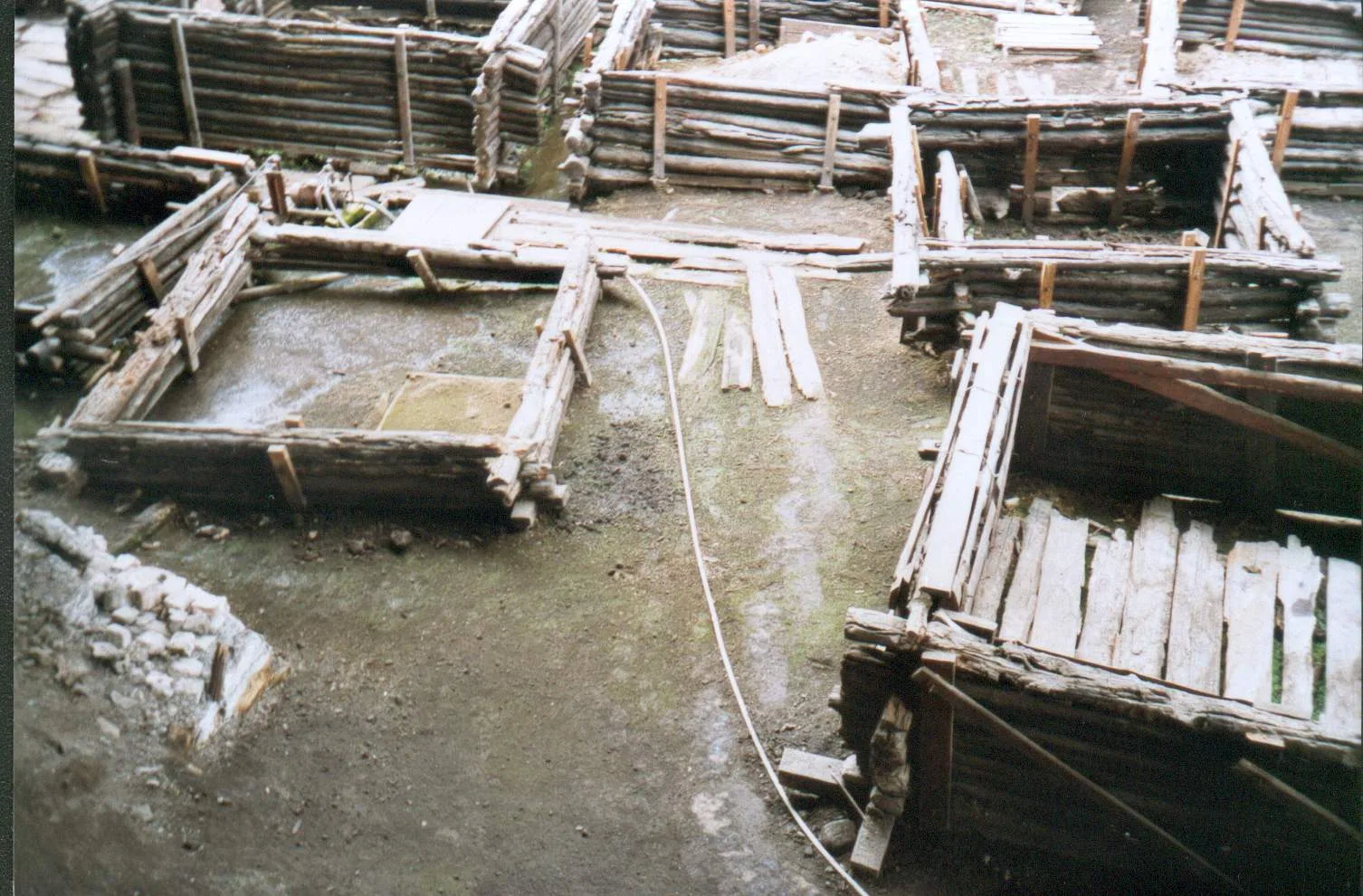
The Berestye Archaeological Museum in Brest contains one of Belarus’s most extraordinary preserved environments: the remains of a medieval East Slavic settlement displayed in situ. Archaeologists began excavating the site in 1968 and uncovered an artisans’ neighbourhood several metres below ground, including wooden buildings, streets, fences and the remains of ovens. A large modern structure was constructed over the excavation so that visitors could look down into the preserved town.[belarus.by]belarus.byOpen source on belarus.by.
The experience is closer to entering a giant archaeological cabinet than walking through a conventional local-history museum. Instead of seeing one reconstructed house, visitors encounter an entire darkened field of original timbers. Everyday objects recovered from the settlement help explain crafts, trade, clothing and domestic life, but the central exhibit is the buried urban fabric itself.
Berestye’s “mystery” is archaeological rather than paranormal. The preservation of so much timber creates the impression that the settlement was abruptly frozen in time, although the display is the result of excavation, conservation and substantial museum engineering. Official descriptions have promoted it as the only museum of a medieval Eastern European town of its type in Europe; such uniqueness claims can depend on how “museum”, “town” and “in situ” are defined, but the surviving concentration of wooden structures is unquestionably exceptional.[belarus.by]belarus.byi 22659i 22659
The museum matters within Belarus’s strange-history landscape because it demonstrates that an archaeological site can itself become the curiosity. Nothing needs to be invented or embellished: the uncanny effect comes from looking into the physical footprint of ordinary lives that disappeared centuries ago.
Private clutter as a museum of memory
The Janusz Parulis Museum of Life and History of Hrodna represents a very different kind of preservation. Rather than concentrating on royal treasures or major political events, this privately assembled museum is known for accumulating objects associated with the everyday history of Hrodna. It is regularly described as an unusual collection of household items and urban remnants rather than a formally ordered sequence of masterpieces.[Atlas Obscura]atlasobscura.comOpen source on atlasobscura.com.
Its appeal lies in density and personality. Old signs, tools, containers, furniture, photographs and other discarded things gain meaning through accumulation. A professionally curated museum usually removes repetition and visual noise; a collector’s museum often does the opposite, allowing objects to crowd together until the room itself becomes a portrait of obsession.
That informality is both the museum’s strength and its limitation. Private collections can preserve material that institutions once considered too common or insignificant, especially evidence of shops, workshops and domestic habits. Yet documentation, conservation and provenance may be inconsistent. Visitors should treat such a place as a personal archive shaped by its founder’s eye, not as a neutral or comprehensive history of the city.
Belarus has many conventional regional museums, but collections such as Parulis’s reveal a more eccentric tradition: the individual collector as rescuer of things that official history leaves behind. In that sense, a broken household object or fading shop sign can become as culturally revealing as a ceremonial artefact.
Medicine, illness and older explanations of the body
The Republican Museum of the History of Medicine in Minsk offers Belarus’s nearest equivalent to a medical-curiosity collection. Established under the Ministry of Health around the end of the Soviet period and opened to the wider public in the early 1990s, it holds documents, photographs, medical literature, instruments, awards and personal possessions connected with healthcare. A published visitor description reports a collection of more than 25,000 items.[KudaGo.com]minsk.kudago.comrespublik muzej istorii mediciny belarusrespublik muzej istorii mediciny belarus
Its most unusual material concerns the boundary between medicine and belief. Displays have addressed folk remedies, religious explanations of disease, malevolent spirits and protective objects. Such exhibits are valuable when they show how people made sense of illness before modern biomedical explanations became widely available. An amulet should therefore not be presented merely as a quaint superstition: it belonged to a practical system through which families understood danger, protection and recovery.
The museum appears to be an institutional history collection rather than a spectacular anatomy museum filled with pathological specimens. Visitors expecting preserved bodies or theatrical surgical horrors may find the tone more educational and documentary. Its strength is the contrast between folk healing, religious belief and professional medicine.
Public information about access has not always been consistently updated, and some listings describe limited weekday hours. This is the kind of specialist museum where opening arrangements should be confirmed directly rather than assumed from older tourism pages.[KudaGo.com]minsk.kudago.comrespublik muzej istorii mediciny belarusrespublik muzej istorii mediciny belarus
Bunkers, weapons and staged military history
Belarus’s landscape contains an unusually dense network of war memorials, fortress museums and preserved military structures. The most visitor-oriented bunker complex is Stalin’s Line, near Zaslavl. Built around surviving positions from the Minsk fortified area, it includes pillboxes, trenches, anti-tank obstacles, gun emplacements and a large collection of military vehicles and equipment.[belarus.by]belarus.byOpen source on belarus.by.
This is not a preserved battlefield left untouched. It is a reconstructed historical and cultural complex, opened with state support and developed as a venue for demonstrations, commemorations and large-scale re-enactments. Some vehicles are restored or assembled from components, and the site has created working replicas where complete originals were unavailable. A recent project to reproduce a rare tank variant, for example, used parts from three wartime vehicles.[belarus.by]belarus.byOpen source on belarus.by.
That combination of genuine fortifications, restored machines and theatrical action makes Stalin’s Line an important case study in authenticity. The bunkers are historic; parts of the wider visitor experience are reconstructed; and the interpretive framework is closely connected to the Belarusian state’s official culture of wartime remembrance. Displays and re-enactments can be impressive while still presenting a selective political narrative.
The site is therefore best approached on two levels. It is a substantial open-air collection of military engineering and machinery, but it is also a modern memory institution. The name, heroic presentation and emphasis on Soviet military continuity tell visitors as much about present-day state identity as about the original fortified line.
A smaller and more intimate prison-related collection exists in Hrodna. The Museum of Prison Life was developed from research into the local prison’s history and reportedly worked with the Hrodna historical and archaeological museum. Its subject is not imaginary horror but institutional confinement: the routines, objects and experiences associated with prison life.[Знай свой край]my-places.bygrodno muzej tyuremnogo bytagrodno muzej tyuremnogo byta
Political memory inside and outside Belarus
Some of the country’s most important unusual collections cannot be understood without considering what is difficult to commemorate publicly. The Virtual Museum of Soviet Repression in Belarus is a civil, non-profit project that gathers testimony and evidence concerning people affected by Soviet persecution. Its digital format allows photographs, documents, statistics and recorded memories to be presented without relying on a permanent state museum building.[represii.net]represii.netOpen source on represii.net.
This is a museum created partly in response to absence. Where official institutions give limited space to a contested history, an online archive can function as both memorial and evidence store. The “objects” are often voices, scans and family records rather than dramatic physical exhibits. Their significance comes from restoring individual lives to a history easily reduced to statistics.
The Free Belarus Museum in Warsaw performs a related role for the events surrounding the 2020 protests and subsequent repression. Established as a cultural and civic space in exile, it collects objects, documents, photographs and personal accounts associated with protest, imprisonment, forced migration and political resistance.[freebelarus.museum]freebelarus.museumOpen source on freebelarus.museum.
Its exhibitions demonstrate how quickly ordinary possessions can become historical artefacts. A 2026 display concerning released and deported political prisoners included prison-related objects and the small collection of necessities people carried from detention, including spoons, soap, clothing and food packages. Another account describes more than 30 objects linked to prison colonies and deportation procedures.[freebelarus.museum]freebelarus.museumFree Belarus MuseumFree Belarus Museum
These are not “curiosities” in the light entertainment sense. They are disturbing because of their ordinariness. A piece of prison clothing or improvised object records a system of confinement more directly than a grand monument can. The museum also digitises selected artefacts, recognising that contemporary evidence may be lost, confiscated or dispersed among an exiled community.[freebelarus.museum]freebelarus.museumFree Belarus MuseumFree Belarus Museum
The existence of Belarusian memory collections in Warsaw and online complicates the meaning of a country-level museum guide. Belarusian museum culture is no longer confined to Belarusian territory. Political exile has produced a parallel heritage network in which objects are collected abroad because exhibiting them at home may be unsafe or institutionally impossible.
What visitors should expect
Belarus’s strange-collection landscape rewards careful distinctions. The most obviously supernatural museums are generally folklore attractions, not occult research centres. Archaeological museums are professionally grounded but can still create a powerful sense of the uncanny. Private collections may be vivid and revealing while offering less systematic documentation. Military sites combine original fabric with reconstruction and state-sponsored interpretation. Political archives may be digital or exiled because the histories they preserve remain contested.
The strongest itinerary would combine contrasting forms of curiosity:
- For myth and forest spirits: the Children’s Museum of Mythology and Forests in Zaslavl and the Museum of Mythology at the Berezinsky Biosphere Reserve.
- For unusual religious material: the Vetka Museum of Old Believers and Belarusian Traditions.
- For archaeological immersion: the preserved medieval settlement at the Berestye Archaeological Museum.
- For collector-led eccentricity: the Janusz Parulis collection in Hrodna, subject to confirming current access.
- For medical belief and instruments: the Republican Museum of the History of Medicine in Minsk, with opening arrangements checked in advance.
- For bunkers and reconstructed military machinery: Stalin’s Line near Zaslavl.
- For difficult and suppressed memory: the Virtual Museum of Soviet Repression and the Warsaw-based Free Belarus Museum.
Belarus’s most distinctive collections are not united by a single love of monsters or macabre spectacle. They are united by the unstable border between official history and what might otherwise disappear: household spirits, buried streets, old icons, obsolete tools, prison possessions, ruined defences and personal testimony. The strange museum in Belarus is often a place where neglected material is asked to carry an unusually heavy burden of memory.

Amazon book picks
Further Reading
Books and field guides related to Where Belarus Keeps Its Strangest Stories. Use these as the next step if you want deeper reading beyond the article.
Belarus
Belarus remains the most inaccessible, unknown and misunderstood country in Europe. This new guide therefore offers a rare opportunity to...
The Gates of Europe
"[An] exemplary account of Europe's least-known large country... leavened by aphorism and anecdote." --Wall Street Journal Award-winning...
Bloodlands
Under Hitler and Stalin the Nazi and Soviet regimes murdered fourteen million people in the bloodlands between Berlin and Moscow. The kil...

The Last Empire: The Final Days of the Soviet Union
First published 2015. Subjects: Cold war, Soviet union, politics and government, 1985-1991.
eBay marketplace picks
Marketplace Samples
Live-tested eBay searches with available results related to this page.
Selected fromfolklore art print oneBay.co.uk.
Endnotes
1.
Source: zaslaue.by
Link:https://zaslaue.by/en/nashy-ab-ekty/dzicjachy-muzej-mifalogii-i-lesu/
Source snippet
ion complex at the address 4, Rynochnaya str., Zaslavl.Read more...
2.
Source: zaslaue.by
Link:https://zaslaue.by/en/
Source snippet
A gallery of mythical characters who, according to our ancestors, inhabited the surrounding world. Price. Музей...Read more...
3.
Source: berezinsky.by
Title: Museum of Mythology
Link:https://berezinsky.by/en/ekoturizm/museum-of-mythology/
Source snippet
ГПУMuseum of Mythology Museum … (2132) 37744 (2132) 37742 (факс) Accepting applications for excursions and tours, Republic of Belarus...
4.
Source: berezinsky.by
Link:https://berezinsky.by/en/
Source snippet
Berezinsky Biosphere ReserveThis is the only specially protected natural area of the highest rank in the Republic of Belarus. You can boo...
5.
Source: berezinsky.by
Title: Video materials and reports
Link:https://berezinsky.by/en/i/video-materials-and-reports/
Source snippet
ГПУMuseums and parks of the reserve Ecotours tours into nature Mythological tourism. The most mystical festival of the summer! (2132) 377...
6.
Source: berezinsky.by
Link:https://berezinsky.by/en/category/news/
Source snippet
ГПУMuseums and parks of the reserve Ecotours ・ nature Mythological tourism ・ mythological festival «Shlyakh ・ (2132) 37744. Republic of B...
7.
Source: berezinsky.by
Link:https://berezinsky.by/en/news/photo-report-on-the-fifth-festival-of-slavic-mythology-shlyakh-tsmoka/
Source snippet
Photo report on the fifth festival of Slavic mythology. Museum of Nature: (2132) 37713. Republic of...
8.
Source: belarus.by
Link:https://www.belarus.by/en/travel/top-guide-belarus/things-to-see-in-vetka-an-old-believers-refuge-major-iconographic-center_i_0000152375.html
9.
Source: researchgate.net
Link:https://www.researchgate.net/publication/361664515_An_icon_within_a_tradition_Fatherland_with_17_plot_stamps_from_the_collection_of_iconography_of_the_Vetka_Museum
10.
Source: ich.unesco.org
Title: ICH UNESCONegliubka textile tradition of Vetka District Gomel Region
Link:https://ich.unesco.org/en/USL/negliubka-textile-tradition-of-vetka-district-gomel-region-02088?USL=02088
11.
Source: ich.unesco.org
Title: ICH UNESCOPhotos: Negliubka textile tradition of Vetka District Gomel Region
Link:https://ich.unesco.org/en/7a-urgent-safeguarding-list-01411?call=slideshow&id=02088&include=slideshow_inc.php&mode=scroll&width=620
12.
Source: belarus.by
Link:https://www.belarus.by/en/travel/belarus-life/sightseeing/tourist-attraction-brest
13.
Source: belarus.by
Title: i 22659
Link:https://www.belarus.by/en/press-center/photo/i_22659.html?page=1
14.
Source: minsk.kudago.com
Title: respublik muzej istorii mediciny belarus
Link:https://minsk.kudago.com/place/respublik-muzej-istorii-mediciny-belarus/
15.
Source: belarus.by
Link:https://www.belarus.by/en/travel/military-history-tourism/memorials-great-patriotic-war
16.
Source: belarus.by
Link:https://www.belarus.by/en/travel/belarus-life/sightseeing/tourist-attraction-minsk
17.
Source: belarus.by
Link:https://www.belarus.by/en/press-center/news/veterans-proposed-lukashenko-supported-story-behind-stalins-line-museum-near-minsk_i_0000190544.html
18.
Source: belarus.by
Link:https://www.belarus.by/en/press-center/press-release/we-use-parts-of-three-tanks-stalins-line-museum-creates-replica-of-rarest-t-34-57_i_0000188959.html
19.
Source: represii.net
Link:https://represii.net/en/e_about
20.
Source: freebelarus.museum
Link:https://freebelarus.museum/en/about-us
21.
Source: freebelarus.museum
Link:https://freebelarus.museum/en
22.
Source: freebelarus.museum
Title: Free Belarus Museum
Link:https://freebelarus.museum/en/museum-exhibitions/fondavaya-vystava-muzeya-volnay-belarusi-kropka-uvahodu—-123
23.
Source: freebelarus.museum
Link:https://freebelarus.museum/en/exhibition
24.
Source: freebelarus.museum
Title: Free Belarus Museum
Link:https://freebelarus.museum/en/news/muzey-volnay-belarusi-raspachynae-praekt-pa-lichbavizacyi-i-pradastaulenni-dostupu-da-nazapashanyh-artefaktau
25.
Source: freebelarus.museum
Link:https://freebelarus.museum/en/projects-and-activities/praekt-muzey-svobodnay-belarusi—-centr-zahavannya-gistarychnay-pamyaci
26.
Source: freebelarus.museum
Title: Free Belarus Museum
Link:https://freebelarus.museum/pl/news/muzey-volnay-belarusi-zapusciu-novy-sayt
27.
Source: ich.unesco.org
Title: attiéké ivorian traditional dish made from fermented cassava 02088
Link:https://ich.unesco.org/en/RL/atti%C3%A9k%C3%A9-ivorian-traditional-dish-made-from-fermented-cassava-02088
28.
Source: belarus.by
Link:https://www.belarus.by/en/travel/belarus-life/sightseeing/tourist-attraction-vitebsk
29.
Source: belarus.by
Link:https://www.belarus.by/en/travel/belarus-life/museums
30.
Source: belarus.by
Link:https://www.belarus.by/rel_image/6419
31.
Source: belarus.by
Title: belarus events calendar april 2025 i 190078
Link:https://www.belarus.by/en/press-center/press-release/belarus-events-calendar-april-2025_i_190078.html
Published: april 2025
32.
Source: belarus.by
Link:https://www.belarus.by/en/press-center/press-release/ancient-fibulae-on-display-at-brest-regional-history-museum_i_202765.html
33.
Source: belarus.by
Title: museum night at stalin line complex near minsk ti 1682 0000034566
Link:https://www.belarus.by/en/press-center/photo/museum-night-at-stalin-line-complex-near-minsk_ti_1682_0000034566.html
34.
Source: belarus.by
Title: belarus events calendar july 2023 i 158919
Link:https://www.belarus.by/en/press-center/press-release/belarus-events-calendar-july-2023_i_158919.html
Published: july 2023
35.
Source: belarus.by
Title: lukashenko points out deep roots of belarusian statehood i 107306
Link:https://www.belarus.by/en/press-center/news/lukashenko-points-out-deep-roots-of-belarusian-statehood_i_107306.html
36.
Source: belarus.by
Link:https://www.belarus.by/en/travel/belarus-life/krevo-castle
37.
Source: belarus.by
Link:https://www.belarus.by/en/press-center/news/recipients-of-belarusian-presidents-award-in-art-and-culture-2019-announced_i_107271.html
38.
Source: belarus.by
Link:https://www.belarus.by/en/travel/belarus-life/sophia-cathedral-in-polotsk
39.
Source: belarus.by
Title: belarus president presents spiritual revival awards i 107305
Link:https://www.belarus.by/en/press-center/news/belarus-president-presents-spiritual-revival-awards_i_107305.html
40.
Source: belarus.by
Title: railway artifacts added to ww2 museum stalin line near minsk i 83581
Link:https://www.belarus.by/en/press-center/press-release/railway-artifacts-added-to-ww2-museum-stalin-line-near-minsk_i_83581.html
41.
Source: belarus.by
Title: belarusian written language day celebrations in belynichi ti 1783 0000036739
Link:https://www.belarus.by/en/press-center/photo/belarusian-written-language-day-celebrations-in-belynichi_ti_1783_0000036739.html
42.
Source: belarus.by
Link:https://www.belarus.by/en/travel/military-history-tourism
43.
Source: belarus.by
Link:https://www.belarus.by/en/search/?page=74&q=fullz+shop+list+&search_in=0
44.
Source: belarus.by
Link:https://www.belarus.by/en/travel/top-guide-belarus/what-to-see-in-mozyr-streets-running-through-ravines-a-temple-museum-and-a-unique-tram-service_i_0000135846.html
45.
Source: belarus.by
Link:https://www.belarus.by/en/search/?page=42&q=carding+sites+without+cvv+&search_in=0
46.
Source: belarus.by
Title: museum night 2020 at stalin line complex i 34569
Link:https://www.belarus.by/en/press-center/photo/museum-night-2020-at-stalin-line-complex-_i_34569.html?page=1
47.
Source: freebelarus.museum
Link:https://freebelarus.museum/en/news
48.
Source: zaslaue.by
Title: zaprashaem navedac noch muzeja u zasla i 20 maja uvahod volny
Link:https://zaslaue.by/en/naviny/zaprashaem-navedac-noch-muzeja-u-zasla-i-20-maja-uvahod-volny/
49.
Source: zaslaue.by
Link:https://zaslaue.by/en/naviny/pesnya-metalla/
50.
Source: zaslaue.by
Title: nashy ab ekty
Link:https://zaslaue.by/en/tag/nashy-ab-ekty/
51.
Source: zaslaue.by
Link:https://zaslaue.by/en/fotagalerjeja/
52.
Source: zaslaue.by
Link:https://zaslaue.by/en/muzejnyja-kalekcyi/
53.
Source: zaslaue.by
Link:https://zaslaue.by/en/blog/page/19/
54.
Source: zaslaue.by
Link:https://zaslaue.by/en/nashy-ab-ekty/museyna-vystovychniy-kompleks/
55.
Source: zaslaue.by
Title: звярніце ўвагу
Link:https://zaslaue.by/en/naviny/%D0%B7%D0%B2%D1%8F%D1%80%D0%BD%D1%96%D1%86%D0%B5-%D1%9E%D0%B2%D0%B0%D0%B3%D1%83/
56.
Source: berezinsky.by
Title: River builder
Link:https://berezinsky.by/en/ekoturizm/river-builder/
57.
Source: berezinsky.by
Link:https://berezinsky.by/en/news/results-of-the-summer-spartakiad-among-employees-of-organizations-of-the-presidential-property-management-department-of-the-republic-of-belarus/
58.
Source: berezinsky.by
Link:https://berezinsky.by/en/news/news-from-the-forest-protection-and-forestry-department-of-our-reserve/
59.
Source: berezinsky.by
Title: Drivers, beware
Link:https://berezinsky.by/en/news/drivers-beware-sudden-appearance-of-wild-animals-is-possible/
60.
Source: ich.unesco.org
Title: dossiers 2025 en cours 01347
Link:https://ich.unesco.org/fr/dossiers-2025-en-cours-01347?call=slideshow&id=02088&include=slideshow_inc.php&mode=scroll&width=620
61.
Source: cyberleninka.ru
Link:https://cyberleninka.ru/article/n/prostranstvennaya-ikona-v-kulture-vetki-bogomater-kazanskaya
62.
Source: atlasobscura.com
Link:https://www.atlasobscura.com/things-to-do/belarus/museums
63.
Source: my-places.by
Title: grodno muzej tyuremnogo byta
Link:https://my-places.by/en/places/grodno-muzej-tyuremnogo-byta
64.
Source: batafiche.trentu.ca
Link:https://batafiche.trentu.ca/web/mmepsv/node/95
65.
Source: belarus-nau.org
Link:https://www.belarus-nau.org/en/post/entry-point-123-new-exhibition-at-the-museum-of-free-belarus
66.
Source: my-places.by
Title: minsk muzej zemlevedeniya
Link:https://my-places.by/en/places/minsk-muzej-zemlevedeniya
67.
Source: my-places.by
Title: zaslavl detskij muzej mifologii i lesa
Link:https://my-places.by/places/zaslavl-detskij-muzej-mifologii-i-lesa
68.
Source: my-places.by
Title: grodno muzej byta i istorii grodno yanusha parulisa
Link:https://my-places.by/en/places/grodno-muzej-byta-i-istorii-grodno-yanusha-parulisa
69.
Source: icon-art.info
Link:https://www.icon-art.info/location.php?lng=ru&loc_id=901
70.
Source: atlasobscura.com
Title: Januš Parulis Museum of Life and History of Hrodna in Hrodna
Link:https://www.atlasobscura.com/places/museum-of-urban-life-and-history-of-grodno
71.
Source: atlasobscura.com
Title: Cool and Unusual Things to Do in Hrodna
Link:https://www.atlasobscura.com/things-to-do/hrodna-belarus
72.
Source: atlasobscura.com
Title: Museum of Stones in Minsk
Link:https://www.atlasobscura.com/places/museum-of-stones
73.
Source: atlasobscura.com
Link:https://www.atlasobscura.com/things-to-do/belarus
74.
Source: atlasobscura.com
Link:https://www.atlasobscura.com/things-to-do/hrodna-belarus/museums
75.
Source: atlasobscura.com
Link:https://www.atlasobscura.com/things-to-do/hrodna-belarus/collections
76.
Source: my-places.by
Link:https://my-places.by/en/places/zaslavl-detskij-muzej-mifologii-i-lesa
77.
Source: my-places.by
Link:https://my-places.by/en/places/rutkevichi-muzej-holodnoj-vojny-bunker-77
78.
Source: my-places.by
Link:https://my-places.by/en/places/istoriko-kulturnyj-muzej-zapovednik-zaslavl
79.
Source: my-places.by
Link:https://my-places.by/en/places/minsk-muzej-valunov
80.
Source: medicalhistorymuseum.mdhs.unimelb.edu.au
Link:https://medicalhistorymuseum.mdhs.unimelb.edu.au/collections
Additional References
81.
Source: youtube.com
Link:http://www.youtube.com/watch?v=5Ppzbjrc4Y4
Source snippet
Zaslavl museum Belarus mythology forest Zaslavl Tatyana's travels...
82.
Source: youtube.com
Link:http://www.youtube.com/watch?v=phqnRzQgntY
Source snippet
BACK TO THE FUTURE_The new Museum of Belarusian culture in Minsk / 2021...
83.
Source: youtube.com
Link:http://www.youtube.com/watch?v=qH5bPYBfZHs
Source snippet
Who are the Gods of Slavic Mythology?...
84.
Source: belarustourism.by
Link:https://belarustourism.by/i/2010/10prichin_engl.pdf
85.
Source: bmm-charite.de
Link:https://bmm-charite.de/en/museum
86.
Source: tripadvisor.co.uk
Link:https://www.tripadvisor.co.uk/Attraction_Review-g661665-d11875157-Reviews-Janusz_Parulis_s_History_Museum_of_Grodno-Grodno_Grodno_Region.html
87.
Source: belarusvc.com
Link:https://belarusvc.com/visit/belovezhskaya-pushcha/
88.
Source: findit.city
Link:https://findit.city/en/belarus/minsk/leisure/recreation/parks/boulder-museum-park-of-stones/description
89.
Source: waze.com
Link:https://www.waze.com/af/live-map/directions/by/hrodna-region/hrodna/janus-parulis-museum-of-life-and-history-of-hrodna?to=place.ChIJXTOdtiDW30YRgk9FW4WjVqU
90.
Source: facebook.com
Link:https://www.facebook.com/LivingSlavic/posts/every-slavic-childhood-fear-unlocked/877114525069222/