Within Mozambique Curiosities
What Is Lost When Makonde Masks Stop Moving
Nampula's Makonde masks reveal how ritual, identity and movement can be flattened when living performance becomes a static exhibit.
On this page
- How masks functioned in performance
- How museums changed their meaning
- Colonial collecting and the recovery of named artists
Page outline Jump by section
Introduction
Makonde masks are among the most striking objects found in museums in northern Mozambique, but they were never created to be admired as isolated artworks. In their original setting, a carved mask was only one element in a larger performance involving costume, music, dance, drumming, movement and carefully defined social roles. Once placed behind glass, much of that meaning disappears. Understanding what is lost when Makonde masks stop moving helps explain why ethnographic collections can feel both fascinating and incomplete. The issue is not simply that museums preserve objects rather than performances; it is that the relationship between the mask, the performer and the community is central to what the object actually is.[columbia.edu]wallach.columbia.eduRevolutions: A Century of Makonde Masquerade in Mozambique | Wallach Art GallerySeptember 18, 2007…
How masks functioned in performance
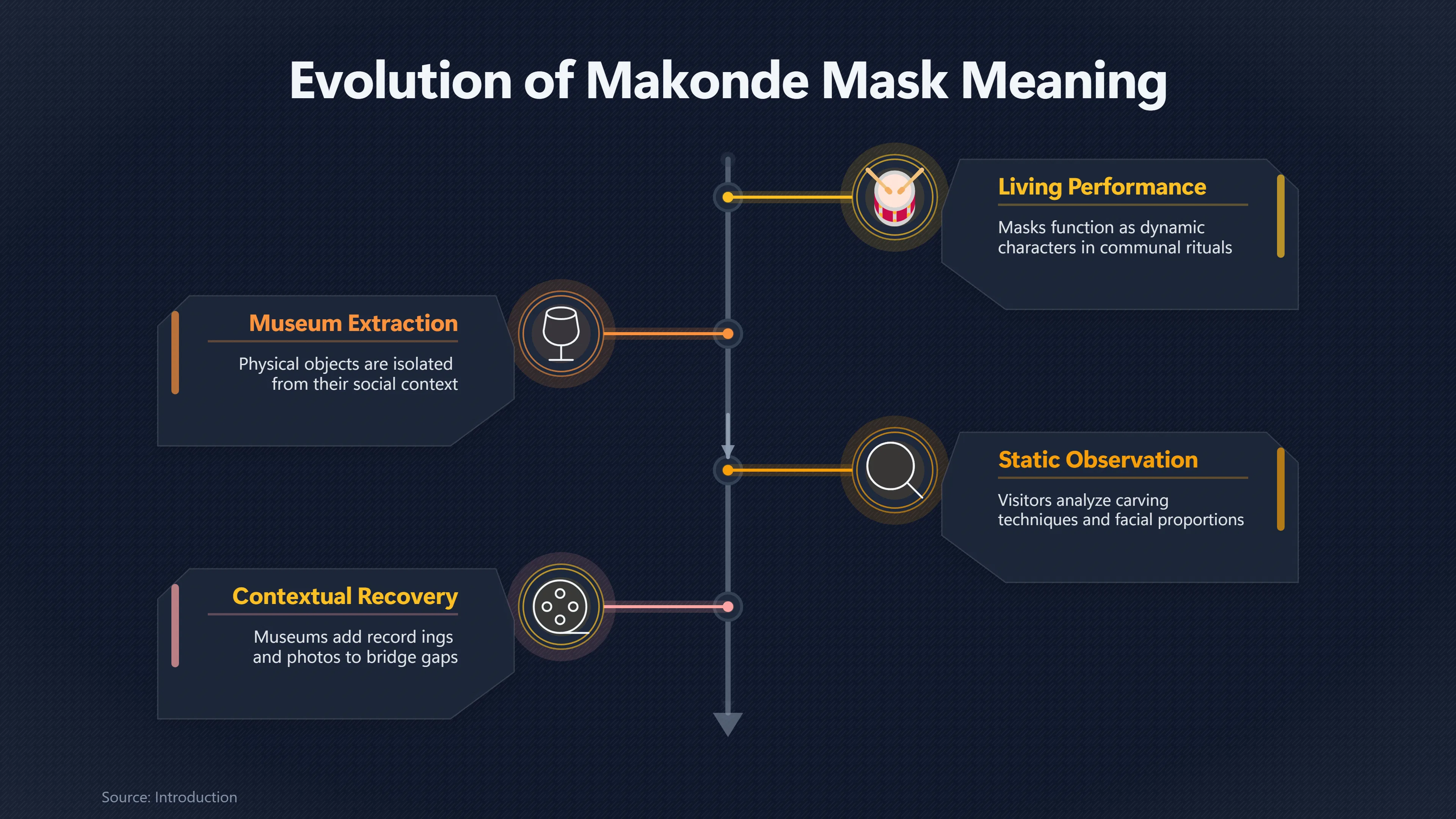
Among Makonde communities of northern Mozambique and neighbouring Tanzania, carved masks were used within the performance tradition known as mapiko. The carved wooden head was only the visible part of an elaborate masquerade. Performers concealed their entire bodies beneath costumes, danced to drums and trumpets, interacted with spectators and embodied particular characters rather than simply wearing decorative disguises. The performance could accompany initiation ceremonies, public celebrations or other significant communal events, with the meaning emerging through movement, sound and dramatic interaction rather than through the carved object alone.[wallach.columbia.edu]wallach.columbia.eduRevolutions: A Century of Makonde Masquerade in Mozambique | Wallach Art GallerySeptember 18, 2007…
Many masks were deliberately unsettling. They portrayed recognisable human faces but exaggerated expressions, scarification, hairstyles or physical features. Some represented named personalities, outsiders or social types rather than anonymous spirits. Others formed part of performances that instructed young people about adult responsibilities through humour, satire or carefully staged encounters. Audiences did not merely observe a carved object; they responded to a living character whose identity depended on performance.[wallach.columbia.edu]wallach.columbia.eduRevolutions: A Century of Makonde Masquerade in Mozambique | Wallach Art GallerySeptember 18, 2007…
Even apparently static features carried meaning only in motion. Fibre beards, real hair, elaborate costumes and bodily gestures combined to create convincing personalities. A museum visitor viewing only the wooden helmet mask sees craftsmanship, but the original audience experienced a complete theatrical event involving rhythm, choreography and community participation.[British Museum]britishmuseum.orgBritish Museummask | British MuseumBritish Museummask | British Museum
How museums changed their meaning
When Makonde masks entered museum collections, they became easier to preserve, compare and study, but they also became detached from the performances that gave them life. Display cases encourage visitors to examine carving techniques, facial proportions and artistic style. These are important qualities, yet they represent only one layer of the original cultural practice.
This shift reflects a broader challenge in ethnographic museums. Objects survive far more easily than songs, choreography, spoken dialogue or relationships between performers and audiences. A visitor may spend several minutes looking at a mask that originally appeared only briefly during a performance before disappearing again into ritual secrecy. What was once dynamic becomes permanently motionless.
Museums increasingly acknowledge this limitation by presenting masks alongside photographs, recordings or explanations of mapiko performance. Even so, documentation cannot fully recreate the experience of masked dancers moving through space, responding to musicians and interacting unpredictably with spectators. The object remains authentic, but the cultural event has necessarily been transformed into an exhibition.[wallach.columbia.edu]wallach.columbia.eduRevolutions: A Century of Makonde Masquerade in Mozambique | Wallach Art GallerySeptember 18, 2007…

Colonial collecting and the recovery of named artists
The history of Makonde collections in Mozambique also reflects the priorities of colonial-era collecting. The National Museum of Ethnology in Nampula originated within a Portuguese colonial project to gather and classify African material culture. Researchers have shown that many objects entered the collection through inconsistent documentation, with limited attention paid to individual makers, local contexts or the circumstances in which pieces were acquired.[scielo.pt]scielo.ptOpen source on scielo.pt.
Recent research has begun to reverse that pattern by identifying master Makonde sculptors whose names had disappeared from museum records. Artists such as Chibanga Muali, Amisse Chipatela and Matete Mepondala are now being linked back to works that had long been treated simply as anonymous examples of “Makonde art”. This changes how visitors understand the collection. Instead of viewing every mask or sculpture as the interchangeable product of a culture, they can recognise individual artistic choices, distinctive carving styles and personal creativity.[scielo.pt]scielo.ptOpen source on scielo.pt.
The same research also shows that colonial commissions influenced what was collected. Some carvings reflected local artistic innovation, while others responded to requests from colonial administrators or collectors seeking particular subjects or styles. As a result, museum collections preserve both traditional performance culture and the history of changing artistic markets, making careful interpretation essential.[scielo.pt]scielo.ptOpen source on scielo.pt.
Why this matters for visitors
For visitors to Mozambique’s ethnographic collections, Makonde masks are best understood as fragments of a larger cultural performance rather than complete artworks in themselves. The carved face remains an extraordinary achievement of craftsmanship, but it originally functioned alongside music, costume, movement and social interaction.
Recognising that distinction changes the museum experience. Instead of asking only who carved a mask or how old it is, visitors can also ask:
- Who would have worn it?
- What sounds and movements accompanied it?
- What role did the audience play?
- Which parts of the performance cannot be preserved inside a gallery?
- Can the individual artist be identified rather than treated as anonymous?
These questions reveal why Makonde masks occupy such an important place in Mozambique’s landscape of unusual collections. Their mystery does not arise from supernatural claims or hidden powers but from the fact that museums preserve the physical shell of a living performance while inevitably leaving much of its original life outside the display case.[columbia.edu]wallach.columbia.eduRevolutions: A Century of Makonde Masquerade in Mozambique | Wallach Art GallerySeptember 18, 2007…
Amazon book picks
Further Reading
Books and field guides related to What Is Lost When Makonde Masks Stop Moving. Use these as the next step if you want deeper reading beyond the article.
African Art in Motion: Icon and Act
National Gallery of Art, Washington, Apr. 28 - Aug. 18, 1974
The Museum of Other People
A TLS BEST BOOK OF 2023 'A formidable work' Nigel Barley, author of The Innocent Anthropologist 'Should be required reading' Richard Lamb...

The Scramble for Art in Central Africa
Western attitudes to Africa have been influenced to an extraordinary degree by the arts and artefacts that were brought back by the early...
eBay marketplace picks
Marketplace Samples
Live-tested eBay searches with available results related to this page.
Selected fromAfrican tribal art oneBay.co.uk.
Endnotes
1.
Source: wallach.columbia.edu
Title: Revolutions: A Century of Makonde Masquerade in Mozambique | Wallach Art Gallery
Link:https://wallach.columbia.edu/exhibitions/revolutions-century-makonde-masquerade-mozambique
Source snippet
September 18, 2007...
Published: September 18, 2007
2.
Source: scielo.pt
Link:https://scielo.pt/scielo.php?lng=es&nrm=iso%21&pid=S2184-04582025000104003&script=sci_arttext&tlng=pt
3.
Source: museum.makonde.jp
Link:https://museum.makonde.jp/en/gallery/makonde/mask/
4.
Source: museum.makonde.jp
Link:https://museum.makonde.jp/en/gallery/culture/
5.
Source: wallach.columbia.edu
Title: revolutions century makonde masquerade mozambique
Link:https://wallach.columbia.edu/content/revolutions-century-makonde-masquerade-mozambique
6.
Source: lammuseum.wfu.edu
Title: Timothy S. Y. Lam Museum of Anthropology Makonde Body Mask
Link:https://lammuseum.wfu.edu/2022/07/makonde-body-mask/
Source snippet
Timothy S. Y. Lam Museum of AnthropologyMakonde Body Mask - Timothy S. Y. Lam Museum of Anthropology...
7.
Source: britishmuseum.org
Title: British Museummask | British Museum
Link:https://www.britishmuseum.org/collection/object/E_Af1924
8.
Source: wepa.unima.org
Link:https://wepa.unima.org/en/mozambique/
9.
Source: britishmuseum.org
Link:https://www.britishmuseum.org/collection/object/E_Af1924
10.
Source: britishmuseum.org
Link:https://www.britishmuseum.org/collection/object/E_Af1958
11.
Source: britishmuseum.org
Link:https://www.britishmuseum.org/collection/object/E_Af2003
12.
Source: britishmuseum.org
Link:https://www.britishmuseum.org/collection/object/E_Af1957
13.
Source: britishmuseum.org
Link:https://www.britishmuseum.org/collection/object/E
Additional References
14.
Source: researchgate.net
Link:https://www.researchgate.net/publication/397605577_Arte_e_cultura_material_makonde_no_Museu_de_Nampula_formacao_de_acervo_e_ciencia_colonial_em_Mocambique
Source snippet
(PDF) Arte e cultura material makonde no Museu de Nampula: formação de acervo e ciência colonial em Moçambique (1950- 1960)January 1, 202...
15.
Source: researchgate.net
Link:https://www.researchgate.net/publication/392675576_A_Procura_de_Historias_Desconhecidas_no_Museu_Nacional_de_Etnologia_em_Nampula_Mestres_Escultores_e_Obras
Source snippet
(PDF) À Procura de Histórias Desconhecidas no Museu Nacional de Etnologia em Nampula: Mestres Escultores e ObrasJune 1, 2025 — À PROCURA...
Published: June 1, 2025
16.
Source: youtube.com
Title: BMA Voices: A Royal Man’s Mask (Mukenga) from the Kuba kingdom
Link:https://www.youtube.com/watch?v=EnYoYuDfP7c
Source snippet
Makonde mask Mozambique Mapiko The Makonde The Mystical Sculptors Makonde community National Museums Of Kenya...
17.
Source: youtube.com
Title: Brooklyn Museum’s Exhibit “Disguise” Celebrates African Masks | BK Live
Link:https://www.youtube.com/watch?v=Hym-tD_zk3c
Source snippet
BMA Voices: A Royal Man’s Mask (Mukenga) from the Kuba kingdom...
18.
Source: youtube.com
Title: The Makonde The Mystical Sculptors Makonde community
Link:https://www.youtube.com/watch?v=ZTO1B3hPtpE
Source snippet
Brooklyn Museum's Exhibit "Disguise" Celebrates African Masks | BK Live...
19.
Source: ich.unesco.org
Link:https://ich.unesco.org/en/Decisions/18.COM/8.a.5
Source snippet
of the Intergovernmental Committee: 18.COM 8.a.5 - UNESCO Intangible Cultural HeritageDecember 5, 2023 — DECISION OF THE INTERGOVERNMENTA...
Published: December 5, 2023
20.
Source: nms.ac.uk
Link:https://www.nms.ac.uk/profile/dr-zachary-kingdon
21.
Source: missionsmuseum.de
Link:https://www.missionsmuseum.de/en/museum/object-in-focus/makonde-helmet-masks-mapiko
22.
Source: maskmuseum.org
Link:https://www.maskmuseum.org/mask/makonde-face/
23.
Source: maskmuseum.org
Link:https://www.maskmuseum.org/mask/lipiko-1/