Within Strange Bolivia
Are Bolivia's Witches' Markets Really for Tourists?
La Paz and El Alto turn ritual ingredients, healing knowledge and devotional goods into a living marketplace rather than a staged curiosity.
On this page
- What the markets sell and why
- Ritual specialists, customers and offerings
- Tourism, photography and respectful visiting
Page outline Jump by section
Introduction
Bolivia’s so-called “Witches’ Markets” are not open-air museums or theatrical attractions created for visitors. They are working marketplaces where ritual specialists, herbal vendors and customers buy the materials needed for ceremonies connected with health, protection, prosperity, travel, farming, construction and family life. Although the best-known stalls in central La Paz have become a major tourist attraction, they remain part of a broader ritual economy that extends into neighbourhoods of El Alto and other parts of the Andean highlands. Understanding these markets means looking beyond the colourful displays to the living relationships between belief, commerce, healing and everyday life. Rather than preserving a vanished tradition behind glass, the markets demonstrate how ritual knowledge continues to circulate through ordinary buying and selling.[nationalgeographic.com]nationalgeographic.comNational Geographic La Paz, Bolivia, Witch Market | National GeographicNational GeographicLa Paz, Bolivia, Witch Market | National GeographicFebruary 26, 2018…

Are Bolivia’s Witches’ Markets Really for Tourists?
The simple answer is no, although tourism has become an important part of the economy surrounding the markets.
Many visitors arrive expecting a spectacle centred on “witchcraft”. In practice, the famous Mercado de las Brujas in central La Paz is a mixed commercial space. Some stalls cater heavily to international travellers with souvenirs, small charms and photo-friendly displays. Others continue to supply ritual practitioners and local customers with items that are intended to be used in ceremonies rather than displayed as curiosities. The same shop may serve both audiences on the same day.[National Geographic]nationalgeographic.comNational Geographic La Paz, Bolivia, Witch Market | National GeographicNational GeographicLa Paz, Bolivia, Witch Market | National GeographicFebruary 26, 2018…
The popular English name “Witches’ Market” can itself be misleading. It reflects a tourist-friendly label rather than a precise description of Indigenous religious practice. The markets bring together vendors, healers and spiritual specialists whose work combines traditional Andean beliefs with elements of Catholic devotion and local healing traditions. Their activities range from preparing ritual offerings to advising clients on ceremonies, interpreting coca leaves and recommending medicinal plants.[National Geographic]nationalgeographic.comNational Geographic La Paz, Bolivia, Witch Market | National GeographicNational GeographicLa Paz, Bolivia, Witch Market | National GeographicFebruary 26, 2018…
Looking beyond the tourist quarter also changes the picture. El Alto, the large city above La Paz, contains larger ritual markets that are less oriented towards foreign visitors and more closely connected with everyday local demand. Journalists and anthropologists frequently describe these districts as places where ritual commerce continues largely for Bolivian customers rather than sightseeing groups.[Geographical]geographical.co.ukGeographical Old and new in El Alto, Bolivia's highest cityOld and new in El Alto, Bolivia's highest city - GeographicalMay 6, 2022…
What the Markets Sell and Why
The merchandise appears unusual because many objects are designed for ceremonial use rather than decoration.
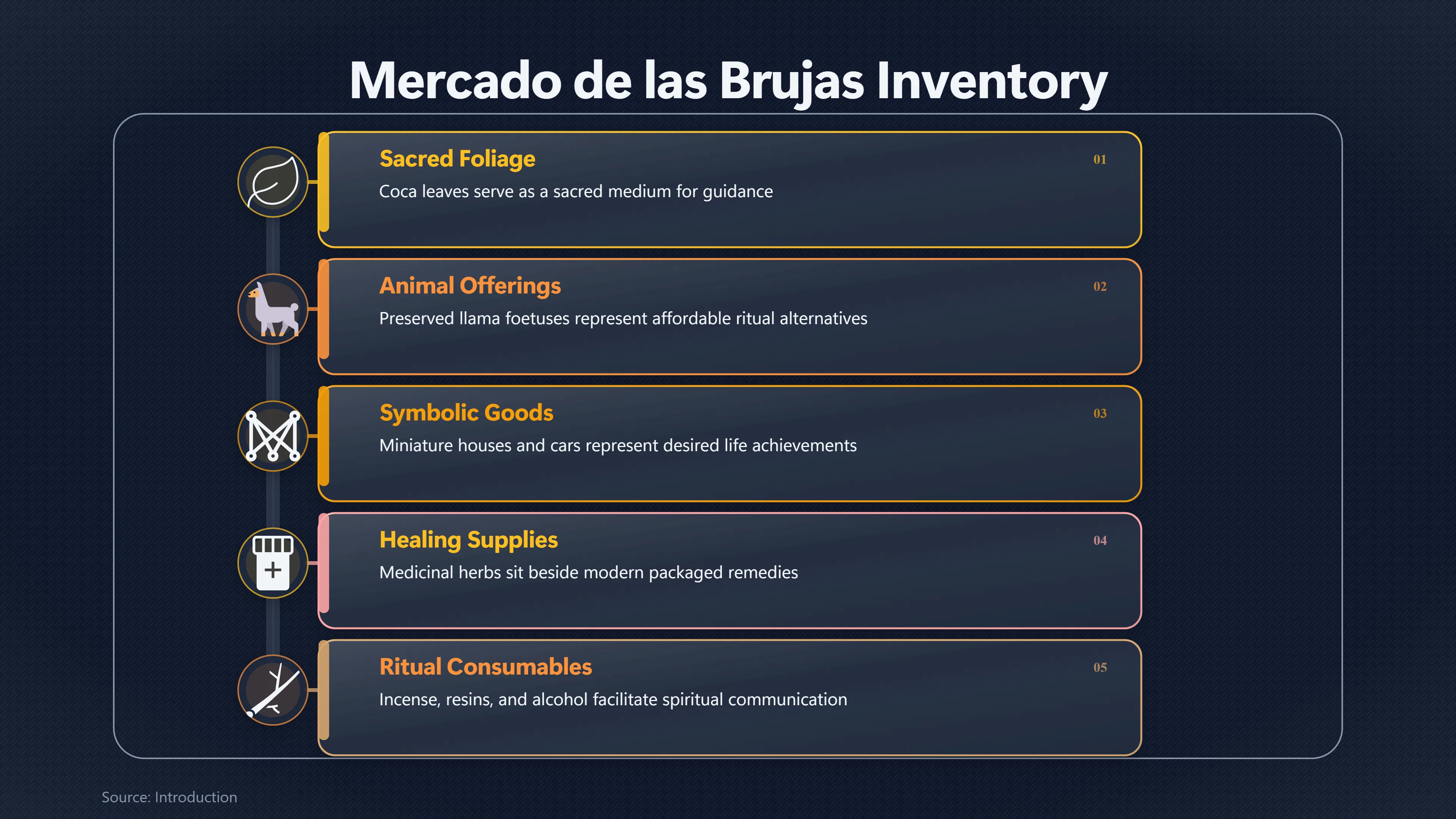
A visitor will typically encounter shelves and sacks filled with medicinal herbs, coca leaves, incense, resins, candles, alcohol, coloured sugars, miniature houses, cars and banknotes, carved figurines, amulets and ritual powders. Individually these items may seem ordinary or mysterious, but their significance comes from how they are assembled into offerings known as ritual “tables” or packages prepared for specific requests.[nationalgeographic.com]nationalgeographic.comNational Geographic La Paz, Bolivia, Witch Market | National GeographicNational GeographicLa Paz, Bolivia, Witch Market | National GeographicFebruary 26, 2018…
The best-known objects are preserved llama foetuses. Their prominence in travel photography has sometimes obscured their actual ritual purpose. In Andean tradition they are commonly placed within offerings made to Mother Earth, especially before constructing a new building, opening a business or asking for protection. Wealthier families or construction projects may commission larger ceremonies, while preserved foetuses provide a more affordable alternative to the animal sacrifices used in some traditional rituals.[National Geographic]nationalgeographic.comNational Geographic La Paz, Bolivia, Witch Market | National GeographicNational GeographicLa Paz, Bolivia, Witch Market | National GeographicFebruary 26, 2018…
Coca leaves are equally important but far less sensational. They function as both a practical crop and a sacred medium. Ritual specialists read their patterns for guidance, while offerings frequently include coca alongside sweets, grains and symbolic objects representing health, work or prosperity. Coca also remains a legal everyday product within Bolivia’s traditional growing regions and plays a central role in many Indigenous ceremonies.[AP News]apnews.comFor farmers like 69-year-old Tomas Zavala, coca is more than a crop—it's a sacred connection to nature and a family inheritance. Used in…
The markets also stock remedies that blur distinctions between herbal medicine, spiritual protection and popular healing. Modern packaged products may sit beside dried plants and traditional preparations, illustrating how these markets continually adapt rather than freezing ancient practices in time.[Geographical]geographical.co.ukGeographical Old and new in El Alto, Bolivia's highest cityOld and new in El Alto, Bolivia's highest city - GeographicalMay 6, 2022…
Ritual Specialists, Customers and Offerings
The markets function because they connect specialist knowledge with everyday needs.
Many customers are not seeking supernatural experiences but practical help with life’s uncertainties: opening a business, moving into a new house, protecting livestock, improving health, resolving family problems or asking for success at work. Ritual specialists prepare customised offerings according to these requests rather than selling identical products to everyone.[National Geographic]nationalgeographic.comNational Geographic La Paz, Bolivia, Witch Market | National GeographicNational GeographicLa Paz, Bolivia, Witch Market | National GeographicFebruary 26, 2018…
These specialists often work as advisers as much as retailers. They may explain which combination of ingredients is appropriate, perform blessings, conduct ceremonies or interpret coca leaves before preparing an offering. Their expertise is rooted in apprenticeship, family traditions or personal spiritual callings rather than a standardised religious institution.[Bolivian Express]bolivianexpress.orgOpen source on bolivianexpress.org.
The resulting ceremonies usually combine multiple symbolic elements. Offerings may contain sweets representing abundance, miniature goods symbolising desired achievements, coca leaves for communication with spiritual forces, alcohol shared ceremonially with the earth, and other materials chosen for a client’s particular request. After burning, the ashes are often buried, completing the exchange with Mother Earth.[AP News]apnews.comThe ceremonies, performed by spiritual guides called yatiris, include offerings known as “mesitas” composed of sweets, grains, coca leave…
This continual preparation, purchase and performance explains why the markets are better understood as living ritual economies than as collections of strange objects. The objects only gain their full meaning through relationships between sellers, specialists, clients and ceremonies.
Commerce, Authenticity and Change
Commercial success has inevitably changed the markets, but it has not transformed them into simple tourist performances.
Some shops now devote considerable shelf space to souvenirs, decorative charms and inexpensive keepsakes designed for visitors. International tourism has encouraged English-language signs, packaged products and more accessible explanations of rituals. These developments have made the markets easier for outsiders to approach, but they have also encouraged stereotypes that reduce a complex religious tradition to “magic” or “witchcraft”.[Wikipedia]WikipediaThe Witches' MarketThe Witches' Market
At the same time, demand from Bolivian customers remains substantial. Annual ceremonies associated with Mother Earth, construction projects, agricultural cycles and personal milestones continue to generate business for ritual suppliers. Contemporary reports show that ritual offerings remain part of everyday life for farmers, miners, builders and urban households, demonstrating that these markets continue to serve active communities rather than existing solely for tourism.[AP News]apnews.comThe ceremonies, performed by spiritual guides called yatiris, include offerings known as “mesitas” composed of sweets, grains, coca leave…
This overlap between local practice and visitor interest is precisely what makes the markets distinctive within Bolivia’s landscape of unusual collections. Unlike a museum display, the objects are continually entering and leaving circulation as part of ongoing religious and social life.

Tourism, Photography and Respectful Visiting
Visitors can learn a great deal from Bolivia’s ritual markets, but respectful behaviour matters.
Photography is the issue most frequently raised by vendors and guides. Many ritual practitioners object to being photographed while working or performing ceremonies, and permission should always be requested before taking close-up images of people or ritual preparations. Some stalls welcome photographs after a purchase or conversation, while others do not.[Trazee Travel]trazeetravel.comTrazee Travel Visit the Witches’ Market of La Paz, BoliviaTrazee TravelVisit the Witches’ Market of La Paz, Bolivia - Trazee Travel…
Equally important is recognising that ritual objects are not theatrical props. Dried animals, ceremonial bundles and offerings may appear unusual to international visitors, but they are intended for genuine religious use. Treating them as jokes or horror curiosities misunderstands their cultural role.
Travellers interested in the markets gain the most by approaching them as functioning centres of Indigenous knowledge, healing and exchange rather than simply as one of South America’s strangest tourist attractions. Seen in that light, Bolivia’s Witches’ Markets become less a collection of bizarre objects than a rare opportunity to observe how belief, commerce and everyday life remain closely intertwined in the modern Andes.
Amazon book picks
Further Reading
Books and field guides related to Are Bolivia's Witches' Markets Really for Tourists?. Use these as the next step if you want deeper reading beyond the article.
The Hold Life Has: Coca and Cultural Identity in an Andean Co...
This second edition of Catherine J. Allen's distinctive ethnography of the Quechua-speaking people of the Andes brings their story into t...
Lonely Planet Bolivia
Lonely Planet: The world's number one travel guide publisher* Lonely Planet's Bolivia is your passport to the most relevant, up-to-date a...
Shamans of the Foye Tree: Gender, Power, and Healing Among Ch...
Drawing on anthropologist Ana Mariella Bacigalupo's fifteen years of field research, Shamans of the Foye Tree: Gender, Power, and Healing...
eBay marketplace picks
Marketplace Samples
Live-tested eBay searches with available results related to this page.
Selected fromAndean decor oneBay.co.uk.

Endnotes
1.
Source: nationalgeographic.com
Title: National Geographic La Paz, Bolivia, Witch Market | National Geographic
Link:https://www.nationalgeographic.com/travel/article/la-paz-bolivia-witch-market
Source snippet
National GeographicLa Paz, Bolivia, Witch Market | National GeographicFebruary 26, 2018...
Published: February 26, 2018
2.
Source: apnews.com
Link:https://apnews.com/article/3ff0b82f0324e9fef5cd24a4b6a6552d
Source snippet
The ceremonies, performed by spiritual guides called yatiris, include offerings known as “mesitas” composed of sweets, grains, coca leave...
3.
Source: apnews.com
Link:https://apnews.com/article/e79a3b90cf6a58e98a628e21f564571e
Source snippet
For farmers like 69-year-old Tomas Zavala, coca is more than a crop—it's a sacred connection to nature and a family inheritance. Used in...
4.
Source: Wikipedia
Title: The Witches’ Market
Link:https://en.wikipedia.org/wiki/The_Witches%27_Market
5.
Source: bolivianexpress.org
Link:https://bolivianexpress.org/magazine-sub-item/970
6.
Source: geographical.co.uk
Title: Geographical Old and new in El Alto, Bolivia’s highest city
Link:https://geographical.co.uk/culture/bolivias-highest-city-el-alto
Source snippet
Old and new in El Alto, Bolivia's highest city - GeographicalMay 6, 2022...
Published: May 6, 2022
7.
Source: trazeetravel.com
Title: Trazee Travel Visit the Witches’ Market of La Paz, Bolivia
Link:https://www.trazeetravel.com/visit-the-witches-market-of-la-paz-bolivia/
Source snippet
Trazee TravelVisit the Witches’ Market of La Paz, Bolivia - Trazee Travel...
8.
Source: bolivianexpress.org
Title: Bolivian Express | Bolivian Express
Link:https://bolivianexpress.org/magazine-item/127
9.
Source: bolivianexpress.org
Title: Bolivian Express | Bolivian Express
Link:https://bolivianexpress.org/magazine-sub-item/186
10.
Source: bolivianexpress.org
Title: Bolivian Express | Bolivian Express
Link:https://bolivianexpress.org/magazine-sub-item/82
Additional References
11.
Source: shunculture.com
Title: Bolivia’s Witch Market: A Mystical Shopping Experience | Shun Culture
Link:https://shunculture.com/article/what-is-the-witches-market-in-bolivia
Source snippet
Bolivia's Witch Market: A Mystical Shopping Experience | ShunCultureOctober 8, 2024 — BOLIVIA'S WITCH MARKET: A MYSTICAL SHOPPING EXPERIE...
Published: October 8, 2024
12.
Source: correosbolivia.com
Title: The witchcraft goods and paid rituals in Bolivia
Link:https://www.correosbolivia.com/the-witchcraft-goods-and-paid-rituals-in-bolivia/
Source snippet
Bolivia. 04.25.08. The Witches Market or La Hechiceria in La Paz, Bolivia. Run by local witch doctors known as yatiri, goods include poti...
13.
Source: youtube.com
Title: Faithful to Pachamama tradition in Bolivia make offerings to ‘feed’ Mother Earth
Link:https://www.youtube.com/watch?v=7MSz2kJIGLw
Source snippet
I Left the Airport… and Found the World's Strangest Market (La Paz, Bolivia)...
14.
Source: youtube.com
Title: I Left the Airport… and Found the World’s Strangest Market (La Paz, Bolivia)
Link:https://www.youtube.com/watch?v=83mo7AbYq38
Source snippet
Cast a Spell with a Bolivian Witch | La Paz, Bolivia 360 VR Video...
15.
Source: youtube.com
Title: Inside La Paz’s Most Iconic Market | Mercado de las Brujas
Link:https://www.youtube.com/watch?v=-04WUtdjeL0
Source snippet
Faithful to Pachamama tradition in Bolivia make offerings to 'feed' Mother Earth...
16.
Source: youtube.com
Title: Cast a Spell with a Bolivian Witch | La Paz, Bolivia 360 VR Video
Link:https://www.youtube.com/watch?v=2_qcyTijc2E
Source snippet
Festival for the indigenous 'god of bounty'...
17.
Source: traveldojo.com
Link:https://www.traveldojo.com/the-witches-market/
18.
Source: antipode-bolivia.com
Link:https://antipode-bolivia.com/en-guide-the-witches-market-mercado-de-las-brujas-or-mercado-de-hechiceria-
19.
Source: kupi.com
Link:https://www.kupi.com/en/explore/bolivia/la-paz/witches-market
20.
Source: news24.com
Link:https://www.news24.com/pics-a-testament-to-the-worship-of-ancient-andean-gods-survives-at-this-bolivian-witches-market-20180724