Where The Gambia Keeps Its Strangest Stories
The Gambia does not have a large network of museums devoted to monsters, occultism, medical oddities or deliberate hoaxes.
Page outline Jump by section
Introduction
The essential place is Kachikally Crocodile Pool and Museum in Bakau, where a privately managed cultural collection shares its grounds with a sacred pool associated with fertility, healing and ancestral tradition. Farther inland, the museums at Wassu and Kerbatch interpret hundreds of ancient stone circles and burial mounds whose exact social meanings are still debated. Tanji Village Museum preserves domestic, musical, medicinal and craft traditions in a recreated settlement, while the National Museum in Banjul supplies the broader archaeological and historical framework. Together, these places show that The Gambia’s curiosity culture is rooted less in theatrical “weirdness” than in living belief, oral memory and landscapes where archaeology, tourism and spiritual practice overlap.[gambiadaily.gov.gm]gambiadaily.gov.gmPeople believed in the crocodile pool and made ritual prayers by offering sacrifices like cola nuts, milk, anything…. Kachikally is on…
Kachikally: museum, sanctuary and crocodile pool
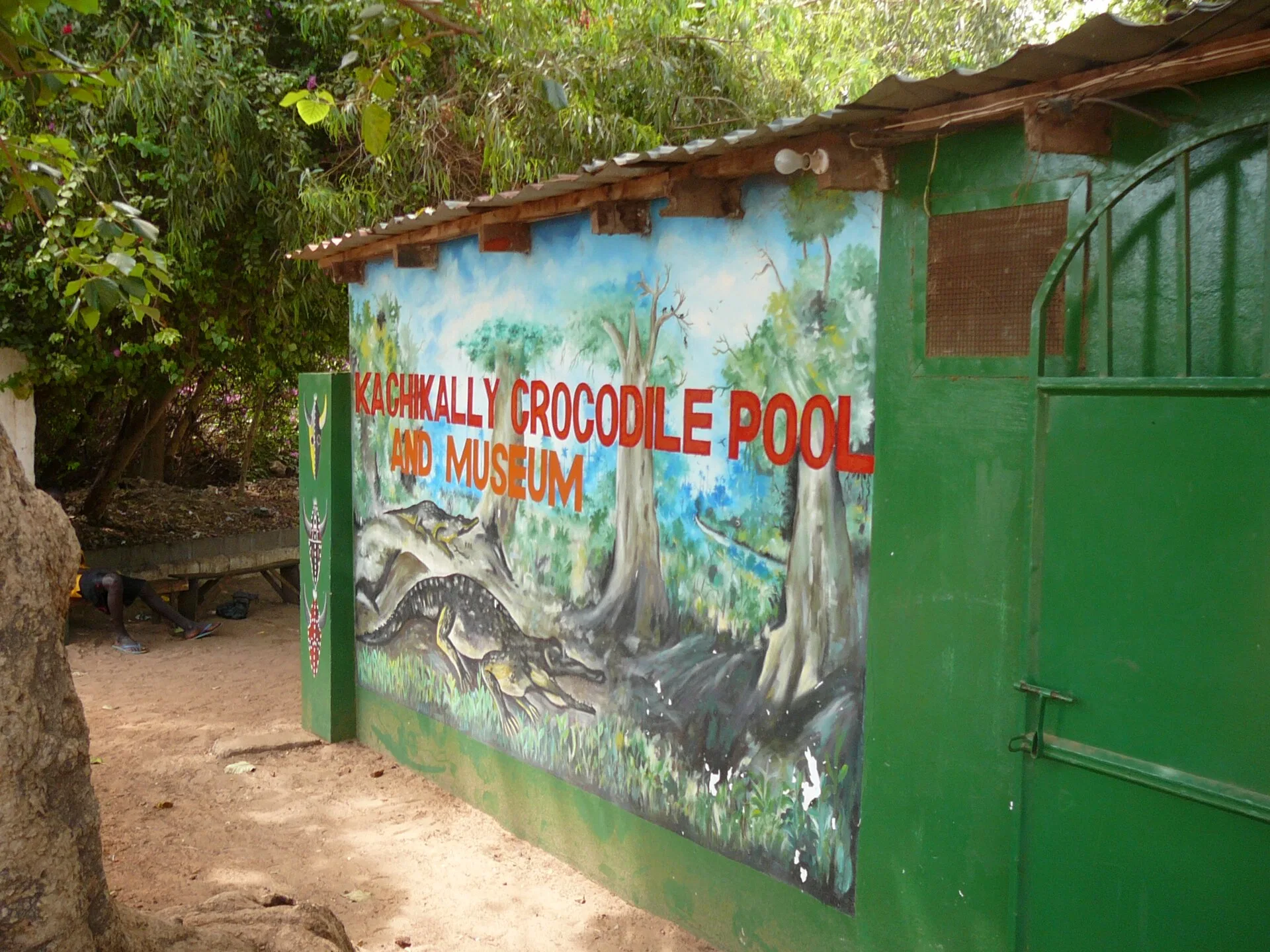
Kachikally is the clearest answer to anyone searching for an unusual museum in The Gambia. Located in Bakau, it combines an ethnographic museum, wooded grounds and a pool inhabited by crocodiles that are treated not simply as wildlife but as part of a sacred place. Visitors usually encounter conventional cultural objects first or last — musical instruments, agricultural tools, clothing, household equipment and other items connected with Gambian communities — but the experience is dominated by the pool and the relationship between its animals, custodians, worshippers and tourists.[gambiadaily.gov.gm]gambiadaily.gov.gmPeople believed in the crocodile pool and made ritual prayers by offering sacrifices like cola nuts, milk, anything…. Kachikally is on…
The site belongs to the Bojang family, one of Bakau’s founding families, rather than to the national museum system. The National Centre for Arts and Culture records an oral tradition in which the family’s ancestors encountered a female spirit associated with the place and accepted responsibility for its care. This makes Kachikally a privately run attraction, but not merely a commercial wildlife park: family custodianship and inherited spiritual authority are central to its identity.[NATIONAL CENTRE FOR ARTS & CALTURE]ncac.gmNATIONAL CENTRE FOR ARTS & CALTURESacred SitesThe legend has it that Katchikally was the woman’s name and she was a spirit dwelling in the bush who appeared to them in female form…
Kachikally is particularly associated with fertility. Accounts describe people visiting to pray, make offerings or take part in ritual washing, especially when hoping to conceive. Government and heritage sources report offerings such as milk and kola nuts and identify Kachikally as one of several sacred crocodile pools in the country. Folonko, near Kartong, and Berending on the north bank are often named as related sites, though they are less developed as visitor-facing museum attractions.[gambiadaily.gov.gm]gambiadaily.gov.gmPeople believed in the crocodile pool and made ritual prayers by offering sacrifices like cola nuts, milk, anything…. Kachikally is on…
These beliefs should be presented as living religious and cultural traditions, not as scientifically demonstrated treatments. A respectful interpretation distinguishes between the spiritual meaning attributed to the pool and medical evidence about fertility. Kachikally matters precisely because it allows visitors to see how belief, family memory, animal symbolism and tourism can occupy the same physical space without being identical things.
What visitors actually encounter
The crocodiles are accustomed to the managed environment, and supervised visitors have long been allowed to approach some of them closely. Tourist accounts frequently describe touching or photographing the animals. This should not be mistaken for evidence that crocodiles are naturally harmless. Their apparent calm is specific to the site, its feeding practices and the guidance of handlers; visitors should follow current instructions rather than treating the experience as an ordinary wildlife encounter.[Tripadvisor]tripadvisor.co.ukTripadvisor Kachikally Crocodile PoolTripadvisor Kachikally Crocodile Pool
The museum component is modest beside the spectacle of the pool, but it changes the meaning of the visit. Its objects place Kachikally within Gambian social history rather than presenting the crocodiles as an isolated novelty. The result is an unusual hybrid institution: part family heritage site, part ethnographic museum, part sacred sanctuary and part tourist attraction.
Claims about exact crocodile numbers vary considerably across guidebooks and promotional material, so figures should be treated cautiously. There is also a taxonomic complication. Animals historically described as Nile crocodiles may belong to the West African crocodile species, which modern research has distinguished from the Nile crocodile. The important visitor-facing point is not the disputed headcount but the unusual continuity between sacred tradition and a living crocodile population.[Wikipedia]WikipediaKachikally Museum and Crocodile PoolKachikally Museum and Crocodile Pool
Wassu and Kerbatch: museums beside ancient graves
The stone circles of Wassu and Kerbatch provide The Gambia’s most powerful archaeological mystery. They form part of the UNESCO-listed Stone Circles of Senegambia, a much larger zone extending into Senegal and containing more than 1,000 stone circles and associated burial mounds. The four principal UNESCO groups — Wassu and Kerbatch in The Gambia, and Wanar and Sine Ngayene in Senegal — contain 93 circles as well as numerous mounds.[UNESCO World Heritage Centre]whc.unesco.orgWorld Heritage Centre Stone Circles of SenegambiaThe four megalithic sites inscribed bear witness to a prosperous and highly organized society with traditions of stone circle constructio…
The stones are not a Gambian version of Stonehenge, despite the tempting visual comparison. Excavation associates many of them with burials, and evidence indicates a long construction tradition extending across many centuries. UNESCO describes the monuments as products of organised and prosperous societies, with some excavated material suggesting dates ranging from the first millennium BC into the second millennium AD. Such a broad range warns against imagining a single lost civilisation building every circle at once.[UNESCO World Heritage Centre]whc.unesco.orgWorld Heritage Centre Stone Circles of SenegambiaThe four megalithic sites inscribed bear witness to a prosperous and highly organized society with traditions of stone circle constructio…
Small museum and reception buildings at the Gambian sites help visitors interpret what would otherwise appear to be unexplained groups of reddish stone pillars. Displays commonly address excavation, burial customs, stone working and objects recovered from the wider archaeological landscape. UNESCO documentation notes that the sites are fenced and that traditional-style round buildings provide museum, reception and caretaker facilities.[UNESCO World Heritage Centre]whc.unesco.orgWorld Heritage Centre Stone Circles of SenegambiaThe four megalithic sites inscribed bear witness to a prosperous and highly organized society with traditions of stone circle constructio…
The enduring mystery concerns identity and meaning. Archaeology can show that the circles were connected with funerary practices, labour organisation and specialised stone extraction, but it cannot recover every name, ritual or political relationship involved. The nearby Wassu quarry is especially valuable because it provides direct evidence for the source of at least some of the laterite pillars. That reduces one mystery — where the stones came from — while leaving larger questions about the people commemorated and the ceremonies performed around them.[UNESCO World Heritage Centre]whc.unesco.orgWorld Heritage Centre Wassu Stone Circles Quarry SiteWorld Heritage Centre Wassu Stone Circles Quarry Site
For curious travellers, this is one of the country’s most credible “mystery-object” experiences. The monuments are authentic archaeological sites protected within an international heritage framework, not modern reconstructions or invented ancient enigmas. Their uncertainty comes from incomplete historical knowledge rather than from paranormal claims.
Preservation remains an active issue. UNESCO approved assistance in July 2025 for community-based measures against bush fires at the Wassu stone-circle site and quarry. This is a reminder that the monuments are vulnerable rural landscapes, not indestructible museum pieces sealed behind glass.[UNESCO World Heritage Centre]whc.unesco.orgWorld Heritage Centre Gambia AssistanceWorld Heritage Centre Gambia Assistance
Tanji Village Museum: a private cabinet of everyday life
Tanji Village Museum is less uncanny than Kachikally or the stone circles, but it is one of The Gambia’s most distinctive collections. Founded in 1997 by Abdoulie Bayo, a former National Museum curator, it was created as a privately operated museum presenting traditional Gambian life through buildings, objects and landscape rather than through display cases alone.[Access Gambia]accessgambia.comtanje village museumtanje village museum
The site resembles a village compound, with round buildings containing domestic utensils, farming equipment, fishing tools, musical instruments, craft materials and other ethnographic objects. Its appeal lies in accumulation: objects that might appear ordinary in isolation become a broad record of technologies, habits and knowledge that can disappear quickly when materials, housing and livelihoods change. Recent visitor accounts continue to describe displays connected with coastal culture, fishing and local daily life.[Tripadvisor]tripadvisor.co.ukTripadvisor TANJE VILLAGE MUSEUMTripadvisor TANJE VILLAGE MUSEUM
A botanical trail expands the collection beyond manufactured artefacts. Trees and plants are interpreted according to uses such as food, medicine and building material. This gives Tanji some of the character of an open-air cabinet of curiosity, where a fishing implement, a musical instrument and a medicinal plant all belong to the same system of practical knowledge.[Wikipedia]WikipediaTanje Village MuseumTanje Village Museum
Tanji is tourist-facing, but it is not simply a staged entertainment village. It also serves local visitors and school groups and reflects the collecting choices of a museum professional working outside direct state control. The interpretation may feel more personal and less standardised than that of a large national institution. That is part of its value, although visitors should remember that any reconstructed “traditional village” arranges diverse and changing ways of life into a simplified physical setting.
What the National Museum adds
The Gambia National Museum in Banjul is the country’s principal public museum and has operated under the National Centre for Arts and Culture. Opened in 1985, it was established to collect, preserve and present objects documenting Gambian material culture and to support public education about national history.[NATIONAL CENTRE FOR ARTS & CALTURE]ncac.gmNATIONAL CENTRE FOR ARTS & CALTURECultural heritageNATIONAL CENTRE FOR ARTS & CALTURE16 Sept 2019 — The museum's primary goal is the collection, preservation and presentation of artifacts…
Its collections are broader than the strange-museum theme, covering archaeology, political history, colonial and post-independence history, music, photography and everyday culture. Yet it is useful to curiosity-minded visitors because it provides the background needed to understand the more unusual sites. Musical instruments and masquerade traditions help contextualise objects seen at Kachikally or Tanji, while archaeological displays connect the stone circles to a longer regional past. Its photographic holdings also preserve visual evidence of social and political change that cannot be reconstructed from monuments alone.[Wikipedia]WikipediaGambia National MuseumGambia National Museum
The museum is therefore not best approached as a collection of bizarre objects. Its importance lies in preventing isolated curiosities from becoming detached from Gambian history. A sacred pool, burial monument or ritual object becomes more meaningful when visitors understand the country’s communities, trade networks, religious life and colonial experience.
Public information about museum hours, gallery access and temporary closures in The Gambia is not always consistently maintained online. Visitors should confirm arrangements locally, especially before making a special journey. That caution applies even more strongly to small regional museums and displays at monuments.
Slavery museums and disturbing collections
The country’s most emotionally difficult museums concern the Atlantic slave trade. The UNESCO-listed Kunta Kinteh Island and Related Sites include forts, trading locations and settlements along the River Gambia that document shifting systems of European trade, colonial control and enslavement. UNESCO emphasises the river’s importance as a route connecting the interior with Atlantic commerce and describes the island and related sites as tangible evidence of that history.[UNESCO World Heritage Centre]whc.unesco.orgWorld Heritage Centre Kunta Kinteh Island and Related SitesWorld Heritage Centre Kunta Kinteh Island and Related Sites
At Albreda and Juffureh, museum displays use documents, images, maps and objects to explain capture, sale, forced transportation and the wider Atlantic system. The landscape is also inseparable from the international influence of Alex Haley’s Roots, which turned Juffureh into a major destination for African diaspora tourism. Academic research on this tourism has examined how local history, personal ancestry, commemoration and souvenir commerce became intertwined.[OpenEdition Journals]journals.openedition.orgOpen source on openedition.org.
This produces a complicated museum experience. The underlying history of slavery is real and extensively documented, but individual genealogical narratives associated with Roots have been debated. Visitors should separate the well-established history of enslavement on the Gambia River from claims that depend upon particular oral accounts or commercial tour storytelling. The best interpretation does not require every detail of a famous family narrative to be certain in order to recognise the scale and human consequences of the trade.
Fort Bullen at Barra offers another unusual reversal. Built after Britain had outlawed its participation in the slave trade, the fort was intended to help suppress continuing trafficking at the river mouth. A small museum developed there explains abolition and the fort’s role, alongside historical and ethnographic material. The site is therefore a military ruin whose collection is concerned not with celebrating conquest but with the troubled and incomplete enforcement of abolition.[thepoint.gm]thepoint.gmThe Point British High Commission to work with NCAC to createThe Point British High Commission to work with NCAC to create
These are not “oddity museums” in a playful sense. Their relevance to strange-history travel comes from their difficult artefacts, ruined confinement spaces and contested public memory. They demand a different tone from Kachikally or Tanji: curiosity must not turn human suffering into spectacle.
Belief, folklore and museum credibility
The most important distinction in The Gambia is not between “real” and “fake” attractions, but between different kinds of truth. The stone circles are archaeological monuments supported by excavation and UNESCO documentation. Kachikally is a real sacred site whose fertility powers belong to religious belief rather than clinical proof. Tanji is a curated reconstruction of cultural life, not an untouched village frozen in time. The slavery museums interpret extensively documented history while also operating within tourism shaped by Roots and ancestry-seeking.
A useful credibility guide is to ask what kind of claim is being made:
- Archaeological claims should be supported by excavation, dating, material evidence and conservation records.
- Spiritual claims should be understood as accounts of belief and practice, not converted automatically into scientific fact.
- Oral histories can preserve valuable community memory but may have several versions and should be identified as oral tradition.
- Tourism claims — especially exact crocodile numbers, guaranteed rituals or simplified genealogies — deserve more caution when they appear only in promotional material.
- Reconstructed displays can be educational without representing every Gambian community or historical period equally.
This layered approach makes The Gambia’s unusual collections more interesting, not less. It allows a visitor to respect a sacred tradition without pretending to verify a miracle, appreciate an ancient mystery without inventing lost civilisations, and engage with slavery heritage without confusing popular storytelling with settled evidence.
Why The Gambia’s curiosity culture matters
The Gambia’s unusual heritage is rarely sealed inside grand purpose-built museums. It survives in family custodianship, sacred pools, archaeological landscapes, reconstructed compounds, small regional displays and ruins connected by the River Gambia. That distribution reflects the country’s scale and resources, but also a broader understanding of heritage in which place, oral explanation and continuing practice may matter as much as an isolated object in a case.
Kachikally is the defining example because it cannot be reduced to one category. It is simultaneously devotional, folkloric, zoological, ethnographic, private and commercial. Wassu and Kerbatch show how a genuine archaeological mystery can be presented without paranormal invention. Tanji demonstrates the importance of private collecting in preserving vulnerable everyday knowledge. The slavery museums reveal how heritage can become both a site of mourning and part of an international tourism economy.
For visitors seeking conventional displays of witchcraft, cryptids, UFOs or medical specimens, The Gambia offers little firmly documented material. Its stranger achievement is more culturally specific: institutions where living crocodiles, ancestral spirits, burial stones, medicinal plants and traumatic historical memory remain connected to the communities and landscapes that give them meaning.
Amazon book picks
Further Reading
Books and field guides related to Where The Gambia Keeps Its Strangest Stories. Use these as the next step if you want deeper reading beyond the article.
African History: A Very Short Introduction
Intended for those interested in the African continent and the diversity of human history, this work looks at Africa's past and reflects...


The Story of Africa
"Basil Davidson's Africa is an exciting and compelling history of the peoples who make up Africa today: where they came from, how they de...
The Archaeology of Africa
Africa has a vibrant past. It emerges from this book as the proud possessor of a vast and highly complicated interweaving of peoples and...
eBay marketplace picks
Marketplace Samples
Live-tested eBay searches with available results related to this page.
Selected fromGambia poster oneBay.co.uk.
Endnotes
1.
Source: whc.unesco.org
Title: World Heritage Centre Stone Circles of Senegambia
Link:https://whc.unesco.org/en/list/1226/
Source snippet
The four megalithic sites inscribed bear witness to a prosperous and highly organized society with traditions of stone circle constructio...
2.
Source: ncac.gm
Title: NATIONAL CENTRE FOR ARTS & CALTURECultural heritage
Link:https://ncac.gm/cultural-heritage/
Source snippet
NATIONAL CENTRE FOR ARTS & CALTURE16 Sept 2019 — The museum's primary goal is the collection, preservation and presentation of artifacts...
3.
Source: my-gambia.com
Title: est 1997 tanji village museum
Link:https://www.my-gambia.com/mymagazine/est-1997-tanji-village-museum/
Source snippet
My GambiaEstablished in 1997: Tanji Village MuseumThe museum is the first privately operated museum that was founded in 1997 by Mr Abdoul...
4.
Source: ncac.gm
Title: NATIONAL CENTRE FOR ARTS & CALTURESacred Sites
Link:https://ncac.gm/sacred-sites/
Source snippet
The legend has it that Katchikally was the woman’s name and she was a spirit dwelling in the bush who appeared to them in female form...
5.
Source: Wikipedia
Title: Kachikally Museum and Crocodile Pool
Link:https://en.wikipedia.org/wiki/Kachikally_Museum_and_Crocodile_Pool
6.
Source: whc.unesco.org
Title: World Heritage Centre UNESCO World Heritage Centre
Link:https://whc.unesco.org/en/documents/122226
7.
Source: whc.unesco.org
Title: World Heritage Centre Wassu Stone Circles Quarry Site
Link:https://whc.unesco.org/en/tentativelists/6063/
8.
Source: whc.unesco.org
Title: World Heritage Centre Gambia Assistance
Link:https://whc.unesco.org/en/statesparties/gm/assistance
9.
Source: whc.unesco.org
Title: World Heritage Centre Stone Circles of Senegambia
Link:https://whc.unesco.org/en/list/1226/assistance/
10.
Source: Wikipedia
Title: Tanje Village Museum
Link:https://de.wikipedia.org/wiki/Tanje_Village_Museum
11.
Source: ncac.gm
Link:https://ncac.gm/
12.
Source: Wikipedia
Title: Gambia National Museum
Link:https://en.wikipedia.org/wiki/Gambia_National_Museum
13.
Source: whc.unesco.org
Title: World Heritage Centre Kunta Kinteh Island and Related Sites
Link:https://whc.unesco.org/en/list/761
14.
Source: journals.openedition.org
Link:https://journals.openedition.org/etudesafricaines/18780?lang=en
15.
Source: my-gambia.com
Link:https://www.my-gambia.com/mymagazine/fort-bullen/
16.
Source: my-gambia.com
Title: Kachikally Crocodile Pool | My Gambia
Link:https://www.my-gambia.com/mymagazine/kachikally-crocodile-pool/
17.
Source: whc.unesco.org
Link:https://whc.unesco.org/en/statesparties/gm/
18.
Source: whc.unesco.org
Link:https://whc.unesco.org/en/list/1226/maps/
20.
Source: whc.unesco.org
Link:https://whc.unesco.org/en/statesparties/gm/documents/
21.
Source: whc.unesco.org
Link:https://whc.unesco.org/en/list/761/maps/
22.
Source: whc.unesco.org
Link:https://whc.unesco.org/en/list/761/documents/
23.
Source: my-gambia.com
Link:https://www.my-gambia.com/article/discover-the-museums-of-the-gambia/
24.
Source: kachikally.com
Link:https://kachikally.com/
25.
Source: Wikipedia
Link:https://zh.wikipedia.org/zh-tw/The
26.
Source: tripadvisor.com
Title: National Museum
Link:https://www.tripadvisor.com/Attraction_Review-g293795-d12078429-Reviews-National_Museum-Banjul_Banjul_Division.html
27.
Source: tripadvisor.com
Link:https://www.tripadvisor.com/Attraction_Review-g293795-d12078429-Reviews-or10-National_Museum-Banjul_Banjul_Division.html
28.
Source: tripadvisor.com
Link:https://www.tripadvisor.com/ShowUserReviews-g293795-d600536-r439848211-Arch_22-Banjul_Banjul_Division.html
29.
Source: tripadvisor.ca
Title: National Museum
Link:https://www.tripadvisor.ca/Attraction_Review-g293795-d12078429-Reviews-National_Museum-Banjul_Banjul_Division.html
30.
Source: tripadvisor.in
Link:https://www.tripadvisor.in/Attraction_Review-g293795-d12078429-Reviews-National_Museum-Banjul_Banjul_Division.html
31.
Source: tripadvisor.es
Title: NATIONA L MUSEUM (Banjul)
Link:https://www.tripadvisor.es/Attraction_Review-g293795-d12078429-Reviews-National_Museum-Banjul_Banjul_Division.html
32.
Source: youtube.com
Title: Kachikally Crocodile Pool | My Gambia | My Magazine
Link:http://www.youtube.com/watch?v=xYzp3BKzcJQ
Source snippet
Stone Circles of Senegambia (UNESCO/NHK)...
33.
Source: gambiadaily.gov.gm
Link:https://www.gambiadaily.gov.gm/veil-behind-kachikally-crocodile-pool?gvas=blue
Source snippet
People believed in the crocodile pool and made ritual prayers by offering sacrifices like cola nuts, milk, anything.... Kachikally is on...
34.
Source: thomascook.com
Link:https://www.thomascook.com/holidays/gambia/bijilo/things-to-do/day-trip-to-the-kachikally-crocodile-pool
Source snippet
Thomas CookKachikally Crocodile Pool BakauKachikally Museum, an ethnographic museum with over 1,000 historical artefacts. some ancient mu...
35.
Source: tripadvisor.co.uk
Title: Tripadvisor Kachikally Crocodile Pool
Link:https://www.tripadvisor.co.uk/Attraction_Review-g479198-d2462024-Reviews-Kachikally_Crocodile_Pool-Bakau_Banjul_Division.html
36.
Source: accessgambia.com
Title: tanje village museum
Link:https://www.accessgambia.com/information/tanje-village-museum.html
37.
Source: tripadvisor.co.uk
Title: Tripadvisor TANJE VILLAGE MUSEUM
Link:https://www.tripadvisor.co.uk/Attraction_Review-g3675810-d3935590-Reviews-Tanje_Village_Museum-Tanji_West_Coast_Division.html
38.
Source: thepoint.gm
Title: The Point British High Commission to work with NCAC to create
Link:https://thepoint.gm/africa/gambia/article/british-high-commission-to-work-with-ncac-to-create-museum-at-fort-bullen
39.
Source: ncac.gm
Title: National Monuments and Sites Entry Fees
Link:https://ncac.gm/nationalmonuments-and-sites-entry-fees/
40.
Source: ncac.gm
Title: nams ratify 1970 unesco convention
Link:https://ncac.gm/nams-ratify-1970-unesco-convention/
41.
Source: ncac.gm
Title: ncac brief feb june 2020
Link:https://ncac.gm/ncac-brief-feb-june-2020/
Published: june 2020
42.
Source: ncac.gm
Title: Monuments and Sites
Link:https://ncac.gm/monuments-and-sites/
43.
Source: ncac.gm
Title: Our Partners
Link:https://ncac.gm/our-partners/
44.
Source: thepoint.gm
Title: trust bank hands over renovated national museum to ncac
Link:https://thepoint.gm/africa/gambia/article/trust-bank-hands-over-renovated-national-museum-to-ncac
45.
Source: thepoint.gm
Title: nigerian high commissioner visits national museum
Link:https://thepoint.gm/africa/gambia/article/nigerian-high-commissioner-visits-national-museum
46.
Source: thepoint.gm
Title: Kachikally Pool: Spiritual and Social by Nature
Link:https://thepoint.gm/africa/gambia/article/kachikally-pool-spiritual-and-social-by-nature
47.
Source: policies.gov.gm
Link:https://policies.gov.gm/d/caa8b078-5bad-11ec-9b31-029254d29bb1
48.
Source: op.gov.gm
Link:https://op.gov.gm/sites/default/files/2023-08/OP%20NEWSLETTER%2012TH%20EDITION%20%281%29.pdf
49.
Source: gambia.gov.gm
Link:https://gambia.gov.gm/national-centre-for-arts-and-culture/
50.
Source: facebook.com
Link:https://www.facebook.com/mygambiatravel/posts/the-kachikally-crocodile-pool-and-museum-in-the-centre-of-bakaukachikally-crocod/619517245343804/
51.
Source: dictionary.cambridge.org
Link:https://dictionary.cambridge.org/zht/%E8%A9%9E%E5%85%B8/%E8%8B%B1%E8%AA%9E-%E6%BC%A2%E8%AA%9E-%E7%B9%81%E9%AB%94/the
52.
Source: youtube.com
Link:https://www.youtube.com/watch?v=fhn9rBKBO04
53.
Source: pop.accessgambia.com
Title: bakau kachikally
Link:https://pop.accessgambia.com/information/bakau-kachikally.html
54.
Source: accessgambia.com
Link:https://accessgambia.com/information/bakau-kachikally.html
55.
Source: accessgambia.com
Link:https://www.accessgambia.com/information/sacred-sites.html
57.
Source: accessgambia.com
Title: Tanji Fishing Village
Link:https://accessgambia.com/information/tanje-fishing-village.html
58.
Source: accessgambia.com
Title: Mama Africa
Link:https://www.accessgambia.com/mpages/mama-africa-womens-museum-art-centre.html
59.
Source: accessgambia.com
Title: Mama Africa
Link:https://accessgambia.com/extra/mama-africa-womens-museum-art-centre.html
60.
Source: pop.accessgambia.com
Title: tanje fishing village
Link:https://pop.accessgambia.com/information/tanje-fishing-village.html
61.
Source: accessgambia.com
Title: Tanji Fishing Village
Link:https://www.accessgambia.com/msite/m-tanje-fishing-village.html
62.
Source: pop.accessgambia.com
Title: july 22nd arch
Link:https://pop.accessgambia.com/information/july-22nd-arch.html
63.
Source: nationalarchives.gov.uk
Link:https://www.nationalarchives.gov.uk/
64.
Source: sitesofconscience.org
Title: National Centre for Arts and Culture
Link:https://www.sitesofconscience.org/membership/national-centre-for-arts-and-culture-the-gambia/
65.
Source: africa.com
Link:https://africa.com/museums-of-the-gambia
66.
Source: ncac.gm
Title: Official map of historic and cultural sites
Link:https://ncac.gm/product/official-map-of-historic-and-cultural-sites/
67.
Source: ncac.gm
Title: Ceremonies of The Gambia tradition in transition
Link:https://ncac.gm/product/ceremonies-of-the-gambia-tradition-in-transition/
68.
Source: ncac.gm
Title: Kankurang and other masking traditions of The Gambia
Link:https://ncac.gm/product/kankurang-and-other-masking-traditions-of-the-gambia/
69.
Source: ncac.gm
Link:https://ncac.gm/shop/?product_view=list
70.
Source: ncac.gm
Title: Sona Mariama folktales from The Gambia
Link:https://ncac.gm/product/sona-mariama-folktales-from-the-gambia/
71.
Source: ehanlin.com.tw
Link:https://www.ehanlin.com.tw/app/keyword/%E5%9C%8B%E4%B8%AD/%E8%8B%B1%E8%AA%9E/the.html
72.
Source: tripadvisor.co.uk
Title: NATIONA L MUSEUM
Link:https://www.tripadvisor.co.uk/Attraction_Review-g293795-d12078429-Reviews-National_Museum-Banjul_Banjul_Division.html
73.
Source: ons.gov.uk
Link:https://www.ons.gov.uk/
74.
Source: tripadvisor.com.au
Link:https://www.tripadvisor.com.au/Attraction_Review-g293795-d12078429-Reviews-National_Museum-Banjul_Banjul_Division.html
75.
Source: tripadvisor.com.ph
Link:https://www.tripadvisor.com.ph/Attraction_Review-g293795-d12078429-Reviews-National_Museum-Banjul_Banjul_Division.html
Additional References
76.
Source: youtube.com
Title: Exploring West Africa | Kachikally Crocodile Pool and Museum | Bakau, The Gambia
Link:http://www.youtube.com/watch?v=Q-usuuE9Bkg
Source snippet
Kachikally Crocodile Pool and Museum Bakau Gambia Kachikally Crocodile Pool | My Gambia | My Magazine MyGambia...
77.
Source: gambianexcursions.com
Title: kachikally museum and crocodile pool
Link:https://www.gambianexcursions.com/tourist-trips/kachikally-museum-and-crocodile-pool/
Source snippet
Gambian ExcursionsThe Best Places to Visit: Kachikally Museum and Crocodile...24 Dec 2024 — Discover the Kachikally Museum and Crocodile...
78.
Source: youtube.com
Title: National Museum of The Gambia | My Magazine | My Gambia
Link:http://www.youtube.com/watch?v=y5tPm1HqRIo
Source snippet
Exploring West Africa | Kachikally Crocodile Pool and Museum | Bakau, The Gambia...
79.
Source: iccrom.org
Title: 1 frica n
Link:https://www.iccrom.org/sites/default/files/publications/2019-11/iccrom_ics02_traditionalpractices_en.pdf
Source snippet
crocodile pool... Barren women undergo ritual washing in thepool to restore their fertility.... Katchikally is also th...
80.
Source: researchgate.net
Link:https://www.researchgate.net/publication/374635383_Impacts_of_COVID-19_on_Ecotourism_A_Study_in_Bijilo_Monkey_Forest_and_Kachikally_Crocodile_Pool_The_Gambia
81.
Source: atlasobscura.com
Link:https://www.atlasobscura.com/things-to-do/zambia
82.
Source: gambiasantosudrivesexperiences.com
Link:https://gambiasantosudrivesexperiences.com/albert-markt-2/
83.
Source: findtourguide.com
Link:https://www.findtourguide.com/destinations/gambia/arch
84.
Source: en-academic.com
Link:https://en-academic.com/dic.nsf/enwiki/3745565/
85.
Source: facebook.com
Link:https://www.facebook.com/mygambiatravel/posts/following-the-footsteps-of-slavery-kunta-kinteh-is-one-of-the-significant-memori/774030313225829/