Within Curious New Zealand
Why Do New Zealand's Private Curiosity Museums Feel So Different?
From bone collections to handmade marvels, private museums reveal how individual collectors shape New Zealand's curiosity culture.
On this page
- Cabinets of curiosity revived
- Collectors and creative vision
- What visitors should expect
Page outline Jump by section
Introduction
New Zealand does not have a long tradition of grand, aristocratic cabinets of curiosity in the European sense. Instead, its most distinctive private museums tend to grow from the passions of individual artists, collectors, naturalists and local historians who gradually transform homes, workshops or small galleries into public spaces filled with remarkable objects. The result is a curiosity culture that feels unusually personal. Visitors are often meeting not only a collection but also the person who assembled it, hearing stories about how objects were found, restored or reinterpreted rather than following the polished narrative of a national museum.
This approach gives New Zealand’s private curiosity museums a character that differs sharply from major public institutions. They mix art with natural history, historical artefacts with personal creativity, and careful documentation with the collector’s own sense of wonder. Rather than claiming to present a complete picture of the past, they invite visitors into an individual vision of what is worth preserving and why.[royaldunedinmuseum.com]royaldunedinmuseum.comRoyal Dunedin Museum > HomeRoyal Dunedin Museum > Home
Cabinets of curiosity revived
The classic European cabinet of curiosities (or Wunderkammer) gathered natural specimens, artworks, scientific instruments and exotic objects into a single room where categories deliberately overlapped. Before museums separated collections into archaeology, zoology, ethnography and art, these cabinets celebrated surprise and comparison as much as systematic knowledge. Modern New Zealand has relatively few direct descendants of that tradition, but several private collections consciously recreate its atmosphere.[The Suter Art Gallery]thesuter.org.nzThe Suter Art Gallery Cabinet of Curiosities — The Suter Art GalleryThe Suter Art Gallery Cabinet of Curiosities — The Suter Art Gallery
Unlike many contemporary museums, these collections rarely follow a strict chronological or scientific order. Instead they encourage visitors to notice unexpected relationships:
- animal skulls displayed beside cultural artefacts;
- handmade sculptures sitting alongside genuine biological specimens;
- historical ephemera mixed with natural history;
- labels that explain provenance while also telling personal stories about acquisition or local history.
This style reflects curiosity as a method of exploration rather than classification. The collection grows organically as its owner discovers objects that seem to belong together, even if they originate from different disciplines or centuries.[mahalski.org]mahalski.orgThe Dunedin Museum of Natural Mystery | The Bone Art of Bruce MahalskiThe Dunedin Museum of Natural Mystery | The Bone Art of Bruce Mahalski
Collectors shape the museum as much as the objects
Perhaps the clearest example is the Dunedin Museum of Natural Mystery, also known as the Royal Dunedin Museum. Created by artist Bruce Mahalski, it occupies rooms within an old villa rather than a purpose-built museum. The collection includes skulls, bones, preserved biological specimens, ethnological art, historical curiosities and Mahalski’s own bone sculptures, all arranged in dense display cabinets reminiscent of nineteenth-century curiosity rooms.[royaldunedinmuseum.com]royaldunedinmuseum.comRoyal Dunedin Museum > HomeRoyal Dunedin Museum > Home
What makes the museum distinctive is not simply the material on display but the collector’s presence throughout it. Mahalski has described himself as a lifelong collector rather than a wealthy purchaser, explaining that many objects were found, exchanged or donated over decades. Labels frequently record where an item came from and why it mattered enough to keep, reinforcing that the museum is as much about collecting as about the finished collection itself.[mahalski.org]mahalski.orgThe Dunedin Museum of Natural Mystery | The Bone Art of Bruce MahalskiThe Dunedin Museum of Natural Mystery | The Bone Art of Bruce Mahalski
The museum also demonstrates how private collections can blur boundaries between museum, studio and gallery. Visitors move between authentic zoological material, artistic reinterpretations made from bone and carefully researched historical objects without rigid institutional divisions. That mixture creates an experience closer to visiting an artist’s world than walking through a conventional natural history museum.[royaldunedinmuseum.com]royaldunedinmuseum.comRoyal Dunedin Museum > HomeRoyal Dunedin Museum > Home
Why private museums feel different from national institutions
Large public museums generally work under formal collecting policies, conservation standards and academic interpretation. Their displays are designed to represent broad histories supported by documented provenance and specialist research.
Private curiosity museums operate differently.
They often prioritise:
- the collector’s individual interests rather than comprehensive coverage;
- emotional or visual impact alongside historical interpretation;
- unusual juxtapositions that encourage exploration;
- ongoing change as new discoveries continually reshape displays;
- direct conversation between visitors and the museum’s creator.
This does not necessarily make them less informative, but it changes how visitors should approach them. A personal museum reflects one person’s lifelong interests and judgement, while a national museum aims to represent wider scholarly consensus. Understanding that distinction helps visitors appreciate each on its own terms.[mahalski.org]mahalski.orgThe Dunedin Museum of Natural Mystery | The Bone Art of Bruce MahalskiThe Dunedin Museum of Natural Mystery | The Bone Art of Bruce Mahalski
Creativity often matters as much as authenticity
An important feature of New Zealand’s curiosity museums is that they frequently combine authentic artefacts with original creative work.
Bruce Mahalski’s museum illustrates this particularly well. Genuine animal skulls and natural history specimens appear alongside sculptures assembled from bones, coral and other natural materials. The artistic pieces are not presented as archaeological finds or scientific specimens but as contemporary artworks inspired by the same fascination with anatomy and nature that shaped the museum itself.[mahalski.org]mahalski.orgHome | The Bone Art of Bruce MahalskiHome | The Bone Art of Bruce Mahalski
This blending of collecting and making reflects a broader characteristic of New Zealand’s independent museum culture. Rather than preserving objects exactly as received, collectors often become interpreters, artists or storytellers who add another layer of meaning through display, restoration or creative reuse.
What visitors should expect
Visitors accustomed to major museums sometimes find private curiosity museums surprisingly intimate.
Typical characteristics include:
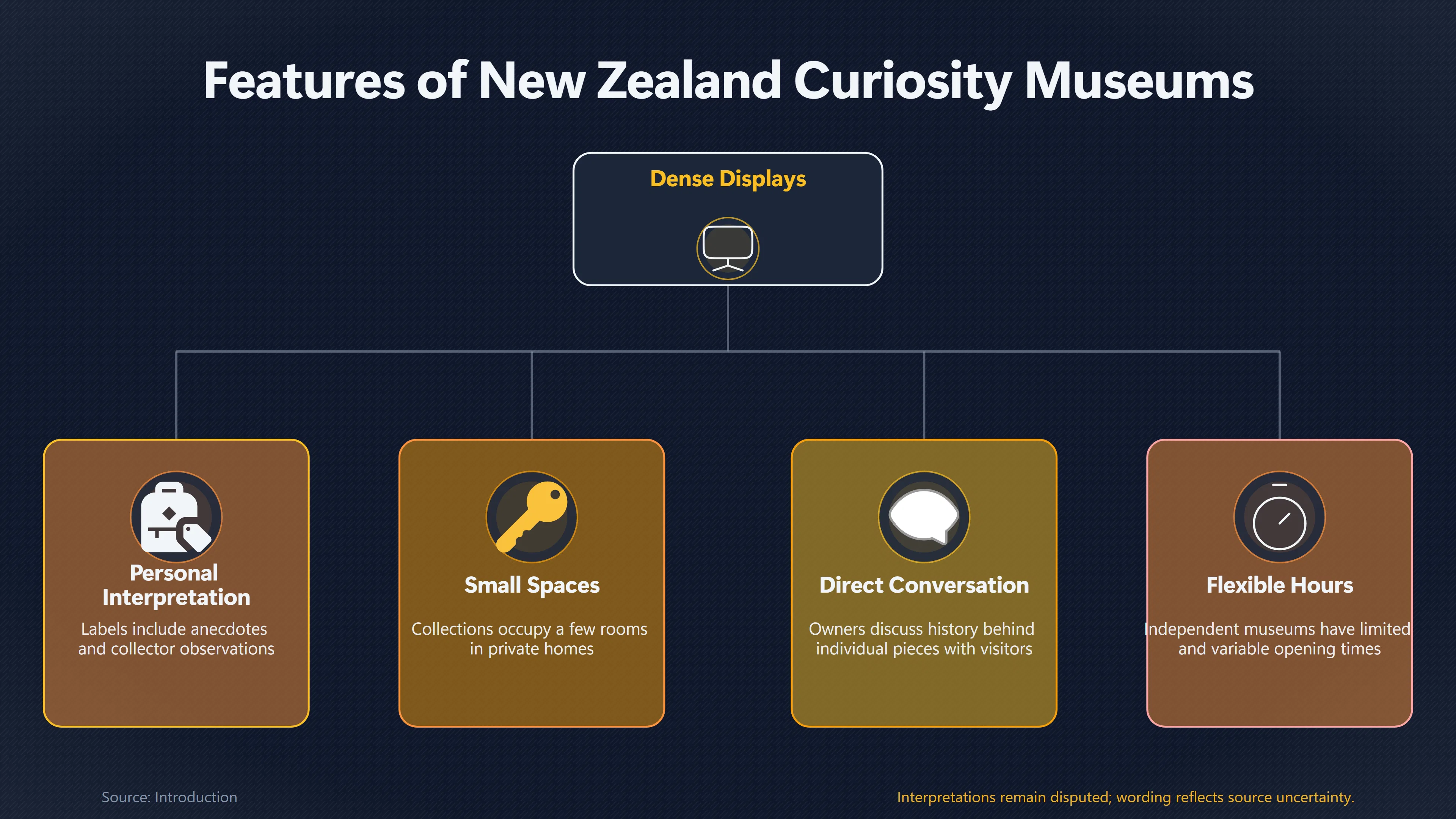
- Small spaces. Collections may occupy only a few rooms rather than an entire building.
- Dense displays. Cabinets, shelves and walls are often packed with hundreds of objects.
- Personal interpretation. Labels frequently include anecdotes or the collector’s own observations.
- Flexible opening hours. Many independent museums have limited opening days or encourage visitors to check availability before travelling.
- Conversation with the curator. Owners are often present and willing to discuss the history behind individual pieces.[royaldunedinmuseum.com]royaldunedinmuseum.comRoyal Dunedin Museum > HomeRoyal Dunedin Museum > Home
The experience rewards slow looking. Instead of following a prescribed route, visitors often discover overlooked details on a second or third circuit of the rooms, reinforcing the feeling of exploring rather than consuming a finished exhibition.[DunedinNZ official website]dunedinnz.comDunedin NZ official website Museum of Natural MysteryDunedinNZ official websiteMuseum of Natural Mystery - Ōtepoti | Dunedin New Zealand official website…
A distinctive part of New Zealand’s curiosity culture
Private curiosity museums occupy an unusual place within New Zealand’s heritage landscape. They preserve objects that may never enter national collections while also keeping alive the older idea that collecting is driven by fascination rather than institutional duty.
Some eventually influence public collections or inspire exhibitions elsewhere. Others remain deeply personal projects whose identity cannot easily be separated from their creators. That individuality is precisely what makes them valuable. They remind visitors that museums need not begin with governments or universities; they can begin with one person who spends decades noticing unusual things and deciding they deserve to be remembered.
Within New Zealand’s wider landscape of strange collections—from scientific specimens in major museums to local folklore displays and eccentric regional attractions—private curiosity museums provide the closest modern equivalent to the historic cabinet of curiosities: places where natural history, art, craftsmanship and storytelling coexist under a collector’s singular vision.[thesuter.org.nz]thesuter.org.nzThe Suter Art Gallery Cabinet of Curiosities — The Suter Art GalleryThe Suter Art Gallery Cabinet of Curiosities — The Suter Art Gallery
Amazon book picks
Further Reading
Books and field guides related to Why Do New Zealand's Private Curiosity Museums Feel So Different?. Use these as the next step if you want deeper reading beyond the article.
Lonely Planet New Zealand
Lonely Planet: The world's leading travel guide publisher Lonely Planet's New Zealand is your passport to the most relevant, up-to-date a...
Cabinets of Curiosities
"Maurie`s' tour of strange objects is entertaining and fascinating." --Antiques And The Arts Weekly
Ways of Curating
Drawing on his own experiences and inspirations - from staging his first exhibition in his tiny Zurich kitchen in 1986 to encounters and...
The Penguin History of New Zealand
New Zealand was the last country in the world to be discovered and settled by humankind. It was also the first to introduce full democrac...
eBay marketplace picks
Marketplace Samples
Live-tested eBay searches with available results related to this page.
Selected fromcabinet of curiosities print oneBay.co.uk.
Endnotes
1.
Source: royaldunedinmuseum.com
Title: Royal Dunedin Museum > Home
Link:https://www.royaldunedinmuseum.com/
2.
Source: mahalski.org
Title: The Dunedin Museum of Natural Mystery | The Bone Art of Bruce Mahalski
Link:https://mahalski.org/news/the-dunedin-museum-of-natural-mystery/
3.
Source: mahalski.org
Title: Home | The Bone Art of Bruce Mahalski
Link:https://mahalski.org/
4.
Source: dunedinnz.com
Title: Dunedin NZ official website Museum of Natural Mystery
Link:https://www.dunedinnz.com/insiders/museum-of-natural-mystery2
Source snippet
DunedinNZ official websiteMuseum of Natural Mystery - Ōtepoti | Dunedin New Zealand official website...
5.
Source: dunedinnz.com
Link:https://www.dunedinnz.com/visit/see-and-do/culture/museums
6.
Source: dunedinnz.com
Title: Tūhura Otago Museum
Link:https://www.dunedinnz.com/visit/see-and-do/tours/activities/otago-museum
7.
Source: dunedinnz.com
Title: Olveston’s Cabinets of Curios
Link:https://www.dunedinnz.com/insiders/olvestons-cabinet-of-curios
8.
Source: thesuter.org.nz
Title: The Suter Art Gallery Cabinet of Curiosities — The Suter Art Gallery
Link:https://thesuter.org.nz/exhibitions/2023/2/22/cabinet-of-curiosities
9.
Source: localmatters.co.nz
Link:https://www.localmatters.co.nz/opinion/history-cabinet-of-curiosities/
Source snippet
Cabinet of curiosities - Local MattersAugust 19, 2025 — HISTORY – CABINET OF CURIOSITIES Megan Biles August 19, 2025 9:37am Image Megan B...
Published: August 19, 2025
10.
Source: en.wikivoyage.org
Link:https://en.wikivoyage.org/wiki/Dunedin
11.
Source: saintcrowgallery.co.nz
Link:https://www.saintcrowgallery.co.nz/about
12.
Source: tripadvisor.com.au
Title: The Dunedin Museum of Natural Mystery
Link:https://www.tripadvisor.com.au/Attraction_Review-g255119-d13930118-Reviews-The_Dunedin_Museum_of_Natural_Mystery-Dunedin_Otago_Region_South_Island.html
Additional References
13.
Source: webjet.co.nz
Title: Quirky Museums in New Zealand | Places to Visit in New Zealand | NZ Museums
Link:https://www.webjet.co.nz/travel/arts-culture/cool-museums-in-new-zealand/
Source snippet
May 6, 2026 — Arts and Culture THE COOLEST (AND QUIRKIEST) MUSEUMS IN NEW ZEALAND By Deanna Savoia May 6, 2026 Share on Facebook Share on...
Published: May 6, 2026
14.
Source: commons.wikimedia.org
Title: Category:Dunedin Museum of Natural Mystery
Link:https://commons.wikimedia.org/wiki/Category%3ADunedin_Museum_of_Natural_Mystery
Source snippet
wikimedia.orgCategory:Dunedin Museum of Natural Mystery - Wikimedia CommonsJanuary 25, 2025 — CATEGORY:DUNEDIN MUSEUM OF NATURAL MYSTERY...
Published: January 25, 2025
15.
Source: youtube.com
Link:https://www.youtube.com/watch?v=WbgmsStBkzY
Source snippet
The $600 Dinosaur Tail That Proved Warm-Blooded Dinosaurs...
16.
Source: youtube.com
Title: Illicit Fossils: The Ethical Dilemma in Protecting the World’s Natural History
Link:https://www.youtube.com/watch?v=PnssaLktiXw
Source snippet
A tale of two papers: ethics of Burmese amber...
17.
Source: 1news.co.nz
Title: Creepy doll
Link:https://www.1news.co.nz/2024/10/27/nine-delightfully-weird-museums-to-factor-into-your-summer-roadtrip/
Source snippet
Nine delightfully weird museums to factor into your summer roadtripOctober 27, 2024 — NINE DELIGHTFULLY WEIRD MUSEUMS TO FACTOR INTO YOUR...
Published: October 27, 2024
18.
Source: aa.co.nz
Link:https://www.aa.co.nz/travel/editorial/13-intriguing-museums-to-visit-around-new-zealand-this-winter/
19.
Source: tripadvisor.co.nz
Link:https://www.tripadvisor.co.nz/Attraction_Review-g255119-d13930118-Reviews-The_Dunedin_Museum_of_Natural_Mystery-Dunedin_Otago_Region_South_Island.html
20.
Source: wilddunedin.nz
Link:https://www.wilddunedin.nz/daily-events/museum-of-natural-mystery
21.
Source: otago.ac.nz
Link:https://www.otago.ac.nz/healthsciences/research/resources/facilities/w-d-trotter-anatomy-museum
22.
Source: youtube.com
Title: Episode 135: Burmese Amber Pt2
Link:https://www.youtube.com/watch?v=ABC736Ron80
Source snippet
Illicit Fossils: The Ethical Dilemma in Protecting the World's Natural History...