Where Senegal Keeps Its Strangest Stories
Senegal does not have a famous museum of witchcraft, cryptids or theatrical “oddities” in the European cabinet-of-curiosities sense.
Page outline Jump by section
Introduction
The strongest route for curious visitors runs through Dakar and nearby Gorée Island. The Théodore Monod Museum offers West African masks, funerary objects and ritual sculpture; the Museum of Black Civilisations reframes sacred and historic material through African-led interpretation; and Gorée concentrates museums of slavery, imprisonment, archaeology and marine science within a remarkably small area. The most unusual feature is not shock value but uncertainty: whether an object was sacred, collected fairly, displayed accurately or transformed into a symbol larger than its documented history.[musee-monod.sn]musee-monod.snLe Musée Théodore Monod d’Art Africain de Dakar sera représenté au Africa Forward Summit 2026 à Nairobi, au Kenya…
Where Senegal’s strangest collections are found
Senegal’s main curiosity museums are concentrated in the capital region rather than scattered evenly across the country. Central Dakar contains the two largest institutions for unusual ritual and ethnographic material: the Théodore Monod Museum of African Art and the Museum of Black Civilisations. A ferry journey away, Gorée Island brings together the House of Slaves, the Historical Museum of Senegal and the currently closed Museum of the Sea. The Henriette Bathily Women’s Museum, formerly on Gorée, now operates from Dakar’s Place du Souvenir Africain.[musee-monod.sn]musee-monod.snPrésentation | MonodLe Musée Théodore Monod d’art africain est une institution de l’IFAN.Ex Institut français d’Afrique Noire créé en 193…
This geography matters. Gorée is not merely a cluster of separate attractions but an entire landscape of curated memory: colonial houses, defensive works, former cells, archaeological material and monuments share space with homes, restaurants and everyday island life. UNESCO describes the island as a place shaped by European rivalry, trade, military strategy and slavery, while contemporary heritage managers stress that it remains a living community rather than an open-air museum frozen in tragedy.[UNESCO World Heritage Centre]whc.unesco.orgWorld Heritage Centre Island of GoréeUNESCO World Heritage CentreIsland of Gorée - UNESCO World Heritage CentreFirst terminus of the “homeoducs” who drained the slaves from t…
Masks and ritual objects at the Théodore Monod Museum
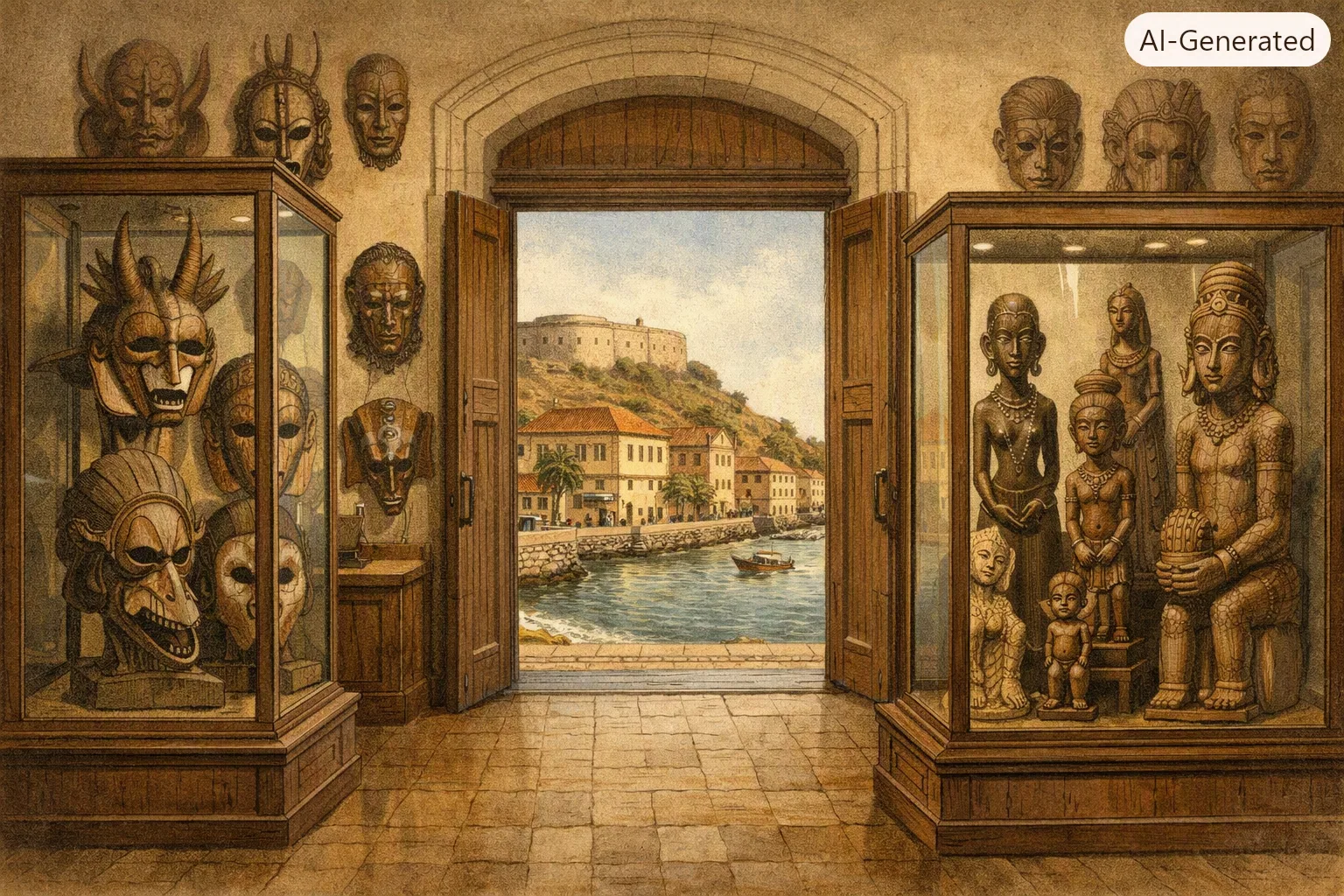
For visitors looking for objects associated with spirits, initiation, death or ceremonial transformation, the Théodore Monod Museum is Senegal’s most relevant permanent collection. An institution of the Fundamental Institute of Black Africa at Cheikh Anta Diop University, it developed from the colonial-era research body established in 1936. Its holdings cover West African art and material culture rather than Senegal alone.[musee-monod.sn]musee-monod.snPrésentation | MonodLe Musée Théodore Monod d’art africain est une institution de l’IFAN.Ex Institut français d’Afrique Noire créé en 193…
The collection reportedly contains more than 9,000 objects, with only several hundred normally shown in the permanent galleries. Masks and figurative sculpture form a large part of the holdings, alongside terracotta figures, textiles, jewellery, musical instruments and objects connected with funerary or ritual practice. The museum also maintains documentation, photographic and archival resources behind the public display.[Guide.en-vols]guide.en-vols.comOpen source on en-vols.com.
What makes these galleries uncanny is the separation between object and action. A ceremonial mask standing motionless in a case can look like an autonomous monster, ancestor or spirit. In its original setting, however, a mask might have been only one component of a larger event involving costume, movement, music, restricted knowledge and community participation. Visitors should therefore resist treating every fierce face or hybrid creature as evidence of a secret cult. Museum display preserves the carved form but can flatten the living system that gave it meaning.
The museum’s value lies partly in this tension. It emerged from an ethnographic tradition in which researchers and colonial institutions classified African cultural objects, but it is now a Senegalese university museum and an active venue for contemporary art, craft and debate. Its official site describes it as both a conservation institution and a space for cultural mediation rather than a storehouse of supposedly “primitive” curiosities.[musee-monod.sn]musee-monod.snOpen source on musee-monod.sn.

The Museum of Black Civilisations: sacred objects and disputed ownership
The Museum of Black Civilisations is not an oddity museum, but it is central to understanding why unusual African objects can no longer be viewed simply as exotic collectibles. Opened in Dakar in 2018, the museum was designed to present the history and culture of Africa and its global diaspora from an African intellectual and curatorial perspective. Its galleries have included archaeological material, masks, sculpture, manuscripts, religious objects and modern art.[Africa Is a Country]africasacountry.comOpen source on africasacountry.com.
Some exhibitions deliberately place different systems of belief beside one another. A recent museum discussion described displays combining manuscripts, relics and material associated with the specifically Senegalese development of Islamic brotherhood traditions. This approach is more useful than presenting amulets or sacred artefacts as isolated examples of “magic”: it shows how religious objects may connect scripture, political authority, personal protection, memory and local practice.[Africa Renewal]africarenewal.un.orgmuseum motion where memory creativity and cultural justice convergemuseum motion where memory creativity and cultural justice converge
The museum is also a stage for disputes over restitution. Senegal and other African countries have argued that museums in Europe hold important objects removed during conquest, military campaigns or colonial collecting. In this setting, provenance — the documented history of an object’s ownership and movement — becomes part of the exhibit. A sword, charm or manuscript may be visually modest yet historically explosive because the description attached to it is uncertain or contested.[Africa Renewal]africarenewal.un.org21 August 2025…
One prominent example is the sword traditionally associated with the nineteenth-century religious and military leader El Hadj Oumar Tall. France symbolically returned it to Senegal, but historians have challenged the claim that the blade actually belonged to him. It remains an instructive museum object precisely because its symbolic importance and its documented attribution do not align neatly.[Le Monde.fr]lemonde.frOpen source on lemonde.fr.
The House of Slaves: powerful memorial, contested literal history
The House of Slaves on Gorée is Senegal’s best-known visitor site and its most emotionally charged museum. Visitors move through small rooms interpreted as holding cells and towards the waterside opening known as the Door of No Return. The building functions simultaneously as a historic structure, memorial, pilgrimage destination and symbol of the Atlantic slave trade. It continues to receive hundreds of visitors a day and remains open to the public, reached by ferry from Dakar.[unesco.org]courier.unesco.orggoree island memorygoree island memory
Its interpretation requires care. Gorée unquestionably participated in Atlantic slavery, and UNESCO recognises the island as a major place of memory connected with that history. Historians have nevertheless disputed claims that enormous numbers of enslaved people passed through this particular house or departed through its famous doorway. The building’s worldwide significance consequently rests not only on what can be demonstrated about each room but also on the memorial narrative developed there, especially by its long-serving curator Boubacar Joseph Ndiaye.[unesco.org]whc.unesco.orgWorld Heritage Centre Island of GoréeUNESCO World Heritage CentreIsland of Gorée - UNESCO World Heritage CentreFirst terminus of the “homeoducs” who drained the slaves from t…
That does not make the site a hoax. It makes it a revealing case of how museums turn complex, dispersed suffering into a place people can physically enter. The confined rooms, architecture and sea-facing exit provide an immediate emotional structure for a history that stretched across many ports, routes, prisons and generations. The problem arises only when symbolic truth is presented as if every detail were securely established documentary fact.
Visitors interested in strange-history museums may recognise a familiar pattern: one object or architectural feature becomes more famous than the evidence supporting its most dramatic interpretation. At Gorée, however, the stakes are exceptionally high. The Door of No Return is not a playful mystery object but a focus for grief, diaspora identity, political ceremony and public remembrance.
A prison-fort filled with Senegal’s past
At the northern end of Gorée, the Historical Museum of Senegal occupies Fort d’Estrées, a French fortification built between 1852 and 1856. The building was later used as a civil prison before being transferred to the Fundamental Institute of Black Africa and converted into a museum. Its circular defensive architecture and former penal function give the visit an atmosphere quite different from a conventional chronological history gallery.[Wikipedia]WikipediaHistorical Museum of Senegal in GoréeHistorical Museum of Senegal in Gorée
The collection spans archaeology, documentary sources and Senegalese history from prehistory to the modern period. Here the building is arguably the most unusual exhibit. Visitors pass through a structure designed first to control maritime space and later to confine people, while cases and panels attempt to narrate societies whose histories long predated the fort.[musee-historiquedusenegal.sn]musee-historiquedusenegal.snOpen source on musee-historiquedusenegal.sn.
This creates a productive contradiction. The museum preserves national history inside a monument of colonial military power. Rather than encountering archaeological artefacts in a neutral modern hall, visitors see them within walls that embody conquest, surveillance and imprisonment. That relationship between container and collection makes the museum one of Senegal’s most distinctive heritage experiences.
The closed museum of creatures in jars
Gorée’s Museum of the Sea is the closest Senegal comes to a traditional scientific cabinet of curiosities. Founded in 1960 under the influence of naturalist Théodore Monod, it assembled an extensive marine reference collection. Historic descriptions emphasise fish from deep water, shells, photographs, scientific documentation and preserved specimens displayed in glass vessels.[UNESCO Digital Library]unesdoc.unesco.orgOpen source on unesco.org.
Recent project accounts describe more than 10,000 specimens, including hundreds of marine species preserved in formalin. Rows of pale fish and other organisms suspended in liquid would make this the country’s most visibly “odd” museum collection: part educational display, part ageing scientific archive.[la-guilde.org]la-guilde.orgmusee de la mer a goree la renaissancemusee de la mer a goree la renaissance
The important practical point is that it is not presently a dependable visitor attraction. Rehabilitation organisations report that the museum has remained closed since the Covid-19 pandemic. Humidity, building deterioration and climate-related risks have affected both the former eighteenth-century commercial building and its collections. Conservation work is intended to stabilise the site and eventually recreate it as a centre for maritime heritage and environmental education.[Aliph Foundation]aliph-foundation.orgAliph FoundationRehabilitation of the Sea Museum in GoréeThe Musée de la Mer, the museum, closed since the Covid-19 pandemic, The Musée d…
Its closure is itself part of the story of unusual collections. Wet specimens require stable containers, controlled conditions and specialist maintenance. A preserved fish may survive for decades, yet the room around it can fail through salt air, damp and rising temperatures. The museum therefore demonstrates that collecting nature is easier than preserving an old collection indefinitely.
Women’s history through ordinary objects
The Henriette Bathily Women’s Museum appears less uncanny than masks or creatures in jars, but its approach is unusual within Senegalese museum history. Conceived in the late 1980s and opened in 1994, it was the country’s first private museum and was initially housed in a colonial residence on Gorée. It later moved to the Place du Souvenir Africain in Dakar.[Wikipedia]WikipediaHenriette-Bathily Women's MuseumHenriette-Bathily Women's Museum
Its displays use photographs, clothing, pottery, farming tools, baskets, musical instruments and domestic objects to make women’s lives visible. Such things often disappear from grand national narratives because they are considered ordinary, repetitive or insufficiently prestigious. In this museum, a cooking implement, garment or work tool becomes evidence of labour, skill, social expectation and changing status.[Atlas Obscura]atlasobscura.comAtlas Obscura Henriette Bathily Women's Museum in DakarAtlas Obscura Henriette Bathily Women's Museum in Dakar
The museum has also combined exhibition work with workshops, literacy activity, craft training and documentation. It is therefore part museum, part social and cultural institution. For curiosity-minded visitors, its main lesson is that an unusual collection need not consist of rare monsters or occult paraphernalia. A carefully assembled archive of everyday objects can reveal a largely hidden history.
Colonial trophies and the war amulet of Samba Sadio
A temporary exhibition shown in Thiès and Saint-Louis in 2025 and 2026 provided one of Senegal’s clearest recent examples of objects acting as evidence in a historical investigation. “Samba Sadio 1875” brought eight objects from a French museum back to Senegal on loan. They included horse equipment, a coin purse, a wooden Quranic teaching tablet and a necklace described as a war amulet. APS - Agence de Presse Sénégalaise+2APS - Agence de Presse Sénégalaise[aps.sn]aps.snOpen source on aps.sn.
The objects were linked to fighters killed during the 1875 Battle of Samba Sadio. Researchers traced their presence in Dunkirk to a French officer involved in the campaign, leading organisers to argue that they had been removed from dead combatants or their horses. The display thus turned apparently small personal possessions into possible battlefield spoils and evidence of colonial collecting.[Le Monde.fr]lemonde.frOpen source on lemonde.fr.
The war amulet is especially revealing. In a sensational display it might be marketed as a magical charm believed to make a warrior invulnerable. In the Senegalese exhibition, its more important meanings concerned faith, protection, identity, death and ownership. The unresolved question was not whether the amulet had supernatural power, but whether a European museum had the moral right to retain an object taken during violent conquest.
The exhibition was temporary and the objects were due to return to Dunkirk, so travellers should not assume they remain on view. Its legacy nevertheless points towards a growing form of Senegalese curiosity culture: exhibitions that reconstruct an object’s disputed journey and ask whether the museum label has concealed the circumstances of acquisition.[Saint-louis info]saintlouis-info.comthies exposition des artefacts de la bataille de 1875thies exposition des artefacts de la bataille de 1875
What Senegal does not currently offer
Evidence for a permanent, public Senegalese museum devoted specifically to witchcraft, ghosts, UFOs, cryptids, medical deformities, crime or deliberate hoaxes is thin. Travel pages sometimes describe ritual art in supernatural language, but this can misrepresent religious or ceremonial objects by stripping them of context. The country’s strongest unusual collections are institutional, historical and ethnographic rather than commercial horror attractions.
That distinction helps visitors choose realistically:
- For masks, funerary forms and ritual sculpture: the Théodore Monod Museum is the clearest choice.
- For restitution, disputed attribution and African-led interpretation: the Museum of Black Civilisations offers the richest context.
- For emotionally powerful but historically debated memorial presentation: visit the House of Slaves.
- For archaeology inside a former fort and prison: choose the Historical Museum on Gorée.
- For scientific specimens and preserved marine creatures: the Museum of the Sea is the key collection, but current closure must be confirmed before travel.
- For overlooked social history told through clothes, tools and domestic objects: visit the Henriette Bathily Women’s Museum.

Why Senegal matters to strange-museum culture
Senegal’s museums show that “strange” often depends on who is looking. A mask may appear monstrous after being removed from its dance. A leather amulet may look occult until its religious and military history is explained. A fish in formalin may seem grotesque but function as irreplaceable scientific evidence. A famous doorway may carry enormous emotional truth even while historians dispute the literal scale of events attributed to it.
The country’s most compelling collections therefore reward scepticism without cynicism. Visitors should ask who collected an object, what was lost when it entered a museum, whether its identification is secure and why one interpretation became dominant. In Senegal, the cabinet of curiosities is less a room of bizarre things than a network of objects caught between ritual, science, colonial power, national memory and modern tourism.
Amazon book picks
Further Reading
Books and field guides related to Where Senegal Keeps Its Strangest Stories. Use these as the next step if you want deeper reading beyond the article.
The Fortunes of Africa: A 5,000-Year History of Wealth, Greed...
In this vast and vivid panorama of history, Martin Meredith, bestselling author of The State of Africa, follows the fortunes of Africa ov...
The Slave Ship: A Human History
The slave ship was the instrument of history's greatest forced migration and a key to the origins and growth of global capitalism, yet mu...
African Art in Detail
First published 2009. Subjects: Art, african, Art, themes, motives, etc., African Art, Themes, motives.
eBay marketplace picks
Marketplace Samples
Live-tested eBay searches with available results related to this page.
Selected fromSenegal art oneBay.co.uk.

Endnotes
1.
Source: musee-monod.sn
Link:https://musee-monod.sn/
Source snippet
Le Musée Théodore Monod d’Art Africain de Dakar sera représenté au Africa Forward Summit 2026 à Nairobi, au Kenya...
2.
Source: whc.unesco.org
Title: World Heritage Centre Island of Gorée
Link:https://whc.unesco.org/en/list/26/
Source snippet
UNESCO World Heritage CentreIsland of Gorée - UNESCO World Heritage CentreFirst terminus of the “homeoducs” who drained the slaves from t...
3.
Source: musee-monod.sn
Link:https://musee-monod.sn/presentation
Source snippet
Présentation | MonodLe Musée Théodore Monod d’art africain est une institution de l’IFAN.Ex Institut français d’Afrique Noire créé en 193...
4.
Source: mcn-sn.com
Link:https://mcn-sn.com/
Source snippet
Musee des Civilisations noiresMusée des Civilisations noires: Bienvenue... 19 MAI 2026...
5.
Source: Wikipedia
Title: Henriette-Bathily Women’s Museum
Link:https://en.wikipedia.org/wiki/Henriette-Bathily_Women%27s_Museum
6.
Source: aliph-foundation.org
Link:https://www.aliph-foundation.org/en/projects/rehabilitation-of-the-sea-museum-in-goree-initial-steps
Source snippet
Aliph FoundationRehabilitation of the Sea Museum in GoréeThe Musée de la Mer, the museum, closed since the Covid-19 pandemic, The Musée d...
7.
Source: guide.en-vols.com
Link:https://guide.en-vols.com/en/adresse/musee-theodore-monod-primitive-arts-from-all-of-west-africa/
8.
Source: musee-monod.sn
Link:https://musee-monod.sn/venir-au-musee
9.
Source: courier.unesco.org
Title: goree island memory
Link:https://courier.unesco.org/en/articles/goree-island-memory
10.
Source: shs.cairn.info
Link:https://shs.cairn.info/journal-ethnologie-francaise-2020-1-page-77?lang=en
11.
Source: Wikipedia
Title: House of Slaves
Link:https://en.wikipedia.org/wiki/House_of_Slaves
12.
Source: Wikipedia
Title: Historical Museum of Senegal in Gorée
Link:https://en.wikipedia.org/wiki/Historical_Museum_of_Senegal_in_Gor%C3%A9e
13.
Source: musee-historiquedusenegal.sn
Link:https://musee-historiquedusenegal.sn/collections
14.
Source: musee-historiquedusenegal.sn
Link:https://musee-historiquedusenegal.sn/collection/collections-musee-historique
15.
Source: unesdoc.unesco.org
Link:https://unesdoc.unesco.org/ark%3A/48223/pf0000010940
16.
Source: la-guilde.org
Title: musee de la mer a goree la renaissance
Link:https://la-guilde.org/en/actualites/musee-de-la-mer-a-goree-la-renaissance/
17.
Source: aps.sn
Link:https://aps.sn/des-objets-de-combattants-morts-a-la-bataille-de-samba-sadio-exposes-au-musee-regional-de-thies/
18.
Source: aps.sn
Link:https://aps.sn/a-saint-louis-une-exposition-intitulee-samba-sadio-1875-met-la-lumiere-sur-la-restitution-des-biens-culturels/
19.
Source: aps.sn
Title: Le MCN lance une programmation annuelle dédiée aux musiques noires
Link:https://aps.sn/le-mcn-lance-une-programmation-annuelle-dediee-aux-musiques-noires/
20.
Source: aps.sn
Title: CULTUR E
Link:https://aps.sn/culture/?_page=42
21.
Source: Wikipedia
Title: Art of Burkina Faso
Link:https://en.wikipedia.org/wiki/Art_of_Burkina_Faso
22.
Source: Wikipedia
Title: Musée de la Mer
Link:https://en.wikipedia.org/wiki/Mus%C3%A9e_de_la_Mer
23.
Source: Wikipedia
Title: Théodore Monod African Art Museum
Link:https://en.wikipedia.org/wiki/Th%C3%A9odore_Monod_African_Art_Museum
24.
Source: Wikipedia
Title: Traditional African masks
Link:https://en.wikipedia.org/wiki/Traditional_African_masks
25.
Source: mcn-sn.com
Link:https://mcn-sn.com/tarifs/
26.
Source: mcn-sn.com
Link:https://mcn-sn.com/premiere-ligne/
27.
Source: mcn-sn.com
Link:https://mcn-sn.com/actualites/
28.
Source: mcn-sn.com
Link:https://mcn-sn.com/category/actualites/
29.
Source: whc.unesco.org
Link:https://whc.unesco.org/document/194925
30.
Source: unesdoc.unesco.org
Link:https://unesdoc.unesco.org/ark%3A/48223/pf0000043474
31.
Source: whc.unesco.org
Link:https://whc.unesco.org/uploads/nominations/761rev.pdf
32.
Source: whc.unesco.org
Link:https://whc.unesco.org/document/154203
33.
Source: whc.unesco.org
Link:https://whc.unesco.org/document/167760
34.
Source: whc.unesco.org
Link:https://whc.unesco.org/uploads/nominations/916.pdf
35.
Source: whc.unesco.org
Link:https://whc.unesco.org/en/tentativelists/5745/
36.
Source: whc.unesco.org
Link:https://whc.unesco.org/en/tentativelists/5796/
37.
Source: whc.unesco.org
Link:https://whc.unesco.org/uploads/nominations/1150.pdf
38.
Source: whc.unesco.org
Link:https://whc.unesco.org/document/152514
39.
Source: musee-monod.sn
Link:https://musee-monod.sn/restaurant
40.
Source: musee-monod.sn
Link:https://musee-monod.sn/search
41.
Source: musee-historiquedusenegal.sn
Link:https://musee-historiquedusenegal.sn/
42.
Source: africa.com
Title: museums of senegal
Link:https://africa.com/museums-of-senegal
43.
Source: africarenewal.un.org
Link:https://africarenewal.un.org/en/magazine/reclaiming-stolen-artefacts-africas-landmark-museum-heart-global-discussion-about
Source snippet
21 August 2025...
Published: August 2025
44.
Source: africarenewal.un.org
Title: goree between remembrance and living vibrant world heritage site
Link:https://africarenewal.un.org/en/magazine/goree-between-remembrance-and-living-vibrant-world-heritage-site
Source snippet
Africa RenewalGorée, between remembrance and living: a vibrant world...22 Aug 2025 — An emblematic site of African history and the memor...
45.
Source: africasacountry.com
Link:https://africasacountry.com/2019/03/the-museum-of-black-civilizations
46.
Source: africarenewal.un.org
Title: museum motion where memory creativity and cultural justice converge
Link:https://africarenewal.un.org/en/magazine/museum-motion-where-memory-creativity-and-cultural-justice-converge
47.
Source: lemonde.fr
Link:https://www.lemonde.fr/en/le-monde-africa/article/2025/11/09/in-senegal-150-years-after-being-seized-by-french-colonizers-the-spoils-of-samba-sadio-go-on-display_6747269_124.html
48.
Source: maisondesesclaves.org
Link:https://www.maisondesesclaves.org/visitus
49.
Source: maisondesesclaves.org
Link:https://www.maisondesesclaves.org/
50.
Source: atlasobscura.com
Title: Atlas Obscura Henriette Bathily Women’s Museum in Dakar
Link:https://www.atlasobscura.com/places/henriette-bathily-womens-museum
51.
Source: saintlouis-info.com
Title: thies exposition des artefacts de la bataille de 1875
Link:https://saintlouis-info.com/thies-exposition-des-artefacts-de-la-bataille-de-1875/
52.
Source: sudquotidien.sn
Link:https://www.sudquotidien.sn/saint-louis-exposition-samba-sadio-1875-un-butin-de-guerre-au-coeur-de-lhistoire-huit-objets-sur-lhistoire-de-la-bataille-de-coki-datant-du-19eme-siecle-present/
53.
Source: maisondesesclaves.org
Link:https://www.maisondesesclaves.org/directory1
54.
Source: maisondesesclaves.org
Link:https://www.maisondesesclaves.org/press
55.
Source: maisondesesclaves.org
Link:https://www.maisondesesclaves.org/eloi-coly-bio
56.
Source: atlasobscura.com
Title: ifan museum of african arts
Link:https://www.atlasobscura.com/places/ifan-museum-of-african-arts
57.
Source: atlasobscura.com
Link:https://www.atlasobscura.com/lists/the-ultimate-list-of-wonderfully-specific-museums
58.
Source: atlasobscura.com
Link:https://www.atlasobscura.com/things-to-do/dakar-senegal/museums
59.
Source: youtube.com
Title: Gorée Island
Link:https://www.youtube.com/watch?v=v0li2ANPIbg
60.
Source: africarenewal.un.org
Title: goree island and fragility freedom
Link:https://africarenewal.un.org/en/magazine/goree-island-and-fragility-freedom
61.
Source: helloasso.com
Title: samba sadio 1875
Link:https://www.helloasso.com/associations/alter-natives/collectes/samba-sadio-1875
62.
Source: petitfute.com
Title: MAISO N DES ESCLAVES
Link:https://www.petitfute.com/v37476-ile-de-goree/c1173-visites-points-d-interet/c958-musee/362436-maison-des-esclaves.html
63.
Source: visitbruges.be
Title: Museum of Witchcraft
Link:https://www.visitbruges.be/en/things-to-do/culture-and-heritage/museum-witchcraft
64.
Source: maps.apple.com
Link:https://maps.apple.com/place?place-id=I6CD5A1F38AD2CE41
Additional References
65.
Source: youtube.com
Title: Senegal’s Museum of Black Civilisations: Celebrating Blackness
Link:https://www.youtube.com/watch?v=Eri0OMwG-es
Source snippet
The Fragility of Freedom – Changing the Discourse on the Transatlantic Slave Trade | United Nations...
66.
Source: youtube.com
Title: Senegal museum reopening celebrates art ‘back on African soil’
Link:https://www.youtube.com/watch?v=DVgsYK7wwJc
Source snippet
Theodore Monod Museum: A showcase of African art...
67.
Source: youtube.com
Link:https://www.youtube.com/watch?v=XdFCW_HTQRc
Source snippet
The Island Nobody Wants to Talk About...
68.
Source: africamuseum.be
Link:https://www.africamuseum.be/sites/default/files/media/docs/publications/ENG_Remaking_collections_avec%20cover%20online%20def.pdf
69.
Source: nhm.ac.uk
Link:https://www.nhm.ac.uk/visit/weird-objects-in-the-museum.html
70.
Source: researchgate.net
Link:https://www.researchgate.net/publication/367506663_Dakar%27s_Museum_of_Black_Civilisations_Towards_a_New_Imaginary_of_a_Post-ethnographic_Museum
71.
Source: facebook.com
Link:https://www.facebook.com/groups/1717386145223681/posts/3812399545722320/
72.
Source: instagram.com
Link:https://www.instagram.com/p/DVpBVCtCILY/
73.
Source: nm.cz
Link:https://www.nm.cz/en/collections/collection-of-non-european-ethnography-africa
74.
Source: museedescivilisations.com
Link:https://www.museedescivilisations.com/contactez-nous.html