Where Bhutan Keeps Its Strangest Objects
Bhutan does not have a large circuit of purpose-built “weird museums” devoted to ghosts, crime, monsters or medical horrors. Its curiosity culture is stranger in a quieter and more culturally specific way.
Page outline Jump by section
Introduction
The strongest destinations for curious visitors are the National Museum in Paro, Bhutan Postal Museum in Thimphu, the private Ogyen Choling estate museum in Bumthang and the fertility landscape around Chimi Lhakhang. Together they show an important distinction: in Bhutan, an object that looks bizarre to an outsider may be devotional, protective or entirely practical within its original setting. The most rewarding visits therefore come from asking what an object does and who still believes in it, rather than treating it simply as something strange.
Where Bhutan keeps its strangest objects
The National Museum: masks, deities and a talking stamp
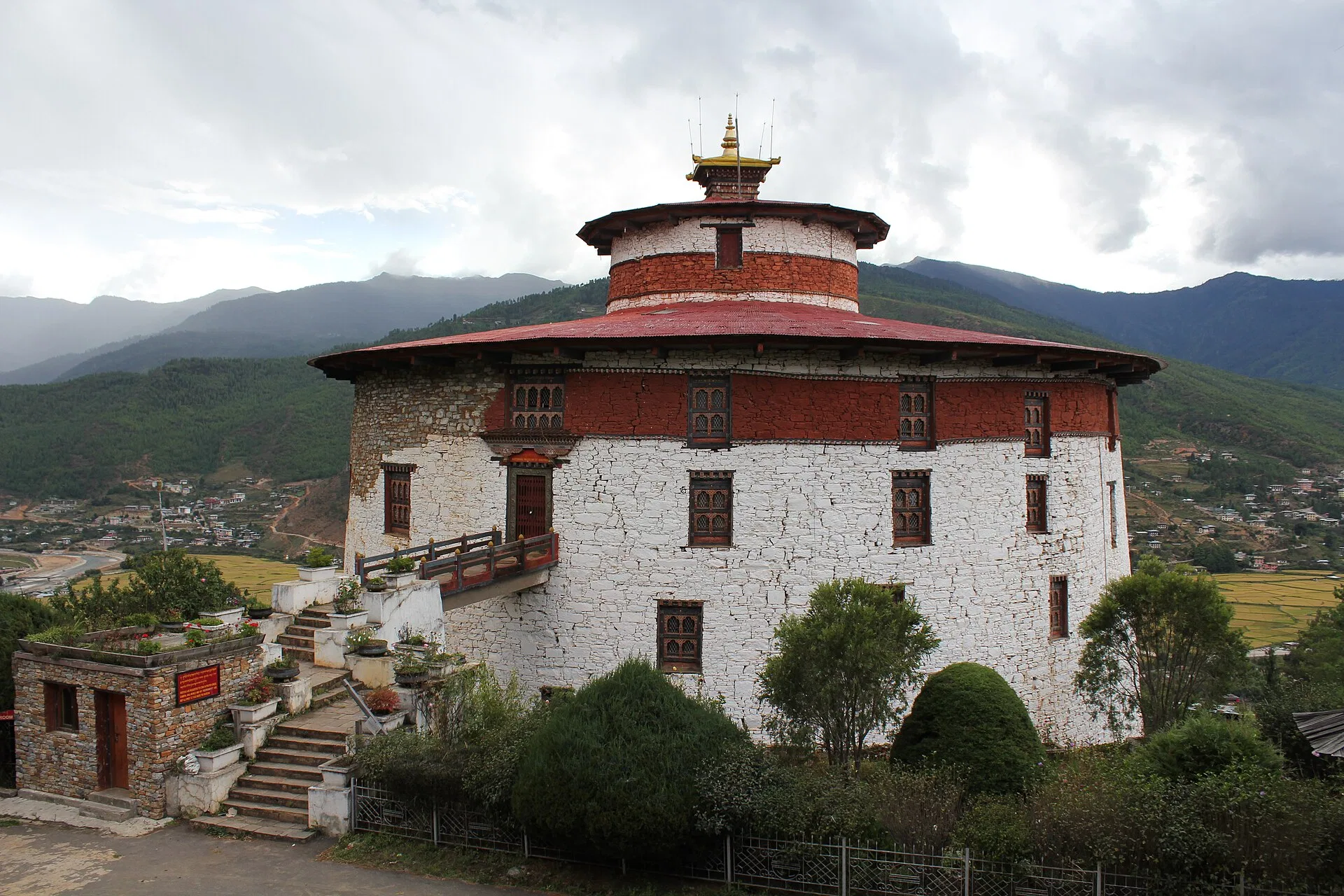
The National Museum of Bhutan occupies a seventeenth-century watchtower above Paro. Its broad remit covers archaeology, religion, art and natural history, but several exhibits fall squarely within the territory of unusual collections. Displays include Stone Age tools, early Buddhist material, ritual objects and imagery connected with deities and sacred diagrams. The tower itself adds to the atmosphere: it was built in 1649 as a defensive structure rather than as a museum, and was later repaired after severe earthquake damage in 2011.[Museums of Bhutan]museums.gov.btnational museum of bhutanIn 2011, a devastating earthquake caused significant damage to the museum, threatening both its collection and structure…. Stone Age t…
The masks and ritual material require careful interpretation. Fierce faces, skull imagery and weapons in Bhutanese religious art are not normally evidence of devil worship or a hidden occult tradition. They belong to Buddhist systems in which intimidating deities can represent protection, the destruction of ignorance or the subduing of harmful forces. Masked dances similarly place gods, demons, animals and historical teachers within moral and devotional narratives. Comparable Bhutanese masks are worn during religious festivals intended to transmit teachings and confer merit or blessings on those present.[Museums of Bhutan]museums.gov.btImage: Fifth Gallery Gallery in the Royal Heritage Museum of Bhutan - Sacred Mask Dances… Ritual items, shrine with golden butter lamp…
One of the museum’s most genuinely eccentric displays is philatelic rather than religious. Its stamp collection includes issues devoted to wildlife, space travel, motor cars and the yeti, alongside a stamp designed to play Bhutan’s national anthem when opened. This is not folklore reconstructed for modern tourists: unusual stamps were a deliberate part of Bhutan’s twentieth-century international identity and collector economy.[The National Museum of Bhutan]nationalmuseum.gov.btThere is a unique stamp on display that plays Bhutan’s national anthem when opened, and is one of a kind in the world…. The National M…
The museum is therefore the best single starting point for Bhutan’s curiosity culture. It combines professionally conserved national collections with objects whose strangeness comes from unfamiliar symbolism, unusual materials or unexpected juxtapositions. Visitors should expect a cultural-history museum, not a theatrical cabinet of horrors.
The Postal Museum: Bhutan’s miniature media experiments
Bhutan Postal Museum in Thimphu tells the history of communication through postal equipment, photographs, documents and rare stamps. It opened in 2015 and has subsequently added collections of maps, newsletters, clippings and other communications material. On paper, that sounds specialised rather than strange. In practice, Bhutan’s stamps are among the country’s most inventive public artefacts.[bhutanpost.bt]bhutanpost.btPostal Museum – Bhutan PostThe Bhutan Postal Museum invites you to discover the major events that marked the history of the postal servic…
From the 1960s onwards, Bhutan issued stamps designed to attract international collectors as well as carry postage. The formats included three-dimensional images and small playable records, sometimes called “talking stamps”. Later experiments extended to compact-disc stamps containing digital material. The most extravagant examples sit somewhere between postage, souvenir, record, miniature advertisement and state-sponsored novelty.[bhutanpostagestamps.com]bhutanpostagestamps.comBhutan Postage Stamps Official BlogBhutan Postage Stamps Official Blog
Their unusual character also raises a useful question about authenticity. These were official issues, not forged curiosities, but many were produced partly with the international collector market in mind. They should therefore be understood as both genuine postal artefacts and calculated commercial objects. That tension is what makes them interesting: Bhutan used the authority of the postage stamp as a platform for sound, moving imagery, national promotion and export revenue.
The Postal Museum is consequently one of the country’s clearest examples of an intentionally eccentric collection. Unlike a sacred mask or fertility emblem, the stamps were meant to surprise outsiders. Visitors interested in design, media archaeology, obsolete technology and odd commercial history may find it more distinctive than many of Bhutan’s larger heritage museums.
The fertility temple that became a curiosity landscape
Chimi Lhakhang, near Punakha, is a working religious site rather than a museum. Yet the temple and surrounding settlement form Bhutan’s most recognisable public collection of unusual symbols. Painted phalluses appear on buildings, while carved versions hang from roofs or are sold as souvenirs. Within the tradition, these images are associated with fertility and protection from harmful forces; they are not simply sexual decoration.[Chimi Lhakhang]chimilhakhang.comOpen source on chimilhakhang.com.
The symbolism is strongly associated with Drukpa Kunley, an unconventional Buddhist teacher remembered for provocative behaviour, sexual humour and stories in which he subdued demons through deliberately shocking methods. His reputation helps explain why the imagery combines sacred purpose with irreverence. Chimi Lhakhang remains a destination for people seeking fertility blessings, and accounts of the temple describe a ritual blessing involving a wooden or metal-handled phallic object.[Druk Asia]drukasia.comchhime lhakhangchhime lhakhang
For visitors, the difficulty lies in separating three overlapping layers:
- Living devotion: Couples and families visit for blessings, protection and help with conception.
- Folklore: Stories about Drukpa Kunley mix remembered history, religious teaching, humour and legend.
- Tourism commerce: Workshops and souvenir sellers reproduce the symbol in increasingly decorative and portable forms.
The village can therefore resemble an open-air museum of fertility imagery, but describing it only as a “phallus attraction” misses its religious role. It is also misleading to imply that every painted image is ancient. Some are modern restorations, commercial signs or tourist-oriented elaborations of an older custom. The official heritage collection maintained by Bhutan’s cultural authorities includes historic phallic architectural elements, showing that the motif has material significance beyond contemporary souvenir culture.[Re-Heritage]dcdd.moha.gov.btOpen source on moha.gov.bt.
Chimi Lhakhang matters to Bhutan’s strange-history landscape because it challenges the usual division between museum object and active ritual implement. The objects are not safely isolated behind glass. They remain in use, are reproduced on houses and circulate as gifts, charms and souvenirs.
An ancestral house preserved from the inside
Ogyen Choling in Bumthang offers a different kind of unusual museum experience. Parts of the ancestral estate were converted into a museum by the family’s heirs, creating a privately managed collection within the buildings where many objects were originally stored or used. The estate also has longstanding religious associations, giving the site importance beyond domestic history.[Ogyen Choling]oling.btOpen source on oling.bt.
Its exhibitions are organised around roughly twenty themes, including agriculture, trade, weapons, emergency grain storage, printing, ritual observances, masks, musical instruments, dance costumes and household rooms. This breadth makes the museum resemble an expanded cabinet of everyday life: sacred items sit near food stores, textiles, tools and administrative equipment rather than being separated into rigid modern categories.[Ogyen Choling]oling.btOpen source on oling.bt.
The most atmospheric displays are likely to be the masks, costumes, ritual objects, old printing equipment and storerooms. They show how an elite rural household functioned as residence, economic centre, religious institution and repository. The museum’s library is also significant, containing Buddhist writings associated principally with one major religious tradition while representing several others.[Ogyen Choling]oling.btOpen source on oling.bt.
Ogyen Choling is credible because the collection is tied to a documented family estate and retained in its architectural setting. At the same time, it is not a neutral time capsule. The family selected what to preserve, how to group it and what story to tell about the household. That curatorial layer should be recognised rather than treated as a flaw. All house museums reconstruct the past; Ogyen Choling is valuable precisely because its reconstruction remains close to the objects’ original social world.
For travellers seeking polished display cases and extensive English interpretation, it may feel less conventional than a national institution. For those interested in private collections, historic interiors and the blurred boundary between household storage and museum display, it is one of Bhutan’s richest sites.
Medicine as a collection of substances and beliefs
Bhutan’s traditional-medicine collections are among the closest equivalents to a medical-curiosity museum, although they are primarily educational rather than macabre. The collection associated with the country’s traditional-medicine institute has been described as containing herbarium sheets, medicinal plant materials, painted medical diagrams and older instruments. Such displays reveal medicine as a material system built from gathered plants, processed substances, diagnostic practices and religious understandings of the body.[Firefox Tours Bhutan]firefoxtours.comOpen source on firefoxtours.com.
Traditional Bhutanese medicine remains part of the country’s healthcare landscape and is not presented merely as extinct folklore. Its diagnostic methods include questioning, physical examination, pulse assessment and examination of bodily waste, while treatment traditions draw on Himalayan materia medica and Buddhist intellectual frameworks.[bhutanfound.org]bhutanfound.orgTraditional MedicineTraditional Medicine
Visitors should nevertheless distinguish cultural legitimacy from scientific proof. A specimen can be historically important even when a particular therapeutic claim is uncertain, difficult to test or unsupported by modern clinical evidence. The most credible interpretation presents the collection as evidence of how Bhutanese practitioners classified illness and gathered medicinal resources, rather than implying that every historic remedy has been independently demonstrated to work.
This makes the medical collection valuable to readers interested in apothecary museums, ethnobotany and unusual healing systems. Its strangeness lies less in grotesque instruments than in the transformation of mountain plants, minerals, diagrams and religious philosophy into an organised medical practice.
Sacred objects are not simply museum exhibits
Bhutan’s museums contain relics, temple fittings and ritual implements, but sacred material is also preserved in monasteries and temples where access may be restricted. The Royal Heritage Museum in Trongsa, for example, includes galleries devoted to royal artefacts, sacred relics, ritual objects and mask dances, as well as two functioning or consecrated temple spaces.[Museums of Bhutan]museums.gov.btImage: Fifth Gallery Gallery in the Royal Heritage Museum of Bhutan - Sacred Mask Dances… Ritual items, shrine with golden butter lamp…
This complicates the ordinary museum expectation that every displayed object is available for detached inspection. A ritual implement may still carry religious authority. A shrine may remain a devotional environment. Photography, physical proximity and detailed explanation can consequently be limited by custom, conservation or institutional policy.
For curiosity-minded visitors, this is an important safeguard against misreading the collection. Fierce deities should not automatically be labelled demons; relics should not be reduced to archaeological specimens; and ritual weapons are not straightforward evidence of historic violence. Their meanings depend on ceremonial context, religious teaching and the relationship between the object and the community preserving it.
Bhutan’s national museums have increasingly formal conservation facilities, documentation programmes and public-education work, indicating that the collections are managed as cultural heritage rather than assembled merely for tourist spectacle.[Museums of Bhutan]museums.gov.btThrough these activities, the National Museum can preserve Bhutan's cultural heritage, ensuring the protection of significant historical…
Living curiosities beyond museum walls
Some of Bhutan’s most memorable “collections” are living ones. The Royal Takin Preserve at Motithang keeps Bhutan’s national animal, a large and unusual-looking hoofed mammal often described as resembling a mixture of goat and cattle. Folklore attributes its creation to Drukpa Kunley, who supposedly assembled the creature from the remains of a goat and a cow after consuming both. The zoological animal is real; the hybrid origin is legend.[Wikipedia]WikipediaMotithang Takin PreserveMotithang Takin Preserve
The preserve is not a cryptid museum, but it occupies similar imaginative territory. Visitors encounter a genuine species alongside a supernatural origin story that helps explain its national symbolism. The site’s history as a former small zoo, later adapted into a forested enclosure, also gives it a distinctive institutional background. It is best understood as a wildlife facility with folklore attached, not proof of an anomalous creature.
In Phobjikha Valley, the Black-Necked Crane Information Centre combines conservation displays, film presentations, observation equipment and, at times, care for injured birds unable to return to the wild. Its subject is an actual migratory species, but the cranes also carry strong cultural and spiritual associations in the region.[drukasia.com]drukasia.comblack necked crane centreblack necked crane centre
These centres matter because Bhutan’s curiosity culture does not draw a hard line between natural history and belief. Animals can be scientifically observed, protected through conservation programmes and simultaneously understood through legends, blessings and local moral relationships.
What is genuinely unusual, and what is tourist packaging?
Bhutan’s strongest strange collections are credible, but they are unusual for different reasons. The National Museum and Royal Heritage Museum are state institutions with conservation responsibilities. Ogyen Choling is a curated private estate. The Postal Museum interprets official communications history while celebrating products created partly for collectors. Chimi Lhakhang is an active religious site surrounded by a growing souvenir economy. The wildlife centres combine public education with conservation and folklore.
That variety makes simple labels such as “authentic” and “touristy” inadequate. A newly carved fertility symbol may be commercially produced yet based on a living protective tradition. A talking stamp may look like a gimmick but remain an official piece of postal history. A frightening mask may seem theatrical while retaining serious religious meaning.
A practical credibility test is to ask four questions:
- Who manages the display? Government department, religious institution, family estate, conservation organisation or commercial operator?
- Was the object made for its original purpose or for visitors? Both can be worth seeing, but they tell different stories.
- Is the interpretation distinguishing history from legend? The takin’s biology and its miraculous creation story should not be presented as the same kind of claim.
- Is the collection still active? Ritual implements, shrines and medicinal materials may belong to continuing practices rather than a finished historical period.
Evidence for small or remote Bhutanese collections can be fragmented, and visitor information may change. Lesser-known displays are often described mainly by tour companies rather than detailed institutional catalogues. It is therefore sensible to verify access locally, especially for collections inside monasteries, educational institutes or private houses.

Why Bhutan’s curiosity culture is distinctive
Bhutan’s unusual collections are rarely built around scandal, gore or deliberate horror. Their power comes from the coexistence of sacred and ordinary things: masks beside grain stores, medical diagrams beside dried plants, postage stamps that double as records, and protective fertility symbols painted onto domestic walls.
The country also resists the assumption that preservation requires removing objects from use. Some objects enter conservation laboratories and museum cases; others remain in temples, houses, ceremonies or healing institutions. This produces a landscape in which museums are only one part of the collecting culture.
For the strange-travel reader, the essential Bhutan itinerary is therefore not a hunt for a single sensational oddity. It is a route through different systems of belief and classification: the National Museum’s ritual and natural-history galleries, the Postal Museum’s miniature media experiments, Ogyen Choling’s ancestral storerooms, Chimi Lhakhang’s protective fertility imagery and the wildlife centres where zoology meets legend. What looks uncanny from the outside often proves, on closer inspection, to be a carefully preserved expression of how Bhutan understands protection, memory, nature and sacred power.
Amazon book picks
Further Reading
Books and field guides related to Where Bhutan Keeps Its Strangest Objects. Use these as the next step if you want deeper reading beyond the article.
Beyond the Sky and the Earth: A Journey into Bhutan
Stirring, poignant, funny, and full of joy, Beyond the Sky and the Earth is at once a classic tale of discovery and adventure, and a love...
Treasures of the Thunder Dragon: A Portrait of Bhutan
Author's memoir of travelogue with the historical and cultural description of Bhutan.
Lonely Planet Bhutan
Lonely Planet Bhutan is your passport to the most relevant, up-to-date advice on what to see and skip, and what hidden discoveries await...
eBay marketplace picks
Marketplace Samples
Live-tested eBay searches with available results related to this page.
Selected fromBhutan art oneBay.co.uk.
Endnotes
1.
Source: bhutanpost.bt
Link:https://bhutanpost.bt/postal-museum/
Source snippet
Postal Museum – Bhutan PostThe Bhutan Postal Museum invites you to discover the major events that marked the history of the postal servic...
2.
Source: bhutanpostagestamps.com
Title: Bhutan Postage Stamps Official Blog
Link:https://www.bhutanpostagestamps.com/blog/
3.
Source: bhutanpostagestamps.com
Title: Bhutan Stamps
Link:https://www.bhutanpostagestamps.com/prm_worldsfirst_cdrom.htm
4.
Source: bhutanfound.org
Title: Traditional Medicine
Link:https://www.bhutanfound.org/our_work/traditional-medicine/
5.
Source: Wikipedia
Title: Motithang Takin Preserve
Link:https://en.wikipedia.org/wiki/Motithang_Takin_Preserve
6.
Source: bhutanfound.org
Link:https://www.bhutanfound.org/the-faculty-of-traditional-medicine-fotm-and-the-bhutan-foundation-inaugurate-the-tanadugphodrang/
7.
Source: bhutan.travel
Link:https://bhutan.travel/journal/editorial/cultural-fabric
8.
Source: bhutan.travel
Link:https://bhutan.travel/journal/editorial/cycling-holidays-in-bhutan
9.
Source: bhutan.travel
Link:https://bhutan.travel/adventure_art
10.
Source: bhutan.travel
Link:https://bhutan.travel/journal/editorial/mushrooms-and-foraging-in-bhutan
11.
Source: bhutan.travel
Link:https://bhutan.travel/
12.
Source: Wikipedia
Link:https://en.wikipedia.org/wiki/Thimphu
13.
Source: Wikipedia
Title: Folk music
Link:https://en.wikipedia.org/wiki/Folk_music
14.
Source: Wikipedia
Title: Phallus paintings in Bhutan
Link:https://en.wikipedia.org/wiki/Phallus_paintings_in_Bhutan
15.
Source: Wikipedia
Link:https://en.wikipedia.org/wiki/Bhutan
16.
Source: Wikipedia
Title: Chimi Lhakhang
Link:https://en.wikipedia.org/wiki/Chimi_Lhakhang
17.
Source: tripadvisor.com
Title: The best show of artifacts in Bhutan
Link:https://www.tripadvisor.com/ShowUserReviews-g321541-d455672-r119568490-National_Museum-Paro_Paro_District.html
18.
Source: tripadvisor.com
Link:https://www.tripadvisor.com/Attractions-g293844-Activities-c49-Bhutan.html
19.
Source: tripadvisor.com
Link:https://www.tripadvisor.com/Tourism-g293845-Thimphu_Thimphu_District-Vacations.html
20.
Source: tripadvisor.com
Title: Motithang Takin Preserve
Link:https://www.tripadvisor.com/Attraction_Review-g293845-d1722391-Reviews-Motithang_Takin_Preserve-Thimphu_Thimphu_District.html
21.
Source: bhutanpost.bt
Title: stamps and products
Link:https://bhutanpost.bt/stamps-and-products/
22.
Source: bhutanpost.bt
Link:https://bhutanpost.bt/mail-service/
23.
Source: youtube.com
Title: The Burning Lake & The Manor: Tang Valley, Bhutan
Link:https://www.youtube.com/watch?v=mdFeH5PyxxU
Source snippet
Chimi Lhakhang - women pray at the temple of fertility...
24.
Source: youtube.com
Title: Chimi Lhakhang
Link:https://www.youtube.com/watch?v=xvozftE0qmQ
Source snippet
BHUTAN Trip Day 4|Thimphu Post Office Buddha Dordenma | Takin...
25.
Source: museums.gov.bt
Title: national museum of bhutan
Link:https://museums.gov.bt/our-museums/national-museum-of-bhutan
Source snippet
In 2011, a devastating earthquake caused significant damage to the museum, threatening both its collection and structure.... Stone Age t...
26.
Source: museums.gov.bt
Link:https://www.museums.gov.bt/our-museums/conservation-and-preservation
Source snippet
Through these activities, the National Museum can preserve Bhutan's cultural heritage, ensuring the protection of significant historical...
27.
Source: museums.gov.bt
Link:https://www.museums.gov.bt/our-museums/royal-heritage-museum
Source snippet
Image: Fifth Gallery Gallery in the Royal Heritage Museum of Bhutan - Sacred Mask Dances... Ritual items, shrine with golden butter lamp...
28.
Source: nationalmuseum.gov.bt
Link:https://www.nationalmuseum.gov.bt/collections/second-floor
Source snippet
There is a unique stamp on display that plays Bhutan’s national anthem when opened, and is one of a kind in the world.... The National M...
29.
Source: postalmuseum.si.edu
Link:https://postalmuseum.si.edu/exhibition/international-philately-asia-southern-asia/bhutan
Source snippet
National Postal MuseumBhutan | National Postal MuseumSince 1966, Bhutan has issued large numbers of attractive (and philatelically inspir...
30.
Source: chimilhakhang.com
Link:https://www.chimilhakhang.com/
31.
Source: dcdd.moha.gov.bt
Link:https://dcdd.moha.gov.bt/collection/phallus/
32.
Source: drukasia.com
Title: chhime lhakhang
Link:https://www.drukasia.com/bhutan/punakha/chhime-lhakhang/
33.
Source: oling.bt
Link:https://www.oling.bt/museum.html
34.
Source: oling.bt
Link:https://www.oling.bt/exhibitions.html
35.
Source: oling.bt
Link:https://www.oling.bt/library.html
36.
Source: firefoxtours.com
Link:https://www.firefoxtours.com/regions-places/sorig-museum-national-institute-traditional-medicine
37.
Source: museums.gov.bt
Link:https://www.museums.gov.bt/our-museums/educational-and-resources
38.
Source: drukasia.com
Title: black necked crane centre
Link:https://www.drukasia.com/bhutan/gangtey/black-necked-crane-centre/
39.
Source: tripadvisor.co.uk
Title: Tripadvisor BLACK NECKED CRANE CENTER
Link:https://www.tripadvisor.co.uk/Attraction_Review-g2425780-d18939912-Reviews-Black_Necked_Crane_Center-Phobjikha_Valley_Wangdue_Phodrang_District.html
40.
Source: museums.gov.bt
Link:https://museums.gov.bt/news-events/nft-drop-on-opensea-unlock-exclusive-access-to-bhutan-s-cultural-and-heritage-experiences
42.
Source: museums.gov.bt
Title: Heritage Science for Conservation in Bhutan | The National Museum of Bhutan
Link:https://museums.gov.bt/news-events/heritage-science-for-conservation-in-bhutan/
43.
Source: museums.gov.bt
Link:https://www.museums.gov.bt/news-events/harmony-with-nature-solo-art-exhibition-by-penjor-dorji
44.
Source: museums.gov.bt
Title: Flag hoisting ceremony at the National Museum | The National Museum of Bhutan
Link:https://www.museums.gov.bt/news-events/flag-hoisting-ceremony-at-the-national-museum
45.
Source: bhutantraveladvisor.com
Title: Bhutan Postal Museum
Link:https://www.bhutantraveladvisor.com/bhutan-postal-museum
46.
Source: museums.gov.bt
Link:https://www.museums.gov.bt/
47.
Source: museums.gov.bt
Link:https://www.museums.gov.bt/our-museums
48.
Source: museums.gov.bt
Link:https://www.museums.gov.bt/our-museums/royal-heritage-museum/temples-in-the-royal-heritage-museum
50.
Source: museum.systems.gov.bt
Link:https://museum.systems.gov.bt/
51.
Source: drukasia.com
Link:https://www.drukasia.com/bhutan/thimphu/folk-heritage-museum/
52.
Source: drukasia.com
Title: bhutan national animal
Link:https://www.drukasia.com/blog/bhutan-national-animal/
53.
Source: oling.bt
Link:https://www.oling.bt/contact.html
54.
Source: oling.bt
Link:https://www.oling.bt/tools.html
55.
Source: oling.bt
Link:https://oling.bt/index.html
56.
Source: foundbht.com
Title: chimi lhakhang fertility temple bhutan
Link:https://foundbht.com/blog/post/chimi-lhakhang-fertility-temple-bhutan
57.
Source: thimphu.gov.bt
Link:https://thimphu.gov.bt/
58.
Source: thimphu.gov.bt
Link:https://thimphu.gov.bt/motithang-takin-preserve/
59.
Source: GOV.UK
Link:https://www.gov.uk/foreign-travel-advice/bhutan
60.
Source: nationalmuseum.gov.bt
Link:https://nationalmuseum.gov.bt/collections/fourth-floor/
61.
Source: cntraveller.com
Link:https://www.cntraveller.com/topic/bhutan
62.
Source: moh.gov.bt
Link:https://moh.gov.bt/pages/about-us-nctms/
63.
Source: doc.gov.bt
Link:https://doc.gov.bt/divisions/museum-division/
Additional References
64.
Source: collection.sciencemuseumgroup.org.uk
Link:https://collection.sciencemuseumgroup.org.uk/objects/co123887/wooden-mask
Source snippet
Science Museum Group CollectionWooden maskA smiling skull has been carved and painted on to this wooden mask. For centuries, masks like t...
65.
Source: youtube.com
Title: BHUTAN Trip Day 4|Thimphu Post Office Buddha Dordenma | Takin
Link:https://www.youtube.com/watch?v=be0u07oy8LU
Source snippet
Simply Bhutan Museum Full Tour | Culture, Tradition & Amazing Experience...
66.
Source: instagram.com
Link:https://www.instagram.com/reel/DRwqLyMjHX7/?hl=en
67.
Source: atlasobscura.com
Link:https://www.atlasobscura.com/things-to-do/bhutan/museums
68.
Source: sciencedirect.com
Link:https://www.sciencedirect.com/science/article/pii/S037887411300295X
69.
Source: wikitravel.org
Link:https://wikitravel.org/en/Bhutan
70.
Source: bhutanwiki.org
Link:https://www.bhutanwiki.org/articles/bhutan-postal-service
71.
Source: responsibletravel.com
Link:https://www.responsibletravel.com/holidays/bhutan/travel-guide
72.
Source: heavenlybhutan.com
Link:https://www.heavenlybhutan.com/sightseeing-places-of-bhutan/places-to-visit-in-wangdue-phobjikha/black-necked-crane-center/
73.
Source: raventoursbhutan.com
Link:https://www.raventoursbhutan.com/experience/black-necked-crane-centre