What Makes Chile's Strangest Collections Matter?
Chile’s strangest collections are not concentrated in one eccentric museum district.
Page outline Jump by section
Introduction
The strongest attractions are not novelty museums in the usual sense. The Chinchorro displays around Arica are internationally important archaeological collections; the Meteorite Museum in San Pedro de Atacama connects private collecting with planetary science; and sites such as Villa Grimaldi and Londres 38 use disturbing buildings and surviving objects to confront recent political terror. Chile also has more speculative collections, particularly the UFO Museum in La Serena, where documentation and testimony are displayed without providing proof of extraterrestrial visitors. The country’s curiosity culture therefore ranges from rigorous research institutions to belief-led private museums, with credibility depending heavily on who collected the material and how it is interpreted.
Where Chile’s unusual collections are found
Chile’s geography helps explain the character of its odd museums. The exceptionally dry north preserves bodies, textiles, archaeological sites and meteorites that would decay or disappear more quickly elsewhere. Santiago, by contrast, holds academic collections and memory institutions created by universities, government bodies and human-rights organisations. Smaller private museums often emerge in places associated with tourism, astronomy or local legends.
Several broad types stand out:
- Ancient death and mummification, centred on Arica and the Chinchorro archaeological landscape.
- Objects from space, especially meteorites recovered from the Atacama Desert.
- UFO records and anomalous claims, represented most clearly by the private museum in La Serena.
- Medical and scientific curiosities, preserved by the University of Chile and natural-history museums.
- Prisons, torture sites and material evidence of dictatorship, presented through memorial museums rather than entertainment-led “dark tourism”.
These categories overlap. The desert that preserves a mummy can also preserve a meteorite for hundreds of thousands of years. Astronomy tourism can encourage interest in UFO stories. A medical instrument may be both a scientific artefact and a disturbing reminder of older treatments. The most rewarding visits are therefore those that explain not simply what an unusual object is, but why Chilean institutions chose to preserve it.
The Chinchorro mummies: Chile’s most important encounter with the dead
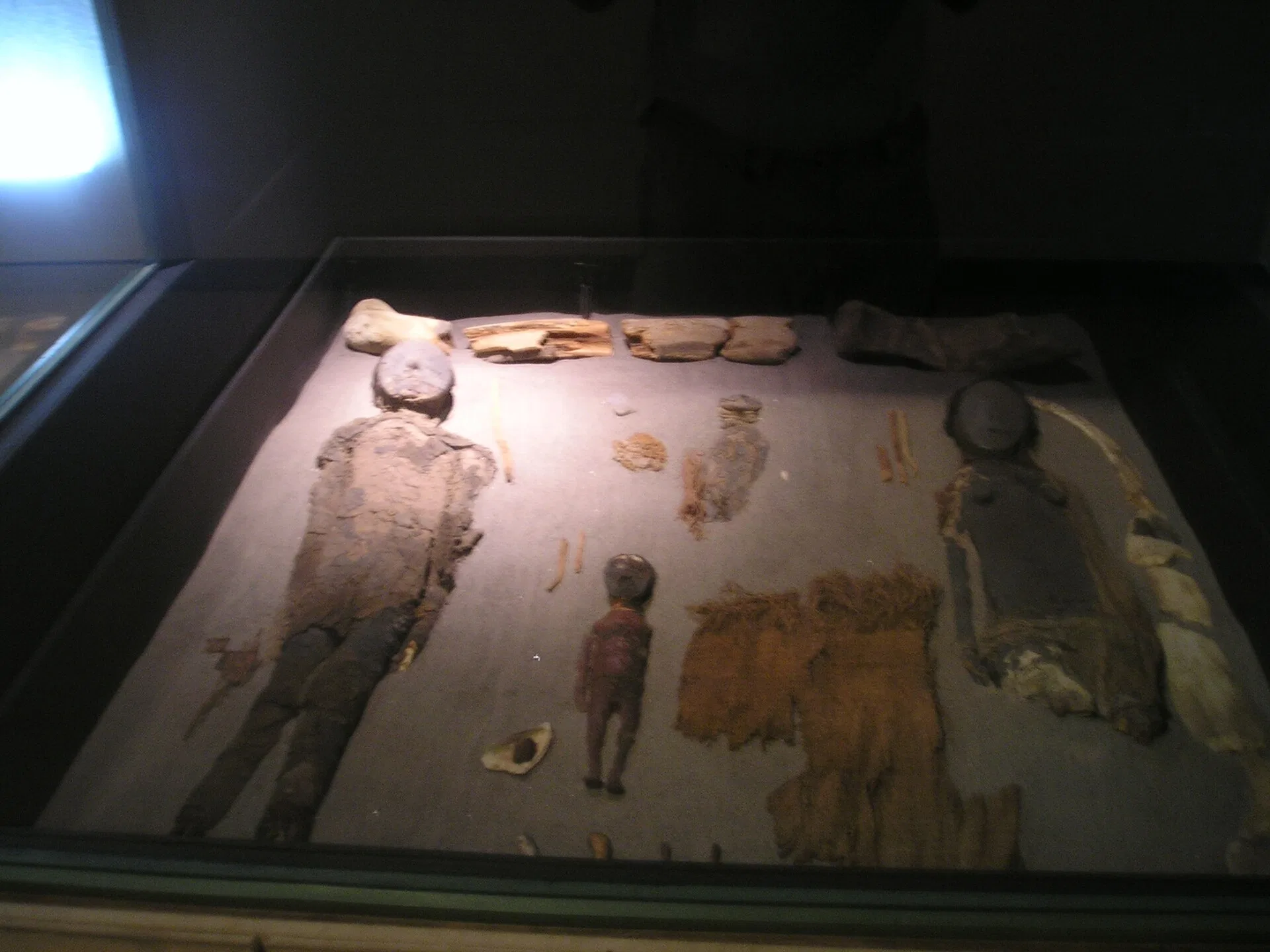
The most extraordinary human remains displayed in Chile belong to the Chinchorro culture, whose communities lived along the Pacific coast of what is now northern Chile and southern Peru. They developed artificial mummification thousands of years before the better-known royal mummies of ancient Egypt. UNESCO inscribed the settlements and artificial mummification of the Chinchorro culture in the Arica and Parinacota region as a World Heritage Site in 2021.[UNESCO World Heritage Centre]whc.unesco.orgUNESCO World Heritage CentreSettlement and Artificial Mummification of the Chinchorro…27-07-2021 — The Chinchorro cemeteries reveal ar…
What makes the tradition especially unusual is that preservation was not apparently reserved for rulers. Adults, children and infants were treated, sometimes through elaborate reconstruction of the body using clay, plant material, sticks, hair and pigments. Archaeologists have also found evidence that certain mummified bodies were repaired or handled after death, suggesting that they may have remained part of family or communal life before final burial.[patrimoniocultural.gob.cl]patrimoniocultural.gob.clSome 7,000 years ago, the coast of southern Peru and northern Chile was inhabited by the Chinchorro, a hunting, fishing and gathering peo…
Colón 10 and the archaeology beneath the city
The Colón 10 site museum in Arica offers one of Chile’s most direct encounters with this heritage. Human remains were found beneath an urban property, and the site was preserved rather than simply cleared after excavation. Visitors look into the burial area from an elevated or glazed walkway, making the museum feel less like a conventional gallery than a protected archaeological trench inside the modern city.
This presentation is powerful because the bodies remain connected to the place where they were buried. It also raises difficult questions. These are not curiosities produced for display but human ancestors, including children. Chilean heritage authorities, university specialists and local organisations have held discussions about ethical standards for excavating, conserving and exhibiting Chinchorro bodies, reflecting a wider international shift away from treating human remains as neutral museum specimens.[patrimoniocultural.gob.cl]patrimoniocultural.gob.clOpen source on gob.cl.
San Miguel de Azapa and the broader Chinchorro story
The archaeological museum at San Miguel de Azapa, operated by the University of Tarapacá, provides a fuller cultural and scientific context. Its collections extend beyond bodies to fishing equipment, textiles, tools and other evidence of life in the desert and coastal valleys. This matters because the Chinchorro are often reduced in popular tourism to the phrase “the world’s oldest mummies”, obscuring the communities, subsistence systems and mortuary beliefs behind the remains.
Chinchorro material also appears in other Chilean institutions. Santiago’s National Museum of Natural History has presented an exhibition on the Chinchorro heritage, while the Natural History Museum of Valparaíso holds Chinchorro bodies alongside other mummified remains from northern Chile.[patrimoniocultural.gob.cl]patrimoniocultural.gob.clOpen source on gob.cl.
For visitors, the distinction is important. Colón 10 is primarily an archaeological site; San Miguel de Azapa is a regional research museum; and displays farther south place Chinchorro material inside wider national narratives. None should be approached as a “mummy attraction” alone. Their real significance lies in the unusual relationship between desert preservation, deliberate body reconstruction and the continuing ethical problem of displaying the dead.
The Atacama’s stones from space
San Pedro de Atacama’s Meteorite Museum is one of Chile’s clearest examples of a private passion becoming a visitor-facing scientific collection. Its founders spent decades searching the desert, and the museum states that its holdings now exceed 6,700 pieces, all associated with meteorite falls in the Atacama. Only a selection is displayed publicly. Chile’s national museum register describes it as the result of roughly four decades of collecting by two brothers from the region.[museodelmeteorito.cl]museodelmeteorito.clOpen source on museodelmeteorito.cl.
Visitors can expect a compact, specialised exhibition rather than a large national museum. The appeal lies in the physical variety of meteorites and the opportunity to learn how they are identified, classified and distinguished from ordinary terrestrial rocks. The museum sits naturally within San Pedro’s astronomy economy, but its objects are not props for stargazing tourism: meteorites from the Atacama have genuine scientific value.
The desert is particularly useful to researchers because its stable, extremely dry surfaces allow meteorites to survive for very long periods and remain comparatively visible. A scientific study of meteorites from the El Médano area found an average terrestrial age of about 710,000 years in its sample, demonstrating how the Atacama can preserve an exceptionally long record of material arriving from space.[arXiv]arxiv.orgarXiv The meteorite flux of the last 2 Myr recorded in the Atacama desertarXiv The meteorite flux of the last 2 Myr recorded in the Atacama desert
The museum’s own claim to possess the world’s largest meteorite collection should still be read as institutional or promotional wording rather than an independently settled ranking. Collection size depends on whether researchers count individual fragments, documented falls, classified specimens or total mass. Its importance does not require a world record: it is unusual because it brings together local desert knowledge, long-term private collecting and a landscape that functions as a natural archive of the Solar System.
Chile’s UFO museum: archive, belief and popular investigation
The UFO Museum in La Serena occupies a different evidential category. Founded in 2004, it describes itself as Chile’s first museum devoted to the UFO phenomenon. Its holdings include documents, photographs, newspapers, magazines, books, videos and research files assembled over several decades. It remains listed in Chile’s national museum register, which was updated in June 2026, and operates as a ticketed visitor attraction.[museoovni.cl]museoovni.clNosotros – Museo Ovni La SerenaNosotros – Museo Ovni La Serena
This is primarily an archive of claims and UFO culture, not a scientific museum containing verified alien technology. Visitors should expect case histories, media material, reported sightings and interpretations produced by investigators. Such objects can be historically valuable even when the underlying claims remain unproven. Newspaper cuttings, witness accounts and photographs document how Chileans have imagined unexplained aerial phenomena, how cases were circulated, and how UFO investigation became a recognisable popular practice.
The museum has also taken part in contemporary discussion of unexplained images. In 2025, researchers from the University of Magallanes consulted it about unusual lights captured by a wildlife camera in Patagonia. Suggested explanations included an insect near the camera, internal lens reflections and an atmospheric or electrical phenomenon. No conclusive explanation was established, and none of the available evidence demonstrated an extraterrestrial origin.[Live Science]livescience.comResearchers remain baffled. Theories advanced include lens reflections, plasmoids (ionized gas bubbles like ball lightning), or a nearby…
That episode illustrates both the attraction and limitation of the collection. The museum can preserve reports, compare imagery and maintain specialist knowledge of earlier cases, but unresolved does not mean alien. Its displays are most useful when understood as material culture: evidence of investigation, uncertainty and belief, rather than physical proof of visitors from another world.
Chile is particularly fertile territory for this kind of museum because northern desert tourism already combines vast skies, major observatories and an otherworldly landscape. Scientific astronomy and UFO enthusiasm are very different activities, but they often share the same tourist geography. The museum commercialises that overlap while also preserving an eccentric modern archive that might otherwise be dispersed.
Medical objects and the unsettling history of treatment
Santiago’s National Museum of Medicine, named after medical historian Enrique Laval, preserves the material and documentary history of healthcare in Chile. It grew from the merger of an earlier medical museum with historic holdings from the University of Chile’s medical school and the former San Vicente de Paul Hospital. The institution functions not only as an exhibition space but also as a library and archive.[medicina.uchile.cl]medicina.uchile.clMuseo Nacional de MedicinaMuseo Nacional de Medicina
Its collections include historic instruments, hospital records, photographs, plans, books, theses and personal papers. The unusual appeal lies in seeing medicine before disposable equipment, digital imaging and modern infection control. Older surgical tools, diagnostic devices and hospital furnishings can look alarming to contemporary visitors, even when they represented advanced treatment in their own period.
This is not a commercial “museum of horrors”. The objects are curated within an academic institution, where their purpose is to document medical education, public health and the development of Chilean hospitals. Some fragile archival materials are available only under controlled conditions, and public access may depend on scheduled opening or guided visits rather than constant tourist admission. Chile’s museum register currently describes guided visiting hours on weekdays, so arrangements should be checked directly before travelling.[Registro Museos Chile]registromuseoschile.clw3 article 83367w3 article 83367
Related University of Chile collections cover anatomy, chemistry and pharmacy. These holdings broaden the idea of a cabinet of curiosity: glassware, teaching models, preparations, instruments and historic scientific equipment were accumulated for practical instruction, but later became records of how knowledge was produced.[Universidad de Chile]uchile.clUniversidad de Chile Museos y salas de exposicionesUniversidad de Chile Museos y salas de exposiciones
The credibility here is high in institutional terms. Provenance, preservation and scholarly use matter more than shock value. Nevertheless, visitors should be prepared for material connected with illness, surgery and death, and for the ethical complications that can accompany anatomical or clinical collections.

Former detention centres as museums of evidence
Chile’s most disturbing public collections are found in sites connected with the military dictatorship of 1973–1990. These places should not be grouped casually with playful oddity museums. They preserve buildings, testimony and surviving objects associated with imprisonment, torture, execution and disappearance.
Villa Grimaldi in Santiago was a clandestine detention and torture centre before becoming a peace park and memorial site. Much of the original complex was destroyed in an attempt to erase evidence, so its interpretation combines surviving structures, reconstructed spaces, commemorative art, testimony and recovered objects. One especially charged exhibit is a mother-of-pearl button fused to a section of railway rail, connected with evidence that victims’ bodies were weighted and thrown into the sea.[Sage Journals]journals.sagepub.comOpen source on sagepub.com.
This is an unusual collection because absence is part of the display. Visitors encounter erased rooms, reconstructed cells and spaces whose meaning depends on survivor accounts. The site does not claim that every reconstruction is an untouched original. Instead, it explains how destruction itself formed part of the crime and how memory work has attempted to restore what perpetrators tried to remove.
Londres 38 presents a different experience. The Santiago building served as a secret detention centre, and its relatively unembellished architecture gives the visit an unsettling domestic quality. It was opened as a public memorial and has developed programmes linking dictatorship-era repression with continuing debates about human rights and political responsibility.[Hakikat Adalet Hafıza Merkezi]hakikatadalethafiza.orgreclaiming memory dictatorship chile 1 londres 38reclaiming memory dictatorship chile 1 londres 38
Both institutions are public-facing, historically grounded and politically significant. They are sometimes included in dark-tourism itineraries, but tourism is not their primary purpose. They exist to preserve evidence, honour victims and challenge denial. Visitors should expect emotional difficulty rather than theatrical scares.
What counts as credible in Chile’s curiosity culture?
Chile’s unusual museums range from archaeological institutions to privately assembled belief archives, so a single standard of credibility is not useful. A better approach is to ask what kind of claim each collection is making.
Archaeological and scientific museums should provide excavation context, classification, conservation records and named institutional responsibility. The Chinchorro collections and university medical holdings meet this standard, although ethical debate continues over the treatment of human remains.
Private natural-history collections may still have strong scientific value. The Meteorite Museum is collector-led, but its specimens come from a landscape studied extensively by planetary scientists. Its interpretations can be separated from promotional claims about size or global rank.
Folkloric or UFO museums preserve stories, testimony and media culture. Their objects may be authentic documents without making the events described in those documents true. A photograph can genuinely belong to a historic investigation while remaining ambiguous or misidentified.
Memory sites depend on testimony, judicial records, forensic work and surviving architecture. Reconstructions should be clearly identified, but reconstruction does not make a site fictitious. In Chile, the destruction of detention centres often makes survivor knowledge essential to interpreting what remains.
This distinction protects the pleasures of strange travel without flattening everything into either blind belief or cynical debunking. A museum can be culturally revealing even when its central mystery is unresolved.
Planning an unusual-museum route
The most coherent route begins in northern Chile. Arica offers the Chinchorro archaeological landscape, including Colón 10 and the collections at San Miguel de Azapa. Farther south, San Pedro de Atacama provides the Meteorite Museum alongside the desert environment that preserved its specimens. La Serena adds the country’s main public UFO archive.
Santiago then offers a more institutional and politically difficult group of collections: the National Museum of Medicine, the National Museum of Natural History’s archaeological displays, Villa Grimaldi, Londres 38 and the Museum of Memory and Human Rights. These attractions should not be rushed into a single day. The medical and natural-history collections require close attention to objects and labels, while the memory sites are emotionally demanding.
Opening arrangements vary considerably. National and regional museums usually publish regular hours, but university collections may require advance coordination, private museums may alter sessions seasonally, and archaeological sites can close for conservation. Human-remains displays may also change as ethical policies develop. Current information should therefore be checked through the institution or Chile’s national museum register before visiting.
Why Chile’s strange collections matter
Chile’s distinctive museum landscape is shaped by preservation: bodies dried by the desert, meteorites resting on ancient surfaces, medical equipment retained by universities, witness testimony assembled into archives, and damaged buildings protected against forgetting. The country’s most memorable collections are unusual not because they are random, but because each preserves material that could easily have vanished.
They also reveal different ways of dealing with uncertainty. Archaeology reconstructs ancient mortuary practice from bodies and burial contexts. Planetary science extracts long histories from stones. UFO collectors organise reports that remain open to competing explanations. Memory institutions rebuild histories that perpetrators tried to erase.
For the curious traveller, the result is more substantial than a list of odd exhibits. Chile offers museums where death, outer space, contested belief and political violence are treated as problems of evidence. The best displays do not merely show strange things. They ask who collected them, what can responsibly be claimed about them, and why society decided they should remain visible.

Amazon book picks
Further Reading
Books and field guides related to What Makes Chile's Strangest Collections Matter?. Use these as the next step if you want deeper reading beyond the article.
The Oxford Handbook of the Archaeology of Death and Burial
The Oxford Handbook of the Archaeology of Death and Burial reviews the current state of mortuary archaeology and its practice, highlighti...
The Chile Reader: History, Culture, Politics
First published 2013. Subjects: Politics and government, Civilization, History, Chile, history, Chile, politics and government.
eBay marketplace picks
Marketplace Samples
Live-tested eBay searches with available results related to this page.
Selected fromChile map print oneBay.co.uk.
Endnotes
1.
Source: whc.unesco.org
Link:https://whc.unesco.org/en/list/1634/
Source snippet
UNESCO World Heritage CentreSettlement and Artificial Mummification of the Chinchorro...27-07-2021 — The Chinchorro cemeteries reveal ar...
2.
Source: patrimoniocultural.gob.cl
Link:https://www.patrimoniocultural.gob.cl/noticias/unesco-incluye-asentamientos-y-momificacion-artificial-de-la-cultura-chinchorro-en-la
Source snippet
Por las evidencias del lugar de entierro, a pocos centímetros de la superficie, y cerca o en los lugares en que vivían, y por el desgaste...
3.
Source: patrimoniocultural.gob.cl
Link:https://www.patrimoniocultural.gob.cl/en/santiago-museums/national-natural-history-museum/chinchorro-heritage-worlds-oldest-mummies
Source snippet
Some 7,000 years ago, the coast of southern Peru and northern Chile was inhabited by the Chinchorro, a hunting, fishing and gathering peo...
4.
Source: patrimoniocultural.gob.cl
Link:https://www.patrimoniocultural.gob.cl/noticias/visita-el-sitio-de-patrimonio-mundial-chinchorro-con-el-nuevo-recorrido-virtual-serpat
5.
Source: patrimoniocultural.gob.cl
Link:https://www.patrimoniocultural.gob.cl/noticias/taller-internacional-abordo-en-arica-excavacion-conservacion-y-exhibicion-de-cuerpos
Source snippet
Además de las ponencias e instancias de reflexión, se llevó a cabo una visita guiada al Museo de Sitio Colón 10, mientras que el tercer d...
6.
Source: patrimoniocultural.gob.cl
Link:https://www.patrimoniocultural.gob.cl/en/santiago-museums/national-natural-history-museum
7.
Source: patrimoniocultural.gob.cl
Link:https://www.patrimoniocultural.gob.cl/en/regional-museums/valparaiso-natural-history-museum
Source snippet
In addition, it has an bioanthropological collection that includes four mummies from northern Chile's indigenous Chinchorro people, sixte...
8.
Source: museodelmeteorito.cl
Link:https://www.museodelmeteorito.cl/
9.
Source: arxiv.org
Title: arXiv The meteorite flux of the last 2 Myr recorded in the Atacama desert
Link:https://arxiv.org/abs/1904.12644
10.
Source: museoovni.cl
Title: Nosotros – Museo Ovni La Serena
Link:https://museoovni.cl/museo/nosotros/
11.
Source: museoovni.cl
Link:https://museoovni.cl/museo/tickets/
12.
Source: medicina.uchile.cl
Title: Museo Nacional de Medicina
Link:https://medicina.uchile.cl/biblioteca/museo-nacional-de-medicina/presentacion
13.
Source: uchile.cl
Title: Universidad de Chile Museos y salas de exposiciones
Link:https://uchile.cl/extension-y-cultura/museos-y-salas
14.
Source: patrimoniocultural.gob.cl
Link:https://www.patrimoniocultural.gob.cl/noticias/desde-el-ascensor-cordillera-de-valparaiso-se-lanzo-el-pasaporte-de-los-sitios-de
15.
Source: patrimoniocultural.gob.cl
Link:https://www.patrimoniocultural.gob.cl/noticias/un-nuevo-viaje-por-chile-lanzan-pasaporte-de-sitios-patrimonio-mundial
16.
Source: patrimoniocultural.gob.cl
Link:https://www.patrimoniocultural.gob.cl/noticias/objetos-y-practicas-en-torno-la-muerte-colecciones-funerarias-de-arqueologia-e-historia-en
17.
Source: minciencia.gob.cl
Title: Min Ciencia
Link:https://www.minciencia.gob.cl/noticias/como-sacar-a-los-ninos-de-la-pantalla-en-vacaciones-minciencia-recopilo-mas-de-30-panoramas-para-desafiar-la-curiosidad/
18.
Source: patrimoniocultural.gob.cl
Link:https://www.patrimoniocultural.gob.cl/noticias/taller-sobre-la-cultura-chinchorro-como-sitio-patrimonio-mundial
19.
Source: medicina.uchile.cl
Title: cl Más de 3.200 personas visitaron el Museo de Anatomía
Link:https://medicina.uchile.cl/noticias/205684/mas-de-3200-personas-visitaron-el-museo-de-anatomia
20.
Source: uchile.cl
Title: Los 100 años del Museo de Anatomía de la Universidad de Chile
Link:https://uchile.cl/noticias/186660/los-100-anos-del-museo-de-anatomia-
21.
Source: patrimoniocultural.gob.cl
Link:https://www.patrimoniocultural.gob.cl/noticias/conoce-la-cultura-chinchorro-y-sus-momias-nuevo-patrimonio-mundial-de-la-unesco
22.
Source: patrimoniocultural.gob.cl
Link:https://www.patrimoniocultural.gob.cl/noticias/crean-corporacion-para-proteger-y-preservar-momias-de-la-cultura-chinchorro
23.
Source: medicina.uchile.cl
Title: cl Museo de Anatomía en el Día del Patrimonio Cultural
Link:https://medicina.uchile.cl/agenda/133509/museo-de-anatomia-en-el-dia-del-patrimonio-cultural
24.
Source: medicina.uchile.cl
Title: cl Museo Nacional de Medicina inaugura moderna sala de exhibición
Link:https://medicina.uchile.cl/noticias/15230/museo-nacional-de-medicina-inaugura-moderna-sala-de-exhibicion
25.
Source: uchile.cl
Title: Ubicación de colecciones
Link:https://uchile.cl/informacion-y-bibliotecas/colecciones-antiguas-y-valiosas/ubicacion-de-colecciones
26.
Source: uchile.cl
Title: Arte y cultura
Link:https://uchile.cl/presentacion/hechos-y-cifras/categorias/arte-y-cultura
27.
Source: uchile.cl
Title: Objetos médicos, odontológicos y farmacéuticos
Link:https://uchile.cl/informacion-y-bibliotecas/colecciones-antiguas-y-valiosas/imagenes/objetos-medicos-odontologicos-y-farmaceuticos
28.
Source: libros.uchile.cl
Link:https://www.libros.uchile.cl/index.php/sisib/catalog/book/3
29.
Source: portaluchile.uchile.cl
Title: cl Bibliotecas, archivos y colecciones de la Universidad de Chile
Link:https://portaluchile.uchile.cl/informacion-y-bibliotecas/nuestras-bibliotecas/archivos-museos-y-otras-colecciones
30.
Source: libros.uchile.cl
Link:https://libros.uchile.cl/files/presses/1/monographs/3/submission/proof/111/
31.
Source: anales.uchile.cl
Link:https://anales.uchile.cl/index.php/ANUC/article/view/2519
32.
Source: chile.travel
Title: meet the chinchorro mummies the oldest ones in the world
Link:https://chile.travel/en/blog/meet-the-chinchorro-mummies-the-oldest-ones-in-the-world/
33.
Source: chile.travel
Link:https://chile.travel/en/attractions/chinchorro-mummies/
34.
Source: dark-tourism.com
Title: Villa Grimaldi
Link:https://www.dark-tourism.com/index.php/151-villa-grimaldi-parque-por-la-paz
35.
Source: monumentos.gob.cl
Link:https://www.monumentos.gob.cl/monumentos/monumentos-historicos/colecciones-del-museo-arqueologico-de-la-serena-dependiente-de-la
36.
Source: monumentos.gob.cl
Link:https://www.monumentos.gob.cl/monumentos/monumentos-historicos/colecciones-del-museo-historico-gabriel-gonzalez-videla
37.
Source: museodelmeteorito.cl
Link:https://www.museodelmeteorito.cl/index.php
38.
Source: museodelmeteorito.cl
Link:https://www.museodelmeteorito.cl/index.php/nosotros/contacto
39.
Source: museodelmeteorito.cl
Link:https://www.museodelmeteorito.cl/index.php/el-futuro-proyecto/museografia
40.
Source: museodelmeteorito.cl
Link:https://www.museodelmeteorito.cl/index.php/tour/caceria-de-meteoritos
41.
Source: museodelmeteorito.cl
Link:https://www.museodelmeteorito.cl/index.php/nosotros/historia
42.
Source: museodelmeteorito.cl
Link:https://www.museodelmeteorito.cl/index.php/tour/crater-de-monturaqui
43.
Source: whc.unesco.org
Link:https://whc.unesco.org/en/events/242/
44.
Source: museoarqueologicolaserena.gob.cl
Link:https://www.museoarqueologicolaserena.gob.cl/
45.
Source: museoarqueologicolaserena.gob.cl
Link:https://www.museoarqueologicolaserena.gob.cl/inmuebles/museo-arqueologico-de-la-serena
46.
Source: museoarqueologicolaserena.gob.cl
Link:https://www.museoarqueologicolaserena.gob.cl/seccion-publico-general
47.
Source: chilepatrimonios.gob.cl
Link:https://www.chilepatrimonios.gob.cl/ficha?doi=09RMC-779
48.
Source: chilepatrimonios.gob.cl
Link:https://www.chilepatrimonios.gob.cl/index.php/ficha?doi=09RMC-715
49.
Source: chilecultura.gob.cl
Title: Descubre La Colección Digital Del Museo Arqueológico De La Serena
Link:https://chilecultura.gob.cl/cultural-sections/142/
50.
Source: chilecultura.gob.cl
Title: Museo Del Meteorito
Link:https://chilecultura.gob.cl/events/264/
51.
Source: museodeatacama.gob.cl
Link:https://www.museodeatacama.gob.cl/exposicion-permanente
52.
Source: youtube.com
Title: The World’s Oldest Mummies… and a Ghost Town Arica → Iquique S6Ep20
Link:https://www.youtube.com/watch?v=vNYXRhFrlAc
Source snippet
Meteorite Museum in San Pedro de Atacama...
53.
Source: youtube.com
Title: Meteorite Museum in San Pedro de Atacama
Link:https://www.youtube.com/watch?v=s-NSWKAYAuQ
Source snippet
Meteorite Men: Hidden Atacama Desert Gems, Chile...
54.
Source: registromuseoschile.cl
Link:https://www.registromuseoschile.cl/663/w3-article-50832.html
55.
Source: registromuseoschile.cl
Title: w3 article 122988
Link:https://www.registromuseoschile.cl/663/w3-article-122988.html
56.
Source: livescience.com
Link:https://www.livescience.com/space/extraterrestrial-life/camera-trap-in-chile-detects-strange-lights-blazing-through-the-wilderness-researchers-are-scrambling-to-explain-them
Source snippet
Researchers remain baffled. Theories advanced include lens reflections, plasmoids (ionized gas bubbles like ball lightning), or a nearby...
57.
Source: registromuseoschile.cl
Title: w3 article 83367
Link:https://www.registromuseoschile.cl/663/w3-article-83367.html
58.
Source: journals.sagepub.com
Link:https://journals.sagepub.com/doi/10.1177/12063312211066563
59.
Source: hakikatadalethafiza.org
Title: reclaiming memory dictatorship chile 1 londres 38
Link:https://hakikatadalethafiza.org/en/news/reclaiming-memory-dictatorship-chile-1-londres-38
60.
Source: atlasobscura.com
Title: meteorite museum
Link:https://www.atlasobscura.com/places/meteorite-museum
61.
Source: Wikipedia
Title: Chinchorro culture
Link:https://en.wikipedia.org/wiki/Chinchorro_culture
62.
Source: Wikipedia
Title: Chinchorro mummies
Link:https://en.wikipedia.org/wiki/Chinchorro_mummies
63.
Source: Wikipedia
Title: Londres 38
Link:https://en.wikipedia.org/wiki/Londres_38
64.
Source: Wikipedia
Title: Museo del Meteorito
Link:https://es.wikipedia.org/wiki/Museo_del_Meteorito
65.
Source: tripadvisor.com
Title: Museo del Meteorito
Link:https://www.tripadvisor.com/Attraction_Review-g303681-d3950147-Reviews-Museo_del_Meteorito-San_Pedro_de_Atacama_Antofagasta_Region.html
66.
Source: tripadvisor.co.uk
Title: Museum of Memory and Human Rights
Link:https://www.tripadvisor.co.uk/Attraction_Review-g294305-d1886318-Reviews-Museum_of_Memory_and_Human_Rights-Santiago_Santiago_Metropolitan_Region.html
67.
Source: ebsco.com
Link:https://www.ebsco.com/research-starters/anthropology/chinchorro
Additional References
68.
Source: elpais.com
Link:https://elpais.com/chile/2025-12-11/todo-el-horror-de-la-dictadura-de-pinochet-cabe-en-un-boton-de-nacar.html
Source snippet
El texto reflexiona sobre los riesgos para la memoria histórica ante la posible victoria presidencial de José Antonio Kast, político de u...
69.
Source: atlasobscura.com
Link:https://www.atlasobscura.com/things-to-do/chile/museums
70.
Source: researchgate.net
Link:https://www.researchgate.net/publication/327571580_Museo_del_Meteorito_Divulgacion_de_las_Ciencias_Planetarias_en_el_Desierto_de_Atacama_Region_de_Antofagasta_Chile
71.
Source: coam.org.uk
Link:https://www.coam.org.uk/
72.
Source: researchgate.net
Link:https://www.researchgate.net/publication/226538473_Chinchorro_Culture_Pioneers_of_the_Coast_of_the_Atacama_Desert
73.
Source: researchgate.net
Link:https://www.researchgate.net/figure/Figura-6-Consultorio-Maruri-Santiago-Museo-de-Medicina-Enrique-Laval_fig4_298913942
74.
Source: wellcomecollection.org
Link:https://wellcomecollection.org/works/epxw883c
75.
Source: plancondor.org
Link:https://plancondor.org/en/taxonomy/term/494
76.
Source: reddit.com
Link:https://www.reddit.com/r/ArtefactPorn/comments/1ehwxhl/mummies_of_fetuses_of_the_chinchorro_culture/
77.
Source: instagram.com
Link:https://www.instagram.com/museodelmeteorito/?hl=en