Where Bahrain Keeps Its Strangest Surviving Objects
Bahrain does not have a well-documented museum of witchcraft, monsters, UFOs or medical horrors.
Page outline Jump by section
Introduction
The strongest starting point is the Bahrain National Museum, particularly its reconstructed Dilmun tombs. Beyond it, Bahrain’s most distinctive “museum” may be an entire landscape: burial fields and archaeological mounds preserved within modern towns. The country also offers specialised collections devoted to Quranic manuscripts, pearls, postage and money. Together, they reveal a curiosity culture based less on sensational oddities than on objects that survived from worlds which have almost disappeared.[Culture Bahrain]culture.gov.bhThe administrative offices, curatorial research areas, conservation laboratories, exhibition construction and collection storage areas ar…
Why Bahrain’s strangest museum is full of graves
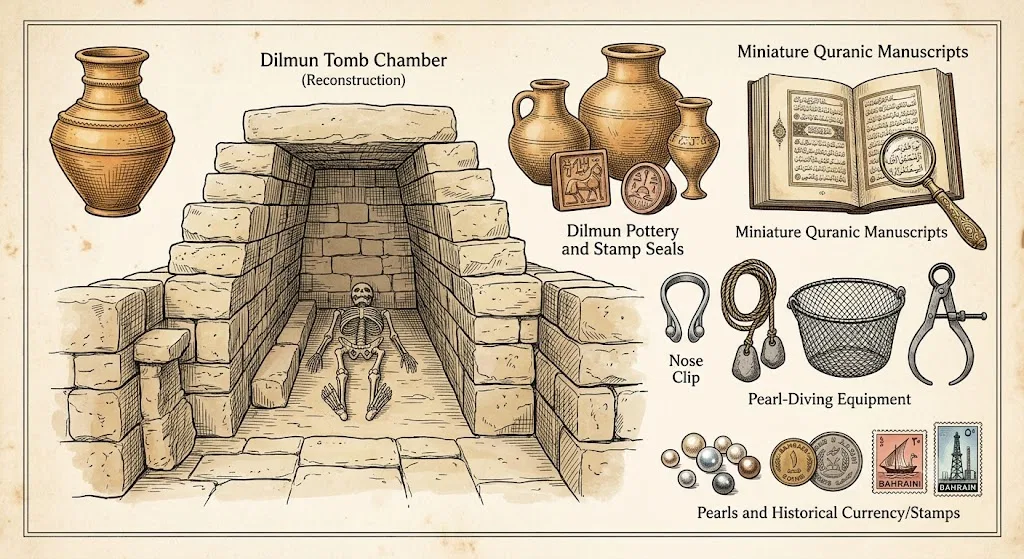
The Hall of Dilmun Graves at the Bahrain National Museum is the country’s clearest answer to a traditional museum of curiosities. Its centrepiece is a reconstructed burial mound, presented with grave structures and artefacts associated with the Dilmun civilisation. The redesigned hall retained the original tomb reconstruction while adding newer interpretation and multimedia displays. Visitors are therefore not simply looking at pottery in cases: they are entering a deliberately recreated funerary environment.[Culture Bahrain]culture.gov.bhCulture BahrainKingdom of Bahrain | Hall of Dilmun GravesThe new Hall of Dilmun Graves preserved the original reconstitution of the Dilmu…
Dilmun flourished when Bahrain occupied an important position in trade between Mesopotamia, the Indus Valley and other parts of the ancient world. The museum’s wider Dilmun galleries contain stamp seals, temple deposits, settlement finds and distinctive pottery, but the graves carry the greatest emotional weight. They turn archaeological classification into a physical encounter with how ancient communities arranged bodies, possessions and monuments for the dead.[Culture Bahrain]culture.gov.bhCulture Bahrain Hall of DilmunCulture BahrainHall of Dilmun - Culture and AntiquitiesDilmun Burial Mounds Oral History. The display traces the chronological developmen…
This material is unusual without needing supernatural embellishment. Grave goods and mound architecture can suggest beliefs about status, memory and an afterlife, but they do not provide a complete guide to Dilmun religion. Responsible interpretation separates what archaeologists can document—the construction of tombs, the placement of bodies and objects, and changes in burial design—from broader claims about precisely what the dead or their families believed.
The hall also matters because Bahrain’s burial archaeology is not confined to museum storage. It is a response to a landscape in which the remains of the dead once appeared in extraordinary numbers. The museum reconstruction condenses that much larger, sometimes difficult-to-read landscape into a visitor-facing display.
A country shaped by burial mounds
The Dilmun Burial Mounds became a UNESCO World Heritage property in 2019. The protected serial site includes large mound fields and a group of elite two-storey tombs dating principally from the Early Dilmun period. Some fields contain anything from dozens to several thousand burial structures, making the remains remarkable not because of one legendary king or spectacular treasure, but because funerary monuments were produced on an almost industrial scale.[UNESCO World Heritage Centre]whc.unesco.orgWorld Heritage Centre UNESCO World Heritage CentreAll site components of the Dilmun Burial Mounds serial property are registered as National Monuments and are protected according to the K…
For visitors interested in strange landscapes, this is Bahrain’s most memorable contribution. Low, rounded tombs sit within or beside developed areas, roads and modern housing. They can initially resemble natural hills or construction spoil. Once their purpose is understood, the surrounding landscape changes character: apparently empty ground becomes a vast archive of human remains, social divisions and ancient labour.
The mounds should not be treated as mysterious in the sensational sense. Archaeologists have studied their forms, dates and contents extensively, and the World Heritage designation rests on their exceptional concentration and their importance to understanding Dilmun society. Yet important uncertainties remain. Individual identities are often lost, many tombs were disturbed or robbed, and the surviving evidence cannot answer every question about ritual or belief. Their power comes from scale and persistence, not from a modern paranormal story.
Saar Heritage Park provides another useful way into this funerary world. UNESCO’s description notes that it offers visitors an opportunity to see how a Dilmun burial mound may originally have appeared, making it a bridge between an archaeological site, an outdoor reconstruction and a museum display.[UNESCO World Heritage Centre]whc.unesco.orgWorld Heritage Centre Saar Heritage ParkWorld Heritage Centre Saar Heritage Park
Qal’at al-Bahrain and the museum built around a tell
Qal’at al-Bahrain is unusual because the primary object is the ground itself. The site is a tell: an artificial mound formed by successive layers of occupation. Archaeological remains accumulated there across thousands of years, producing a compressed vertical record of settlements, trade, fortifications and political change. UNESCO identifies it with the ancient harbour and capital of Dilmun, whose commercial networks connected Bahrain with Mesopotamia and the Indus region.[UNESCO World Heritage Centre]whc.unesco.orgWorld Heritage Centre Qal’at al-Bahrain – Ancient Harbour and Capital of DilmunQal'at al-Bahrain, considered as the capital of the ancient Dilmun Empire and the original harbour of this long since disappeared civilis…
The site museum interprets this layered history through galleries arranged chronologically. Its design incorporates a large wall intended to evoke the archaeological strata of the mound, while hundreds of objects explain different periods of occupation. This makes the museum itself a model of archaeological thinking: visitors are encouraged to imagine history not as a straight line of kings and dates, but as layers of broken buildings, discarded vessels and reused ground.[Culture Bahrain]culture.gov.bhOpen source on culture.gov.bh.
For a curiosity-minded visitor, Qal’at al-Bahrain offers fewer theatrical oddities than the Hall of Graves, but a stronger sense of accumulated time. Small objects acquire significance because of where they were found within the mound. The experience is academically curated rather than folkloric, and the distinction matters: the site’s mysteries are questions created by incomplete evidence, not claims of curses, lost races or impossible artefacts.
Tiny scriptures and sacred craftsmanship
Beit Al Quran in Manama is Bahrain’s most distinctive specialist collection. It combines a museum, library, mosque, teaching spaces and exhibition facilities, with holdings devoted to Quranic manuscripts, calligraphy and Islamic art. Bahrain’s tourism authority describes a collection of nearly 10,000 Quran copies and manuscripts originating from many parts of the Islamic world and spanning early centuries through modern production.[Bahrain]bahrain.comOpen source on bahrain.com.
Its curiosity value lies partly in variations of scale, material and script. One widely documented example is an octagonal Quran measuring only about 43 millimetres across. Such miniature manuscripts were not joke objects. They demanded highly controlled handwriting and were valued as portable works of devotion and craftsmanship. The collection also contains manuscripts associated with different centres of book production, allowing visitors to compare changes in calligraphy, decoration and physical format.[AramcoWorld]archive.aramcoworld.comOpen source on aramcoworld.com.
Beit Al Quran should be understood primarily as a devotional and scholarly institution, not as a secular cabinet of oddities. The objects are sacred texts, and their unusual qualities—extreme smallness, elaborate illumination, rare scripts or disputed antiquity—sit within a living religious tradition. Visitors should also treat dramatic dating claims carefully. Labels such as “one of the oldest” or attribution to the period of a particular historical ruler can depend on palaeography, provenance and later tradition; securely dating a manuscript may require scientific analysis as well as comparison of handwriting and materials. The famous early Quran leaves held by the University of Birmingham, for example, received international attention because their parchment was radiocarbon tested, illustrating the level of evidence needed for especially early dates.[Bahrain]bahrain.comOpen source on bahrain.com.
The Bahrain National Museum has a separate Documents and Manuscripts Hall. Its displays include Quranic manuscripts from different parts of the Islamic world alongside political records and documents associated with Bahrain’s ruling family. Compared with Beit Al Quran, it places sacred manuscripts within a broader national history rather than making the history of the book its central subject.[Culture Bahrain]culture.gov.bhOpen source on culture.gov.bh.
Pearls as relics of a dangerous vanished economy
Bahrain’s pearl collections are unusual because their most attractive objects came from a punishing and hazardous industry. Before oil transformed the economy, pearling depended on crews spending long periods at sea while divers repeatedly descended to oyster beds with minimal equipment. Pearls later became luxury goods, but the historic system also involved debt, physical danger, strict hierarchies and communities organised around the seasonal voyage.
The UNESCO-listed Pearling Path in Muharraq turns this history into a distributed museum. Rather than placing everything inside one building, it connects merchant houses, shops, storerooms, gathering places and other structures associated with the pearling economy. The World Heritage property also includes offshore oyster beds and the coastal fortress from which pearling boats departed.[The Guardian]theguardian.comOpen source on theguardian.com.
This route is one of Bahrain’s most successful expansions of the museum idea. A diver’s dwelling, a wealthy dealer’s reception room and a restored commercial building tell different parts of the same story. Historic architecture becomes an exhibit, while the streets between sites preserve the physical relationship between labour, trade and domestic life.
The Siyadi complex represents the merchant end of that world. Its historic reception room is presented as an open museum, and a newer pearl museum displays objects within spaces designed to contrast rough surfaces, darkened metallic finishes and the lustre of pearls. The result is partly historic house, partly jewellery collection and partly contemporary architectural installation.[Bahrain]bahrain.comOpen source on bahrain.com.
Pearling heritage can easily be romanticised as a story of beautiful gems and heroic divers. Bahrain’s stronger displays resist that simplification when they connect pearls to tools, buildings, music, labour and social rank. Recent efforts to revive licensed pearl diving also show that the tradition is not entirely sealed in the past, although modern recreational or commercial diving operates in a very different setting from the historic industry.[The United Nations Office at Geneva]ungeneva.orgbahrains pearling legacy reviving millennia old culturebahrains pearling legacy reviving millennia old culture
Stamps, coins and miniature state histories
The Bahrain Post Museum occupies the restored historic post office near Bab Al Bahrain. Its holdings include Bahraini and international stamps, postal photographs, cancellation devices, scales and franking machines. The collection is a classic example of how an apparently narrow hobby can become a record of empire, technology and national identity.[Bahrain]bahrain.comOpen source on bahrain.com.
Bahrain’s postal history is particularly layered. Before issuing its own designs, the country used Indian stamps and later overprinted Indian and British issues. A small piece of paper might therefore carry evidence of British influence, regional postal administration and Bahrain’s gradual development of a separate national identity. The museum’s reported international holdings include rare and historically important stamps, but the most meaningful objects for understanding Bahrain are often the less spectacular local issues and the equipment used to process ordinary mail.[National Postal Museum]postalmuseum.si.eduOpen source on si.edu.
The Currency Museum at the Central Bank of Bahrain follows a similar logic through money. It traces currencies used in Bahrain before and after Islam and displays Islamic coins, official documents, banknotes and material associated with the Bahrain Currency Board, the Bahrain Monetary Agency and the present central bank. Because the museum is housed within a working financial institution, it feels more institutional than tourist-led, and visitors should check current access requirements before travelling.[CBB]cbb.gov.bhcurrency museumcurrency museum
Coins and stamps belong within Bahrain’s strange-collections landscape because they are miniature political artefacts. Their portraits, scripts, overprints and changing denominations record transitions that can be difficult to see in larger monuments. They also attract collectors, which means rarity and market value can sometimes overshadow historical meaning. A museum setting restores context: why a currency circulated, who authorised it, and what changing designs said about Bahrain at a particular moment.
The oil museum that may not be reliably open
Bahrain’s first oil well is one of the country’s most consequential industrial relics. Oil was discovered at Well Number One in 1932, the first commercial discovery on the Arabian side of the Gulf, accelerating a transformation away from the old pearling economy. The nearby oil museum has displayed drilling equipment, photographs, documents and material connected with the development of the petroleum industry.[bapco.net]bapco.netOpen source on bapco.net.
It fits the curiosity theme because an oil field is rarely treated as heritage while its wider industry remains active. Pipes, drill components and technical records become archaeological objects of the recent past. The site also creates a sharp historical contrast: within a short period, Bahrain moved from an economy symbolised by breath-hold divers and oyster shells to one defined by wells, refineries and geological engineering.
Practical information is inconsistent, however. Older visitor sources advise telephoning ahead because the museum has limited or irregular opening, while more recent visitor reports describe it as closed. The well itself remains historically significant, but travellers should not assume that the museum building is accessible without direct confirmation.[tripadvisor.co.uk]tripadvisor.co.ukTripadvisor OIL MUSEUM AND FIRST OIL WELLTripadvisor OIL MUSEUM AND FIRST OIL WELL
This uncertainty is worth stating plainly. Unlike the National Museum or major UNESCO sites, the oil museum is not currently a dependable drop-in attraction on the available evidence. It is better treated as an important industrial heritage site with uncertain museum access than promoted as a guaranteed visitor experience.
Folklore without a dedicated folklore museum
Bahrain’s customs and traditions are largely presented inside broader national and heritage museums rather than in a separate museum of ghosts, magic or folk belief. At the Bahrain National Museum, reconstructed domestic settings, traditional crafts and displays of pre-oil life place belief and ritual beside clothing, marriage, childhood, medicine and household organisation. The approach is ethnographic: customs are interpreted as parts of everyday social life rather than isolated as exotic superstitions.[Culture Bahrain]culture.gov.bhThe administrative offices, curatorial research areas, conservation laboratories, exhibition construction and collection storage areas ar…
This means a visitor looking specifically for jinn stories, protective objects, sea monsters or occult practices may find less than expected. Bahrain certainly has oral traditions and beliefs shared with the wider Gulf, but there is no strong current evidence for a permanent, publicly accessible institution devoted primarily to paranormal folklore. Claims about secret magic museums or monster collections should therefore be treated sceptically unless supported by an official institution or reliable local reporting.
Folklore survives more visibly through performance and living heritage. Along the Pearling Path, traditional music associated with pearling communities connects museum interpretation to sound, memory and public events. This is important because the culture of the sea cannot be preserved adequately through shells and diving weights alone. Work songs, family histories and remembered hardship are collections too, even when their principal form is performance rather than an object in a case.[The Guardian]theguardian.comOpen source on theguardian.com.
What is most worth seeing
For the strongest single encounter with Bahrain’s unusual collections, the Hall of Dilmun Graves at the Bahrain National Museum is the priority. It provides the clearest combination of authentic artefacts, reconstructed space, professional interpretation and unsettling subject matter. It also gives visitors the knowledge needed to understand the burial mounds elsewhere in the country.
The most rewarding wider route combines several different kinds of curiosity:
- Bahrain National Museum: reconstructed graves, seals, archaeological finds, manuscripts and displays of pre-oil customs.
- Dilmun Burial Mounds: an immense funerary landscape whose meaning becomes clearer after visiting the national collection.
- Qal’at al-Bahrain Site Museum: artefacts interpreted through the physical layers of an ancient settlement mound.
- Beit Al Quran: miniature and rare sacred manuscripts viewed within a devotional and scholarly setting.
- Pearling Path and the Siyadi complex: houses, tools, pearls and urban spaces preserving the social system behind a luxury object.
- Bahrain Post Museum and Currency Museum: compact specialist collections that turn stamps, coins and administrative machinery into histories of sovereignty and exchange.
- Well Number One and the oil museum site: an important industrial landmark, although museum opening should be confirmed before travel.
Bahrain’s unusual museums are credible largely because they avoid pretending to possess inexplicable objects. Their oddness is rooted in material evidence: a tomb moved indoors, a sacred book written at miniature scale, a city route built around a vanished maritime industry, or an obsolete machine that once helped reorganise the country. The result is a distinctive form of curiosity culture—less a parade of freakish exhibits than an encounter with death, devotion, labour and historical change preserved in unusually tangible forms.
Amazon book picks
Further Reading
Books and field guides related to Where Bahrain Keeps Its Strangest Surviving Objects. Use these as the next step if you want deeper reading beyond the article.
Looking for Dilmun
The quest for the real Dilmun, the lost civilisation of Arabia, began when the author Geoffrey Bibby revisited Bahrain in order to explor...
Museums of the Arabian Peninsula: Historical Developments and...
Museums of the Arabian Peninsula offers new insights into the history and development of museums within the region. Recognising and engag...
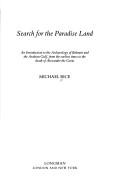
Search for the Paradise Land: An Introduction to the Archaeol...
First published 1985. Subjects: Excavations (Archaeology), Antiquities, Fouilles (Archéologie), Antiquités, Archeologie.
eBay marketplace picks
Marketplace Samples
Live-tested eBay searches with available results related to this page.
Selected fromBahrain travel poster oneBay.co.uk.
Endnotes
1.
Source: whc.unesco.org
Title: World Heritage Centre Dilmun Burial Mounds
Link:https://whc.unesco.org/en/list/1542/
Source snippet
All site components of the Dilmun Burial Mounds serial property are registered as National Monuments and are protected according to the K...
2.
Source: whc.unesco.org
Title: World Heritage Centre Qal’at al-Bahrain – Ancient Harbour and Capital of Dilmun
Link:https://whc.unesco.org/en/list/1192/
Source snippet
Qal'at al-Bahrain, considered as the capital of the ancient Dilmun Empire and the original harbour of this long since disappeared civilis...
3.
Source: whc.unesco.org
Title: World Heritage Centre UNESCO World Heritage Centre
Link:https://whc.unesco.org/en/decisions/7369
Source snippet
All site components of the Dilmun Burial Mounds serial property are registered as National Monuments and are protected according to the K...
4.
Source: whc.unesco.org
Link:https://whc.unesco.org/en/news/2003/
5.
Source: whc.unesco.org
Title: World Heritage Centre Saar Heritage Park
Link:https://whc.unesco.org/en/tentativelists/1571
7.
Source: bahrain.com
Link:https://www.bahrain.com/en/beit-al-quran
8.
Source: archive.aramcoworld.com
Link:https://archive.aramcoworld.com/issue/200003/beit.al.qur.an-religion.art.scholarship.htm
9.
Source: bahrain.com
Link:https://www.bahrain.com/en/majlis-siyadi
10.
Source: bahrain.com
Link:https://www.bahrain.com/en/bahrain-post-museum
11.
Source: cbb.gov.bh
Title: currency museum
Link:https://www.cbb.gov.bh/currency-museum/
12.
Source: bapco.net
Link:https://www.bapco.net/en/page/history/
13.
Source: yourbahrain.com
Link:https://www.yourbahrain.com/oil-museum
14.
Source: bahrain.com
Title: beit al quran
Link:https://www.bahrain.com/ar/beit-al-quran
15.
Source: bahrain.com
Link:https://www.bahrain.com/en/bahrain-national-museum
16.
Source: unesdoc.unesco.org
Link:https://unesdoc.unesco.org/ark%3A/48223/pf0000264629
17.
Source: whc.unesco.org
Link:https://whc.unesco.org/en/statesparties/bh
19.
Source: whc.unesco.org
Link:https://whc.unesco.org/en/list/1542/maps/
20.
Source: whc.unesco.org
Link:https://whc.unesco.org/en/list/1542/documents/
21.
Source: whc.unesco.org
Link:https://whc.unesco.org/en/list/1542/gallery/
22.
Source: whc.unesco.org
Link:https://whc.unesco.org/en/documents/175424
23.
Source: bahrain.bh
Link:https://www.bahrain.bh/wps/portal/en/BNP/HomeNationalPortal/ContentDetailsPage/%21ut/p/z1/nVVdV-IwEP0refGc3YfS9JP2ERYFXV1cEJS-eNJ0gKxNGpsAy_76TXH3qK2A2pe2yZ3JnZk7Ezux7-xEkDVbEM0KQXLzP0vCe-c8wIPoG8bXPd_FP6fxKOxeOfiq79m3rwHOzQQbwHlnNDzrOdh37OQ99njP08HH7Kd2YieSssye-ZHjB35GrSil1PK9OLWizAusMIjx3Djz4iCt0FRoqZf2LBXyHsQJJmmx0kgvAT0wscgKfoJ1SdaQIyIypItVyZRZKyEnGqoFyag6wRlTtFhD-dKycq90PSkD5zrEodudTk87Xbd_Gb4OKr6Jq22347vjvoeH-M2kdHB35HY9jPvjWlJq7gP3yPkGkBymV7NvEkw-JIomIDlc84sawR_XPRwOB1HbbZsMeLiSJfv1-Jh0TDULoeG3tu_-l3NrCoZyNgfEBErJsiTMrC6qUgkOQu-qqgrKSI7USsqi1M3ivoCrVapYxkCheVEanxlbs2xFcoXIfA60skq3yEiBZZYTI2ncA2f0cBDDnncwiDc0SbepEZsCavSot03KJVShGDTaIWnJOKgjqey6n0jlcsWJQCVbLLVq0piXAIYvKuY7-rIEpXYp55Ax0uDT0N4HswIcykUVtAa6FEVeLEylmqyY8VQK0E-0DF6hL6zQX41Uk2PdVAPURtx3fARQzcBjgn8L8NzwwwaHeDI5w2HUP_P9MBq1g7Y9My3X3htF2_T0msHGnoii5Gauj5_HZgpxGAUZtkIah5YfRZEV-zi2qBMTSLN27KSuPcD_TtjDsXPpPvkktLo57NlGqlalxxy0auVMPFSb1ZtIWZ1KC95iKW9tZItknInWEnLzKWVrA7nZhJY0FTQdx-uh1abJubc_tHfdCBfHptkHFfnpu2MMwpZ8MuGRJ7bMPFaSBvma35p3ODodDf50f1h9sxss-P2Vjv4CChKSsA%21%21/
24.
Source: bahrain.bh
Link:https://www.bahrain.bh/wps/portal/en/BNP/HomeNationalPortal/ContentDetailsPage/%21ut/p/z1/pVRdV-IwEP0r9cHHNtPv8lhWBRTEpaLSF0_aBoikaWwDuP76TZFzXIqAnp2HND25k8nM3DsoRk8o5nhFZ1jSgmOm_iex92z2XOgGvwDuLhwLfj-0Rl57YMKgY6PHXUD39u4CvGE38C2_bQ9bFor_PW6Nx1fgBZ0rx_GCke_66AHFKK5kvaZcCjlHk4SLZ8LPASfFUmpyTrQF5bOsyM9BLBNGU60SOCUa5pk2JyWVeEbOoSQMS5JpshA0rZR3KTeIdMnksiR1AJHSDE3ATJT5ru60WmohLU8PLBt08EmALd9yXXC2acGOhdAeWW0boBPBblqNrLunyqIA8fGqNf37kQve4DZqm-OO2e15jbLetzzwLCt0rKhjwxCa_vt1j49f3_A378eg-t4LR8OrCxMcc9f_EC3ggIXwPf8jCf7Mfx8QH3_e9dEG3dm1MOjL62scKt4WXJI3iZ5q4uLyS-ImeF5iyqnGyIxWbCOvap-0ssTTKU1PhFf8OBT-gG624bWMzpRcmDYrVqTkOeFSeymWJSd_vhAQo7MPyJrKuca3I2EjKlakapeRFWGF2GAq9XSpciOVqn18Sh4NQINeN3ACUPPvVAe_AnwqeGg1Q-xLZKI45B-6IexbKKrvwGldFzRZi8oQRSkZkZXBKF_Uh_UXC1GPnbTIDZrkxloYOMspN-aEqa0QxpowdUiMlBXLbBv1YOsVtVeUrNGYF2WuBnT0Odg8b-pA5k71ADup7mTE1LHvEh2wl2DXcSD1MOpCM0JDG70jEb41Oq9PafOH3P2PmR8RjkQ-XiTv05sP67tslT_qi9HlKAA7fx5c2s7kevXen4bh2dlf9k4emA%21%21/
25.
Source: youtube.com
Title: BAHRAIN NATIONAL MUSEUM ancient civilization of Dilmun, Tylos and Islam Part-1
Link:https://www.youtube.com/watch?v=GkxMBKI60U8
Source snippet
The Hall of Dilmun Graves | Bahrain History...
26.
Source: youtube.com
Title: The Hall of Dilmun Graves | Bahrain History
Link:https://www.youtube.com/watch?v=IbcE-a_3ZXY
Source snippet
The Royal Mounds of A’ali, Bahrain - Dr Steffen Laursen...
27.
Source: youtube.com
Title: Discover Dilmun Burial Mounds, Bahrain
Link:https://www.youtube.com/watch?v=GkX6mkgCpak
Source snippet
Bahrain National Museum Dilmun graves burial mounds 4000 years ago Dilmun Burial 🪦 mounds @ A’ali Bahrain 🇧🇭 Rani’s fashions...
28.
Source: culture.gov.bh
Link:https://www.culture.gov.bh/en/authority/cultural_sites/BahrainNationalMuseum/
Source snippet
The administrative offices, curatorial research areas, conservation laboratories, exhibition construction and collection storage areas ar...
29.
Source: culture.gov.bh
Link:https://culture.gov.bh/en/authority/cultural_sites/BahrainNationalMuseum/HallofDilmunGraves/
Source snippet
Culture BahrainKingdom of Bahrain | Hall of Dilmun GravesThe new Hall of Dilmun Graves preserved the original reconstitution of the Dilmu...
30.
Source: culture.gov.bh
Title: Culture Bahrain Hall of Dilmun
Link:https://culture.gov.bh/en/authority/cultural_sites/BahrainNationalMuseum/HallofDilmun/
Source snippet
Culture BahrainHall of Dilmun - Culture and AntiquitiesDilmun Burial Mounds Oral History. The display traces the chronological developmen...
31.
Source: culture.gov.bh
Link:https://culture.gov.bh/en/authority/cultural_sites/QalatAl-BahrainSiteMuseum/
32.
Source: culture.gov.bh
Link:https://www.culture.gov.bh/en/visitingbahrain/CulturalTourism/Destinations/Name%2C10135%2Cen.php
33.
Source: culture.gov.bh
Link:https://culture.gov.bh/en/authority/cultural_sites/BahrainNationalMuseum/HallofDocumentsandManuscripts/
34.
Source: theguardian.com
Link:https://www.theguardian.com/artanddesign/2025/mar/14/bahrain-pearling-path-sci-fi-kingdom-car-parks
35.
Source: ungeneva.org
Title: bahrains pearling legacy reviving millennia old culture
Link:https://www.ungeneva.org/en/news-media/news/2025/03/103882/bahrains-pearling-legacy-reviving-millennia-old-culture
36.
Source: culture.gov.bh
Link:https://culture.gov.bh/en/authority/infra_projects/ManamaPostOffice/
37.
Source: postalmuseum.si.edu
Link:https://postalmuseum.si.edu/exhibition/international-philately-asia-western-asia/bahrain
38.
Source: tripadvisor.co.uk
Title: Tripadvisor OIL MUSEUM AND FIRST OIL WELL
Link:https://www.tripadvisor.co.uk/Attraction_Review-g293997-d5773135-Reviews-Oil_Museum_and_first_oil_well-Manama.html
39.
Source: Wikipedia
Title: Bahrain National Museum
Link:https://en.wikipedia.org/wiki/Bahrain_National_Museum
40.
Source: culture.gov.bh
Title: Bahrain Authority for Culture and Antiquities
Link:https://culture.gov.bh/en/mediacenter/news_center/2022/April2022/Name%2C20550%2Cen.html
41.
Source: culture.gov.bh
Title: Bahrain Authority for Culture and Antiquities
Link:https://culture.gov.bh/en/mediacenter/news_center/2021/November2021/Name%2C20156%2Cen.html
42.
Source: moic.gov.bh
Title: Ministry of Industry and Commerce
Link:https://moic.gov.bh/en/node/1320
43.
Source: culture.gov.bh
Title: Bahrain Authority for Culture and Antiquities
Link:https://www.culture.gov.bh/en/mediacenter/news_center/2019/January2019/Name%2C16639%2Cen.html
44.
Source: culture.gov.bh
Title: Bahrain Authority for Culture and Antiquities
Link:https://culture.gov.bh/en/mediacenter/news_center/2018/November2018/Name%2C16416%2Cen.html
45.
Source: culture.gov.bh
Link:https://culture.gov.bh/en/eservices/dilmun-burials-game/
47.
Source: culture.gov.bh
Title: Past Events
Link:https://culture.gov.bh/en/events/past_events/Name%2C17934%2Cen.php
48.
Source: culture.gov.bh
Link:https://culture.gov.bh/en/mediacenter/news_center/2020/December2020/Name%2C18957%2Cen.html
49.
Source: culture.gov.bh
Title: Past Events
Link:https://culture.gov.bh/en/events/past_events/Name%2C12023%2Cen.php
50.
Source: culture.gov.bh
Link:https://culture.gov.bh/en/mediacenter/news_center/2020/March2020/Name%2C18246%2Cen.html
51.
Source: culture.gov.bh
Link:https://culture.gov.bh/en/mediacenter/news_center/2020/May2020/Name%2C18425%2Cen.html
52.
Source: culture.gov.bh
Link:https://culture.gov.bh/en/mediacenter/news_center/2021/December2021/Name%2C20171%2Cen.html
53.
Source: culture.gov.bh
Link:https://culture.gov.bh/en/mediacenter/news_center/2015/December2015/Name%2C12696%2Cen.html
54.
Source: culture.gov.bh
Title: Bahrain Authority for Culture and Antiquities
Link:https://culture.gov.bh/en/visitingbahrain/CulturalTourism/10top_must_dos/Name%2C10135%2Cen.html
55.
Source: culture.gov.bh
Title: Bahrain Authority for Culture and Antiquities
Link:https://culture.gov.bh/en/visitingbahrain/CulturalTourism/Destinations/Name%2C15018%2Cen.php
56.
Source: culture.gov.bh
Title: Bahrain Authority for Culture and Antiquities
Link:https://www.culture.gov.bh/en/authority/infra_projects/Name%2C14947%2Cen.php
57.
Source: culture.gov.bh
Title: Bahrain Authority for Culture and Antiquities
Link:https://www.culture.gov.bh/en/authority/infra_projects/Name%2C14932%2Cen.php
58.
Source: culture.gov.bh
Title: Bahrain Authority for Culture and Antiquities
Link:https://culture.gov.bh/en/events/past_events/Name%2C15367%2Cen.php
59.
Source: culture.gov.bh
Title: هيئة البحرين للثقافة والآثار
Link:https://culture.gov.bh/ar/visitingbahrain/cultural_tourism/Destinations/Name%2C10135%2Car.php
60.
Source: culture.gov.bh
Title: Bahrain Authority for Culture and Antiquities
Link:https://www.culture.gov.bh/en/visitingbahrain/CulturalTourism/Destinations/Name%2C10338%2Cen.php
61.
Source: culture.gov.bh
Title: Bahrain Authority for Culture and Antiquities
Link:https://culture.gov.bh/en/visitingbahrain/CulturalTourism/Destinations/
62.
Source: culture.gov.bh
Link:https://culture.gov.bh/en/authority/cultural_sites/BahrainNationalMuseum/about/
63.
Source: instagram.com
Link:https://www.instagram.com/p/DaclQffofCk/
64.
Source: instagram.com
Link:https://www.instagram.com/p/DSNHTr0isfJ/
65.
Source: instagram.com
Link:https://www.instagram.com/reel/DZ0MUcdsgpW/
66.
Source: tripadvisor.co.uk
Title: Attractions g293996 Activities Bahrain
Link:https://www.tripadvisor.co.uk/Attractions-g293996-Activities-Bahrain.html
67.
Source: tripadvisor.co.uk
Title: Attractions g293996 Activities c49 t161 Bahrain
Link:https://www.tripadvisor.co.uk/Attractions-g293996-Activities-c49-t161-Bahrain.html
68.
Source: airial.travel
Link:https://airial.travel/attractions/bahrain/bahrain-oil-museum-first-oil-well-wHnAu-Ca
69.
Source: centralbank.ae
Link:https://www.centralbank.ae/en/museum/
70.
Source: greatacre.wordpress.com
Title: bahrain national museum
Link:https://greatacre.wordpress.com/2015/11/30/bahrain-national-museum/
71.
Source: pearlingpath.bh
Title: Pearl Museum
Link:https://pearlingpath.bh/en/location/siyadi-majlis/
72.
Source: Wikipedia
Title: Bahraini dinar
Link:https://en.wikipedia.org/wiki/Bahraini_dinar
73.
Source: un.org
Title: bahrain’s pearling legacy reviving millennia old culture
Link:https://www.un.org/en/information-center-manama/bahrain%E2%80%99s-pearling-legacy-reviving-millennia-old-culture
74.
Source: myartguides.com
Title: bahrain national museum
Link:https://myartguides.com/artspaces/museums/bahrain/bahrain-national-museum/
75.
Source: atlasobscura.com
Title: bahrain oil well no 1
Link:https://www.atlasobscura.com/places/bahrain-oil-well-no-1
76.
Source: beingrubitah.com
Link:https://beingrubitah.com/bahrain-national-museum/
Additional References
77.
Source: maryevans.com
Title: grave reconstruction bahrain national museum 45127844
Link:https://www.maryevans.com/contributors/coh/grave-reconstruction-bahrain-national-museum-45127844.html
Source snippet
Grave reconstruction, Bahrain National MuseumA reconstructed Dilmun grave from Madinat Hamad, Bahrain National Museum, showcases a 6000-y...
78.
Source: youtube.com
Title: The Royal Mounds of A’ali, Bahrain
Link:https://www.youtube.com/watch?v=N413hx7w2o8
Source snippet
Dilmun Burial Mounds in Bahrain and Manama, 1950s - Archive Film 1090037...
79.
Source: archnet.org
Link:https://www.archnet.org/sites/751?media_content_id=10411
80.
Source: facebook.com
Link:https://www.facebook.com/GDNOnline/posts/a-first-of-its-kind-digital-experience-in-bahrain-is-set-to-connect-students-and/970449418461768/
81.
Source: instagram.com
Link:https://www.instagram.com/p/DZMlmuuiDJX/
82.
Source: facebook.com
Link:https://www.facebook.com/HalalZilla/posts/bahrainregarded-as-the-true-pearl-of-the-arabian-gulf-bahrain-makes-for-an-excit/398101934060609/
83.
Source: facebook.com
Link:https://www.facebook.com/NewsofBahrain1/posts/an-exceptional-exhibition-of-numismatic-collectors-entitled-coins-through-cultur/928728971914438/
84.
Source: instagram.com
Link:https://www.instagram.com/reel/DQHbhEkjOsm/?hl=en
85.
Source: instagram.com
Link:https://www.instagram.com/reel/DYDjH1TP77m/
86.
Source: numismatic-directory.com
Link:https://numismatic-directory.com/en/oum-location/central-bank-of-bahrain-currency-museum/