Within Colombia Curiosities
How Colombia Turned Dark Places into Museums
Former places of burial, confinement and punishment now preserve Colombia's civic history through art, architecture and public memory.
On this page
- San Pedro Cemetery as a Living Museum
- The National Museum's Prison Past
- Cartagena's Inquisition and the Problem of Sensation
Page outline Jump by section
Introduction
Colombia has increasingly reinterpreted places once associated with death, punishment and religious persecution as spaces for education, memory and public debate rather than simple dark tourist attractions. Instead of presenting these sites as spectacles, the country’s leading examples invite visitors to consider how architecture, political power and collective remembrance shape national history. The result is a distinctive strand of Colombian heritage in which active cemeteries, former prisons and colonial institutions remain emotionally powerful while serving contemporary cultural purposes.
Three sites illustrate this transformation particularly well. Medellín’s San Pedro Cemetery has become one of Latin America’s best-known cemetery museums, Bogotá’s National Museum occupies a nineteenth-century prison converted into a major cultural institution, and Cartagena’s former Palace of the Inquisition has evolved into a museum that increasingly interprets repression through historical context rather than sensational displays. Together they demonstrate how Colombia has turned difficult places into spaces for reflection.
San Pedro Cemetery as a Living Museum
The San Pedro Cemetery Museum in Medellín is one of Colombia’s most distinctive examples of funerary heritage becoming an active cultural institution. Established in 1842 as a burial place for many of the city’s leading families, it was recognised as a site museum in 1998, becoming the first cemetery in Latin America accepted by the International Council of Museums (ICOM) in that category. It was subsequently declared a Colombian National Cultural Heritage Site because of its architectural, artistic and historical importance.[Alcaldía de Medellín]medellin.gov.coAlcaldía de MedellínCementerio de San Pedro, primero en América Latina declarado museo- Alcaldía de MedellínMay 27, 2026…
Unlike cemetery museums that function mainly as preserved historic landscapes, San Pedro deliberately combines remembrance with contemporary cultural life. Guided heritage tours interpret funerary sculpture, architecture and the biographies of notable Colombians buried there, while exhibitions, educational programmes and evening cultural events encourage visitors to see the cemetery as part of Medellín’s civic identity rather than simply a place of mourning. The institution itself describes this approach as a “living museum”, where historical memory, funeral services and cultural programming coexist.[Cementerio San Pedro]cementeriosanpedro.org.coCementerio San Pedro Museo HistoriaCementerio San PedroMuseo Historia - Cementerio San Pedro…
The artistic landscape is central to this reinterpretation. Marble mausoleums, elaborate chapels and sculptures by important Colombian and European-trained artists reveal changing ideas about wealth, religion and social status during Medellín’s rapid nineteenth- and early twentieth-century growth. Rather than treating tombs as isolated monuments, the museum explains how they reflect the city’s economic development, elite families and changing urban identity.[medellin.travel]medellin.travelSan Pedro Cemetery MuseumMedellín.Travel | Guía Oficial - Qué Hacer en Medellín…
An important feature of San Pedro is that it remains an active cemetery. Visitors therefore encounter both heritage interpretation and contemporary mourning. This dual role distinguishes it from museums built around abandoned burial grounds. Programmes such as guided historical walks and full-moon cultural evenings are designed to encourage respectful engagement with memory rather than paranormal tourism, even though popular media sometimes emphasise ghost stories and nocturnal atmosphere.[medellin.travel]medellin.travelSan Pedro Cemetery MuseumMedellín.Travel | Guía Oficial - Qué Hacer en Medellín…
The National Museum’s Prison Past
Bogotá’s National Museum occupies another kind of transformed dark site. The museum is housed in the former Panopticon prison, completed during the nineteenth century according to the influential prison design developed by English philosopher Jeremy Bentham. The building was intended to maximise surveillance through a radial layout in which guards could observe multiple cell blocks from a central position.
Although the prison operated for many decades, its purpose changed dramatically after closure. Instead of demolishing the structure, Colombia converted it into the National Museum, preserving much of its severe architecture while replacing confinement with public access to art, archaeology, history and political memory.
The building itself remains one of the museum’s most significant exhibits. Thick stone walls, barred windows, narrow corridors and former cell spaces remind visitors that many political prisoners and ordinary inmates once occupied the site. Rather than erasing this uncomfortable history, museum interpretation acknowledges how the prison reflects nineteenth-century ideas about punishment, state authority and modernisation.
This conversion also changes how visitors experience the collections. Colombian art, archaeological objects and historical exhibitions are viewed within a building originally designed to restrict freedom. That architectural contrast reinforces broader themes about democracy, citizenship and human rights without requiring the museum to become exclusively a prison museum.
Compared with dedicated prison museums elsewhere in the Americas, Bogotá’s National Museum is therefore unusual because its primary identity is national cultural history, while its prison architecture remains an integral layer of interpretation rather than merely a preserved backdrop.
Cartagena’s Inquisition and the Problem of Sensation
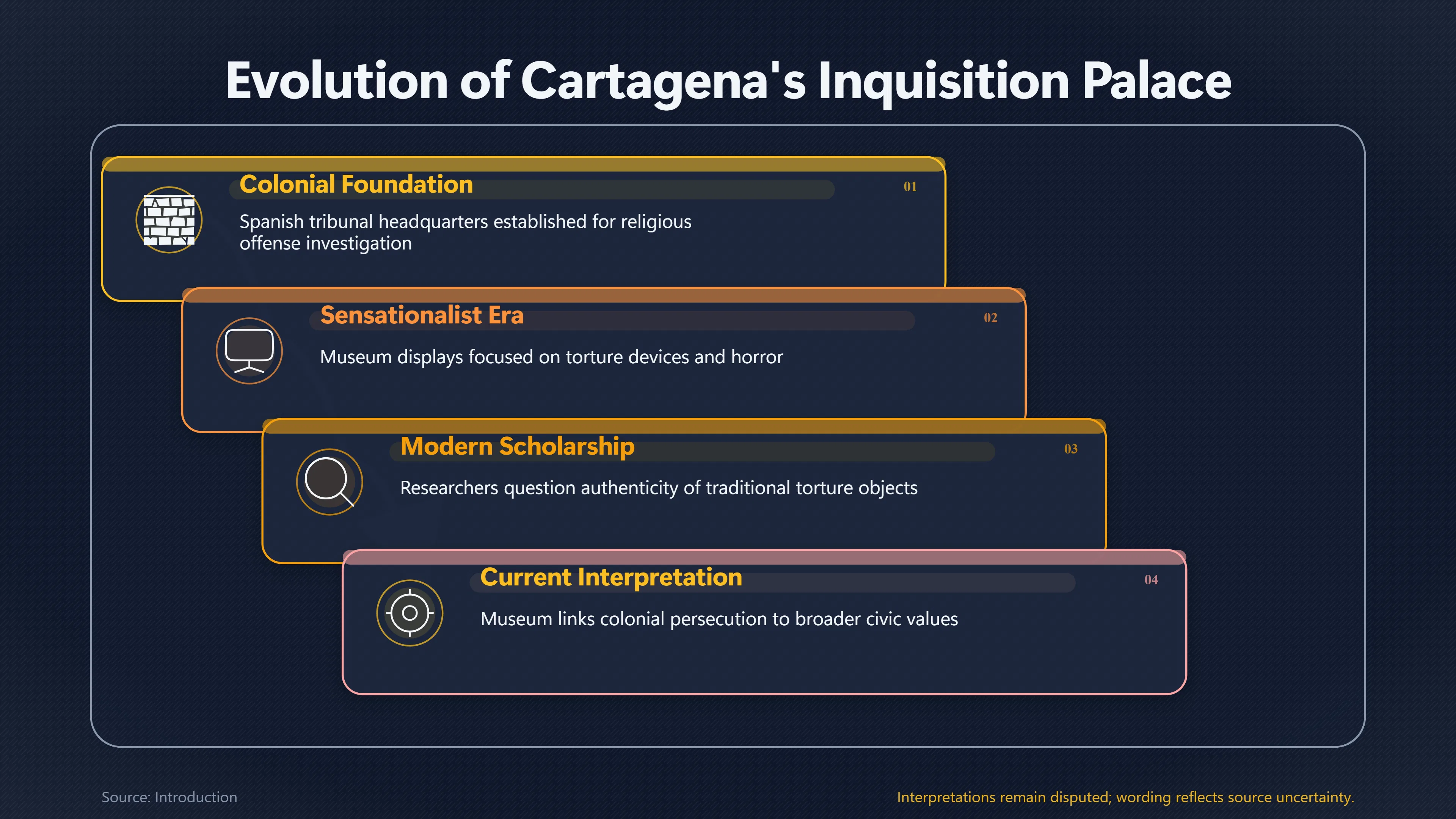
Few colonial buildings in Colombia carry a reputation as unsettling as Cartagena’s Palace of the Inquisition. Constructed during the Spanish colonial period, it served as the headquarters of the Tribunal of the Holy Office, which investigated suspected religious offences throughout much of northern South America. Today the building houses the Historical Museum of Cartagena (MUHCA), where the history of the Inquisition forms one important part of a much broader interpretation of Cartagena and the Colombian Caribbean.[MUHCA]muhca.gov.coOpen source on muhca.gov.co.
This evolution reflects changing attitudes towards difficult heritage. Earlier presentations of the palace often emphasised alleged torture devices and gruesome punishment, encouraging visitors to associate the museum primarily with horror. Modern scholarship has questioned the authenticity or direct provenance of several objects traditionally displayed as instruments of torture, while museum practice has increasingly shifted towards explaining the legal, political and religious systems that produced the tribunal.[MUHCA]muhca.gov.coOpen source on muhca.gov.co.
Current permanent galleries place the Inquisition alongside exhibitions on Cartagena’s wider history, independence, human rights and coexistence. By linking colonial persecution with broader discussions about civic values and historical memory, the museum attempts to avoid reducing the building to a curiosity cabinet of cruelty.[MUHCA]muhca.gov.coOpen source on muhca.gov.co.
The building itself remains a powerful historical document. Visitors encounter not only galleries but also the preserved colonial architecture, including spaces associated with the tribunal’s administrative work and former detention areas. The experience therefore depends as much on the building’s physical presence as on individual museum objects.
Why Colombia’s Dark Heritage Feels Different
Colombia’s approach differs from destinations that market prisons, cemeteries or execution sites primarily through fear or paranormal entertainment. The strongest examples instead balance several overlapping purposes:
- Historical interpretation, explaining how institutions functioned within their own periods.
- Architectural preservation, treating buildings and funerary landscapes as important cultural monuments.
- Public memory, recognising victims, civic leaders and ordinary communities rather than focusing solely on violence.
- Contemporary cultural use, allowing concerts, exhibitions, education and research to coexist with remembrance where appropriate.
This approach does not eliminate difficult questions. Active cemeteries must balance tourism with respect for grieving families. Former prisons raise ethical questions about representing incarceration. Museums housed in sites of colonial persecution must avoid sensationalising suffering while still confronting historical injustice.

What Visitors Should Expect
Travellers expecting haunted-house attractions may find Colombia’s major dark heritage sites quieter and more reflective than anticipated.
At San Pedro Cemetery, the emphasis falls on sculpture, architecture, biography and cultural events within a functioning cemetery. In Bogotá’s National Museum, prison architecture enriches rather than dominates the visitor experience. In Cartagena, the former Palace of the Inquisition encourages reflection on colonial power, justice and memory alongside the wider history of the city.
Together these places demonstrate that Colombia has largely chosen to reinterpret spaces of burial, confinement and persecution as museums of civic memory. Their greatest value lies not in frightening visitors but in revealing how societies preserve difficult histories without allowing those histories to define the present.
Amazon book picks
Further Reading
Books and field guides related to How Colombia Turned Dark Places into Museums. Use these as the next step if you want deeper reading beyond the article.
The Archaeology of Death and Burial
The archaeology of death and burial is central to our attempts to understand vanished societies. Through the remains of funerary rituals...
The Tourist-Historic City: Retrospect and Prospect of Managin...
First Published in 2000. Routledge is an imprint of Taylor & Francis, an informa company.

Uses of Heritage
First published 2006. Subjects: Material culture, Group identity, Performance art.
eBay marketplace picks
Marketplace Samples
Live-tested eBay searches with available results related to this page.
Selected fromcolonial architecture print oneBay.co.uk.


Endnotes
1.
Source: medellin.travel
Title: San Pedro Cemetery Museum
Link:https://www.medellin.travel/san-pedro-cemetery-museum/?lang=en
Source snippet
Medellín.Travel | Guía Oficial - Qué Hacer en Medellín...
2.
Source: muhca.gov.co
Link:https://muhca.gov.co/exposiciones
3.
Source: youtube.com
Title: San Pedro Cemetery Museum
Link:https://www.youtube.com/watch?v=Zi39DX1eivk
Source snippet
El Museo Cementerio San Pedro y sus Relatos - Parte 1...
4.
Source: medellin.gov.co
Link:https://www.medellin.gov.co/es/?p=533426
Source snippet
Alcaldía de MedellínCementerio de San Pedro, primero en América Latina declarado museo- Alcaldía de MedellínMay 27, 2026...
Published: May 27, 2026
5.
Source: normograma.mincultura.gov.co
Title: Compilación Jurídica Mincultura
Link:https://normograma.mincultura.gov.co/mincultura/compilacion/docs/resolucion_mincultura_1616_1999.htm
Source snippet
Resolución 1616 de 1999 MC...
6.
Source: cementeriosanpedro.org.co
Title: Cementerio San Pedro Museo Historia
Link:https://cementeriosanpedro.org.co/nuestra-historia/
Source snippet
Cementerio San PedroMuseo Historia - Cementerio San Pedro...
7.
Source: medellin.gov.co
Link:https://www.medellin.gov.co/es/sala-de-prensa/noticias/patrimonio-y-referente-historico-el-cementerio-museo-san-pedro-esta-mas-alla-de-ser-solo-un-cementerio/
Source snippet
Alcaldía de MedellínPatrimonio y referente histórico: el Cementerio Museo San Pedro está más allá de ser solo un cementerio - Alcaldía de...
8.
Source: muhca.gov.co
Link:https://www.muhca.gov.co/conocenos
9.
Source: muhca.gov.co
Link:https://www.muhca.gov.co/
10.
Source: muhca.gov.co
Link:https://www.muhca.gov.co/archivo
11.
Source: muhca.gov.co
Link:https://muhca.gov.co/visita
Additional References
12.
Source: revistas.udea.edu.co
Link:https://revistas.udea.edu.co/index.php/boletin/article/view/6785
Source snippet
Revistas UdeAComo en un juego de espejos, metrópolis vs. necrópolis. Una aproximación al Cementerio San Pedro de la ciudad de Medellín co...
13.
Source: pmc.ncbi.nlm.nih.gov
Link:https://pmc.ncbi.nlm.nih.gov/articles/PMC10798633/
Source snippet
2024 Jan 19;19(1):e0293746. doi: 10.1371/journal.pone.0293746 TOMBSTONE COST AND LONGEVITY: THE SAN PEDRO CEMETERY MUSEUM IN MEDELLÍN IN...
14.
Source: youtube.com
Title: El Museo Cementerio San Pedro y sus Relatos
Link:https://www.youtube.com/watch?v=rDmQqSiz77k
Source snippet
El Museo Nacional de Colombia, un recinto histórico y cultural...
15.
Source: youtube.com
Title: Historia del Museo Nacional
Link:https://www.youtube.com/watch?v=GYHMj5My2VI
Source snippet
Museo Histórico de Cartagena de Indias (MUHCA)...
16.
Source: youtube.com
Title: El Museo Nacional de Colombia, un recinto histórico y cultural
Link:https://www.youtube.com/watch?v=Hgk37pNrQp8
Source snippet
Historia del Museo Nacional...
17.
Source: youtube.com
Title: Museo Histórico de Cartagena de Indias (MUHCA)
Link:https://www.youtube.com/watch?v=t_LpZ71S_bA