Within Curious Chad
Does Toumai Rewrite the Human Family Tree?
Toumai is both a national icon and an unresolved scientific case about where humanity's lineage began.
On this page
- What visitors see at the National Museum
- Why Toumai matters to human evolution
- The femur dispute and limits of the evidence
Page outline Jump by section
Introduction
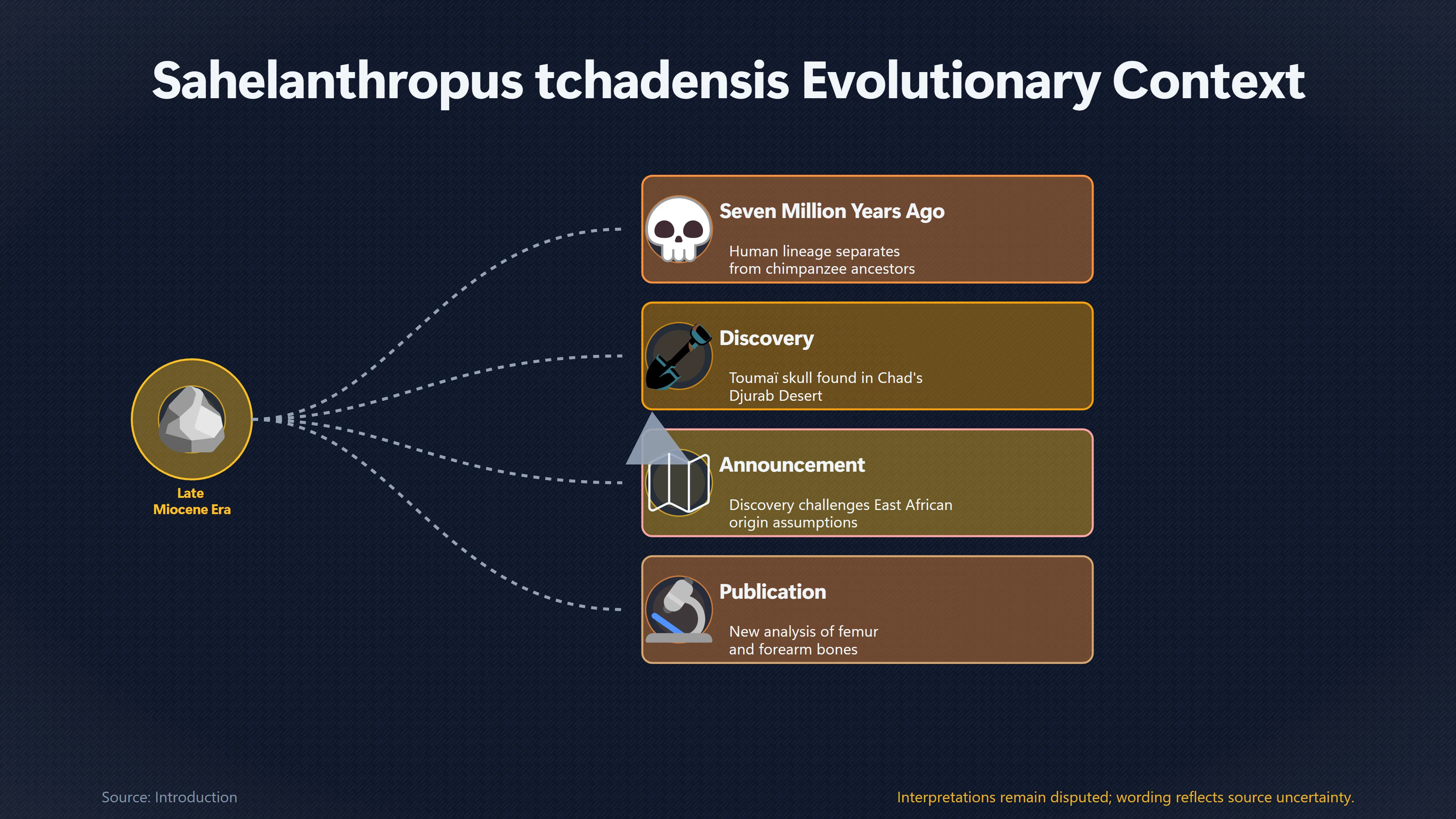
Toumaï is one of the most important and most disputed fossils ever discovered in Africa. Found in Chad’s Djurab Desert in 2001 and assigned to the species Sahelanthropus tchadensis, the skull has been dated to around seven million years ago—close to the estimated period when the human lineage separated from that of chimpanzees. If its interpretation is correct, Toumaï would represent one of the earliest known members of the human family and would demonstrate that crucial stages of human evolution were taking place far beyond the East African Rift Valley traditionally associated with humanity’s origins. Yet the fossil is equally famous because many of its most important claims remain contested.[The Guardian]theguardian.comThis assertion challenged prevailing theories that humanity originated in East Africa. Brunet named the species Sahelanthropus tchadensis…
For visitors interested in Chad’s unusual heritage, Toumaï is not simply an archaeological exhibit but a rare example of a museum display built around an active scientific controversy. Rather than presenting an unquestioned origin story, Chad’s National Museum introduces visitors to a discovery that continues to shape debates about where humans evolved, how scientists interpret fragmentary evidence, and how national identity can become intertwined with one extraordinary fossil.[Wikipedia]WikipediaChad National MuseumChad National Museum
Does Toumaï Rewrite the Human Family Tree?
When Toumaï was announced in 2002, the discovery immediately challenged a long-standing assumption. Most very early hominin fossils had come from Ethiopia, Kenya and neighbouring parts of East Africa. Finding an equally ancient candidate in central Africa suggested that the earliest members of the human lineage may have occupied a much wider geographical range than previously believed.[The Guardian]theguardian.comThis assertion challenged prevailing theories that humanity originated in East Africa. Brunet named the species Sahelanthropus tchadensis…
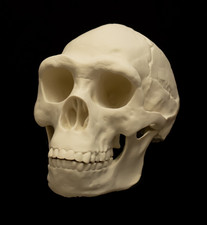
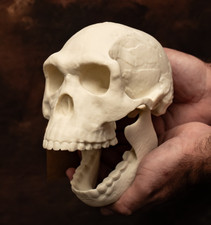
The skull itself is unusual. It combines a remarkably small braincase—closer to that of modern chimpanzees—with facial features and a position of the opening where the spinal column enters the skull that some researchers interpreted as consistent with habitual upright posture. These mixed characteristics are precisely why the fossil remains so important: it appears to combine primitive ape-like anatomy with possible early hominin adaptations.[The Guardian]theguardian.comOpen source on theguardian.com.
Scientists broadly agree that Toumaï is extraordinarily ancient. What remains disputed is whether Sahelanthropus tchadensis belongs inside the human lineage or represents an extinct ape that lived close to, but outside, the branch leading to modern humans. With so few bones available, relatively small differences in anatomical interpretation can produce very different evolutionary conclusions.[The Guardian]theguardian.comThis assertion challenged prevailing theories that humanity originated in East Africa. Brunet named the species Sahelanthropus tchadensis…
What Visitors See at the National Museum
Visitors to Chad’s National Museum encounter Toumaï through carefully presented casts rather than the original fossil. This reflects normal museum practice for exceptionally valuable scientific specimens, which are usually conserved under controlled conditions while accurate replicas are displayed publicly.
The palaeoanthropology galleries place Toumaï alongside other important fossil discoveries from Chad, including Australopithecus bahrelghazali (“Abel”) and additional prehistoric material recovered from the Sahara and Lake Chad Basin. Instead of treating Toumaï as an isolated curiosity, the displays present it as part of a much longer record of environmental and biological change across central Africa.[Wikipedia]WikipediaChad National MuseumChad National Museum
The museum has also used Toumaï as the centrepiece of temporary exhibitions exploring human evolution from the earliest known hominins through to Homo sapiens. These exhibitions underline how a single fossil discovery has become part of Chad’s national cultural identity as well as an internationally significant scientific discovery.[Wikipedia]WikipediaChad National MuseumChad National Museum
Why Toumaï Matters Beyond Chad
Toumaï matters because it altered the questions researchers ask rather than providing all the answers.
Before its discovery, many evolutionary models concentrated heavily on East Africa as the principal setting for humanity’s earliest evolution. Toumaï demonstrated that central Africa must also be considered when reconstructing the environments inhabited by the earliest hominins. Even researchers who disagree about its precise classification generally accept that the discovery greatly expanded the geographical picture of late Miocene Africa.[The Guardian]theguardian.comThis assertion challenged prevailing theories that humanity originated in East Africa. Brunet named the species Sahelanthropus tchadensis…
The fossil also illustrates how palaeoanthropology works in practice. Unlike dinosaurs or later human ancestors represented by numerous skeletons, the earliest hominins are often known from only a handful of bones. Every new fragment can substantially alter existing interpretations. As a result, scientific disagreement is not necessarily evidence of failure but a consequence of working with exceptionally limited material from deep time.[The Guardian]theguardian.comThis assertion challenged prevailing theories that humanity originated in East Africa. Brunet named the species Sahelanthropus tchadensis…
For Chad, Toumaï has become an internationally recognised scientific emblem. The discovery placed a remote part of the Djurab Desert at the centre of one of the most important debates in human evolutionary studies and gave the country a globally recognised contribution to palaeoanthropology.[The Guardian]theguardian.comThis assertion challenged prevailing theories that humanity originated in East Africa. Brunet named the species Sahelanthropus tchadensis…
The Femur Dispute and the Limits of the Evidence
The greatest controversy surrounding Toumaï does not concern the skull itself but a partial thigh bone discovered in the same fossil assemblage.
Because habitual walking on two legs is one of the defining characteristics of hominins, the femur became critically important. If it belonged to the same species and showed adaptations for upright walking, it would strengthen the case that Sahelanthropus tchadensis belonged within the human lineage. If instead it indicated primarily quadrupedal movement, the interpretation of Toumaï would become far less certain.[The Guardian]theguardian.comOpen source on theguardian.com.
The bone became controversial after years passed without a formal description. Disagreements over access to the specimen, publication rights and anatomical interpretation developed into an unusually public dispute among researchers. Critics argued that the delayed publication hindered scientific evaluation, while others defended the original research team’s handling of the material. The episode has become one of the best-known examples of how professional rivalry can complicate the interpretation of rare fossils.[The Guardian]theguardian.comThis assertion challenged prevailing theories that humanity originated in East Africa. Brunet named the species Sahelanthropus tchadensis…
In 2022, researchers associated with the original discovery published an analysis arguing that the femur and forearm bones were consistent with habitual bipedalism combined with climbing ability. Other specialists remained unconvinced, arguing that the anatomy could still be interpreted differently and that the available material is simply too limited for definitive conclusions. Rather than ending the debate, the publication narrowed some questions while leaving others unresolved.[The Guardian]theguardian.comOpen source on theguardian.com.
The continuing disagreement is significant because it illustrates the limits of fossil evidence. A single additional specimen, or a new discovery from the same geological period elsewhere in Africa, could substantially change current interpretations.
Why Toumaï Remains One of the World’s Most Fascinating Museum Stories
Many museum displays celebrate discoveries whose importance has already been settled. Toumaï is unusual because visitors encounter a scientific icon whose interpretation continues to evolve.
The casts displayed in Chad’s National Museum therefore represent more than one of the oldest known candidate human ancestors. They symbolise a moment where archaeology, national heritage and modern scientific debate intersect. Visitors leave not with a simple origin story but with a clearer understanding that humanity’s earliest history is reconstructed from incomplete evidence, and that even the most famous fossils can remain open to reinterpretation as new discoveries and analytical methods emerge.[wikipedia.org]WikipediaChad National MuseumChad National Museum
Amazon book picks
Further Reading
Books and field guides related to Does Toumai Rewrite the Human Family Tree?. Use these as the next step if you want deeper reading beyond the article.
Sapiens: A Brief History of Humankind
Rating: 4.5/5 from 12 Google Books ratings
'Interesting and provocative... It gives you a sense of how briefly we've been on this Earth' Barack Obama What makes us brilliant? What...
The Human Story: Our History, Our Evolution, Our Future
First published 2004. Subjects: History, Nonfiction, Reference, World history, Civilization, history.
The Journey of Man: A Genetic Odyssey
First published 2002. Subjects: Afstamming, Mensen, Mensachtigen, Molecular Evolution, Génétique des populations humaines.
eBay marketplace picks
Marketplace Samples
Live-tested eBay searches with available results related to this page.
Selected fromhuman evolution model oneBay.co.uk.
Endnotes
1.
Source: theguardian.com
Link:https://www.theguardian.com/science/2025/may/27/the-curse-of-toumai-ancient-skull-disputed-femur-feud-humanity-origins
Source snippet
This assertion challenged prevailing theories that humanity originated in East Africa. Brunet named the species Sahelanthropus tchadensis...
2.
Source: theguardian.com
Link:https://www.theguardian.com/science/2022/sep/03/oldest-human-or-just-another-ape-row-erupts-over-7m-year-old-fossil
3.
Source: Wikipedia
Title: Chad National Museum
Link:https://en.wikipedia.org/wiki/Chad_National_Museum
4.
Source: theguardian.com
Link:https://www.theguardian.com/science/2026/jan/02/fresh-bone-analysis-earliest-ancestor-of-humankind-but-doubts-remain
Source snippet
Photograph: Didier Descouens View image in fullscreen A cast of the Sahelanthropus tchadensis craniu...
5.
Source: theguardian.com
Link:https://www.theguardian.com/news/audio/2025/jul/21/the-curse-of-toumai-an-ancient-skull-a-disputed-femur-and-a-bitter-feud-over-humanitys-origins-podcast
Source snippet
July 21, 2025 — This article is more than 10 months old THE CURSE OF TOUMAÏ: AN ANCIENT SKULL, A DISPUTED FEMUR AND A BITTER FEUD OVER HU...
Published: July 21, 2025
6.
Source: theguardian.com
Title: Photograph: Didier Descouens The Audio Long Read The curse of Toumaï: an anc
Link:https://www.theguardian.com/science/neanderthals
Source snippet
Neanderthals | The GuardianJul 25 2025 14.00 EDT * Image: Cast of the Sahelanthropus tchadensis holotype cranium TM 266-01-060-1, dubbed...
Additional References
7.
Source: nmnhs.com
Link:https://www.nmnhs.com/24070801-news_en.html
Source snippet
fute the claim that the Sahelanthropus from Chad was the first bipedal homininJuly 8, 2024 — NEW STUDIES WITH THE PARTICIPATION OF A BULG...
Published: July 8, 2024
8.
Source: scienceandculture.com
Title: “Competition and Politics” Complicate Debate | Science and Culture Today
Link:https://scienceandculture.com/2026/01/competition-and-politics-complicate-debate-over-sahelanthropus-tchadensis/
Source snippet
January 13, 2026 — Indeed, the “bitter” feelings underlying these disputes were elaborated last year in a 2025 article in The Guardian ti...
Published: January 13, 2026
9.
Source: nhm.ac.uk
Title: RELATED INFORMATION * Human Comparative Collection * Fossil
Link:https://www.nhm.ac.uk/our-science/services/collections/palaeontology/palaeoanthropology.html
Source snippet
Palaeoanthropology collection | Natural History MuseumDr Rachel Ives, Curator Contact the curator If you have any questions or would like...
10.
Source: hominides.com
Title: Toumaï, du nouveau: un fémur et deux cubitus
Link:https://www.hominides.com/toumai-du-nouveau-un-femur-et-deux-cubitus/
Source snippet
August 25, 2022 — TOUMAÏ, DU NOUVEAU: UN FÉMUR ET DEUX CUBITUS 25 août 20223 août 2025 Christian Une équipe de recherche, imp...
Published: August 25, 2022
11.
Source: madrimasd.org
Title: El fósil de la discordia | madrimasd
Link:https://www.madrimasd.org/magazine/fosil-discordia?lan=en
Source snippet
May 30, 2025 — Fecha 30/05/2025 EL FÓSIL DE LA DISCORDIA Unos restos encontrados en Chad a principios de siglo motivaron una disputa cien...
Published: May 30, 2025
12.
Source: mnhn.fr
Title: Qu’est-ce qu’un humain?
Link:https://www.mnhn.fr/fr/qu-est-ce-qu-un-humain
Source snippet
MNHNFebruary 17, 2025 — Qui sont les premiers représentants de l’humanité? Image: Toumaï (Sahelanthropus tchadensis), moulage Toumaï (...
Published: February 17, 2025
13.
Source: humanorigins.si.edu
Link:https://humanorigins.si.edu/evidence/human-fossils/fossils/tm
Source snippet
266-01-060-1 | The Smithsonian Institution's Human Origins ProgramTM 266-01-060-1 Exhibit Item Nickname: Toumai Site: Toros-Menalla, Chad...
14.
Source: youtube.com
Title: Was This The First Human Ever? Sahelanthropus tchadensis
Link:https://www.youtube.com/watch?v=cEB1BnUit9Y
Source snippet
EXTINKED: Sahelanthropus tchadensis | Ep. 4 | Lindsay Nikole...
15.
Source: youtube.com
Title: A Researcher Hid This Fossil For Decades. Here’s Why
Link:https://www.youtube.com/watch?v=YS60Tv3EXPs
Source snippet
Was This The First Human Ever? Sahelanthropus tchadensis...
16.
Source: youtube.com
Title: Toumaï, the New Ancestor
Link:https://www.youtube.com/watch?v=dOp6Fy5SX8E
Source snippet
A Researcher Hid This Fossil For Decades. Here's Why...