Within Curious Liechtenstein
Why Does Liechtenstein Have No Witch Museum?
Liechtenstein has no dedicated witch museum, but its severe seventeenth-century persecutions remain central to the country's uncanny history.
On this page
- The Vaduz and Schellenberg persecutions
- Torture, legal abuse and imperial intervention
- How museums and folklore sites interpret the legacy
Page outline Jump by section
Introduction
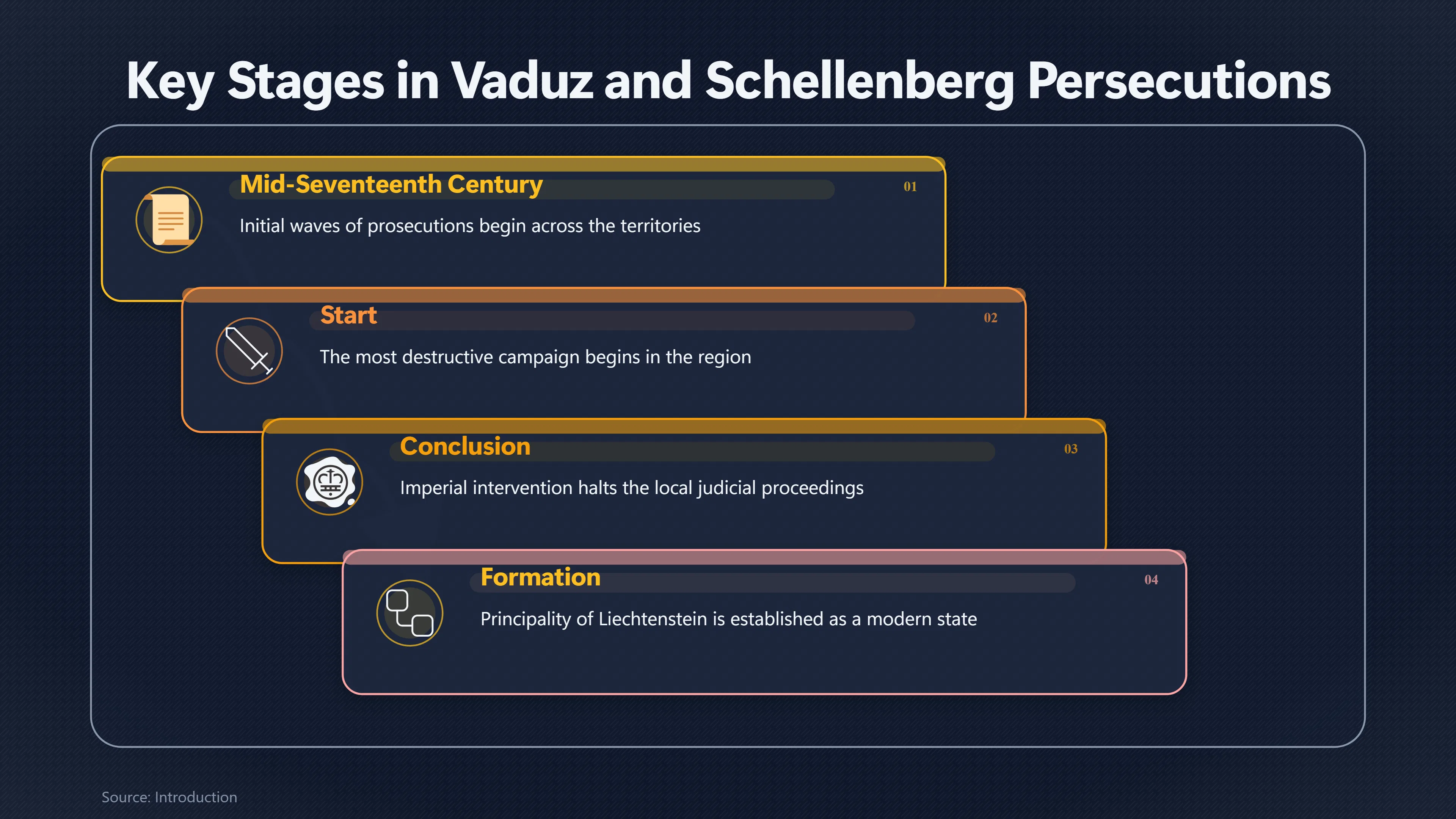
Liechtenstein has no dedicated witch museum, despite one of the darkest histories of witch persecution in the German-speaking world. Between the mid-seventeenth century and 1682, the territories of Vaduz and Schellenberg—then separate lordships within the Holy Roman Empire rather than the modern Principality of Liechtenstein—experienced waves of prosecutions that led to around one hundred executions and devastated entire communities. The trials eventually became so notorious that intervention from the Holy Roman Emperor halted them after complaints about torture, unlawful procedures and abuse of power.[wikipedia.org]WikipediaLiechtenstein witch trialsLiechtenstein witch trials
For visitors interested in unusual history, this absence is striking. Unlike parts of Germany, Switzerland or Scotland, where museums and memorials examine witch persecutions directly, Liechtenstein presents this chapter more quietly through broader historical interpretation rather than a specialist attraction. The result is an unusual kind of heritage: one of Europe’s most severe regional witch hunts is remembered, but not through a dedicated museum.
Why Does Liechtenstein Have No Witch Museum?
The lack of a witch museum does not reflect an absence of history. Instead, it reflects the country’s scale and the way its museums are organised.
Liechtenstein has fewer than 40,000 inhabitants and a compact museum network centred on the Liechtenstein National Museum in Vaduz. Rather than maintaining separate institutions for every historical theme, the country generally integrates difficult subjects into broader exhibitions on political, social and cultural history. The National Museum’s permanent displays focus on the long development of the principality from prehistoric settlement through modern statehood, leaving relatively little space for specialised museums devoted to individual historical episodes.[landesmuseum.li]landesmuseum.liLiechtenstein National Museum | Liechtenstein National MuseumLiechtenstein National Museum | Liechtenstein National Museum
There is also a chronological complication. The worst persecutions occurred decades before the Principality of Liechtenstein was created in 1719. At the time, Vaduz and Schellenberg were independent territories ruled by the Counts of Hohenems. Modern Liechtenstein therefore commemorates atrocities that happened in the same geographical area but under a different political system, making the story part of regional rather than strictly national history.[Swiss History Blog]blog.nationalmuseum.chSwiss History BlogHow the Principality of Liechtenstein came into being – Swiss National Museum - Swiss history blogAugust 20, 2024…
Rather than creating a tourism attraction around the witch hunts, cultural institutions have generally treated them as one element within a wider story about governance, justice and the formation of the state.
The Vaduz and Schellenberg persecutions
The territory experienced several outbreaks of witch prosecutions, but the campaign between 1679 and 1682 became by far the most destructive.
The trials spread through the County of Vaduz and the Lordship of Schellenberg, fuelled by denunciations extracted under torture. As in many major European witch hunts, accused people were pressured into naming supposed accomplices, creating expanding chains of accusation that engulfed families and neighbours. Both women and men were prosecuted, distinguishing the region from places where accusations fell overwhelmingly upon women. Around one hundred executions are generally accepted by historians, an extraordinarily high figure for such a small population.[Wikipedia]WikipediaLiechtenstein witch trialsLiechtenstein witch trials
Economic conditions worsened the crisis. The ruling Counts of Hohenems were heavily indebted, and confiscated property from convicted people could improve their finances. Modern historians caution against reducing the trials to simple financial motives, but the relationship between political instability, debt and confiscation remains an important part of explaining why prosecutions escalated so dramatically.[wikipedia.org]WikipediaLiechtenstein witch trialsLiechtenstein witch trials
Because the population was so small, the social damage was immense. Executions removed substantial numbers of adults from villages that depended on close family networks, while suspicion and forced testimony undermined trust throughout the communities.

Torture, legal abuse and imperial intervention
What makes the Liechtenstein trials especially significant is not only their scale but also the way they ended.
Evidence was frequently obtained through torture, with confessions leading investigators towards ever larger lists of alleged accomplices. Such methods reflected broader European witch-hunting practices, where torture often produced expanding accusations rather than reliable evidence.[The National Archives]nationalarchives.gov.ukThe National Archives Early Modern witch trialsThe National ArchivesEarly Modern witch trials - The National Archives…
The turning point came when several people escaped the territory and appealed beyond the local authorities. Complaints reached Emperor Leopold I through intermediaries including clergy who challenged the legality of the proceedings. An imperial commission investigated the prosecutions and concluded that the trials had been conducted unlawfully. In 1682 the Emperor ordered the prosecutions to cease, making the episode an important example of imperial authority intervening to restrain abusive local justice within the Holy Roman Empire.[wikipedia.org]WikipediaLiechtenstein witch trialsLiechtenstein witch trials
For legal historians, this intervention is as important as the executions themselves. It illustrates that even during Europe’s witch-hunting era, some higher authorities regarded local procedures as illegitimate and were prepared to overturn them.
How museums and folklore sites interpret the legacy
Visitors expecting reconstructed dungeons, theatrical witch exhibits or collections of supposed magical objects will not find them in Liechtenstein.
Instead, interpretation is restrained. The Liechtenstein National Museum presents the country’s development through archaeology, political history and everyday life rather than through immersive displays about witchcraft. The persecutions appear as part of the wider historical narrative of the seventeenth century rather than as an independent attraction.[landesmuseum.li]landesmuseum.liLiechtenstein National Museum | Liechtenstein National MuseumLiechtenstein National Museum | Liechtenstein National Museum
Elsewhere in the country, folklore survives in legends, Alpine traditions and local storytelling, particularly around mountain landscapes and supernatural beliefs. These traditions preserve aspects of popular imagination without attempting to recreate the judicial terror of the witch trials. This creates a clear distinction between folklore and historical persecution: one belongs to living cultural heritage, while the other is treated as a documented injustice.
Compared with neighbouring countries, the silence is noticeable. Germany, Switzerland and several Central European regions have developed memorials, museums or interpretation centres dedicated specifically to witch persecutions. Liechtenstein instead relies on historical scholarship and its general museums to preserve public memory, producing a quieter but arguably more integrated approach to this difficult past.

Why the absence itself is historically interesting
For a project about strange museums and unusual heritage, Liechtenstein’s most intriguing feature is arguably what is missing.
The country experienced one of the final large witch hunts in the Holy Roman Empire, yet it has chosen not to transform that history into a standalone visitor attraction. Instead, the emphasis falls on historical context, legal failure and state formation rather than spectacle.
That decision shapes how the witch trials are remembered. Visitors encounter them not as entertainment or dark tourism but as part of a broader story about how abuse of power, torture and weak legal safeguards affected a tiny Alpine society before the creation of the modern principality. The result is a form of museum silence that is itself revealing: the absence of a witch museum reflects contemporary priorities about remembrance, historical responsibility and the presentation of national identity.
Amazon book picks
Further Reading
Books and field guides related to Why Does Liechtenstein Have No Witch Museum?. Use these as the next step if you want deeper reading beyond the article.
The Witch-Hunt in Early Modern Europe
Between 1450 and 1750 thousands of people – most of them women – were accused, prosecuted and executed for the crime of witchcraft. The w...
Witchcraft in Europe,
Selected by Choice magazine as an Outstanding Academic Book for 2001 The highly-acclaimed first edition of this book chronicled the rise...
Europe's Inner Demons
Europe's Inner Demons: An Enquiry Inspired by the Great Witch-Hunt is a historical study of the beliefs regarding European witchcraft in...
The Oxford Illustrated History of Witchcraft and Magic
The 4000-year story of witchcraft and magic - from the ancient world to Harry Potter... and beyond...
eBay marketplace picks
Marketplace Samples
Live-tested eBay searches with available results related to this page.
Selected fromfolklore art oneBay.co.uk.
![Listing image for Folklore and Symbolism of Flowers, Plants and Trees [Illustrated Edition]](/assets/images/marketplace-covers/c53c7d1fad189826567c.jpg)


Endnotes
1.
Source: Wikipedia
Title: Liechtenstein witch trials
Link:https://en.wikipedia.org/wiki/Liechtenstein_witch_trials
2.
Source: academic.oup.com
Link:https://academic.oup.com/book/44700/chapter-abstract/378812867
Source snippet
OUP AcademicInterventions in Defence of Mediate Subjects: The Smallest Territories, c.1500–1780 | Intervention and State Sovereignty in C...
3.
Source: landesmuseum.li
Title: Liechtenstein National Museum | Liechtenstein National Museum
Link:https://www.landesmuseum.li/en/our-museums/nationalmuseum
4.
Source: landesmuseum.li
Title: History | Liechtenstein National Museum
Link:https://www.landesmuseum.li/en/about-us/history
5.
Source: academic.oup.com
Link:https://academic.oup.com/ehr/article-abstract/131/552/1010/2643315
6.
Source: academic.oup.com
Link:https://academic.oup.com/ehr/article-pdf/131/552/1010/50205301/ehr_131_552_1010.pdf
7.
Source: landesmuseum.li
Link:https://www.landesmuseum.li/de/ueber-uns/geschichte
8.
Source: landesmuseum.li
Link:https://www.landesmuseum.li/en/
10.
Source: landesmuseum.li
Title: nah am krieg liechtenstein 1939 bis 1945
Link:https://www.landesmuseum.li/en/exhibitions/nah-am-krieg-liechtenstein-1939-bis-1945
11.
Source: landesmuseum.li
Link:https://www.landesmuseum.li/en/visit
12.
Source: youtube.com
Title: European Witch Trials and Forgotten History
Link:https://www.youtube.com/watch?v=rB4rYVvKaXI
Source snippet
Liechtenstein National Museum...
13.
Source: youtube.com
Title: Liechtenstein National Museum
Link:https://www.youtube.com/watch?v=H0WCoCfktms
Source snippet
Vaduz Sites, a list of some cultural and informative sites in the city of Vaduz in Liechtenstein...
14.
Source: blog.nationalmuseum.ch
Link:https://blog.nationalmuseum.ch/en/2024/08/how-the-principality-of-liechtenstein-came-into-being/
Source snippet
Swiss History BlogHow the Principality of Liechtenstein came into being – Swiss National Museum - Swiss history blogAugust 20, 2024...
Published: August 20, 2024
15.
Source: nationalarchives.gov.uk
Title: The National Archives Early Modern witch trials
Link:https://www.nationalarchives.gov.uk/education/resources/early-modern-witch-trials/
Source snippet
The National ArchivesEarly Modern witch trials - The National Archives...
16.
Source: blog.nationalmuseum.ch
Title: ch Of greed and ghosts – Swiss National Museum
Link:https://blog.nationalmuseum.ch/en/2025/06/of-greed-and-ghosts/
Source snippet
Illustration by Marco Heer. The dream of getting rich quick is almost as old as humanity itself. Illustration by Marco Hee...
17.
Source: blog.nationalmuseum.ch
Title: ch Les sorcières des Grisons – Musée national
Link:https://blog.nationalmuseum.ch/fr/2022/12/les-sorcieres-des-grisons/
Source snippet
The Witches’ Ride – «la chevauchée des sorcières» de William Holbrook Beard, 1870. Wikimedia LES SORCIÈRES...
Additional References
18.
Source: liechtenstein-institut.li
Link:https://liechtenstein-institut.li/en/research-projects/die-kaiserliche-administration-der-reichsgrafschaft-vaduz-und-der-reichsherrschaft-schellenberg-1684-16991712
Source snippet
Liechtenstein InstituteThe Imperial Administration of the County of Vaduz and the Lordship of Schellenberg (1684–1699/1712):: Liechtenst...
19.
Source: lie-zeit.li
Title: Hexenverfolgungen in Liechtenstein – lie:zeit online
Link:https://www.lie-zeit.li/2023/03/hexenverfolgungen-in-liechtenstein/
Source snippet
März 2023 Bild, das auf die Hexenprozesse hinweist ALS HEXENVERFOLGUNG BEZEICHNET MAN DAS AUFSPÜREN, FESTNEHMEN, FOLTERN UND BESTRAFEN, I...
20.
Source: youtube.com
Title: How did the Holy Roman Empire Work? (Short Animated Documentary)
Link:https://www.youtube.com/watch?v=C8Fd7RSNK0s
Source snippet
European witch trials history documentary European Witch Trials and Forgotten History The History Guy: History Deserves to Be Remembered...
21.
Source: youtube.com
Link:https://www.youtube.com/watch?v=_3uqWRWlpDk
Source snippet
How did the Holy Roman Empire Work? (Short Animated Documentary)...
22.
Source: about-liechtenstein.co.uk
Link:https://about-liechtenstein.co.uk/index.php/villages/unterland-villages/schellenberg-village/schellenberg-history
23.
Source: liechtenstein-institut.li
Link:https://liechtenstein-institut.li/forschungsprojekte/die-kaiserliche-administration-der-reichsgrafschaft-vaduz-und-der-reichsherrschaft-schellenberg-1684-16991712
24.
Source: repository.essex.ac.uk
Link:https://repository.essex.ac.uk/16572/
25.
Source: liechtenstein-institut.li
Link:https://liechtenstein-institut.li/en/publications/frommelt-fabian-2014-kaiserliches-krisenmanagement-der-peripherie-zur-kaiserlichen-administration-vaduzschellenberg-1684-1712-fa
26.
Source: liechtenstein-institut.li
Link:https://liechtenstein-institut.li/publikationen/frommelt-fabian-2019-die-vormoderne-gemeinde-vaduz-und-schellenberg-liechtenstein-institut-2019-gemeinden-geschichte-entwicklung
27.
Source: presseportal.ch
Link:https://www.presseportal.ch/de/pm/100052598/100868030