Within Curious Grenada
How Grenada Turned the Seabed Into a Museum
Grenada's submerged figures are contemporary artworks designed to change as coral, algae and marine life colonise them.
On this page
- How the underwater park began
- The sculptures visitors recognise
- How marine growth transforms the art
Page outline Jump by section
Introduction
Grenada’s Molinere Underwater Sculpture Park is one of the world’s most unusual visitor attractions because it was designed not to remain unchanged. Installed in 2006 in the waters of Molinere Bay, the submerged sculptures were created to become living artificial reefs rather than permanent, pristine works of art. Coral, algae, sponges and other marine organisms gradually colonise their surfaces, so every visit reveals a slightly different museum beneath the sea. This approach transformed the idea of public sculpture from something preserved against nature into something deliberately reshaped by it, making Molinere a landmark in both environmental art and Grenada’s curiosity culture.[Underwater Sculpture]underwatersculpture.comUnderwater Sculpture Molinere Underwater Sculpture ParkUnderwater SculptureMolinere Underwater Sculpture Park - Underwater Sculpture by Jason deCaires Taylor…
Rather than presenting mysterious ruins or a fictional lost civilisation, the park openly embraces its identity as contemporary art. Its fascination lies in watching familiar human figures slowly disappear beneath marine growth while simultaneously creating new habitat for sea life. That balance between artistic expression and ecological restoration has become the defining feature of Grenada’s underwater museum.[Underwater Sculpture]underwatersculpture.comUnderwater Sculpture Molinere Underwater Sculpture ParkUnderwater SculptureMolinere Underwater Sculpture Park - Underwater Sculpture by Jason deCaires Taylor…
How the underwater park began
The project was created by British-Guyanese sculptor Jason deCaires Taylor after Hurricane Ivan severely damaged reefs around Grenada in 2004. Instead of simply placing sculptures underwater as decoration, Taylor worked with local authorities to create structures that could function as artificial reefs while also attracting divers away from the most fragile surviving coral areas. The result was the world’s first large-scale public underwater sculpture park, established in the Molinere Beauséjour Marine Protected Area in 2006.[underwatermuseum.com]underwatermuseum.comUnderwater Museums by Jason deCaires Taylor…
The sculptures were engineered for the marine environment rather than adapted from ordinary gallery works. They were cast in pH-neutral marine cement with rough, textured surfaces that encourage coral larvae to settle and grow. Stainless steel reinforcement provides long-term structural stability while avoiding materials likely to damage surrounding ecosystems. Cavities and crevices within some sculptures also create shelter for fish, lobsters and other marine animals.[Underwater Sculpture]underwatersculpture.comUnderwater Sculpture The Coral CarnivalUnderwater SculptureThe Coral Carnival - Underwater Sculpture by Jason deCaires Taylor…
This combination of art and habitat restoration became highly influential. Molinere demonstrated that underwater sculpture could serve conservation goals while creating a distinctive tourism experience, inspiring later underwater museums across the Caribbean, Europe, Asia and Australia.[Underwater Sculpture]underwatersculpture.comUnderwater Sculpture BiographyUnderwater SculptureBiography - Underwater Sculpture by Jason deCaires Taylor…
The sculptures visitors recognise
Although the collection contains dozens of works, several pieces have become internationally recognised because they illustrate how ordinary human scenes change beneath the sea.
Vicissitudes is the park’s best-known installation. Twenty-six life-sized children stand hand in hand in a circle, facing outward into the surrounding water. Cast from local Grenadian children, the sculpture symbolises shared humanity and the way environments shape people. As coral growth spreads unevenly across the figures, each child gradually develops a unique appearance, reinforcing the work’s central idea of transformation through surroundings. Local interpretations have also linked the circle and its setting in the Atlantic to memories of slavery and the Middle Passage, adding layers of meaning beyond the artist’s original concept.[Underwater Sculpture]underwatersculpture.comUnderwater Sculpture Molinere Underwater Sculpture ParkUnderwater SculptureMolinere Underwater Sculpture Park - Underwater Sculpture by Jason deCaires Taylor…
The Lost Correspondent depicts a journalist seated at a desk with a typewriter covered in newspaper cuttings. Above water, it resembles an ordinary office scene; underwater, it appears like a forgotten room preserved by the sea. Marine organisms slowly coat the desk and typewriter until the sculpture itself becomes a fossil-like object, reinforcing themes of memory, obsolete technology and changing forms of communication.[Underwater Sculpture]underwatersculpture.comUnderwater Sculpture Molinere Underwater Sculpture ParkUnderwater SculptureMolinere Underwater Sculpture Park - Underwater Sculpture by Jason deCaires Taylor…
Other early works, including Grace Reef and The Unstill Life, similarly relocate familiar domestic subjects into an unfamiliar underwater setting. Rather than preserving these scenes, the ocean steadily alters them, making biological change an essential part of the artwork rather than accidental damage.[Wikipedia]WikipediaJason de Caires TaylorJason de Caires Taylor
How marine growth transforms the art
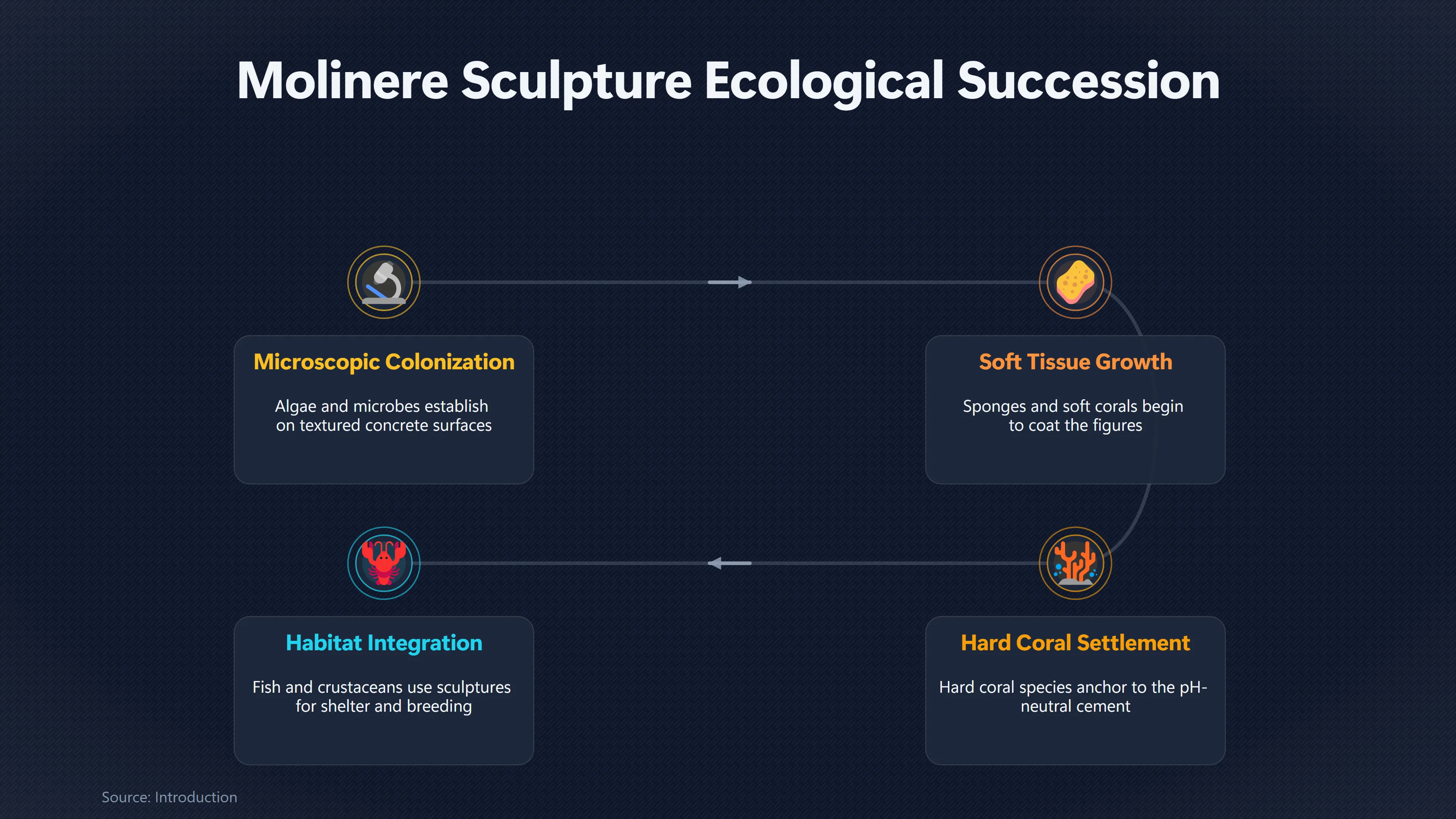
Unlike conventional sculpture, Molinere’s installations were never intended to remain visually complete. Their appearance changes through a process known as ecological succession, as different marine organisms colonise the surfaces over months and years.
Initially, microscopic organisms and algae establish themselves on the textured concrete. These are followed by sponges, soft corals and eventually hard coral species where conditions allow. Fish, crustaceans and other reef animals increasingly use the sculptures for shelter, feeding and breeding. Instead of resisting these changes through cleaning or restoration, the project welcomes them as the final stage of the artwork.[Underwater Sculpture]underwatersculpture.comUnderwater Sculpture Molinere Underwater Sculpture ParkUnderwater SculptureMolinere Underwater Sculpture Park - Underwater Sculpture by Jason deCaires Taylor…
Currents, wave action, sunlight and depth also influence how individual sculptures develop. Two identical figures can evolve very differently depending on water movement or exposure to light, meaning the collection never reaches a finished state. Visitors returning years later often find familiar works almost unrecognisable beneath coral colonies and marine life.[Grenada Tourism Authority]puregrenada.comGrenada Tourism Authority Underwater Sculpture ParkGrenada Tourism AuthorityUnderwater Sculpture Park - Grenada Tourism Authority…
This continual transformation challenges traditional museum ideas about conservation. Most museums attempt to prevent objects from changing; Molinere treats change itself as the artwork’s intended outcome. The sculptures are simultaneously cultural artefacts and living ecological structures.[Wikipedia]WikipediaJason de Caires TaylorJason de Caires Taylor
Why it matters within Grenada’s curiosity landscape
For travellers interested in unusual collections rather than conventional museums, Molinere occupies a distinctive place because it combines contemporary art, environmental engineering and natural history in a single experience. Visitors do not simply observe exhibits—they watch an ecosystem actively rewriting them.
The sculptures also avoid the common misconception that they represent ancient ruins or submerged archaeological remains. Every figure is a documented modern artwork whose gradual disappearance beneath coral is intentional. The haunting atmosphere comes from the interaction between human-made forms and natural processes, not from fabricated legends about lost civilisations.[Underwater Sculpture]underwatersculpture.comUnderwater Sculpture Molinere Underwater Sculpture ParkUnderwater SculptureMolinere Underwater Sculpture Park - Underwater Sculpture by Jason deCaires Taylor…
In 2023 the park gained a significant expansion through Coral Carnival, a series inspired by Grenada’s Spicemas celebrations. These colourful new sculptures continue the original philosophy by using marine-friendly materials designed for long-term colonisation by reef organisms, demonstrating that the underwater museum remains an evolving project rather than a fixed historical attraction.[Underwater Sculpture]underwatersculpture.comUnderwater Sculpture The Coral CarnivalUnderwater SculptureThe Coral Carnival - Underwater Sculpture by Jason deCaires Taylor…

Amazon book picks
Further Reading
Books and field guides related to How Grenada Turned the Seabed Into a Museum. Use these as the next step if you want deeper reading beyond the article.
A brief history of the Caribbean
First published 1992. Subjects: History, West indies, history.
The Sixth Extinction
"Over the last half billion years, there have been five major mass extinctions, when the diversity of life on Earth suddenly and dramatic...
Coral Reefs in the Anthropocene
This volume investigates the effects of human activities on coral reefs, which provide important life-supporting systems to surrounding n...
eBay marketplace picks
Marketplace Samples
Live-tested eBay searches with available results related to this page.
Selected frommarine art print oneBay.co.uk.

Endnotes
1.
Source: Wikipedia
Title: Jason de Caires Taylor
Link:https://en.wikipedia.org/wiki/Jason_deCaires_Taylor
2.
Source: underwatermuseum.com
Link:https://underwatermuseum.com/projects/
Source snippet
Underwater Museums by Jason deCaires Taylor...
3.
Source: underwatermuseum.com
Link:https://underwatermuseum.com/events/
Source snippet
Jason deCaires Taylor at MOUA for World’s Ocean Day Jason deCaires Taylor receives 1st place Award from th...
4.
Source: underwatermuseum.com
Title: His innovative work reimagines the underwater real
Link:https://underwatermuseum.com/about/
Source snippet
About - Underwater Museums by Jason deCaires TaylorABOUT Jason deCaires Taylor is renowned for creating immersive underwater art installa...
5.
Source: underwatersculpture.com
Title: Underwater Sculpture Molinere Underwater Sculpture Park
Link:https://underwatersculpture.com/projects/molinere-underwater-sculpture-park/
Source snippet
Underwater SculptureMolinere Underwater Sculpture Park - Underwater Sculpture by Jason deCaires Taylor...
6.
Source: underwatersculpture.com
Title: Underwater Sculpture Biography
Link:https://underwatersculpture.com/about/biography/
Source snippet
Underwater SculptureBiography - Underwater Sculpture by Jason deCaires Taylor...
7.
Source: underwatersculpture.com
Title: Underwater Sculpture The Coral Carnival
Link:https://underwatersculpture.com/coral-carnival/
Source snippet
Underwater SculptureThe Coral Carnival - Underwater Sculpture by Jason deCaires Taylor...
8.
Source: puregrenada.com
Title: Grenada Tourism Authority Underwater Sculpture Park
Link:https://www.puregrenada.com/underwatersculpturepark/
Source snippet
Grenada Tourism AuthorityUnderwater Sculpture Park - Grenada Tourism Authority...
9.
Source: underwatersculpture.com
Title: Yet while over two-t
Link:https://underwatersculpture.com/
Source snippet
Home - Underwater Sculpture by Jason deCaires TaylorImage: Jason deCaires Taylor Underwater Sculpture Throughout human history, artistic...
Additional References
10.
Source: youtube.com
Title: A World Adrift
Link:http://www.youtube.com/watch?v=l7iXbj28IGU
Source snippet
Molinere Underwater Sculpture Park Jason deCaires Taylor An underwater art museum, teeming with life | Jason deCaires Taylor TED...
11.
Source: ideas.ted.com
Title: Gallery: The sculpture garden at the bottom of the sea
Link:https://ideas.ted.com/the-sculpture-gallery-at-the-bottom-of-the-sea/
Source snippet
ted.comGallery: The sculpture garden at the bottom of the sea |December 23, 2015 — GALLERY: THE SCULPTURE GARDEN AT THE BOTTOM OF THE SEA...
Published: December 23, 2015
12.
Source: earthisland.org
Link:https://www.earthisland.org/journal/index.php/magazine/entry/portraits-of-decay-and-recovery
Source snippet
GRACE, PART OF THE SILENT EVOLUTION, MUSEO SUBACUÁTICO DE ARTE, M...
13.
Source: storymaps.arcgis.com
Title: Arc GIS Story Maps Molinere Underwater Sculpture Park
Link:https://storymaps.arcgis.com/stories/e6484424231b4ea8bda9f1c4c8aca068
Source snippet
## Location Molinere Sculpture park is located in the Moliniere Beausejour marine reserve off the coast of...
14.
Source: dacs.org.uk
Title: DACSJason de Caires Taylor
Link:https://www.dacs.org.uk/artist/jason-decaires-taylor-arts001878
Source snippet
Jason deCaires Taylor - DACSJASON DECAIRES TAYLOR * Nationality British ARR payments are necessary Verified by DACS as eligible for ARR r...
15.
Source: youtube.com
Title: An underwater art museum, teeming with life | Jason de Caires Taylor
Link:http://www.youtube.com/watch?v=RWiI7AkDX-o
Source snippet
Meet Jason deCaires Taylor, the artist protecting marine life with his underwater sculptures...
16.
Source: youtube.com
Link:http://www.youtube.com/watch?v=f8CR6eO-hMs
Source snippet
Underwater Art Gallery by Sculptor Jason deCaires Taylor...
17.
Source: youtube.com
Title: Jason de Caires Taylor and Museo Subaquatico de Arte
Link:http://www.youtube.com/watch?v=oip5M3IJ4bI
Source snippet
A World Adrift - [Carriacou]({{ 'carriacou/' | relative_url }}) and Petite Martinique underwater sculpture park by Jason deCaires Taylor...
18.
Source: youtube.com
Title: Underwater Art Gallery by Sculptor Jason de Caires Taylor
Link:http://www.youtube.com/watch?v=xEewF4kEkt4
Source snippet
Jason deCaires Taylor and Museo Subaquatico de Arte...