Within Strange Uruguay
How Should Uruguay Display Death and Trauma?
Uruguay's mummy, dictatorship and Andes collections raise hard questions about dignity, trauma, memory and responsible display.
On this page
- The Egyptian mummy and the ethics of human remains
- Museo Andes 1972 beyond sensationalism
- Dictatorship memory and the civic role of museums
Page outline Jump by section
Introduction
Uruguay’s most challenging museum experiences are not built around shock value. Instead, they ask visitors to think about how human remains, mass tragedy and political violence should be presented in public. Three very different examples illustrate this debate: the Egyptian mummy preserved at Montevideo’s Museum of Art History, the Museo Andes 1972 dedicated to the survivors and victims of the Andes air disaster, and the country’s museums commemorating the civic and personal trauma of the military dictatorship. Together they show that the central question is not simply whether difficult material should be displayed, but how it can be interpreted with dignity, historical accuracy and respect for those most closely connected to it.[gub.uy]muhar.montevideo.gub.uyMuseo de Historia del Arte Colección | Museo de Historia del ArteMuseo de Historia del Arte Colección | Museo de Historia del Arte
The Egyptian mummy and the ethics of displaying human remains
One of Uruguay’s best-known museum curiosities is the Egyptian mummy of the priestess Esoeris (also rendered as Esoeris or Esmeris in different publications), displayed in Montevideo’s Museum of Art History (MuHAr). Unlike many curiosity displays of the nineteenth century, the mummy today is presented as part of a wider archaeological and educational collection rather than as a stand-alone spectacle. The museum explicitly identifies her as an individual from ancient Egypt and places her within the broader history of Egyptian civilisation.[Museo de Historia del Arte]muhar.montevideo.gub.uyMuseo de Historia del Arte Colección | Museo de Historia del ArteMuseo de Historia del Arte Colección | Museo de Historia del Arte
Even so, the mummy inevitably raises questions that museums around the world continue to debate. Human remains can be powerful educational objects, revealing ancient burial practices, religion and medical history, yet they are also the physical remains of a person who never consented to becoming a public exhibit. Modern museum ethics increasingly encourage institutions to present such remains with contextual information, restrained interpretation and an emphasis on humanity rather than novelty.
Uruguay’s Egyptian mummy therefore occupies an unusual position within the country’s curiosity culture. It attracts visitors because it is rare and visually striking, but its long-term significance lies in how it encourages discussion about changing standards of museum practice. Earlier generations often treated mummies primarily as exotic attractions. Contemporary interpretation is more likely to frame them as people whose remains deserve careful conservation and respectful display.[Museo de Historia del Arte]muhar.montevideo.gub.uyMuseo de Historia del Arte Colección | Museo de Historia del ArteMuseo de Historia del Arte Colección | Museo de Historia del Arte
Museo Andes 1972: telling a survival story without sensationalism
The story of the 1972 Andes air crash could easily be presented as a tale of horror. Instead, Montevideo’s Museo Andes 1972 deliberately shifts attention towards remembrance, resilience and ethical decision-making.
The museum honours all 45 passengers and crew, including the 29 who died, while preserving original artefacts, documents, photographs and survivor testimony. Its stated mission is to commemorate those involved and communicate values such as solidarity, teamwork, resilience and mutual support rather than encouraging fascination with the disaster itself. Permanent exhibitions combine original objects with audiovisual material and artworks inspired by the experience.[Museo Andes 1972]mandes.uyAndes 1972Museo - Museo Andes 1972…
This approach matters because the Andes disaster remains inseparable from one of the most sensitive survival stories of the twentieth century. The survivors’ decision to consume the bodies of those who had died has often dominated popular retellings. The museum instead places that decision within the extreme conditions of more than seventy days trapped at high altitude, presenting it through testimony, historical documentation and the perspectives of those directly involved rather than as sensational entertainment.[Museo Andes 1972]mandes.uyAndes 1972Museo - Museo Andes 1972…
The result is a museum that asks visitors to consider difficult moral questions without pretending they have simple answers. Rather than inviting judgement, it encourages reflection on survival, grief, friendship and the psychological realities of catastrophe. This distinguishes it from exhibitions that focus primarily on disaster tourism or graphic spectacle.
Dictatorship memory and the civic role of museums
Uruguay’s most ethically demanding museum spaces concern neither archaeology nor natural disaster but recent political violence.
The Museo de la Memoria (MUME) in Montevideo is dedicated to preserving the history of state terrorism during Uruguay’s military dictatorship. Rather than displaying human remains, its permanent exhibitions rely on photographs, documents, prison artefacts, personal belongings and testimony connected with imprisonment, torture, exile, resistance and unresolved disappearances. The emphasis is on remembering victims while encouraging democratic reflection and public debate.[mume.montevideo.gub.uy]mume.montevideo.gub.uyMUM E | Museo de la MemoriaMUM E | Museo de la Memoria
This illustrates an important distinction within museum ethics. Human dignity does not depend solely on how physical remains are displayed. Museums dealing with enforced disappearance, political imprisonment and torture also face difficult decisions about whose voices are prioritised, how much graphic material should be shown and how institutions can acknowledge trauma without reducing victims to symbols.
In Uruguay, these exhibitions generally favour documentation and witness testimony over graphic reconstruction. The objective is civic memory rather than emotional shock. Visitors are encouraged to understand the mechanisms of repression and the continuing importance of truth, justice and democratic institutions rather than simply confronting disturbing imagery.[mume.montevideo.gub.uy]mume.montevideo.gub.uyMUM E | Museo de la MemoriaMUM E | Museo de la Memoria
What makes Uruguay’s approach distinctive?
Compared with countries whose museums contain extensive anatomical collections or large displays of archaeological human remains, Uruguay presents relatively few examples. What exists is notable for its emphasis on interpretation rather than spectacle.
Across these institutions several common principles emerge:
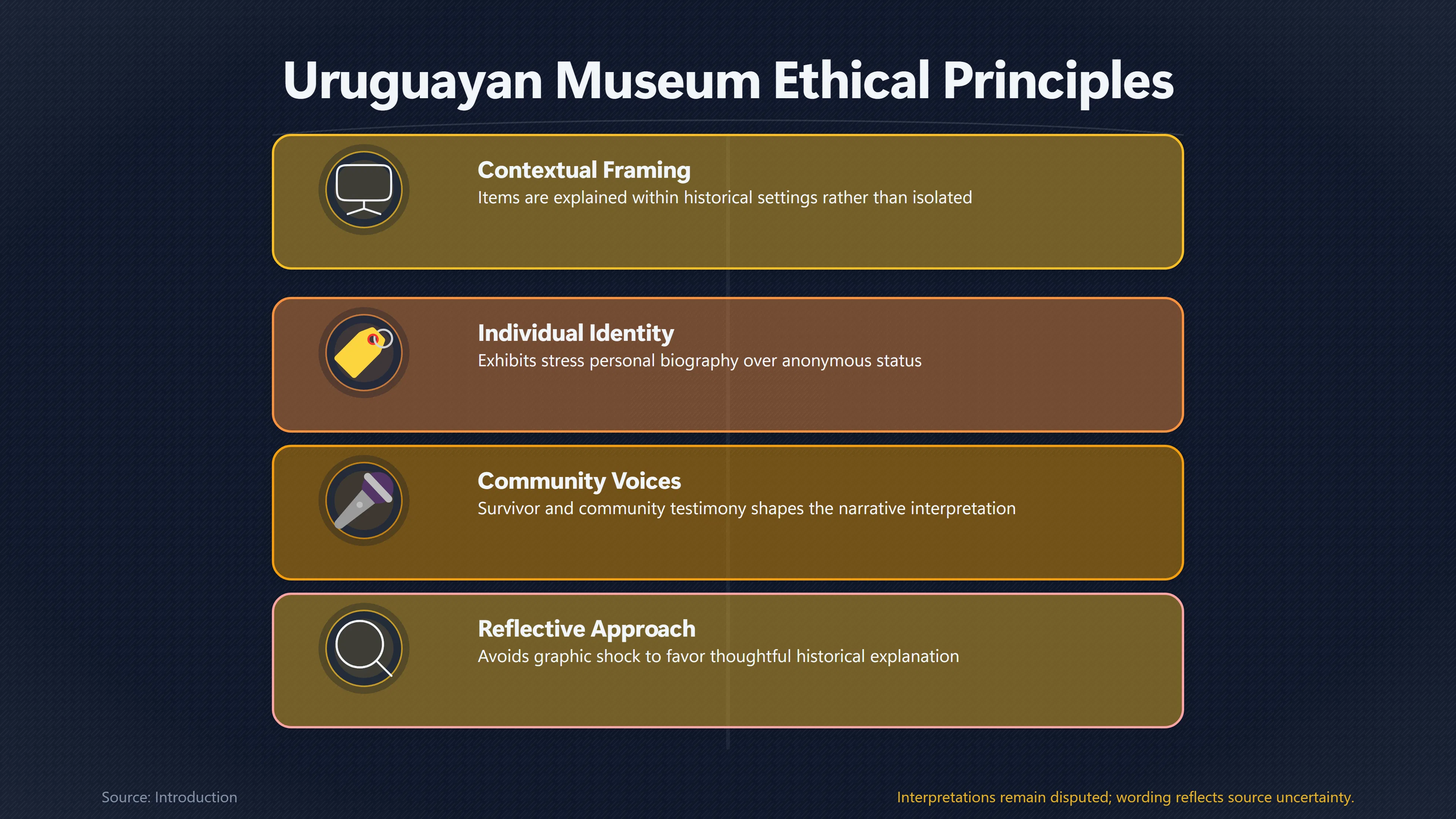
- Context before curiosity. Human remains and traumatic objects are explained within their historical setting instead of being isolated as attractions.
- Named individuals rather than anonymous exhibits. Whether an ancient Egyptian priestess, the passengers of Flight 571 or victims of dictatorship, exhibitions increasingly stress personal identity and biography.
- Survivor and community voices. Particularly in the Andes museum and memory museums, testimony from those directly affected shapes interpretation.
- Reflection instead of shock. Exhibitions generally avoid graphic presentation where thoughtful historical explanation can achieve a deeper understanding.[mandes.uy]mandes.uyAndes 1972Museo - Museo Andes 1972…

Why these museums matter within Uruguay’s strange-history landscape
Visitors looking for unusual museums in Uruguay often expect mysterious artefacts or eccentric collections. Instead, some of the country’s most memorable experiences are unusual because they confront ethical questions.
The Egyptian mummy asks whether ancient human remains can ever be displayed respectfully. Museo Andes 1972 demonstrates how a globally famous survival story can be interpreted without exploiting suffering. The Museo de la Memoria shows that museums can preserve the legacy of political violence through testimony, archives and civic education rather than sensational imagery.
Taken together, these institutions suggest that Uruguay’s contribution to curiosity culture is less about the bizarre than about responsible remembrance. They show how museums can preserve extraordinary stories while continually asking visitors to consider the dignity owed to the dead, the responsibilities owed to survivors and the role museums should play in shaping public memory.
Amazon book picks
Further Reading
Books and field guides related to How Should Uruguay Display Death and Trauma?. Use these as the next step if you want deeper reading beyond the article.
The secret history of the world
First published 2008. Subjects: Errors, inventions, Secret societies, Nonfiction, World history, History.
The Architecture of Happiness
Bestselling author Alain de Botton has written about love, travel, status and how philosophy can console us. Now he turns his attention t...
The Ethics of Memory
First published 2000. Subjects: Moral and ethical aspects, Memory (Philosophy), Memory, Ethics, New York Times reviewed.

Museums and memory
First published 2000. Subjects: Historiography, Museums, Museum exhibits, Culture, Philosophy.
eBay marketplace picks
Marketplace Samples
Live-tested eBay searches with available results related to this page.
Selected frommemorial print oneBay.co.uk.



Endnotes
1.
Source: muhar.montevideo.gub.uy
Title: Museo de Historia del Arte Colección | Museo de Historia del Arte
Link:https://muhar.montevideo.gub.uy/coleccion-0
2.
Source: mume.montevideo.gub.uy
Title: MUM E | Museo de la Memoria
Link:https://mume.montevideo.gub.uy/mume
3.
Source: muhar.montevideo.gub.uy
Title: Museo de Historia del Arte Museo | Museo de Historia del Arte
Link:https://muhar.montevideo.gub.uy/museo
4.
Source: museos.gub.uy
Title: 679 museo andes 1972
Link:https://museos.gub.uy/index.php/museos/museos-por-localidad/montevideo/item/679-museo-andes-1972
Source snippet
Museo Andes 1972...
5.
Source: montevideo.gub.uy
Title: Museo de Historia del Arte (Mu HAr) | Portal institucional
Link:https://montevideo.gub.uy/areas-tematicas/cultura-y-tiempo-libre/museo-de-historia-del-arte-muhar
6.
Source: museos.gub.uy
Title: Los secretos de la momia al descubierto en el Mu HAr
Link:https://www.museos.gub.uy/index.php/noticias/item/1269-los-secretos-de-la-momia-al-descubierto-en-el-muhar
Source snippet
Los secretos de la momia al descubierto en el MuHArNovember 11, 2016 — Viernes, 11 Noviembre 2016 16:33 LOS SECRETOS DE LA MOMIA AL DESCU...
Published: November 11, 2016
7.
Source: museos.gub.uy
Title: 679 museo andes 1972
Link:https://www.museos.gub.uy/index.php/museos/museos-por-localidad/montevideo/item/679-museo-andes-1972?print=1&tmpl=component
8.
Source: museos.gub.uy
Link:https://www.museos.gub.uy/index.php?Itemid=90&id=679%3Amuseo-andes-1972&option=com_k2&view=item
9.
Source: museos.gub.uy
Link:https://www.museos.gub.uy/index.php?Itemid=88&id=679%3Amuseo-andes-1972&option=com_k2&view=item
10.
Source: muhar.montevideo.gub.uy
Link:https://muhar.montevideo.gub.uy/coleccion-0/momia-egipcia-de-la-sacerdotisa-esoeris
11.
Source: mna.gub.uy
Link:https://www.mna.gub.uy/innovaportal/v/3222/12/mecweb/exposicion-antropologia?3colid=3089&contid=3621
12.
Source: pmb.parlamento.gub.uy
Link:https://pmb.parlamento.gub.uy/pmb/opac_css/index.php?id=103644&lvl=notice_display
13.
Source: youtube.com
Title: The Problem with Museums
Link:https://www.youtube.com/watch?v=Av_3tGceTvs
Source snippet
Museo Andes 1972 Montevideo Uruguay english Andes 1972 plane crash museum in Montevideo Guru'Guay...
14.
Source: mandes.uy
Link:https://mandes.uy/en/museo/
Source snippet
Andes 1972Museo - Museo Andes 1972...
15.
Source: mandes.uy
Link:https://mandes.uy/en/
Source snippet
Museo Andes 1972Museo Andes 1972 – Andes Crash Memorial...
16.
Source: mandes.uy
Link:https://mandes.uy/museo/
17.
Source: mandes.uy
Link:https://mandes.uy/
18.
Source: descubrimontevideo.uy
Title: museo andes 1972
Link:https://www.descubrimontevideo.uy/museo-andes-1972
19.
Source: britishmuseum.org
Link:https://www.britishmuseum.org/our-work/departments/human-remains
20.
Source: dialogo-social.axiadev.pixelato.uy
Title: museo andes 1972
Link:https://dialogo-social.axiadev.pixelato.uy/descubrimvd/public_html/museo-andes-1972
21.
Source: uruguay.fandom.com
Title: Museo Andes 1972
Link:https://uruguay.fandom.com/es/wiki/Museo_Andes_1972
Additional References
22.
Source: museos.uy
Title: Los secretos de la momia al descubierto en el Mu HAr
Link:https://www.museos.uy/index.php/noticias/item/1269-los-secretos-de-la-momia-al-descubierto-en-el-muhar?print=1&tmpl=component
Source snippet
Los secretos de la momia al descubierto en el MuHArNovember 11, 2016 — Viernes, 11 Noviembre 2016 16:33 LOS SECRETOS DE LA MOMIA AL DESCU...
Published: November 11, 2016
23.
Source: reddit.com
Title: Has there been a push to not display remains of Ancient Egyptians in museums?
Link:https://www.reddit.com/r/AskHistorians/comments/12bjsav
Source snippet
Has there been a push to not display remains of Ancient Egyptians in museums?...
24.
Source: youtube.com
Link:https://www.youtube.com/watch?v=5aVI-5oZbDA
Source snippet
Do Human Remains Belong in Museum Collections?...
25.
Source: youtube.com
Link:https://www.youtube.com/watch?v=1UYiWqmZ-Fk
Source snippet
My Plane Crashed And I Survived 72 Days In The Andes | Minutes With...
26.
Source: youtube.com
Title: Do Human Remains Belong in Museum Collections?
Link:https://www.youtube.com/watch?v=3iCK-DfdIMY
Source snippet
Human Bodies in Museums // Death Debate...
27.
Source: cairo.gov.eg
Title: The National Museum of Egyptian Civilization
Link:https://www.cairo.gov.eg/en/culture/cultural-destinations/cairo-museums/the-national-museum-of-egyptian-civilization/
28.
Source: guruguay.com
Title: museo del accidente aéreo de los andes
Link:https://www.guruguay.com/es/museo-del-accidente-a%C3%A9reo-de-los-andes/
29.
Source: youtube.com
Title: Human Bodies in Museums // Death Debate
Link:https://www.youtube.com/watch?v=18gK1J-EbxQ
Source snippet
The Problem with Museums...
30.
Source: sydney.edu.au
Title: Human Remains Research Project
Link:https://www.sydney.edu.au/museum/our-research/human-remains.html
31.
Source: sydney.edu.au
Title: The Egyptian Galleries
Link:https://www.sydney.edu.au/museum/whats-on/exhibitions/the-egyptian-galleries.html