Within Strange Brazil
How Did Sacred Objects Become Police Evidence?
Colecao Nosso Sagrado reveals how sacred objects seized as police evidence are being reinterpreted through preservation and historical reparation.
On this page
- Raids, criminalisation and the original collection
- Why the label 'black magic' distorted meaning
- Renaming, transfer and historical reparation
Page outline Jump by section
Introduction
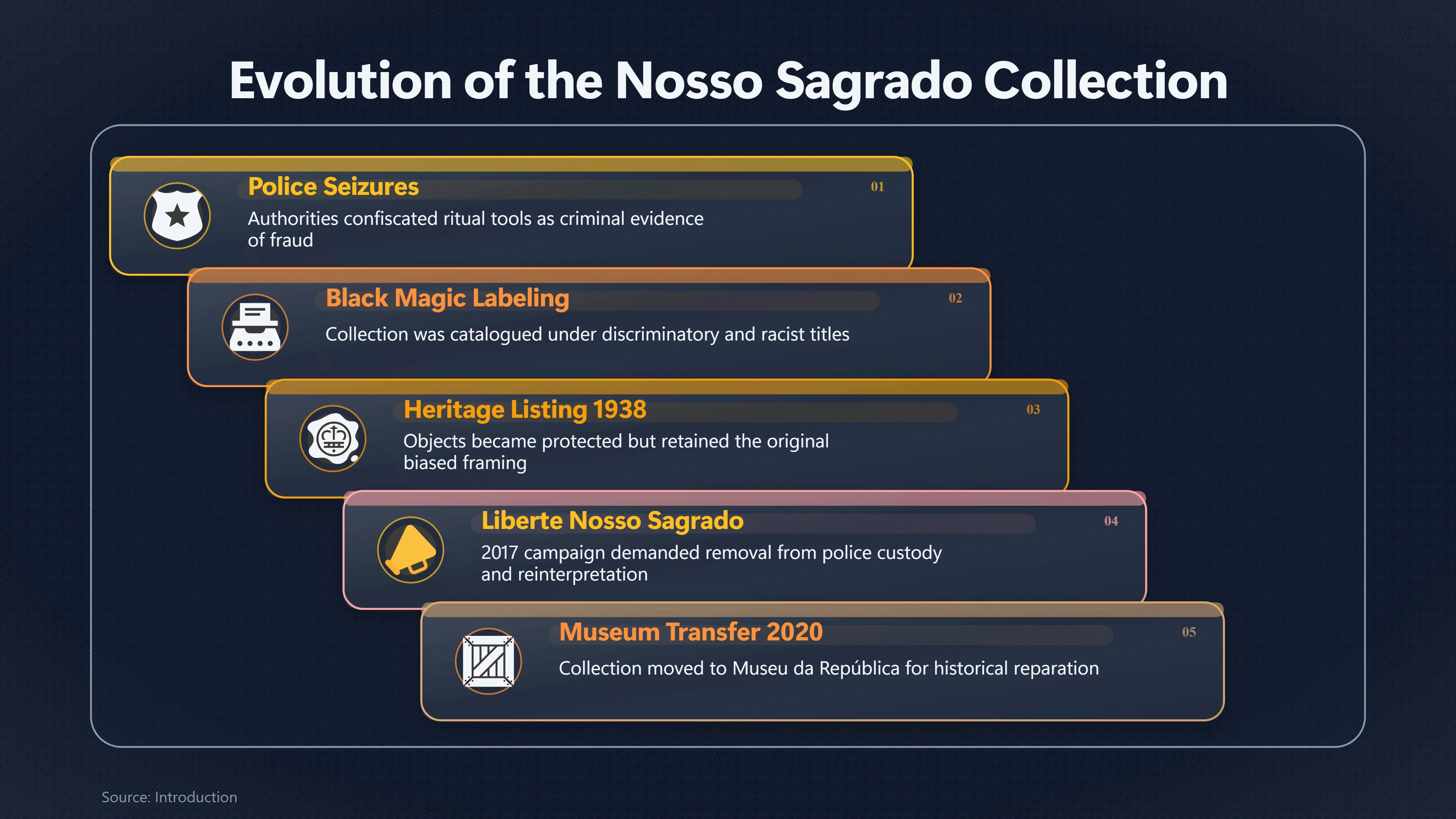
The collection now known as Nosso Sagrado (“Our Sacred”) is one of Brazil’s most unusual and historically significant heritage collections because its objects did not enter a museum through archaeology, donation or collecting. Instead, many were seized during police raids on Afro-Brazilian religious communities and catalogued as evidence of supposed criminal activity. Today the same ritual objects are being reinterpreted as sacred cultural heritage and as evidence of state repression rather than of wrongdoing. This transformation has made the collection an important example of how museums can confront difficult histories instead of preserving the assumptions that created them.[UnB Periodicals]periodicos.unb.brUnB PeriodicalsA chegada e chegadas do nosso sagrado à república | Museologia & InterdisciplinaridadeNovember 20, 2022…

Unlike many museum stories, this is not simply about conserving unusual artefacts. It is about changing the meaning attached to those artefacts. The movement of the collection from police custody to the Museu da República, together with its renaming, reflects a wider process of historical reparation for Afro-Brazilian religious communities whose sacred objects were criminalised for decades.[Instituto Ibirapitanga]ibirapitanga.org.brInstituto Ibirapitanga Ancestral words: a story about the Our Sacred CollectionInstituto IbirapitangaAncestral words: a story about the Our Sacred Collection - Instituto IbirapitangaMay 20, 2025…
How Did Sacred Objects Become Police Evidence?
During the late nineteenth and early twentieth centuries, Afro-Brazilian religions were subjected to sustained surveillance by police authorities. Although freedom of religion formally existed, police frequently relied on criminal law provisions relating to fraud, public order, healing practices or supposed superstition to raid places of worship. Ceremonial objects—including ritual tools, statues, vessels, musical instruments and offerings—were confiscated and treated as physical evidence in criminal investigations.[UnB Periodicals]periodicos.unb.brUnB PeriodicalsA chegada e chegadas do nosso sagrado à república | Museologia & InterdisciplinaridadeNovember 20, 2022…
These seizures were not isolated incidents but formed a pattern during the First Brazilian Republic. Rather than recognising the objects as belonging to living religious traditions, officials interpreted them through racist and colonial assumptions that portrayed African-derived religions as primitive or dangerous. The confiscated material accumulated within police institutions and eventually became known as the Museum of Black Magic collection.[UnB Periodicals]periodicos.unb.brUnB PeriodicalsA chegada e chegadas do nosso sagrado à república | Museologia & InterdisciplinaridadeNovember 20, 2022…
The collection therefore preserves two intertwined histories:
- the religious traditions represented by the objects themselves;
- the machinery of policing that removed them from their communities.
That dual history explains why the collection is so unusual. The objects cannot be understood simply as ethnographic artefacts because their route into museum care was itself part of a system of repression.[Pantheon]pantheon.ufrj.brOpen source on ufrj.br.
Why the Label “Black Magic” Distorted Their Meaning
For decades the official title Museum of Black Magic framed the collection according to the language used by police rather than by the communities from which the objects had been taken. The label implied that the collection documented occult crime or superstition instead of legitimate religious practice.
This naming mattered because museum catalogues shape how visitors understand collections. By presenting ritual implements as examples of “black magic”, institutions repeated the prejudices that had justified their seizure. Sacred objects became curiosities illustrating alleged criminality rather than expressions of faith, ancestry and religious identity.[Instituto Ibirapitanga]ibirapitanga.org.brInstituto Ibirapitanga Ancestral words: a story about the Our Sacred CollectionInstituto IbirapitangaAncestral words: a story about the Our Sacred Collection - Instituto IbirapitangaMay 20, 2025…
A further irony is that, in 1938, part of the collection became Brazil’s first protected ethnographic collection under the national heritage authority. The heritage listing helped preserve the objects physically, but it also preserved the discriminatory title and interpretive framework for many decades. The collection survived, yet its official description continued to reflect the perspective of those who had confiscated it rather than those who had created and used it.[Instituto Ibirapitanga]ibirapitanga.org.brInstituto Ibirapitanga Ancestral words: a story about the Our Sacred CollectionInstituto IbirapitangaAncestral words: a story about the Our Sacred Collection - Instituto IbirapitangaMay 20, 2025…
Renaming, Transfer and Historical Reparation
Pressure to reinterpret the collection grew through decades of advocacy by Afro-Brazilian religious leaders, scholars and museum professionals. A particularly important milestone came with the Liberte Nosso Sagrado (“Free Our Sacred”) campaign, launched in 2017, which argued that the objects should leave police custody and be treated as religious heritage rather than criminal evidence.[Instituto Ibirapitanga]ibirapitanga.org.brInstituto Ibirapitanga Ancestral words: a story about the Our Sacred CollectionInstituto IbirapitangaAncestral words: a story about the Our Sacred Collection - Instituto IbirapitangaMay 20, 2025…
In 2020 the collection was transferred from the Civil Police Museum to the Museu da República in Rio de Janeiro. The move represented far more than a change of storage location. It marked an institutional acknowledgement that the previous setting had reinforced the original injustice by continuing to present sacred objects through a policing framework.[Pantheon]pantheon.ufrj.brOpen source on ufrj.br.
The collection was subsequently renamed Nosso Sagrado (“Our Sacred”), replacing the old title with language chosen to affirm the religious significance of the objects. Recent scholarship describes the renaming not as a symbolic gesture alone but as part of an ongoing reparative process involving museum staff, researchers and representatives of Afro-Brazilian religious communities working together on interpretation, documentation and stewardship.[Pantheon]pantheon.ufrj.brOpen source on ufrj.br.
Why This Collection Is Different from Most Museum Repatriation Cases
Many museum restitution debates concern artefacts removed during colonial expansion and now held overseas. Nosso Sagrado presents a different kind of historical injustice.
Here, the contested journey occurred largely within Brazil itself. The state seized objects from its own citizens, classified them as criminal evidence, then preserved them under that interpretation for generations. As a result, the collection raises questions not only about ownership but also about institutional language, museum authority and the continuing effects of religious discrimination.[Pantheon]pantheon.ufrj.brOpen source on ufrj.br.
The case also illustrates that historical reparation can involve several linked processes rather than a single act of return:
- acknowledging how collections were originally formed;
- replacing discriminatory cataloguing and terminology;
- involving descendant communities in interpretation and governance;
- recognising the spiritual status of the objects rather than treating them as ethnographic curiosities alone.
Researchers increasingly describe these changes as an ongoing process rather than a completed settlement. The collection remains in public care, but its interpretation now seeks to expose the history of repression instead of reproducing it.[Pantheon]pantheon.ufrj.brOpen source on ufrj.br.
What Visitors Should Expect Today
Visitors encountering the collection should not expect a display devoted to mystery, occultism or sensational stories. Instead, the significance lies in understanding why ordinary-looking ritual objects once became police exhibits and how museums can change the narratives attached to them.
The collection includes ceremonial objects used in Afro-Brazilian religious practice, but its greatest importance is historical rather than aesthetic. Every object embodies two overlapping stories: its original sacred purpose and the period when the Brazilian state interpreted that same object as evidence of criminal behaviour. Understanding both histories is essential to appreciating why Nosso Sagrado has become one of Brazil’s most distinctive heritage collections and a landmark in debates over museum ethics, religious freedom and historical justice.[unb.br]periodicos.unb.brUnB PeriodicalsA chegada e chegadas do nosso sagrado à república | Museologia & InterdisciplinaridadeNovember 20, 2022…
Amazon book picks
Further Reading
Books and field guides related to How Did Sacred Objects Become Police Evidence?. Use these as the next step if you want deeper reading beyond the article.
The Brazil Reader
An interdisciplinary anthology that includes many primary resources never before published in English.
Ways of Seeing
"Seeing comes before words. The child looks and recognizes before it can speak. "But there is also another sense in which seeing comes be...
The Brazil Reader: History, Culture, Politics
First published 1999. Subjects: Social conditions, Economic conditions, History, Brazil, history, Brazil, social life and customs.

The Slave Ship: A Human History
First published 2007. Subjects: History, Merchant mariners, Race relations, Slave trade, Slaves.
eBay marketplace picks
Marketplace Samples
Live-tested eBay searches with available results related to this page.
Selected fromcultural art print oneBay.co.uk.

Endnotes
1.
Source: periodicos.unb.br
Link:https://periodicos.unb.br/index.php/museologia/article/view/45280
Source snippet
UnB PeriodicalsA chegada e chegadas do nosso sagrado à república | Museologia & InterdisciplinaridadeNovember 20, 2022...
Published: November 20, 2022
2.
Source: bdm.unb.br
Link:https://bdm.unb.br/handle/10483/30399
3.
Source: youtube.com
Title: Our Sacred | Trailer
Link:https://www.youtube.com/watch?v=1jx3ScQXyD0
Source snippet
Liberte nosso sagrado: liberação do acervo de religiões negras...
4.
Source: youtube.com
Title: Roda de conversa sobre a campanha “Liberte Nosso Sagrado”
Link:https://www.youtube.com/watch?v=zsQitGtJ2gI
Source snippet
Nosso Sagrado...
5.
Source: youtube.com
Title: Nosso Sagrado
Link:https://www.youtube.com/watch?v=9qDicRK_cMI
Source snippet
"Nosso Sagrado" - Cobertura da Estréia do Documentário no Circo Voador...
6.
Source: youtube.com
Title: “Nosso Sagrado”
Link:https://www.youtube.com/watch?v=7tRuZJv61RI
7.
Source: pantheon.ufrj.br
Link:https://www.pantheon.ufrj.br/handle/11422/28898?locale=en
8.
Source: ibirapitanga.org.br
Title: Instituto Ibirapitanga Ancestral words: a story about the Our Sacred Collection
Link:https://ibirapitanga.org.br/en/historias/ancestral-words-a-story-about-the-our-sacred-collection/
Source snippet
Instituto IbirapitangaAncestral words: a story about the Our Sacred Collection - Instituto IbirapitangaMay 20, 2025...
Published: May 20, 2025
9.
Source: pantheon.ufrj.br
Link:https://pantheon.ufrj.br/handle/11422/26247
Source snippet
ufrj.brPantheon: O processo de musealização do acervo "Nosso Sagrado": uma trajetória do Museu da Polícia ao Museu da RepúblicaDecember 1...
10.
Source: pantheon.ufrj.br
Link:https://www.pantheon.ufrj.br/handle/11422/28898?locale=pt_BR
Source snippet
ufrj.brPantheon: Cotidianos de uma reparação: os caminhos da coleção Nosso Sagrado no Museu da RepúblicaMarch 10, 2025 — Use este identif...
Published: March 10, 2025
11.
Source: pantheon.ufrj.br
Link:https://www.pantheon.ufrj.br/handle/11422/28898?mode=full
Source snippet
ufrj.brPantheon: Cotidianos de uma reparação: os caminhos da coleção Nosso Sagrado no Museu da RepúblicaMarch 10, 2025 — Use este identif...
Published: March 10, 2025
12.
Source: pantheon.ufrj.br
Link:https://pantheon.ufrj.br/handle/11422/26247?locale=pt_BR
Source snippet
ufrj.brPantheon: O processo de musealização do acervo "Nosso Sagrado": uma trajetória do Museu da Polícia ao Museu da RepúblicaDecember 1...
13.
Source: pantheon.ufrj.br
Link:https://pantheon.ufrj.br/handle/11422/26247?mode=full
14.
Source: revistas.ufrj.br
Link:https://revistas.ufrj.br/index.php/abeafrica/article/view/56982
Additional References
15.
Source: youtube.com
Title: Liberte nosso sagrado: liberação do acervo de religiões negras
Link:https://www.youtube.com/watch?v=ivz8rVuHhJI
Source snippet
Roda de conversa sobre a campanha "Liberte Nosso Sagrado"...
16.
Source: researchgate.net
Link:https://www.researchgate.net/publication/385172270_Nosso_Sagrado_Collection_Spatiality_of_Afro-Brazilian_religious_practices_based_on_the_location_of_objects_seized_by_the_Civil_Police_1889-1946_in_Rio_de_Janeiro
17.
Source: gov.br
Link:https://www.gov.br/iphan/pt-br/assuntos/noticias/iphan-renomeia-201ccolecao-de-magia-negra201d-para-201cacervo-nosso-sagrado201d
18.
Source: gov.br
Link:https://www.gov.br/secom/pt-br/assuntos/obrasilvoltou/respeito-e-dialogo/reparacao-historica-a-religioes-de-matriz-africana
19.
Source: diariodorio.com
Title: Acervo do Museu da República, no Catete, ganha peças de religiões afro
Link:https://diariodorio.com/museu-da-republica-tem-agora-em-seu-acervo-pecas-religiosas-afro/
20.
Source: funartemaisdigital.funarte.gov.br
Title: funarte.gov.br A chegada e chegadas do nosso sagrado à república
Link:https://funartemaisdigital.funarte.gov.br/periodicos/a-chegada-e-chegadas-do-nosso-sagrado-a-republica/
21.
Source: link.springer.com
Link:https://link.springer.com/article/10.1186/s41257-024-00106-6
22.
Source: onlinelibrary.wiley.com
Link:https://onlinelibrary.wiley.com/doi/full/10.1111/cura.12648
23.
Source: scielo.br
Link:https://www.scielo.br/scielo.php?lng=en&pid=S1809-43412013000100014&script=sci_arttext&tlng=en
24.
Source: artsandculture.google.com
Title: mw Wx9m6ZCuqk5A
Link:https://artsandculture.google.com/story/nosso-sagrado-museudarepublica/mwWx9m6ZCuqk5A?hl=en