Within Mauritius Curiosities
How Museums Rebuilt Mauritius's Vanished Dodo
Mauritius's dodo exhibits reveal how bones, paintings and uncertain eyewitness accounts were combined to recreate a vanished bird.
On this page
- The rare skeletons preserved in Mauritius
- Why many dodo reconstructions disagree
- From scientific specimen to national symbol
Page outline Jump by section
Introduction
The dodo is Mauritius’s most famous lost animal, yet no museum can show visitors a complete record of what the bird looked like in life. Instead, every display is built from fragments: subfossil bones, a handful of seventeenth-century paintings, scattered written descriptions and modern scientific interpretation. That makes the dodo one of the world’s most revealing museum objects. Rather than simply preserving an extinct species, Mauritian collections demonstrate how scientists reconstruct an animal after it has disappeared and how those reconstructions can change as new evidence emerges. The result is a display that is as much about the making of knowledge as it is about the bird itself.[Natural History Museum]nhm.ac.ukOpen source on nhm.ac.uk.
The rare skeletons preserved in Mauritius
The centrepiece of any dodo-focused visit is the Natural History Museum in Port Louis, where two exceptionally rare, almost complete skeletons are preserved. Their importance lies not only in their completeness but also in the fact that the bones in each skeleton belong to a single individual. This is extraordinarily unusual.
Most dodo skeletons displayed around the world are composite mounts assembled from bones recovered from different birds, particularly from the famous Mare aux Songes fossil deposit in south-eastern Mauritius. Composite skeletons are scientifically useful, but they inevitably require curatorial judgement about proportions, missing elements and posture. By contrast, the associated skeletons in Mauritius provide much firmer evidence for the animal’s true anatomy and have become key reference specimens for modern research.[Natural History Museum]nhm.ac.ukOpen source on nhm.ac.uk.
One of these skeletons originated from the discoveries of the Mauritian naturalist Louis Étienne Thirioux in the early twentieth century. Because it is almost entirely composed of original bones from one bird, it has been recognised as one of the most complete dodo skeletal specimens ever recovered.[Guinness World Records]guinnessworldrecords.comGuinness World Records Most complete dodo specimen | Guinness World RecordsGuinness World Records Most complete dodo specimen | Guinness World Records
For visitors, this distinction is easy to overlook. A mounted skeleton may appear complete regardless of how it was assembled. Museum interpretation increasingly explains that the Mauritian specimens are exceptional precisely because they reduce the amount of reconstruction required.
Why many dodo reconstructions disagree
The familiar image of the dodo has never rested on a single authoritative source. Instead, museums have had to combine several imperfect forms of evidence, each with its own limitations.
The main evidence includes:
- Subfossil bones, which reveal skeletal structure but not feathers, colour or soft tissues.
- Early paintings, many produced by artists who never visited Mauritius and often copied earlier works.
- Eyewitness descriptions, which vary considerably in detail and reliability.
- The few surviving historical remains, notably the preserved head and soft tissue in Oxford, which provide invaluable biological information but represent only part of one specimen.[Museum of Natural History]oumnh.ox.ac.ukOpen source on ox.ac.uk.
These sources do not always agree. Early European paintings often portrayed the dodo as an overweight, clumsy bird with an exaggerated body. Modern anatomical studies suggest this stereotype is misleading. Researchers now argue that wild dodos were probably leaner, more upright and more athletic than many famous paintings imply. Seasonal changes in body weight, captive birds fed by humans and repeated copying of earlier artwork may all have contributed to the enduring image of the permanently obese dodo.[Natural History Museum]nhm.ac.ukOpen source on nhm.ac.uk.
As a result, visitors comparing museum displays across different countries may notice obvious differences in body shape, posture, feather colour and even facial expression. These are not necessarily mistakes. They reflect different moments in scientific understanding and different decisions about how much weight to give competing forms of evidence.
How museums reconstruct an extinct bird
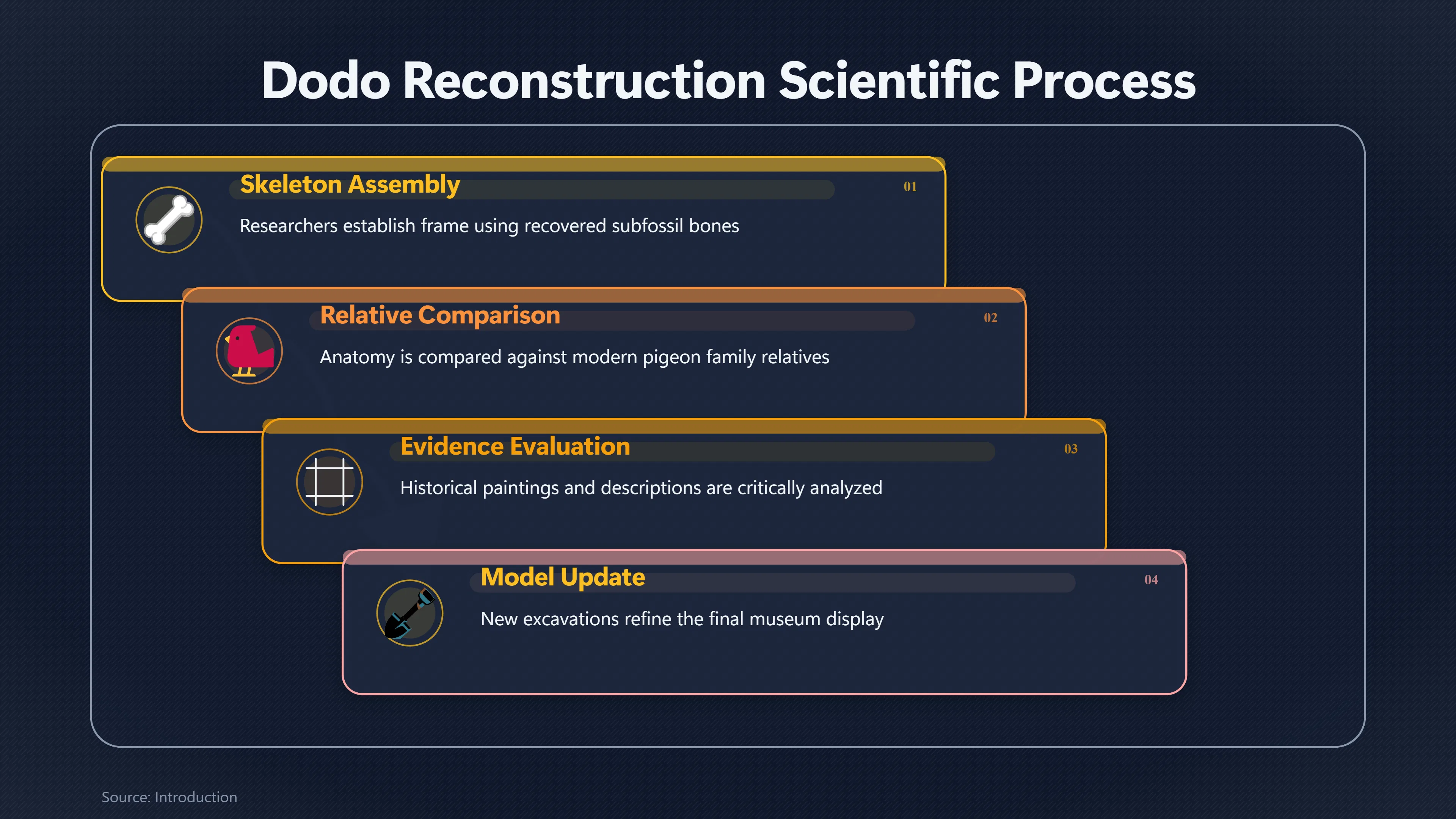
Dodo displays demonstrate that reconstructing an extinct animal is an iterative scientific process rather than a single act of discovery.
Researchers first establish the skeleton from recovered bones, using associated specimens wherever possible and composite material where necessary. They then compare the anatomy with living relatives. The dodo belongs to the pigeon family, so modern pigeons help scientists infer muscles, movement and aspects of behaviour that bones alone cannot reveal. Contemporary artwork and written descriptions are evaluated critically rather than accepted at face value, especially where artists may have worked from captive birds or copied earlier illustrations.[Natural History Museum]nhm.ac.ukOpen source on nhm.ac.uk.
New excavations have also changed museum interpretation. Renewed work at Mare aux Songes in the twenty-first century recovered many additional remains and improved understanding of the environment in which dodos lived. These discoveries have refined anatomical studies while also revealing more about the island ecosystem that supported the species before human settlement.[Wikipedia]WikipediaOpen source on wikipedia.org.
This explains why museum models are periodically updated. Unlike a preserved animal in a jar, the reconstructed dodo continues to evolve as fresh evidence alters scientific consensus.
From scientific specimen to national symbol
The dodo occupies an unusual position in Mauritian museums because it functions simultaneously as a scientific specimen, a historical object and a national emblem.
Natural history displays use the skeletons to explain extinction, island evolution and the consequences of introduced species. At the same time, the bird appears throughout Mauritian public life, from tourism and branding to educational material and national identity. This cultural prominence can sometimes obscure the fact that the real animal remains surprisingly elusive.
Museum displays therefore perform an important corrective role. Rather than presenting a single definitive dodo, they often explain the uncertainties behind every reconstruction. Visitors learn that no complete preserved bird survives, that most mounted skeletons are composites, and that many iconic paintings are interpretive rather than documentary.[ucl.ac.uk]ucl.ac.ukUniversity College London Dodo bones | Museums and CollectionsUniversity College LondonDodo bones | Museums and Collections - UCL – University College London…
Seen this way, the dodo is not simply an extinct curiosity. It is an example of how museums transform incomplete evidence into public understanding while remaining open about the limits of what can truly be known.

Why the dodo remains one of the world’s most unusual museum displays
Many extinct animals are known from abundant fossils, while others survive through complete preserved specimens. The dodo occupies an unusual middle ground. It vanished before modern zoology developed, leaving only scattered physical remains and inconsistent historical observations.
That scarcity has made every authentic specimen unusually significant. The associated skeletons in Mauritius, the Mare aux Songes bone deposits, and the surviving soft tissue preserved overseas each contribute different pieces of the puzzle. No single object tells the whole story; the museum experience emerges from bringing them together.
For visitors interested in Mauritius’s stranger collections, this is what makes the dodo so compelling. The display is not merely about an extinct bird but about the reconstruction of memory itself—how science, historical documents, artistic imagination and museum practice combine to recreate an animal that no human can ever observe alive again.
Amazon book picks
Further Reading
Books and field guides related to How Museums Rebuilt Mauritius's Vanished Dodo. Use these as the next step if you want deeper reading beyond the article.
The Sixth Extinction: An Unnatural History
WINNER OF THE PULITZER PRIZE ONE OF THE NEW YORK TIMES BOOK REVIEW'S 10 BEST BOOKS OF THE YEAR A NEW YORK TIMES BESTSELLER A NATIONAL BOO...
The Song Of The Dodo
Why have island ecosystems always suffered such high rates of extinction? In our age, with all the world's landscapes, from Tasmania to t...
The Dodo: The Bird Behind the Legend
It took less than a hundred years of human influence in Mauritius to wipe out the Dodo. The delicate balance of nature was suddenly tippe...
eBay marketplace picks
Marketplace Samples
Live-tested eBay searches with available results related to this page.
Selected fromdodo model oneBay.co.uk.

Endnotes
1.
Source: nhm.ac.uk
Link:https://www.nhm.ac.uk/discover/the-dodo-bird-the-real-facts-about-this-icon-of-extinction.html
2.
Source: ucl.ac.uk
Title: University College London Dodo bones | Museums and Collections
Link:https://www.ucl.ac.uk/museums-collections/grant-museum-zoology/highlights/dodo-bones
Source snippet
University College LondonDodo bones | Museums and Collections - UCL – University College London...
3.
Source: guinnessworldrecords.com
Title: Guinness World Records Most complete dodo specimen | Guinness World Records
Link:https://www.guinnessworldrecords.com/world-records/650372-most-complete-dodo-specimen
4.
Source: oumnh.ox.ac.uk
Link:https://www.oumnh.ox.ac.uk/learn-the-oxford-dodo
5.
Source: Wikipedia
Link:https://en.wikipedia.org/wiki/Dodo
6.
Source: oumnh.ox.ac.uk
Link:https://oumnh.ox.ac.uk/oxford-dodo-0
7.
Source: oumnh.ox.ac.uk
Link:https://www.oumnh.ox.ac.uk/node/315156
8.
Source: youtube.com
Title: They’re Bringing Back the Dodo – But Here’s The Truth You Haven’t Heard
Link:https://www.youtube.com/watch?v=3VOv__W3Vr4
Source snippet
Natural History Museum - Dodo - Raphus cucullatus...
9.
Source: youtube.com
Title: Natural History Museum
Link:https://www.youtube.com/watch?v=QlCxX0hbiKs
Source snippet
A HYDROTAPHONOMIC MODEL FOR THE MARE AUX SONGES DODO-LAGERSTÄTTE IN MAURITIUS...
Additional References
10.
Source: tandfonline.com
Link:https://www.tandfonline.com/doi/full/10.1080/08912963.2021.1940996
Source snippet
July 27, 2021 — MATERIALS & METHODS We surveyed the literature and online resources for images through time of dodos (Raphus cucullatus)...
Published: July 27, 2021
11.
Source: smithsonianmag.com
Title: Rare Dodo Composite Skeleton Goes On Sale
Link:https://www.smithsonianmag.com/smart-news/rare-dodo-skeleton-goes-sale-180960269/
Source snippet
August 29, 2016 — RARE DODO COMPOSITE SKELETON GOES ON SALE A BRITISH AUCTION HOUSE IS SELLING ONE OF ONLY A DOZEN KNOWN DODO SKELETONS...
Published: August 29, 2016
12.
Source: nhm-wien.ac.at
Title: Naturhistorisches Museum Wien
Link:https://www.nhm-wien.ac.at/presse/top10/dodo
Source snippet
October 2012 Dodo Raphus cucullatus. Mauritius. Skeleton acquisition, 1905. The NHM owns not only the most complete dodo skeleton anywher...
Published: October 2012
13.
Source: ilemaurice.im
Title: Some valuable accounts includ
Link:https://www.ilemaurice.im/en/dodo-raphus-cucullatus/
Source snippet
Mauritius Dodo: History of Extinction and Symbol of the IslandAugust 25, 2025 — HISTORICAL TESTIMONIES AND REPRESENTATIONS THE FIRST STOR...
Published: August 25, 2025
14.
Source: canterburymuseum.com
Link:https://www.canterburymuseum.com/explore/our-stories/dead-as-a-dodo
15.
Source: researchgate.net
Link:https://www.researchgate.net/figure/Photographs-of-the-mounted-Thirioux-dodo-skeletons-A-Port-Louis-specimen-B-Durban_fig1_299347324
16.
Source: mauritius-life.com
Link:https://www.mauritius-life.com/about/dodo
17.
Source: museumgoerlitz.senckenberg.de
Link:https://museumgoerlitz.senckenberg.de/en/exhibition/dodo/
18.
Source: museumfrankfurt.senckenberg.de
Link:https://museumfrankfurt.senckenberg.de/en/exhibition/highlight/ein-dodo/
19.
Source: researchers.mq.edu.au
Link:https://researchers.mq.edu.au/en/publications/a-review-of-the-dodo-and-its-ecosystem-insights-from-a-vertebrate/