Within Strange Belarus
Why Vetka's Sacred Objects Feel So Unusual
Vetka reveals a devotional world where icons, textiles, manuscripts and funerary customs carried profound spiritual meaning.
On this page
- Old Believer refuge and icon painting centre
- Icons, domestic devotion and ritual space
- Negliubka textiles, graves and local funerary folklore
Page outline Jump by section
Introduction
Vetka is one of the most distinctive places in Belarus for anyone interested in unusual religious heritage. Rather than displaying spectacular relics or miracle stories, its collections reveal how an entire community transformed ordinary household objects into expressions of faith. Icons hung in domestic prayer corners, embroidered towels framed sacred images, handwritten books preserved older religious traditions, and even cemeteries reflected a distinctive spiritual worldview.
The town became one of the principal centres of the Old Believers after religious refugees fled reforms in the Russian Orthodox Church during the late seventeenth century. Today, the Vetka Museum of Old Believers and Belarusian Traditions preserves this material culture, making it one of Belarus’s most remarkable collections of devotional art and everyday sacred objects. The result is an experience that feels unusual not because the objects are exotic, but because almost every item reveals how religion shaped domestic life, craftsmanship and memory across generations.[wikipedia.org]WikipediaOld BelieversOld Believers
Old Believer refuge and icon-painting centre
Vetka was founded by Old Believer settlers who sought refuge beyond the direct reach of the Russian state after Patriarch Nikon’s church reforms split Russian Orthodoxy in the seventeenth century. The community became both a religious sanctuary and an artistic centre, attracting icon painters, scribes, printers and craftsmen whose work helped preserve pre-reform traditions. Although the settlement experienced repeated destruction and forced resettlement during the eighteenth century, its artistic influence spread across the wider Vetka and Starodub regions.[Wikipedia]WikipediaOld BelieversOld Believers
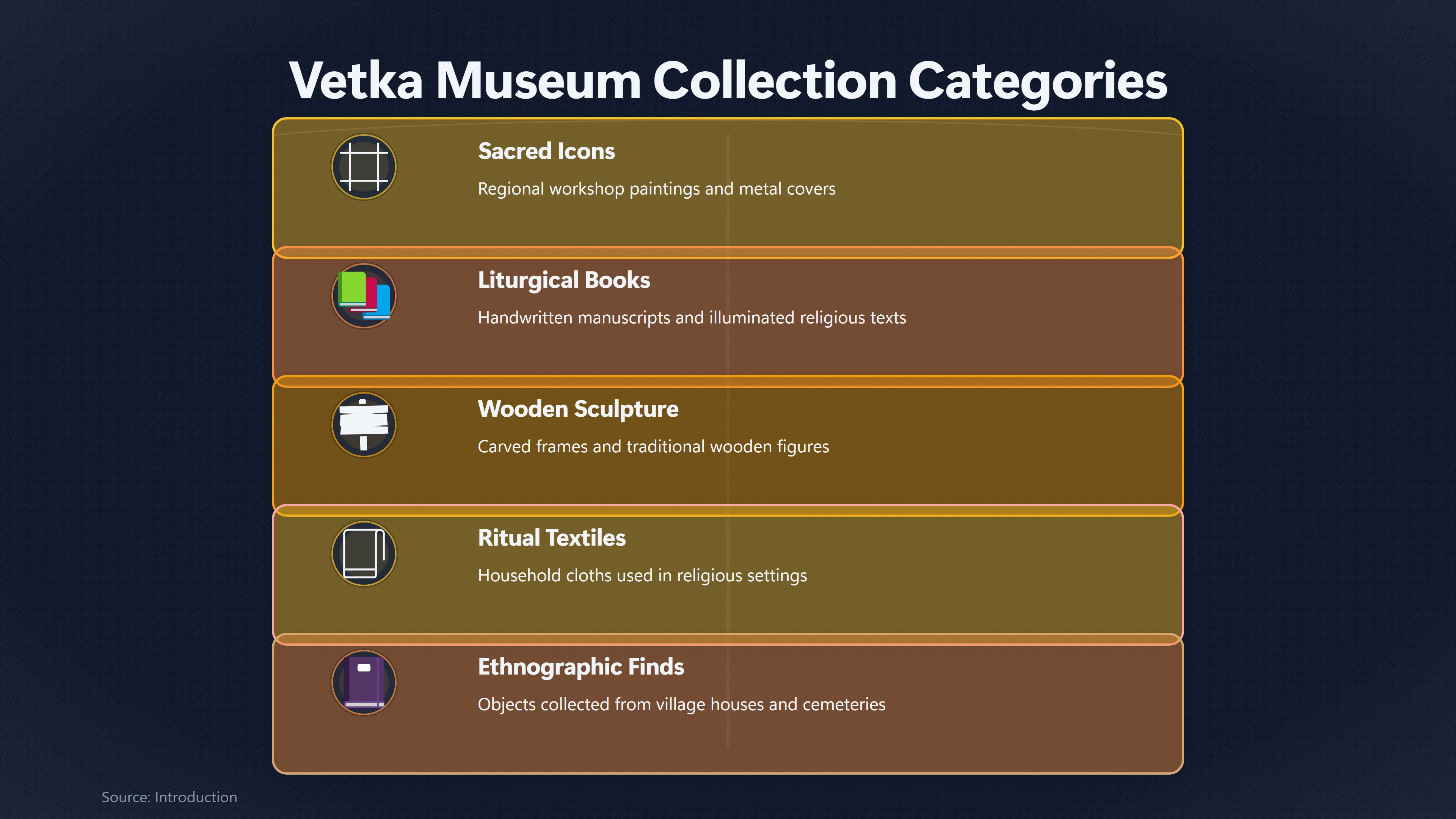
Unlike many museums devoted to religious history, the Vetka Museum is less concerned with political chronology than with reconstructing a devotional world. Its collections combine:
- Old Believer icons from regional workshops.
- Illuminated manuscripts and handwritten liturgical books.
- Wooden sculpture and carved icon frames.
- Metal icon covers and crosses.
- Household textiles used in religious settings.
- Ritual objects collected during ethnographic expeditions in surrounding villages.
Many pieces entered the museum through fieldwork rather than monastery collections. Researchers documented village houses, churches and cemeteries, preserving objects that might otherwise have disappeared as rural communities declined. This ethnographic approach gives visitors an unusually complete picture of everyday religious life rather than elite ecclesiastical art alone.[tripadvisor.co.uk]tripadvisor.co.ukVETKA MUSEUM OF OLD BELIEVERS AND BELARUSIAN TRADITIONS F.G. SHKLYAROV (2026) All You SHOULD Know Before You Go (w/ Reviews)…
Icons, domestic devotion and ritual space
One reason Vetka feels so unusual is that its icons were rarely isolated works of art. They formed part of carefully arranged domestic sacred spaces.
In many homes, the “red corner”—the principal place of prayer—combined icons with embroidered towels, lamps, crosses, flowers and carefully preserved family heirlooms. These arrangements created a miniature sacred landscape inside ordinary houses. Rather than separating church and home, Old Believer practice extended religious life into daily routines through prayer, meals, family celebrations and remembrance of the dead. UNESCO documentation of the region’s living traditions still records these domestic prayer corners as part of the area’s cultural heritage.[ICH UNESCO]ich.unesco.orgICH UNESCOPhotos: Negliubka textile tradition of Vetka District Gomel RegionUNESCO Intangible Cultural Heritage - Culture Sector - UNESCO…
Vetka’s icon painters also developed recognisable regional styles. Their work often retained older iconographic conventions abandoned elsewhere while incorporating unusually rich decorative elements, engraved influences and elaborate metal coverings. Modern research by specialists at the Vetka Museum has identified distinctive local versions of subjects such as the Archangel Michael and richly decorated Kazan Mother of God icons, showing how regional workshops combined Byzantine traditions with local artistic innovation.[ResearchGate]researchgate.netOpen source on researchgate.net.
These icons were not simply decorative paintings. For believers they functioned as active participants in prayer, marking sacred time, family identity and continuity with ancestors. Their elaborate ornamentation expressed reverence rather than luxury.

Negliubka textiles, graves and local funerary folklore
The Vetka region’s sacred culture extends beyond icons into textiles, particularly the famous weaving traditions of the nearby village of Negliubka.
Negliubka towels are among the best-known ritual textiles in Belarus. Richly woven with geometric ornament, decorative fringes and intricate embroidery, they served many ceremonial purposes. They decorated domestic icon corners, accompanied weddings, marked religious festivals and appeared during funerary observances. Their patterns carried meanings recognised within local communities, while the weaving skills themselves passed primarily from mothers and grandmothers to younger generations. UNESCO added the Negliubka textile tradition to its List of Intangible Cultural Heritage in Need of Urgent Safeguarding in 2025, recognising both its cultural importance and its vulnerability.[ICH UNESCO]ich.unesco.orgICH UNESCONegliubka textile tradition of Vetka District Gomel RegionUNESCO Intangible Cultural Heritage…
The museum places these textiles alongside religious objects rather than treating them merely as folk craft. This reflects how local communities understood them: woven cloth was part of devotional practice, not simply decoration.
Funerary customs reinforce the same connection between everyday objects and sacred belief. Cemetery visits during memorial festivals remain important communal events, with graves decorated using embroidered textiles, flowers and ritual offerings. UNESCO’s documentation highlights continuing traditions surrounding cemetery decoration, household memorial practices and the blessing of water during Epiphany celebrations, illustrating how religious customs remain woven into seasonal village life.[ICH UNESCO]ich.unesco.orgICH UNESCOPhotos: Negliubka textile tradition of Vetka District Gomel RegionUNESCO Intangible Cultural Heritage - Culture Sector - UNESCO…
Rather than presenting death as something mysterious or macabre, these traditions emphasise continuity between living families and their ancestors. The cemetery becomes another extension of domestic sacred space, reflecting the Old Believer emphasis on remembrance, ritual order and inherited faith.
Why Vetka matters in Belarus’s landscape of unusual collections
Many countries have museums devoted to icons or church art. Vetka stands apart because it preserves an entire devotional ecosystem rather than isolated masterpieces.
Visitors encounter religious paintings together with handwritten books, domestic interiors, embroidered textiles, carved woodwork and village traditions that explain how these objects were actually used. The museum’s long-running ethnographic expeditions mean that many displays retain strong connections to identifiable communities and family practices instead of becoming anonymous works of religious art.[Tripadvisor]tripadvisor.co.ukVETKA MUSEUM OF OLD BELIEVERS AND BELARUSIAN TRADITIONS F.G. SHKLYAROV (2026) All You SHOULD Know Before You Go (w/ Reviews)…
Within Belarus’s broader landscape of unusual collections, Vetka offers something distinctive. Instead of focusing on the supernatural, it reveals how belief transformed ordinary material culture. A woven towel, an icon frame or a handwritten prayer book becomes extraordinary because it records a community that maintained its identity through centuries of religious pressure, migration and cultural change. That combination of sacred art, domestic ritual and living tradition makes Vetka one of the country’s most compelling encounters with spiritual heritage.
Amazon book picks
Further Reading
Books and field guides related to Why Vetka's Sacred Objects Feel So Unusual. Use these as the next step if you want deeper reading beyond the article.
Russian Folk Belief
A scholarly work that aims to be both broad enough in scope to satisfy upper-division undergraduates studying folk belief and narrative a...
The Beauty of the Infinite
"The Beauty of the Infinite" is a splendid extended essay in theological aesthetics. David Bentley Hart here meditates on the power of a...
Belarus
Belarus remains the most inaccessible, unknown and misunderstood country in Europe. This new guide therefore offers a rare opportunity to...
eBay marketplace picks
Marketplace Samples
Live-tested eBay searches with available results related to this page.
Selected fromheritage collectible oneBay.co.uk.
Endnotes
1.
Source: Wikipedia
Title: Old Believers
Link:https://en.wikipedia.org/wiki/Old_Believers
2.
Source: researchgate.net
Link:https://www.researchgate.net/publication/408244088Arhangel_Mihail-_voevoda_osobennosti_vetkovskoj_ikonografii_Archangel_Michael_the_Voivode_distinctive_features_of_the_Vetka_iconography
3.
Source: ich.unesco.org
Title: ICH UNESCOPhotos: Negliubka textile tradition of Vetka District Gomel Region
Link:https://ich.unesco.org/en/7a-urgent-safeguarding-list-01411?call=slideshow&id=02088&include=slideshow_inc.php&mode=scroll&width=620
Source snippet
UNESCO Intangible Cultural Heritage - Culture Sector - UNESCO...
4.
Source: ich.unesco.org
Title: ICH UNESCONegliubka textile tradition of Vetka District Gomel Region
Link:https://ich.unesco.org/en/USL/negliubka-textile-tradition-of-vetka-district-gomel-region-02088?USL=02088
Source snippet
UNESCO Intangible Cultural Heritage...
5.
Source: ich.unesco.org
Title: ICH UNESCONegliubka textile tradition of Vetka District Gomel Region
Link:https://ich.unesco.org/en/RL/atti%C3%A9k%C3%A9-ivorian-traditional-dish-made-from-fermented-cassava-02088
Source snippet
02088 * Nomination form: English|French * Nomination form: English|French * Consent of communities: Belarusian/English...
6.
Source: researchgate.net
Link:https://www.researchgate.net/publication/361664515_An_icon_within_a_tradition_Fatherland_with_17_plot_stamps_from_the_collection_of_iconography_of_the_Vetka_Museum
Source snippet
June 4, 2022 — AN ICON WITHIN A TRADITION: “FATHERLAND” WITH 17 PLOT STAMPS FROM THE COLLECTION OF ICONOGRAPHY OF THE VETKA MUSEUM * June...
Published: June 4, 2022
7.
Source: ich.unesco.org
Link:https://ich.unesco.org/fr/dossiers-2025-en-cours-01347?call=slideshow&id=02088&include=slideshow_inc.php&mode=scroll&width=620
Source snippet
unesco.orgPhotographies: La tradition textile negliubka du district de Vetka dans la région de Gomel - UNESCO Patrimoine culturel immatér...
8.
Source: ich.unesco.org
Link:https://ich.unesco.org/es/7a-lista-de-salvaguardia-urgente-01411?call=slideshow&id=02088&include=slideshow_inc.php&mode=scroll&width=620
Source snippet
unesco.orgFotografías: La tradición textil negliubka del distrito de Vetka en la región de Gomel - UNESCO Patrimonio cultural inmaterial...
9.
Source: ich.unesco.org
Title: la tradicion textil negliubka del distrito de vetka en la region de gomel 02088
Link:https://ich.unesco.org/es/USL/la-tradicion-textil-negliubka-del-distrito-de-vetka-en-la-region-de-gomel-02088?USL=02088
Source snippet
tradición textil negliubka del distrito de Vetka en la región de Gomel - UNESCO Patrimonio cultural inmaterialLA TRADICIÓN TEXTIL NEGLIUB...
10.
Source: tripadvisor.co.uk
Link:https://www.tripadvisor.co.uk/Attraction_Review-g9720120-d9715974-Reviews-Vetka_Museum_of_Old_Believers_and_Belarusian_Traditions_F_G_Shklyarov-Vetka_Gome.html
Source snippet
VETKA MUSEUM OF OLD BELIEVERS AND BELARUSIAN TRADITIONS F.G. SHKLYAROV (2026) All You SHOULD Know Before You Go (w/ Reviews)...
Additional References
11.
Source: cyberleninka.ru
Link:https://cyberleninka.ru/article/n/prostranstvennaya-ikona-v-kulture-vetki-bogomater-kazanskaya
Source snippet
ст научно-исследовательской работы в электронной библиотеке КиберЛенинка...
12.
Source: iconmuseum.org
Title: Icons: Old Believers and Their World
Link:https://www.iconmuseum.org/exhibition/icons-old-believers-and-their-world/
Source snippet
The Icon Museum and Study CenterFebruary 27, 2026 — ICONS: OLD BELIEVERS AND THEIR WORLD February 27, 2026–August 30, 2026 Co-curators: J...
Published: February 27, 2026
13.
Source: youtube.com
Title: Vetkovskaya Icon | PRO_Holidays | Soothe Your Sorrows
Link:https://www.youtube.com/watch?v=idT8HkQjuc8
Source snippet
A Tour of the "Icons and Horses" Exhibition...
14.
Source: youtube.com
Title: Vetka, Belarus. Old Believers Museum. City tour
Link:https://www.youtube.com/watch?v=cMZPbz8-WVk
Source snippet
Vetka Icon | PRO_Holidays | John the Theologian...
15.
Source: youtube.com
Title: Tour of the “Saved Gospel” exhibition
Link:https://www.youtube.com/watch?v=WH6muZi6tI4
Source snippet
Vetka, Belarus. Old Believers Museum. City tour...
16.
Source: youtube.com
Title: A Tour of the “Icons and Horses” Exhibition
Link:https://www.youtube.com/watch?v=6gxe6OuQx1k
Source snippet
Tour of the "Saved Gospel" exhibition...
17.
Source: youtube.com
Title: Vetka Icon | PRO_Holidays | John the Theologian
Link:https://www.youtube.com/watch?v=RBXq36ZiEN8