Within Strange Senegal
Who Really Owns Senegal's Returned Relics?
At the Museum of Black Civilisations, disputed ownership and uncertain attribution can matter as much as the object on display.
On this page
- Sacred objects in African led displays
- How provenance changes an exhibit
- The disputed sword of Oumar Tall
Page outline Jump by section
Introduction
The most unusual objects at Dakar’s Museum of Black Civilisations are not necessarily the rarest or the oldest. They are the ones whose ownership remains disputed. In Senegal, debates over restitution are about far more than recovering valuable artefacts from Europe. They ask who has the authority to interpret African history, whether colonial collecting can ever be separated from colonial power, and how museums should present objects whose legal status, cultural meaning or provenance remains contested. The Museum of Black Civilisations has deliberately positioned itself as a place where these debates are visible rather than hidden, making restitution part of the visitor experience instead of treating it as a purely legal issue.[Africa Renewal]africarenewal.un.orgAfrica RenewalAfrica's landmark museum at the heart of global discussion…21 Aug 2025 — Only one major object has officially entered it…
Rather than displaying curiosities simply because they are unusual, the museum invites visitors to question why certain objects left Africa in the first place, how they entered European collections, and what changes when they are viewed again within an African institution. That shift in perspective is itself one of Senegal’s most distinctive contributions to the global conversation about museums and contested heritage.[Cambridge University Press & Assessment]cambridge.orgCambridge University Press & AssessmentThe Museum of Black Civilizations (Chapter 7)Funded by the Republic of China, the Museum of Black…
Sacred objects in African-led displays
Many historic African objects held in European museums were originally created for religious practice, royal authority or community ceremonies rather than permanent exhibition. Once removed from their original settings, they often became classified as ethnographic specimens, military trophies or works of art, with little attention paid to the communities that had used or protected them.
The Museum of Black Civilisations approaches these objects differently. Instead of presenting them simply as aesthetic masterpieces, its exhibitions place them within wider histories of African civilisation, spirituality and political authority. This does not automatically resolve questions of ownership, but it changes the interpretive framework. Visitors encounter sacred and historic material as part of living African history rather than as detached examples of “primitive art”, a category widely criticised for reflecting colonial-era assumptions.[Cambridge University Press & Assessment]cambridge.orgCambridge University Press & AssessmentThe Museum of Black Civilizations (Chapter 7)Funded by the Republic of China, the Museum of Black…
This approach also challenges an old argument often made by European institutions: that African countries lacked the facilities needed to conserve returned artefacts. Since opening in 2018, the museum has repeatedly presented itself as evidence that modern conservation, climate control and professional collections management are available within Senegal. The institution therefore functions not only as a museum but also as a practical response to objections frequently raised during restitution debates.[Africa Is a Country]africasacountry.comAfrica Is a CountryThe Museum of Black CivilizationsFrance has lent the museum the sword of nineteenth century political and religious le…
How provenance changes an exhibit
A visitor may see an object in two museums and encounter two entirely different stories.
Provenance—the documented history of an artefact’s ownership and movement—has become one of the most important parts of museum interpretation. At the Museum of Black Civilisations, provenance is not merely a catalogue entry but a central element of the display. Questions such as who removed an object, under what circumstances, whether consent existed and whether colonial military campaigns influenced acquisition can become as significant as the physical object itself.[Cambridge University Press & Assessment]cambridge.orgCambridge University Press & AssessmentThe Museum of Black Civilizations (Chapter 7)Funded by the Republic of China, the Museum of Black…
This means that uncertainty is sometimes acknowledged rather than concealed. Some artefacts have incomplete documentation, conflicting ownership claims or changing historical interpretations. Rather than presenting certainty where none exists, modern restitution debates increasingly encourage museums to explain these ambiguities openly.
For visitors interested in unusual collections, this creates a different type of curiosity. Instead of asking, “What is this object?”, they are encouraged to ask:
- Who originally owned it?
- How did it reach a European museum?
- Was it purchased, gifted, confiscated or taken during military conquest?
- Who has the strongest claim to it today?
- Does legal ownership match moral ownership?
Those questions often become more memorable than the object itself because they expose the political history behind museum collections.
The disputed sword of Oumar Tall
No object illustrates these tensions better than the sword associated with El Hadj Oumar Tall, the nineteenth-century Muslim scholar, political leader and military commander remembered across much of Senegal as an important figure of resistance to French expansion.
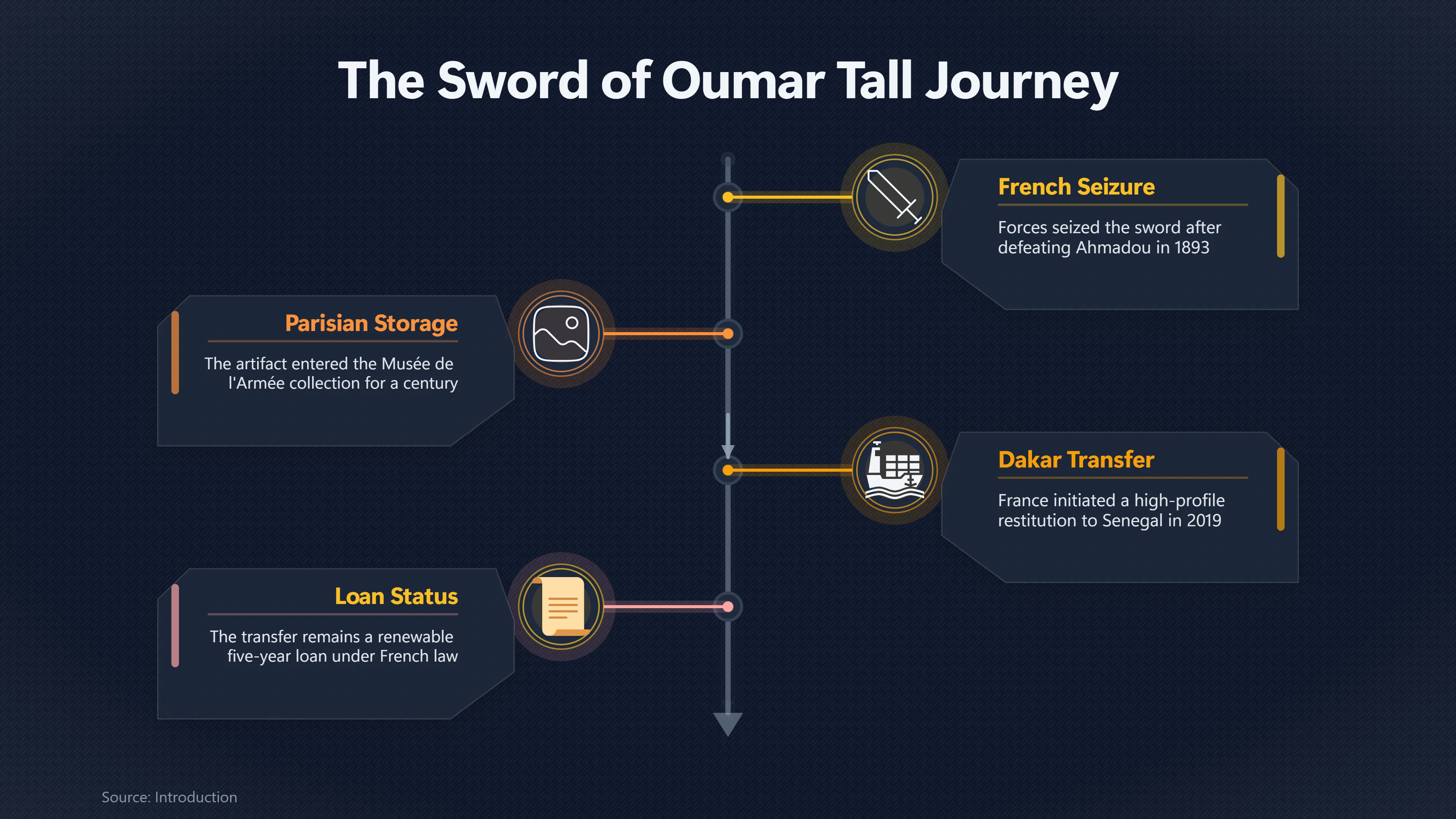
French forces seized the sword after defeating Tall’s son Ahmadou in 1893, and it eventually entered the collection of the Musée de l’Armée in Paris. For more than a century it remained in France before becoming one of the first high-profile African heritage objects transferred to Dakar during France’s recent restitution initiative.[artnet.com]news.artnet.comIt had been part of the collectionArtnet NewsFrance Returns to Senegal a 19th-Century Saber That It…November 18, 2019 — 18 Nov 2019 — The sword was seized from Tall's s…
The object’s display, however, immediately revealed why restitution is rarely straightforward.
Although widely described as a “return”, the transfer was initially structured as a renewable five-year loan because French law historically treated items in national museum collections as inalienable state property. In practical terms, visitors could see the sword in Dakar, but its legal ownership remained unresolved. This distinction transformed the artefact itself into evidence of an ongoing political negotiation rather than the conclusion of one.[theartnewspaper.com]theartnewspaper.comfrance returns a historic sword to senegalArt NewspaperFrance returns a historic sword to Senegal18 Nov 2019 — The sword, whose leather handle is trimmed with a base shaped like a…
The sword is also historically complex. While celebrated in Senegal as a powerful national symbol, Oumar Tall’s legacy extends across modern Senegal, Mali and Guinea, and historians interpret his campaigns differently depending on regional perspectives. As a result, the sword represents overlapping histories of anti-colonial resistance, empire-building, religion and memory rather than a single uncontested national narrative.[Artnet News]news.artnet.comIt had been part of the collectionArtnet NewsFrance Returns to Senegal a 19th-Century Saber That It…November 18, 2019 — 18 Nov 2019 — The sword was seized from Tall's s…
Why one object carries so much weight
The prominence given to Oumar Tall’s sword reflects more than its military history.
It has become a test case for wider restitution policy. If one symbolic object can be transferred, observers naturally ask what happens to thousands of other African artefacts acquired during the colonial period and now held in European museums. France alone holds tens of thousands of objects originating from sub-Saharan Africa, making any individual restitution part of a much larger discussion about legal reform, diplomatic cooperation and historical responsibility.[artnet.com]news.artnet.comIt had been part of the collectionArtnet NewsFrance Returns to Senegal a 19th-Century Saber That It…November 18, 2019 — 18 Nov 2019 — The sword was seized from Tall's s…
Museum leaders in Dakar have therefore used the sword not simply as a prized exhibit but as a conversation starter. Its display demonstrates that restitution is not only about recovering physical artefacts. It is equally about restoring historical agency, encouraging new research, reconnecting descendant communities with cultural heritage and allowing African institutions to shape the narratives presented to their own publics.[Africa Renewal]africarenewal.un.orgAfrica RenewalAfrica's landmark museum at the heart of global discussion…21 Aug 2025 — Only one major object has officially entered it…

Why contested relics matter within Senegal’s curiosity landscape
Senegal’s most intriguing museum experiences rarely depend on mysterious objects or sensational legends. Instead, they emerge from the uncertainty surrounding real historical artefacts.
For travellers interested in unusual collections, the Museum of Black Civilisations offers something distinctive: exhibits whose labels are inseparable from international law, colonial history and competing ideas of cultural ownership. The object in the display case is only part of the story. The debates over provenance, restitution and historical justice become part of the exhibition itself.
That makes contested relics one of Senegal’s most intellectually unusual museum experiences. Rather than asking visitors simply to admire remarkable artefacts, the museum encourages them to consider how museums acquire authority, whose histories they preserve and whether returning an object truly completes its journey—or merely begins a new chapter.[Cambridge University Press & Assessment]cambridge.orgCambridge University Press & AssessmentThe Museum of Black Civilizations (Chapter 7)Funded by the Republic of China, the Museum of Black…
Amazon book picks
Further Reading
Books and field guides related to Who Really Owns Senegal's Returned Relics?. Use these as the next step if you want deeper reading beyond the article.
The Brutish Museums
New York Times 'Best Art Books' 2020 'Essential' – Sunday Times 'Brilliantly enraged' - New York Review of Books 'A real game-changer'– E...
Loot: The Battle over the Stolen Treasures of the Ancient World
A journey across four continents to the heart of the conflict over who should own the great works of ancient art Why are the Elgin Marble...
The Museum of Other People
A TLS BEST BOOK OF 2023 'A formidable work' Nigel Barley, author of The Innocent Anthropologist 'Should be required reading' Richard Lamb...
Who Owns Antiquity? Museums and the Battle over Our Ancient H...
Whether antiquities should be returned to the countries where they were found is one of the most urgent and controversial issues in the a...
eBay marketplace picks
Marketplace Samples
Live-tested eBay searches with available results related to this page.
Selected fromAfrican heritage art oneBay.co.uk.

Endnotes
1.
Source: cambridge.org
Link:https://www.cambridge.org/core/books/decolonizing-heritage/museum-of-black-civilizations/4301081F1C72233CEB74610FF30B46BA
Source snippet
Cambridge University Press & AssessmentThe Museum of Black Civilizations (Chapter 7)Funded by the Republic of China, the Museum of Black...
2.
Source: news.artnet.com
Title: It had been part of the collection
Link:https://news.artnet.com/art-world-archives/france-restitutes-senegal-saber-1707042
Source snippet
Artnet NewsFrance Returns to Senegal a 19th-Century Saber That It...November 18, 2019 — 18 Nov 2019 — The sword was seized from Tall's s...
Published: November 18, 2019
3.
Source: research.cgu.edu
Link:https://research.cgu.edu/cultural-property-disputes-resource/cpdr/senegalese-omar-saidou-talls-sabre-sword/
Source snippet
CGU Research CentersSenegalese Omar Saidou Tall's Sabre SwordProvenance... Coordinated action by Complainant & Respondent Governments Co...
4.
Source: artreview.com
Title: news 19 nov 2019 france returns historic sword to senegal
Link:https://artreview.com/news-19-nov-2019-france-returns-historic-sword-to-senegal/
Source snippet
France returns historic sword to Senegal19 Nov 2019 — France has returned a sword to Senegal that once belonged to West African political...
5.
Source: africarenewal.un.org
Link:https://africarenewal.un.org/en/magazine/reclaiming-stolen-artefacts-africas-landmark-museum-heart-global-discussion-about
Source snippet
Africa RenewalAfrica's landmark museum at the heart of global discussion...21 Aug 2025 — Only one major object has officially entered it...
6.
Source: africasacountry.com
Link:https://africasacountry.com/2019/03/the-museum-of-black-civilizations
Source snippet
Africa Is a CountryThe Museum of Black CivilizationsFrance has lent the museum the sword of nineteenth century political and religious le...
7.
Source: theartnewspaper.com
Title: france returns a historic sword to senegal
Link:https://www.theartnewspaper.com/news/france-returns-a-historic-sword-to-senegal
Source snippet
Art NewspaperFrance returns a historic sword to Senegal18 Nov 2019 — The sword, whose leather handle is trimmed with a base shaped like a...
Additional References
8.
Source: facebook.com
Link:https://www.facebook.com/ameyawofficial/posts/france-has-returned-to-senegal-a-sword-which-belonged-to-a-19th-century-islamic-/10158167821938689/
Source snippet
ghter Omar Saidou Tall. The French Prime Minister Edouard...
9.
Source: facebook.com
Link:https://www.facebook.com/activatorhq/posts/this-week-france-returned-a-19th-century-sword-plundered-among-several-other-art/2539798179450003/
Source snippet
vered west African leader, Omar Saidou Tall of #Senegal...
10.
Source: elsieisy.com
Title: omar talls sword returns to senegal
Link:https://www.elsieisy.com/omar-talls-sword-returns-to-senegal/
Source snippet
Omar Tall's Sword Returns To Senegal21 Nov 2019 — The artefact originally belonged to the revered west African leader Omar Saidou Tall, w...
11.
Source: youtube.com
Title: Return African artefacts home? Europe put to the test
Link:https://www.youtube.com/watch?v=mUURxjNOLis
Source snippet
Museum of Black Civilisations Senegal restitution artifacts Museum of black civilisations opens in Senegalese capital FRANCE 24 English...
12.
Source: youtube.com
Title: French MPs approve return of looted artefacts to Benin, Senegal
Link:https://www.youtube.com/watch?v=GnknrOJ3Tu8
Source snippet
What’s the first piece of looted African art to return from France?...
13.
Source: youtube.com
Title: What’s the first piece of looted African art to return from France?
Link:https://www.youtube.com/watch?v=_nPl4LIpOWw
Source snippet
Museum of black civilisations opens in Senegalese capital...
14.
Source: afrolegends.com
Title: Senegalese hero
Link:https://afrolegends.com/tag/senegalese-hero/
Source snippet
African HeritageFrance had returned the sword of the Senegalese hero Omar Tall, the sword was already on loan at a Museum in Senegal. The...
15.
Source: youtube.com
Title: Senegal Opens Museum of Black Civilizations to Public
Link:https://www.youtube.com/watch?v=bDaBFAVDwks
Source snippet
French MPs approve return of looted artefacts to Benin, Senegal...
16.
Source: afrolegends.com
Title: Omar Tall
Link:https://afrolegends.com/tag/omar-tall/
Source snippet
African Heritage22 Nov 2019 — The curved iron, brass and wood sword has been kept in its leather sheath in the museum in Senegal's capita...
17.
Source: youtube.com
Title: Should stolen African art be returned?
Link:https://www.youtube.com/watch?v=AFl3D6YQJQk
Source snippet
Return African artefacts home? Europe put to the test...