What Makes Cambodia's Collections So Unusual?
Cambodia does not have a large circuit of novelty museums devoted to ghosts, monsters or eccentric collectors.
Page outline Jump by section
Introduction
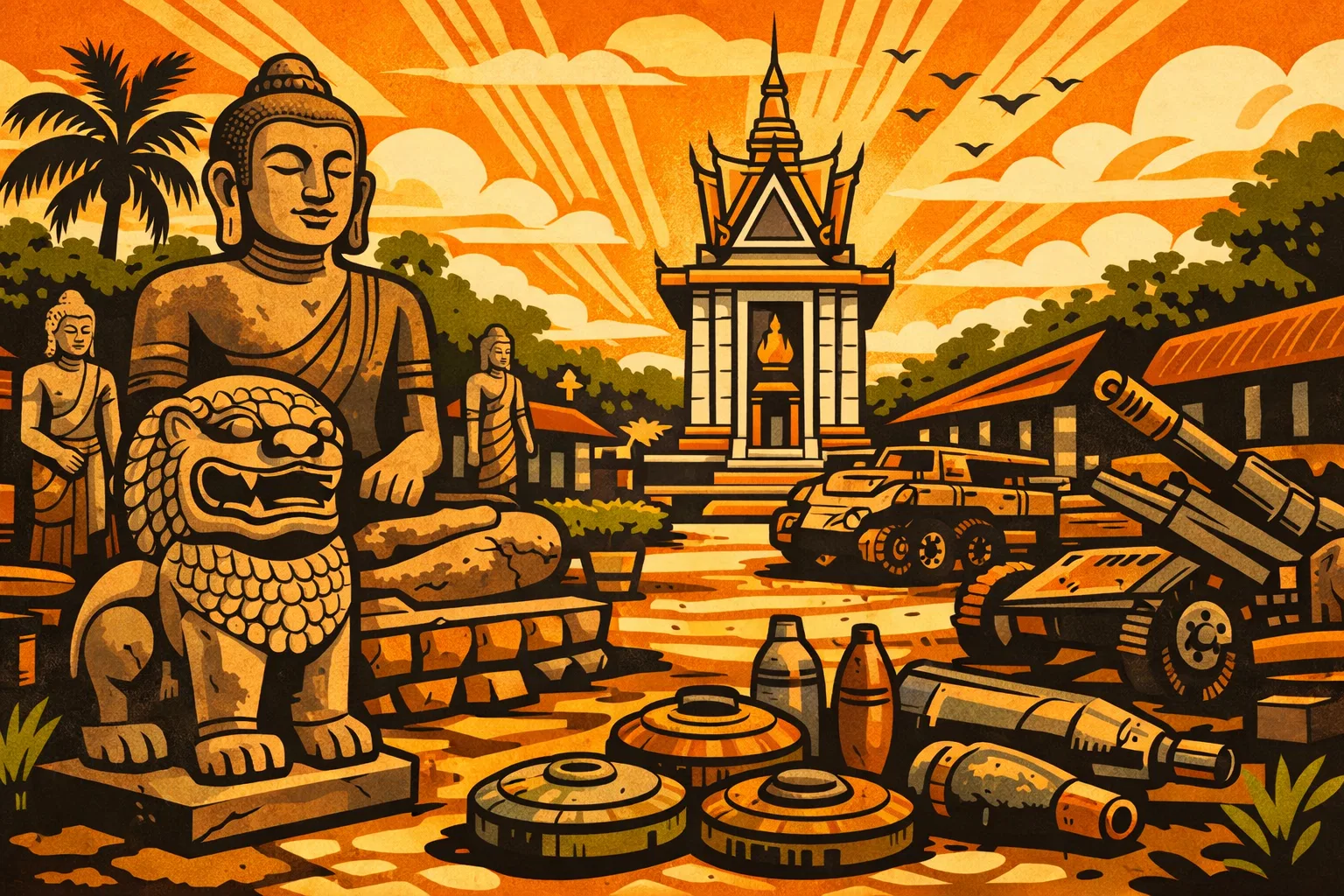
The strongest examples therefore sit between museum, memorial, shrine, archive and working humanitarian project. Tuol Sleng and Choeung Ek confront visitors with the physical evidence of mass violence. Siem Reap’s landmine attractions turn obsolete weapons—and even trained detection rats—into lessons about a danger that remains real. Archaeological museums preserve concealed groups of Buddha images, grave goods and cremation vessels, while the National Museum has become a focal point for the return of sculptures looted during war. Together, these places reveal a Cambodian curiosity culture shaped less by harmless eccentricity than by survival, belief, contested memory and the recovery of displaced objects.
Where the darkest collections are found
The most internationally significant strange-history sites in Cambodia are the Tuol Sleng Genocide Museum and the Choeung Ek Genocidal Center in and around Phnom Penh. They should not be treated as macabre entertainment. Both are places of mourning and evidence, created from locations used within the Khmer Rouge security system.
In July 2025, UNESCO added Tuol Sleng, Choeung Ek and the former M-13 prison site to the World Heritage List as the serial property “Cambodian Memorial Sites: From Centres of Repression to Places of Peace and Reflection”. UNESCO presents the three sites as connected evidence of imprisonment, interrogation, torture and execution between 1971 and 1979, as well as places intended to support remembrance and education.[UNESCO]unesco.orgCongratulates Cambodia on the Inscription of Its Memorial SitesUNESCO Congratulates Cambodia on the Inscription of Its Memorial Sites…
Tuol Sleng: a prison preserved as an archive
Tuol Sleng occupies a former Phnom Penh school converted by the Khmer Rouge into the S-21 security prison. Its disturbing power comes from the survival of both the buildings and the prison bureaucracy. Visitors encounter narrow cells built inside former classrooms, iron beds, shackles, photographs taken when the prison was discovered and rows of identification portraits produced by the institution itself. Paintings by survivor Vann Nath provide visual accounts of torture where direct photography does not exist.[Wikipedia]WikipediaTuol Sleng Genocide MuseumTuol Sleng Genocide Museum
The collection is unusually credible because it is not merely a later reconstruction. S-21 generated a vast documentary trail of portraits, confessions, biographies and administrative records. The Documentation Center of Cambodia provides access to a database containing 5,190 prisoner photographs and has catalogued hundreds of thousands of pages drawn from Tuol Sleng and other archives. UNESCO placed the Tuol Sleng archives on its Memory of the World Register in 2009, describing them as the largest surviving body of evidence concerning the Khmer Rouge prison system.[dccam.org]databases.dccam.orgPermission from the Government to disseminate the photos of S-21 (Toul Sleng Genocide Museum)…. [xyz-ips snippet="database-photo"]…
That evidential strength does not make every aspect of the museum neutral. Tuol Sleng opened soon after the Khmer Rouge were removed from Phnom Penh, under a new government that used the crimes of the former regime to support its own political legitimacy. Cambodia’s official remembrance culture has continued to be shaped by arguments over responsibility, reconciliation and the histories of former Khmer Rouge members who later entered government. The museum is therefore simultaneously a crime scene, archive, national memorial, educational institution and product of post-1979 politics.[TIME]time.comOpen source on time.com.
One notorious early display illustrates how curatorial standards have changed. Hundreds of skulls were once arranged as a map of Cambodia at Tuol Sleng. The display was dismantled in 2002 after deterioration and growing concern about the treatment of victims’ remains. Its removal marked a movement away from shock-based presentation towards documentary evidence, individual identification and commemoration.[WIRED]wired.comSkull Map DismantledSkull Map Dismantled
Choeung Ek: memorial, burial ground and human-remains display
Choeung Ek, outside central Phnom Penh, was an execution and burial site used for many prisoners transported from S-21. Excavations uncovered thousands of skeletons, while numerous graves were deliberately left undisturbed. A Buddhist memorial stupa built in the 1980s contains preserved skulls and other remains arranged on visible tiers. Visitors also walk among former grave depressions and interpretation points across the grounds.[ICTJ]ictj.orgMicrosoft WordMicrosoft Word
The stupa is one of Cambodia’s most confronting public collections because its contents are at once human evidence, sacred remains and a visitor attraction. For some observers, retaining the bones makes denial more difficult and gives the victims a continuing public presence. Others question whether displaying skulls risks turning people into anonymous specimens or conflicts with Buddhist preferences for cremation and ritual release. Proposals for further excavation have likewise produced disagreement between those seeking forensic evidence and those who believe the dead should not be disturbed.[genocidewatch.com]genocidewatch.comThe ethics of exhumationThe ethics of exhumation
Choeung Ek has also existed within commercial tourism. Research by the International Center for Transitional Justice found that it had become a standard stop on Phnom Penh itineraries while being managed through an arrangement involving a private company and municipal oversight. The same research stressed that visitors often arrived with little prior knowledge and depended heavily on the site’s interpretation. That tension—between sacred ground, commercial access and public education—is central to understanding the place.[ICTJ]ictj.orgMicrosoft WordMicrosoft Word
Landmines, tanks and living detection displays
Cambodia’s unusual military collections differ from conventional army museums because the objects are remnants of conflicts whose physical consequences have not entirely disappeared. Mines, shells and armoured vehicles are presented not as polished symbols of national triumph but as damaged, dangerous or obsolete things left behind by decades of war.
The Cambodia Landmine Museum near Siem Reap grew from the activities of former child soldier and deminer Aki Ra. He initially displayed defused mines that he had collected while clearing contaminated land, eventually establishing a formal museum in the late 1990s and moving it to a larger site in 2007. Its displays include deactivated mines, unexploded-ordnance casings, weapons and explanatory material about clearance work and civilian injuries.[theguardian.com]theguardian.comThe Guardian'Whistles, warnings, kaboom!': a day with a landmine clearance teamThe Guardian'Whistles, warnings, kaboom!': a day with a landmine clearance team
This is a private, cause-led museum rather than an academic weapons collection. The appeal lies partly in the dense accumulation of devices that were designed to remain hidden: small anti-personnel mines, larger anti-vehicle weapons and improvised munitions whose ordinary appearance can disguise their purpose. The collection makes an invisible landscape hazard visible, but visitors should remember that safely displayed examples are not representative of items encountered outside controlled sites.
The War Museum Cambodia in Siem Reap offers a rougher open-air experience. Tanks, artillery pieces, aircraft remains, rocket launchers and small arms are distributed around a large site rather than presented in highly controlled galleries. The museum was established on land reportedly once affected by mines, and its collection mixes equipment of Soviet, Chinese and American origin used by different forces during Cambodia’s modern wars.[Tourism Cambodia]tourismcambodia.orgTourism Cambodia Ministry of Tourism, CambodiaTourism Cambodia Ministry of Tourism, Cambodia
Its weathered machinery can feel closer to a battlefield scrapyard than a conventional national military museum. That informality is part of its interest, particularly when guides have personal experience of conflict, but interpretation and conservation may be less systematic than in a major state institution. It is best approached as a collection of surviving war material and testimony rather than a comprehensive account of Cambodian military history.
A more unexpected visitor attraction is the APOPO Visitor Center in Siem Reap. APOPO trains African giant pouched rats to detect the scent associated with explosives. Guided visits explain mine clearance and include demonstrations by trained animals; visitors may also be able to see or handle a rat under supervision.[apopo.org]booking.apopo.orgOpen source on apopo.org.
The centre is not a museum in the traditional sense, yet it belongs naturally within Cambodia’s unusual visitor landscape. Its central “exhibits” are living animals performing specialised humanitarian work. The experience also corrects an easy misconception: the rats do not detonate mines because they are too light to trigger most pressure mechanisms. What might initially look like a tourist novelty is therefore a public demonstration of a functioning detection method.
Buried Buddhas, graves and cremation vessels
Some of Cambodia’s most curious archaeological displays come not from isolated masterpieces but from groups of objects intentionally buried together. The Preah Norodom Sihanouk-Angkor Museum in Siem Reap is especially valuable because its exhibitions remain closely connected to excavated sites rather than presenting a broad, decontextualised survey of Khmer art.
Its best-known collection began with the discovery of 274 Buddha-image fragments and statues in a single cache at Banteay Kdei in 2000 and 2001. The group includes works of different styles and periods, allowing the museum to explain changes in Buddhist imagery around Angkor. A large stele carved with many small Buddha figures adds to the impression of a deliberately concentrated sacred deposit.[APSARA National Authority]apsaraauthority.gov.khAPSARA National Authority Preah Norodom Sihanouk-Angkor MuseumAPSARA National Authority Preah Norodom Sihanouk-Angkor Museum
Why the images were buried is not settled simply by looking at them. Concealment may have protected sacred objects during a period of religious or political change, or it may have been a respectful way of removing damaged images from active worship. The museum’s archaeological framing is important because it discourages exaggerated stories about treasure chambers or curses where the evidence supports more cautious explanations.
Other galleries preserve material from a roughly 3,000-year-old burial ground near the Western Baray, including ceramics, jewellery, utensils and animal remains deposited with the dead. A further collection contains pottery used to hold cremated remains between approximately the fifteenth and seventeenth centuries, including locally made vessels and imported wares from elsewhere in Asia.[APSARA National Authority]apsaraauthority.gov.khAPSARA National Authority Preah Norodom Sihanouk-Angkor MuseumAPSARA National Authority Preah Norodom Sihanouk-Angkor Museum
These displays offer a different kind of encounter with death from the genocide memorials. The objects are archaeological evidence of funerary practice rather than identifiable victims of modern crime. Even so, the presence of grave goods, cremation containers and material once placed beside bodies raises familiar museum questions about excavation, respectful display and the difference between scientific evidence and sacred property.
Battambang has an even more eccentric archaeological story. At Wat Po Veal, hundreds of stone carvings, architectural fragments and religious objects were assembled in and around a temple building, creating what journalists described as a “secret museum”. Much of the collection remained poorly displayed or inaccessible, with heavy objects surviving partly because they were difficult for either conservators or looters to move. The result was less a finished museum than a remarkable store of rescued material caught between monastery, depot and neglected provincial collection.[Tourism Cambodia]tourismcambodia.comTourism Cambodia INSIDE THE SECRET MUSEUM | News from Tourism CambodiaTourism Cambodia INSIDE THE SECRET MUSEUM | News from Tourism Cambodia
Because information about access and refurbishment has varied over time, Wat Po Veal should not be treated as a guaranteed visitor attraction without checking locally. Its importance lies in showing how Cambodian collections were sometimes formed through emergency gathering and improvised protection rather than planned institutional collecting.
Sacred remains and devotional collections
Cambodia’s religious objects are not always displayed as detached historical artefacts. At shrines and monasteries, relics, royal ashes, statues and ritual vessels may remain active participants in worship. Visitors interested in unusual collections need to distinguish between a museum display and a devotional space where an object’s religious function continues.
Oudong, Cambodia’s former royal capital, is a clear example. The hill contains numerous stupas associated with Cambodian kings and members of the royal family. A prominent modern stupa was constructed to house relics believed to be connected with the Buddha. UNESCO’s description of the site stresses the continuing placement of royal remains in ancestral stupas and the importance of the mountain to both local believers and the royal family.[UNESCO World Heritage Centre]whc.unesco.orgOpen source on unesco.org.
The relics themselves have a dramatic modern history. A golden urn containing the reputed Buddha relics was stolen in 2013, later recovered and ceremonially returned to the mountain shrine in 2016. The episode demonstrates why sacred collections cannot be understood only through questions of age or authenticity: their power also comes from communal recognition, ritual custody and the belief that the relic is a living focus of merit and protection.[Global Times]globaltimes.cnOpen source on globaltimes.cn.
Older travel accounts also describe the preserved body of a senior monk displayed in a glass case at Oudong as an object of pilgrimage. Documentation is limited and current access should not be assumed, so it is better regarded as a historically reported devotional display than as a reliably operating “mummy museum”.[Andy Brouwer]andybrouwer.co.ukAndy Brouwer Andy's Cambodia: www.andybrouwer.co.uk: Mummified monkAndy Brouwer Andy's Cambodia: www.andybrouwer.co.uk: Mummified monk
Cambodian religious culture also retains strong traditions concerning guardian spirits associated with places and objects. These beliefs are not generally collected into a dedicated ghost or witchcraft museum. Instead, they remain visible through village shrines, offerings, processions and performances. Recent reporting from a village near Phnom Penh documented an annual ceremony honouring guardian spirits, combining Buddhist surroundings with the belief that spirits can inhabit living beings, landscapes and material objects.[AP News]apnews.comParticipants of all ages travel about two kilometers from a local monastery to a shrine, bringing offerings such as fruit, food, and beve…
For the strange-museum traveller, this absence is significant. Cambodia’s spirit world is more likely to be encountered in an active shrine or community ceremony than behind a labelled museum case. Treating such practices as local “spookiness” misses their roles in agriculture, health, protection and communal identity.
Looted gods and disputed collections
The National Museum of Cambodia is not an oddity museum, but it now holds one of the country’s most compelling collections of contested objects: sculptures removed from temples during colonial rule, civil war and organised looting, then recovered from dealers, private owners and major foreign museums.
Its main holdings include stone, bronze, wood and ceramic art from Cambodia’s Hindu and Buddhist traditions. Many sculptures represent deities, guardians or royal figures rather than decorative objects. Within Cambodian official discourse, their return has often been described in spiritual as well as legal terms—as the homecoming of ancestors or divine beings severed from their landscapes.[cambodiamuseum.info]cambodiamuseum.infoOpen source on cambodiamuseum.info.
The central figure in many disputed provenances was British dealer and collector Douglas Latchford, who was indicted in the United States in 2019 over allegations involving stolen Cambodian antiquities. Investigations connected objects passing through his network with private collections and institutions around the world. Museums have since returned major works after evidence indicated that they had been illegally removed or supplied with misleading ownership histories.[ICIJ]icij.orgHow we tracked Cambodian antiquities to leadingHow we tracked Cambodian antiquities to leading
Cambodia received another 74 objects from the United Kingdom in February 2026 under an agreement with Latchford’s family. They included sandstone sculpture, bronzes and ritual material ranging from the pre-Angkorian period to the height of the Khmer Empire. The objects were unveiled at the National Museum, adding to earlier returns and increasing pressure on the institution’s available exhibition and storage space.[AP News]apnews.comOpen source on apnews.com.
These restitutions have changed what visitors can learn from the museum. A sculpture may now carry two intertwined stories: the ancient religious narrative represented by the figure and the modern crime story of excavation, smuggling, false provenance and eventual return. In that sense, the National Museum has become part archaeological museum, part recovered-property repository and part evidence room for the international antiquities trade.
The returns also complicate romantic ideas about mysterious “lost treasures”. Many objects were not mysteriously lost at all. They were removed from documented temple sites during periods when war, poverty and weak law enforcement made systematic looting possible. The real mystery often lies in how prestigious collectors and museums accepted incomplete or implausible ownership histories for so long.
How to approach Cambodia’s unusual collections
Cambodia’s curiosity sites demand more care than conventional offbeat attractions. Human remains should be treated as people rather than props, and genocide sites should not become backgrounds for playful photographs. At working temples, clothing, photography and movement may be governed by religious expectations rather than museum rules.
It is also useful to recognise the different kinds of authority involved:
- Forensic and archival sites, especially Tuol Sleng, are strongest where original documents, photographs, buildings and court-tested evidence support the interpretation.
- Memorial displays, such as the Choeung Ek stupa, combine evidence with ritual, national politics and changing ideas about the ethical treatment of human remains.
- Private military museums may contain genuine objects and valuable testimony while offering less systematic cataloguing or conservation.
- Humanitarian visitor centres, such as APOPO, explain active fieldwork rather than preserving a closed historical collection.
- Archaeological museums are most reliable when objects retain excavation records and clear links to their original sites.
- Religious shrines present relics through faith and ritual authority; scientific authentication may not be the point of the display.
- Returned-antiquities exhibitions require attention to provenance, because the modern movement of an object can be as revealing as its ancient iconography.
Cambodia’s strange-collection landscape is therefore not defined by a single cabinet of monsters or paranormal museum. Its distinctive objects are prisoner portraits, preserved bones, hidden explosives, trained animals, buried sacred images, relic containers and gods recovered from the international art market. What unites them is the question of custody: who kept the object, who lost it, who has the right to display it and what obligations come with making it public.
Amazon book picks
Further Reading
Books and field guides related to What Makes Cambodia's Collections So Unusual?. Use these as the next step if you want deeper reading beyond the article.
A History of Cambodia
In this clear and concise volume, author David Chandler provides a timely overview of Cambodia, a small but increasingly visible Southeas...
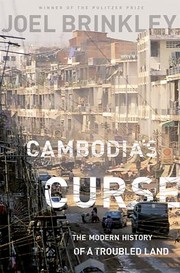
Cambodia's Curse: The Modern History of a Troubled Land
First published 2011. Subjects: Cambodia, history, Cambodia, politics and government, Democracy, Social change, New York Times reviewed.
eBay marketplace picks
Marketplace Samples
Live-tested eBay searches with available results related to this page.
Selected fromAsian wall art oneBay.co.uk.

Endnotes
1.
Source: unesco.org
Title: Congratulates Cambodia on the Inscription of Its Memorial Sites
Link:https://www.unesco.org/en/articles/unesco-congratulates-cambodia-inscription-its-memorial-sites-world-heritage-list
Source snippet
UNESCO Congratulates Cambodia on the Inscription of Its Memorial Sites...
2.
Source: Wikipedia
Title: Tuol Sleng Genocide Museum
Link:https://en.wikipedia.org/wiki/Tuol_Sleng_Genocide_Museum
3.
Source: databases.dccam.org
Link:https://databases.dccam.org/photo
Source snippet
Permission from the Government to disseminate the photos of S-21 (Toul Sleng Genocide Museum).... [xyz-ips snippet="database-photo"]...
4.
Source: databases.dccam.org
Link:https://databases.dccam.org/
Source snippet
Together, we collected, catalogued and entered 2,963 bibliographical records, 10,690 biographical records, 5,190 photographs from the for...
5.
Source: unesco.org
Link:https://www.unesco.org/en/articles/unesco-celebrates-14th-anniversary-inscription-tuol-sleng-genocide-museum-archives-memory-world
Source snippet
UNESCO celebrates the 14th anniversary of the inscription...31 Jul 2023 — Today, 31 July, UNESCO commemorates the 14th anniversary...
6.
Source: unesco.org
Link:https://www.unesco.org/en/memory-world/tuol-sleng-genocide-museum-archives
7.
Source: time.com
Link:https://time.com/5591061/cambodia-remembrance-day-history/
8.
Source: wired.com
Title: Skull Map Dismantled
Link:https://www.wired.com/2002/03/skull-map-dismantled
9.
Source: ictj.org
Title: Microsoft Word
Link:https://www.ictj.org/sites/default/files/ICTJ-Cambodia-Legacy-Genocide-2009-English.pdf
10.
Source: dccam.org
Link:https://www.dccam.org/homepage/justice/archives-physical-evidences/
11.
Source: genocidewatch.com
Title: The ethics of exhumation
Link:https://www.genocidewatch.com/single-post/2017/01/06/the-ethics-of-exhumation
12.
Source: booking.apopo.org
Link:https://booking.apopo.org/
13.
Source: apopo.org
Link:https://apopo.org/support-us/apopo-visitor-center
14.
Source: apopo.org
Link:https://apopo.org/rats-vs-landmines-a-stop-at-the-apopo-visitor-center-in-cambodia/
15.
Source: whc.unesco.org
Link:https://whc.unesco.org/en/tentativelists/6459/
16.
Source: icij.org
Link:https://www.icij.org/investigations/hidden-treasures/cambodia-celebrates-return-of-dozens-of-khmer-treasures-from-the-met-and-other-collections/
17.
Source: icij.org
Title: How we tracked Cambodian antiquities to leading
Link:https://www.icij.org/investigations/pandora-papers/how-we-tracked-ancient-cambodian-antiquities-leading-museums/
18.
Source: apopo.org
Title: Magawa Statue Cambodia
Link:https://apopo.org/magawa-statue-cambodia-apopo-landmine-clearance/
19.
Source: whc.unesco.org
Link:https://whc.unesco.org/en/list/1748/
21.
Source: apopo.org
Title: angkor wat tickets
Link:https://apopo.org/angkor-wat-tickets/
22.
Source: apopo.org
Link:https://apopo.org/herorats/exhibit/
23.
Source: unesco.org
Title: From Remembrance to Resilience: Choeung Ek Genocidal Center
Link:https://www.unesco.org/en/articles/remembrance-resilience-choeung-ek-genocidal-center-strengthens-its-role-cambodias-heritage-future
24.
Source: apopo.org
Title: U.S. State Department Delegation Visits APOPO In Cambodia
Link:https://apopo.org/state-department-visit-cambodia/
25.
Source: apopo.org
Title: 20 new landmine rats to cambodia
Link:https://apopo.org/20-new-landmine-rats-to-cambodia/
26.
Source: whc.unesco.org
Link:https://whc.unesco.org/en/documents/220591
27.
Source: apopo.org
Title: earns top rating from charity navigator
Link:https://apopo.org/latest/apopo-earns-top-rating-from-charity-navigator/
29.
Source: apopo.org
Title: our history
Link:https://apopo.org/who-we-are/our-history/
30.
Source: d.dccam.org
Title: Exhibition TSL
Link:https://d.dccam.org/Archives/Photographs/Exhibition_TSL.htm
31.
Source: d.dccam.org
Link:https://d.dccam.org/Archives/Photographs/Former_Khmer_Rouge/kin.htm
32.
Source: whc.unesco.org
Link:https://whc.unesco.org/en/decisions/8948/
33.
Source: unesco.org
Title: document 3484
Link:https://www.unesco.org/archives/multimedia/document-3484
34.
Source: unesco.org
Title: promoting archives preservation and digitization tuol sleng genocide museum
Link:https://www.unesco.org/en/articles/promoting-archives-preservation-and-digitization-tuol-sleng-genocide-museum
35.
Source: Wikipedia
Link:https://en.wikipedia.org/wiki/Cambodia
36.
Source: Wikipedia
Title: Choeung Ek
Link:https://en.wikipedia.org/wiki/Choeung_Ek
37.
Source: Wikipedia
Title: Buddhist mummy
Link:https://en.wikipedia.org/wiki/Buddhist_mummy
38.
Source: Wikipedia
Title: Silver Pagoda
Link:https://en.wikipedia.org/wiki/Silver_Pagoda
39.
Source: siem-reap.de
Title: Landmine Museum Siem Reap (EN)
Link:https://www.siem-reap.de/en/landmine-museum-siem-reap-en/
40.
Source: d.dccam.org
Link:https://d.dccam.org/Archives/Photographs/Photographs.htm
41.
Source: d.dccam.org
Link:https://d.dccam.org/Database/Photographic/Cts.php
42.
Source: d.dccam.org
Link:https://d.dccam.org/Archives/Photographs/Former_Khmer_Rouge/Yean.htm
43.
Source: d.dccam.org
Link:https://d.dccam.org/Archives/Photographs/Former_Khmer_Rouge/Ming.htm
44.
Source: d.dccam.org
Link:https://d.dccam.org/Archives/Photographs/Former_Khmer_Rouge/nim.htm
45.
Source: d.dccam.org
Link:https://d.dccam.org/Database/Archives.htm
46.
Source: d.dccam.org
Link:https://d.dccam.org/Archives/Photographs/Former_Khmer_Rouge/Huy.htm
47.
Source: dccam.org
Link:https://www.dccam.org/homepage/development/the-queen-mother-library/
48.
Source: booking.apopo.org
Link:https://booking.apopo.org/contactus
49.
Source: history.com
Title: ct scan reveals mummified monk inside ancient buddha statue
Link:https://www.history.com/articles/ct-scan-reveals-mummified-monk-inside-ancient-buddha-statue
50.
Source: manchesterhive.com
Title: article p61
Link:https://www.manchesterhive.com/view/journals/hrv/6/2/article-p61.pdf
51.
Source: theguardian.com
Title: The Guardian’Whistles, warnings, kaboom!’: a day with a landmine clearance team
Link:https://www.theguardian.com/global-development/2019/oct/22/whistles-warnings-kaboom-a-day-with-a-landmine-clearance-team-cambodia
52.
Source: tourismcambodia.org
Title: Tourism Cambodia Ministry of Tourism, Cambodia
Link:https://www.tourismcambodia.org/public/provinces/search/detail/451/landmine-museum-1551325774
53.
Source: tourismcambodia.com
Link:https://www.tourismcambodia.com/travelguides/provinces/siem-reap/what-to-see/432_cambodia-landmine-museum.htm
54.
Source: tourismcambodia.org
Title: Tourism Cambodia Ministry of Tourism, Cambodia
Link:https://tourismcambodia.org/public/attractions/war-museum-1551325396
55.
Source: tourismcambodia.org
Title: Tourism Cambodia Ministry of Tourism, Cambodia
Link:https://tourismcambodia.org/public/provinces/search/detail/449/war-museum-1551325396
56.
Source: tourismcambodia.com
Link:https://www.tourismcambodia.com/travelguides/provinces/siem-reap/what-to-see/79_civil-war-museum.htm
57.
Source: apsaraauthority.gov.kh
Title: APSARA National Authority Preah Norodom Sihanouk-Angkor Museum
Link:https://apsaraauthority.gov.kh/2021/06/15/preah-norodom-sihanouk-angkor-museum/
58.
Source: tourismcambodia.org
Title: Tourism Cambodia Ministry of Tourism, Cambodia
Link:https://tourismcambodia.org/public/official-activities/exhibition-of-semi-precious-stones-opens
59.
Source: tourismcambodia.com
Title: Tourism Cambodia INSIDE THE SECRET MUSEUM | News from Tourism Cambodia
Link:https://www.tourismcambodia.com/news/localnews/19773/inside-the-secret-museum.htm
60.
Source: globaltimes.cn
Link:https://www.globaltimes.cn/content/984280.shtml
61.
Source: andybrouwer.co.uk
Title: Andy Brouwer Andy’s Cambodia: www.andybrouwer.co.uk: Mummified monk
Link:https://www.andybrouwer.co.uk/blog/2009/02/mummified-monk.html
62.
Source: apnews.com
Link:https://apnews.com/article/7a9f98caff63e9aa497ab208c385bc3f
Source snippet
Participants of all ages travel about two kilometers from a local monastery to a shrine, bringing offerings such as fruit, food, and beve...
63.
Source: apnews.com
Link:https://apnews.com/article/da541006dced4cc05dc39a05453dfc92
64.
Source: cambodiamuseum.info
Link:https://www.cambodiamuseum.info/en_collection.html
65.
Source: voanews.com
Link:https://www.voanews.com/a/souls-of-ancestors-display-stirs-new-interest-in-cambodian-antiquity/7793071.html
66.
Source: theguardian.com
Link:https://www.theguardian.com/culture/2023/aug/03/national-gallery-of-australia-hands-back-ninth-century-cambodian-sculptures-it-believes-were-stolen
67.
Source: apnews.com
Link:https://apnews.com/article/64e8bc00afd7e14340c566980190ba4f
68.
Source: apsaraauthority.gov.kh
Link:https://apsaraauthority.gov.kh/museums/
69.
Source: helloangkor.com
Title: Choeung Ek Genocidal Center | Hello Angkor
Link:https://helloangkor.com/attractions/choeung-ek-genocidal-center/
70.
Source: tourismcambodia.com
Title: Preah Norodom Sihanouk Angkor Museum
Link:https://www.tourismcambodia.com/activities/arts-and-crafts-center/preah-norodom-sihanouk-angkor-museum.htm
71.
Source: cambodiantr.gov.kh
Link:https://cambodiantr.gov.kh/en/document/?title=sub-decree-no-023-on-the-production-import-export-and-trade-of-traditional-medicines-for-the-health-sector
72.
Source: awm.gov.au
Link:https://www.awm.gov.au/collection/C267311
73.
Source: GOV.UK
Link:https://www.gov.uk/foreign-travel-advice/cambodia
74.
Source: facebook.com
Link:https://www.facebook.com/unescophnompenh/posts/%EF%B8%8F-%EF%B8%8Fcommemorating-one-year-of-world-heritage-recognitiontoday-the-tuol-sleng-geno/1619107046923754/
76.
Source: tourismcambodia.org
Title: Ministry of Tourism, Cambodia
Link:https://tourismcambodia.org/public/provinces/search/detail/170/choeung-ek-memorial-the-killing-fields-1549623455
77.
Source: tourismcambodia.org
Title: Ministry of Tourism, Cambodia
Link:https://www.tourismcambodia.org/public/provinces/search/detail/162/national-museum-1549618510
78.
Source: tourismcambodia.org
Title: Ministry of Tourism, Cambodia
Link:https://tourismcambodia.org/public/provinces/search/detail/390/angkor-national-museum-1550810877
79.
Source: theguardian.com
Link:https://www.theguardian.com/world/cambodia
80.
Source: google.com
Title: Choeung Ek Genocidal Center
Link:https://www.google.com/maps/search/Killing%2BFields%2Bof%2BChoeung%2BEk%2C%2BPhnom%2BPenh%2C%2BCambodia
81.
Source: tourismcambodia.com
Link:https://www.tourismcambodia.com/
82.
Source: tourismcambodia.com
Title: National Museum
Link:https://www.tourismcambodia.com/attractions/phnompenh/national-museum.htm
83.
Source: tourismcambodia.com
Link:https://www.tourismcambodia.com/travelguides/provinces/phnom-penh/what-to-see/5_cheung-ek-killing-field.htm
84.
Source: tourismcambodia.com
Title: Silver Pagoda, Attraction in Phnom Penh | Tourism Cambodia SILVER PAGODA
Link:https://www.tourismcambodia.com/travelguides/provinces/phnom-penh/what-to-see/370_silver-pagoda.htm
85.
Source: tourismcambodia.com
Title: Ounalom Pagoda, Attraction in Phnom Penh | Tourism Cambodia OUNALOM PAGODA
Link:https://www.tourismcambodia.com/travelguides/provinces/phnom-penh/what-to-see/19_unalom-pagoda.htm
86.
Source: mcfa.gov.kh
Link:https://mcfa.gov.kh/
87.
Source: youtube.com
Title: Tuol Sleng Genocide Museum
Link:https://www.youtube.com/watch?v=MR0aovUksp8
88.
Source: blog.andybrouwer.co.uk
Title: andybrouwer.co.uk Mummified monk
Link:https://blog.andybrouwer.co.uk/2009/02/mummified-monk.html
89.
Source: collection.qagoma.qld.gov.au
Title: qagoma.qld.gov.au House
Link:https://collection.qagoma.qld.gov.au/objects/31976
90.
Source: tuolsleng.gov.kh
Link:https://tuolsleng.gov.kh/en/collections/1000/
91.
Source: tuolsleng.gov.kh
Link:https://tuolsleng.gov.kh/en/
92.
Source: tuolsleng.gov.kh
Link:https://tuolsleng.gov.kh/en/contact/
93.
Source: tuolsleng.gov.kh
Link:https://tuolsleng.gov.kh/en/exhibition/
94.
Source: tuolsleng.gov.kh
Link:https://tuolsleng.gov.kh/en/museum/1000/
95.
Source: tuolsleng.gov.kh
Link:https://tuolsleng.gov.kh/en/collections/archive-research/reading-room/
96.
Source: tuolsleng.gov.kh
Link:https://tuolsleng.gov.kh/en/museum/special-places/
97.
Source: tuolsleng.gov.kh
Link:https://tuolsleng.gov.kh/en/exhibition/mobile/
98.
Source: tuolsleng.gov.kh
Link:https://tuolsleng.gov.kh/en/museum/mission-statement/
99.
Source: tuolsleng.gov.kh
Link:https://tuolsleng.gov.kh/en/collections/conservation-lab/documents/
100.
Source: tuolsleng.gov.kh
Link:https://tuolsleng.gov.kh/en/museum/building/
101.
Source: tuolsleng.gov.kh
Link:https://tuolsleng.gov.kh/en/museum/special-places/memorial/
102.
Source: cambodiamuseum.info
Link:https://cambodiamuseum.info/en_information_visitors.html
103.
Source: cambodiamuseum.info
Link:https://www.cambodiamuseum.info/en_projects_activities/cip.html
104.
Source: cambodiamuseum.info
Link:https://www.cambodiamuseum.info/en_projects_activities.html
105.
Source: boreiangkor.com
Title: War Museum
Link:https://www.boreiangkor.com/attraction/war-museum/
106.
Source: nmc.gov.kh
Link:https://www.nmc.gov.kh/index.php/pages/tour
107.
Source: nmc.gov.kh
Link:https://nmc.gov.kh/index.php/about-us
108.
Source: sosoro.nbc.gov.kh
Title: nbc.gov.kh Sosoro Museum
Link:https://sosoro.nbc.gov.kh/
109.
Source: thehistoryblog.com
Link:https://www.thehistoryblog.com/archives/48136
110.
Source: topmekongcruises.com
Link:https://topmekongcruises.com/oudong-cambodia
111.
Source: cmac.gov.kh
Link:https://cmac.gov.kh/what-we-do/techo-peace-museum/
112.
Source: cmac.gov.kh
Link:https://cmac.gov.kh/what-we-do/
113.
Source: atthemuseum.org
Title: Choeung Ek Genocidal Center
Link:https://atthemuseum.org/museums/choeung-ek-genocidal-center
Additional References
114.
Source: reuters.com
Link:https://www.reuters.com/world/asia-pacific/cambodia-marks-unesco-recognition-khmer-rouge-sites-places-peace-reflection-2025-07-13/
Source snippet
The recognized sites—Tuol Sleng prison, Choeung Ek killing fields in Phnom Penh, and M-13 prison in Kampong Chhnang province—have been ac...
115.
Source: ushmm.org
Link:https://www.ushmm.org/en/genocide-prevention/countries/cambodia/s-21
Source snippet
United States Holocaust Memorial MuseumS-21, Tuol SlengThe most notorious of the 189 known interrogation centers in Cambodia was S-21, ho...
116.
Source: youtube.com
Link:https://www.youtube.com/watch?v=sytWYURhLKY
Source snippet
1 Hour! Exploring the Fascinating National Museum of Cambodia...
117.
Source: youtube.com
Title: Inside Pol Pot’s HORRIBLE Prison — Camp S-21 In Cambodia
Link:https://www.youtube.com/watch?v=wUWaUW8vAEo
Source snippet
Choeung Ek Killing Fields outside of Phnom Penh, Cambodia (ជើងឯក) Khmer Rouge Genocidal Attrocities...
118.
Source: youtube.com
Title: Inside Cambodia’s Landmine Museum Siem Reap Travel Guide
Link:https://www.youtube.com/watch?v=blpefZEdej4
Source snippet
The shocking Truth about Cambodias Dangerous Borders...
119.
Source: youtube.com
Title: The shocking Truth about Cambodias Dangerous Borders
Link:https://www.youtube.com/watch?v=boCtYPMh1SE
Source snippet
Inside Pol Pot's HORRIBLE Prison — Camp S-21 In Cambodia...
120.
Source: pettitts.co.uk
Link:https://www.pettitts.co.uk/guides/things-to-do-cambodia
121.
Source: viator.com
Link:https://www.viator.com/en-HK/blog/Weird-and-Wonderful-Museums-Around-the-World/l98622
122.
Source: tropicalsky.co.uk
Link:https://www.tropicalsky.co.uk/far-east-holidays/cambodia/a-first-timer-s-guide-to-holidaying-in-cambodia
123.
Source: instagram.com
Link:https://www.instagram.com/p/DRvKccNDrkU/