Within Curious Lesotho
When the Landscape Becomes Lesotho's Museum
Across Lesotho, exposed footprints and painted shelters turn the landscape itself into a fragile open-air collection.
On this page
- Where dinosaur tracks remain in the landscape
- Rock shelters as galleries and sacred places
- Access, interpretation and preservation risks
Page outline Jump by section
Introduction
Lesotho has relatively few conventional museums devoted to unusual history, yet some of its most remarkable “collections” have never been moved indoors. Dinosaur footprints remain embedded in sandstone where prehistoric animals crossed ancient floodplains, while rock shelters preserve paintings created by San hunter-gatherers over thousands of years. Rather than displaying objects in glass cases, these sites invite visitors to experience fossils and art in the landscapes that produced them. The result is an open-air museum spread across mountains, valleys and cliffs, where geology, archaeology and living heritage meet.

This approach makes Lesotho unusual within the country’s curiosity landscape. The experience is less about viewing isolated artefacts than about understanding entire environments as collections. That authenticity also creates challenges: footprints erode, paintings fade, and fragile sites can be damaged by careless visitors or natural weathering. The landscape itself is both the exhibition hall and the object being preserved.[UNESCO World Heritage Centre]whc.unesco.orgWorld Heritage Centre Maloti-Drakensberg ParkUNESCO World Heritage CentreMaloti-Drakensberg Park - UNESCO World Heritage Centre…
When the Landscape Becomes Lesotho’s Museum
Unlike countries where prehistoric discoveries are concentrated in large natural history museums, Lesotho’s fossil heritage remains widely dispersed. Much of the country is underlain by sedimentary rocks from the Karoo Supergroup, which preserve evidence of life around the end of the Triassic and beginning of the Jurassic periods. Dinosaur bones have been found, but fossil footprints are especially abundant because ancient muddy surfaces hardened before being buried beneath later sediments.[Natural History Museum]nhm.ac.ukOpen source on nhm.ac.uk.
Thinking of these places as museums helps explain their significance. Visitors encounter:
- Fossilised trackways preserved exactly where dinosaurs walked.
- Rock shelters that still contain paintings in their original setting.
- Geological formations that explain how the fossils and artwork survived.
- Landscapes whose natural features remain part of the historical experience rather than a backdrop.
Instead of separating objects from their context, Lesotho’s heritage sites preserve context as part of the exhibit itself.
Where Dinosaur Tracks Remain in the Landscape
Lesotho is internationally recognised for its wealth of dinosaur footprints. Tracksites occur across much of the country, with well-known examples near Qalo, Morija, Masitise, Subeng Stream, Tsikoane, Matsieng, Maphutseng, Moyeni and other localities. Many remain exposed in their original rock layers rather than being removed for museum display.[seelesotho.com]seelesotho.comOpen source on seelesotho.com.
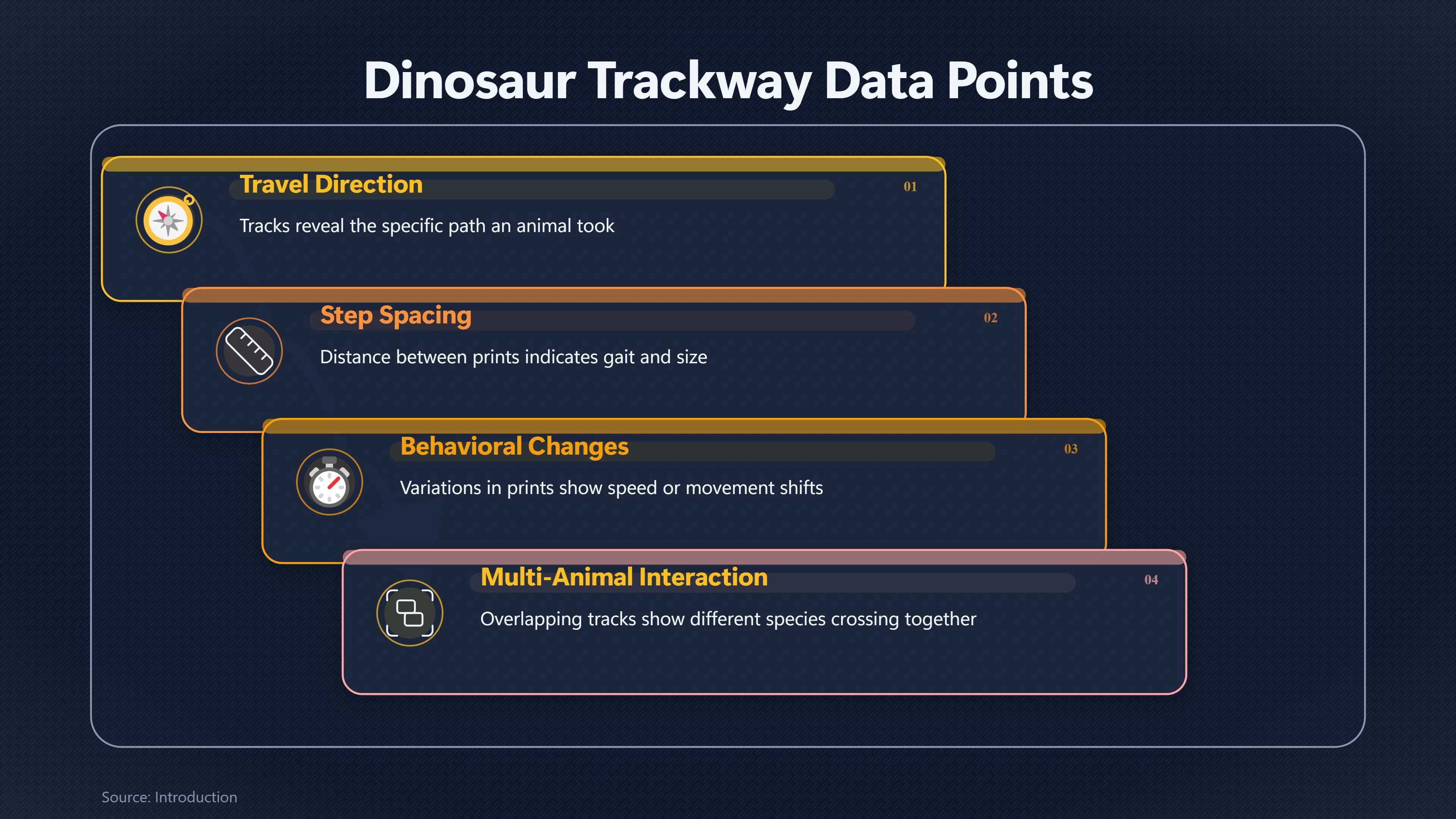
These sites allow visitors to observe details that are often lost when individual footprints are extracted. A complete trackway can reveal:
- The direction an animal travelled.
- The spacing of its steps.
- Changes in speed or behaviour.
- The relationship between different animals crossing the same surface.
Palaeontologists value trackways because they record movement rather than simply anatomy. A skeleton shows what an animal looked like, but footprints reveal how it interacted with its environment.[Natural History Museum]nhm.ac.ukOpen source on nhm.ac.uk.
Some sites are modest, consisting of only a handful of impressions in stream beds or exposed sandstone, while others preserve longer sequences of tracks. Their appearance changes with lighting, weather and water levels, meaning that visitors often experience them as part of an active landscape rather than as static exhibits.
Rock Shelters as Galleries and Sacred Places
Lesotho’s sandstone overhangs served as shelters for generations of San communities, many of whom decorated their walls with paintings depicting animals, people and complex ritual scenes. These shelters function today as open-air galleries, but they were never created simply for decoration.
Research increasingly interprets many paintings as expressions of spiritual belief, ritual practice and altered states of consciousness rather than straightforward hunting scenes. Images of eland, human-animal figures and ceremonial activity are understood within broader San religious traditions documented across southern Africa.[WIReDSpace]wiredspace.wits.ac.zaMT Moorosi's past and present: interpreting San rock art at MTM 1 site in the Quthing District of LesothoMay 22, 2009…
Sites such as Ha Baroana and the wider Maloti-Drakensberg region demonstrate why these shelters resist becoming conventional museums. Their meaning depends on their relationship with cliffs, valleys, water sources and routes through the landscape. Removing the paintings would preserve pigment but destroy much of their cultural context.
The Maloti-Drakensberg World Heritage landscape, which includes Sehlabathebe National Park in Lesotho, contains one of the greatest concentrations of San rock paintings south of the Sahara. UNESCO recognises not only the paintings themselves but also the continuing importance of their natural settings in conveying their cultural value.[UNESCO World Heritage Centre]whc.unesco.orgWorld Heritage Centre Maloti-Drakensberg ParkUNESCO World Heritage CentreMaloti-Drakensberg Park - UNESCO World Heritage Centre…
Why Authenticity Is Also a Risk
The qualities that make these sites remarkable also make them unusually vulnerable.
Unlike museum collections stored in climate-controlled buildings, dinosaur tracks and rock paintings remain exposed to natural and human pressures. Weather gradually erodes sandstone surfaces, while water, frost and vegetation can damage both footprints and painted panels. Human activity—including touching surfaces, graffiti, uncontrolled tourism and even repeated photography from unsafe positions—can accelerate deterioration.[UNESCO World Heritage Centre]unesco.orgWorld Heritage Centre Maloti-Drakensberg ParkUNESCO World Heritage CentreMaloti-Drakensberg Park - UNESCO World Heritage Centre
UNESCO has also identified broader management challenges in the Maloti-Drakensberg region. Grass-burning practices, the removal of protective vegetation around shelters and unregulated visitor access all have the potential to affect the survival of fragile rock art. Conservation therefore involves managing entire landscapes rather than simply protecting individual paintings.[UNESCO World Heritage Centre]unesco.orgWorld Heritage Centre Maloti-Drakensberg ParkUNESCO World Heritage CentreMaloti-Drakensberg Park - UNESCO World Heritage Centre
Fossil sites face comparable problems. Because exposed trackways can be damaged by collecting or vandalism, Lesotho prohibits the unauthorised excavation and removal of dinosaur fossils. This policy reflects the scientific importance of preserving footprints where they were formed instead of treating them as souvenirs.[seelesotho.com]seelesotho.comOpen source on seelesotho.com.

Interpreting an Outdoor Collection
One challenge of an open-air museum is that visitors often encounter remarkable objects with little explanation. Interpretation therefore depends heavily on guides, heritage organisations and nearby museums such as Morija Museum, whose fossil collections and exhibits help visitors understand what they later see in the field. The indoor displays act as an introduction, while the landscape provides the original evidence.[seelesotho.com]seelesotho.comOpen source on seelesotho.com.
Rock art presents an even greater interpretive challenge. Earlier generations sometimes treated the paintings as literal records of everyday life. Modern archaeological research instead emphasises symbolism, ritual and indigenous knowledge, while recognising that not every image has a single agreed meaning. This evidence-based approach encourages visitors to appreciate both the artistic achievement and the cultural complexity of the shelters without reducing them to simple illustrations of prehistoric hunting.[WIReDSpace]wiredspace.wits.ac.zaMT Moorosi's past and present: interpreting San rock art at MTM 1 site in the Quthing District of LesothoMay 22, 2009…
Why These Sites Matter in Lesotho’s Curiosity Landscape
Lesotho’s most unusual heritage attractions are striking precisely because they blur the distinction between museum and landscape. A dinosaur footprint still embedded in sandstone or a painted rock shelter overlooking a mountain valley offers an experience that no reconstructed gallery can fully reproduce.
For travellers interested in unusual collections, these places demonstrate that a country’s most memorable museum may have no walls at all. Instead, the exhibits are cliffs, stream beds, ancient pathways and painted shelters, preserved not as isolated objects but as parts of the landscapes that gave them meaning millions—or thousands—of years ago.
Amazon book picks
Further Reading
Books and field guides related to When the Landscape Becomes Lesotho's Museum. Use these as the next step if you want deeper reading beyond the article.
The Atlas of Archaeology
First published 1998. Subjects: Ancient Civilization, Antigüedades, Antiquities, Archaeology, Arqueología.
The Oxford Handbook of African Archaeology
Africa has the longest and arguably the most diverse archaeological record of any of the continents. It is where the human lineage first...
The Oxford Handbook of Archaeological Theory
This handbook is currently in development, with individual articles publishing online in advance of print publication. At this time, we c...
eBay marketplace picks
Marketplace Samples
Live-tested eBay searches with available results related to this page.
Selected fromrock art print oneBay.co.uk.



Endnotes
1.
Source: whc.unesco.org
Title: World Heritage Centre Maloti-Drakensberg Park
Link:https://whc.unesco.org/en/list/985/
Source snippet
UNESCO World Heritage CentreMaloti-Drakensberg Park - UNESCO World Heritage Centre...
2.
Source: seelesotho.com
Link:https://seelesotho.com/dinosaurs/
3.
Source: whc.unesco.org
Title: World Heritage Centre UNESCO World Heritage Centre
Link:https://whc.unesco.org/en/decisions/5133/
Source snippet
UNESCO World Heritage CentreUNESCO World Heritage Centre - Decision - 37 COM 8B.18...
5.
Source: whc.unesco.org
Title: World Heritage Centre World Heritage
Link:https://whc.unesco.org/archive/2013/whc13-37com-20-en.pdf
Source snippet
UNESCO World Heritage CentreWorld Heritage...
6.
Source: unesco.org
Title: Morija, the Well of Knowledge: Preserving Heritage Through Community
Link:https://www.unesco.org/en/articles/morija-well-knowledge-preserving-heritage-through-community-stewardship
Source snippet
May 13, 2026 — MORIJA, THE WELL OF KNOWLEDGE: PRESERVING HERITAGE THROUGH COMMUNITY STEWARDSHIP Morija, Lesotho’s “Well of Knowledge,” bl...
Published: May 13, 2026
7.
Source: whc.unesco.org
Link:https://whc.unesco.org/en/tentativelists/6737/
Source snippet
rock art in Lake Victoria Region of Kenya, Tanzania, and Uganda (Kenya) - UNESCO World Heritage CentreJanuary 31, 2024 — JUSTIFICATION OF...
Published: January 31, 2024
8.
Source: whc.unesco.org
Link:https://whc.unesco.org/en/list/874/
9.
Source: whc.unesco.org
Link:https://whc.unesco.org/en/list/1021
10.
Source: whc.unesco.org
Link:https://whc.unesco.org/en/statesparties/ls/
11.
Source: whc.unesco.org
Link:https://whc.unesco.org/en/decisions/8782
12.
Source: whc.unesco.org
Link:https://whc.unesco.org/fr/list/985
13.
Source: unesco.org
Link:https://www.unesco.org/en/countries/ls
14.
Source: whc.unesco.org
Link:https://whc.unesco.org/en/list/94/
15.
Source: whc.unesco.org
Link:https://whc.unesco.org/fr/etatsparties/ls
16.
Source: unesco.pl
Link:https://www.unesco.pl/kultura/dziedzictwo-kulturowe/swiatowe-dziedzictwo/lista-swiatowego-dziedzictwa/afryka/lesotho/
17.
Source: nhm.ac.uk
Link:https://www.nhm.ac.uk/discover/dinosaur-footprints.html
18.
Source: wiredspace.wits.ac.za
Link:https://wiredspace.wits.ac.za/items/462b81b0-c3e7-455f-8392-62ca01f5783c
Source snippet
MT Moorosi's past and present: interpreting San rock art at MTM 1 site in the Quthing District of LesothoMay 22, 2009...
Published: May 22, 2009
19.
Source: beg.utexas.edu
Link:https://www.beg.utexas.edu/geowonders/dinosaur
20.
Source: wipo.int
Link:https://www.wipo.int/wipolex/en/legislation/details/11312
Additional References
21.
Source: sciencedirect.com
Link:https://www.sciencedirect.com/science/article/pii/S266603342400008X
Source snippet
view from Ha Makotoko and Ntloana Tšoana rock-shelters, Lesotho - ScienceDirectJanuary 1, 2024 — A ZOOARCHAEOLOGICAL PERSPECTIVE ON LATE...
Published: January 1, 2024
22.
Source: youtube.com
Title: Session 6 – Sepamo – Mahemeng Cave: a rock art site in Mahemeng village, Lesotho
Link:http://www.youtube.com/watch?v=J5pG2l3znbg
Source snippet
Lesotho dinosaur footprints Discovering Lesotho’s Ancient Dinosaur Foot prints Wanderlust Wonders...
23.
Source: youtube.com
Link:http://www.youtube.com/watch?v=idgQee9nRtU
Source snippet
Searching for Dinosaur Footprints in Roma, Lesotho...
24.
Source: youtube.com
Title: The Amazing Cave/Rock Art Of Drakensberg, Lesotho, Africa
Link:http://www.youtube.com/watch?v=bR9B6Q2TIhs
Source snippet
Session 6 – Sepamo – Mahemeng Cave: a rock art site in Mahemeng village, Lesotho...
25.
Source: youtube.com
Title: Discovering Lesotho’s Ancient Dinosaur Foot prints
Link:http://www.youtube.com/watch?v=LZ_BhyuVoV8
Source snippet
Explore Semonkong Waterfall & Dinosaur Footprints in Lesotho | Overland Honeymoon Ep. 6...
26.
Source: youtube.com
Title: Searching for Dinosaur Footprints in Roma, Lesotho
Link:http://www.youtube.com/watch?v=pC8r3280hSI
Source snippet
The Amazing Cave/Rock Art Of Drakensberg, Lesotho, Africa...
27.
Source: tandfonline.com
Link:https://www.tandfonline.com/doi/full/10.1080/10420940591008971
28.
Source: tandfonline.com
Link:https://www.tandfonline.com/doi/abs/10.1080/10420940591008971
29.
Source: tandfonline.com
Link:https://www.tandfonline.com/doi/full/10.1080/08912963.2022.2117042
30.
Source: africanworldheritagesites.org
Link:https://africanworldheritagesites.org/cultural-places/rock-art-pre-history/maloti-drakensberg.html