Within Guinea Bissau Curiosities
Why Cacheu Keeps Its Colonial Statues Broken
Cacheu combines a slavery memorial with broken colonial monuments that remain preserved without returning to public honour.
On this page
- The slavery memorial and its collections
- The fort's displaced Portuguese statues
- Visiting a difficult and informally managed site
Page outline Jump by section
Introduction
Cacheu is one of the most powerful places in Guinea-Bissau for understanding how the country remembers slavery and colonialism without trying to smooth over either history. Instead of celebrating imperial monuments or hiding them away, Cacheu brings together two striking elements: a memorial dedicated to the Atlantic slave trade and a group of damaged Portuguese colonial statues preserved inside the old fort. Together they create an unusual heritage landscape where memory, loss and political change are deliberately left visible rather than resolved. Unlike a conventional museum, this is a place where the condition of the objects—their damage, displacement and unfinished status—is part of what visitors are meant to confront.[Memorial Cache]memorialcacheu.orgMemorial Cache INSTITUCIONALMemorial Cache INSTITUCIONAL

The slavery memorial and its collections
The Memorial of Slavery and the Slave Trade opened in 2016 in the restored remains of the former Casa Gouveia, a historic trading building in Cacheu. Rather than functioning only as a museum, it was designed as a centre for memory, education, research and dialogue about four centuries of enslavement linked to the Guinea coast. The project was developed by the Guinean organisation Acção para o Desenvolvimento (Action for Development) with international partners and support from the European Union.[Memorial Cache]memorialcacheu.orgMemorial Cache INSTITUCIONALMemorial Cache INSTITUCIONAL
Cacheu was one of the major Portuguese trading centres on the Upper Guinea coast. Thousands of enslaved Africans passed through the settlement before being shipped across the Atlantic, particularly towards Brazil and other Portuguese territories. The memorial focuses on this local history rather than presenting slavery as an abstract global story, helping visitors understand how an apparently quiet riverside town became part of one of history’s largest forced migrations.[Mimesis Journals]mimesisjournals.comOpen source on mimesisjournals.com.
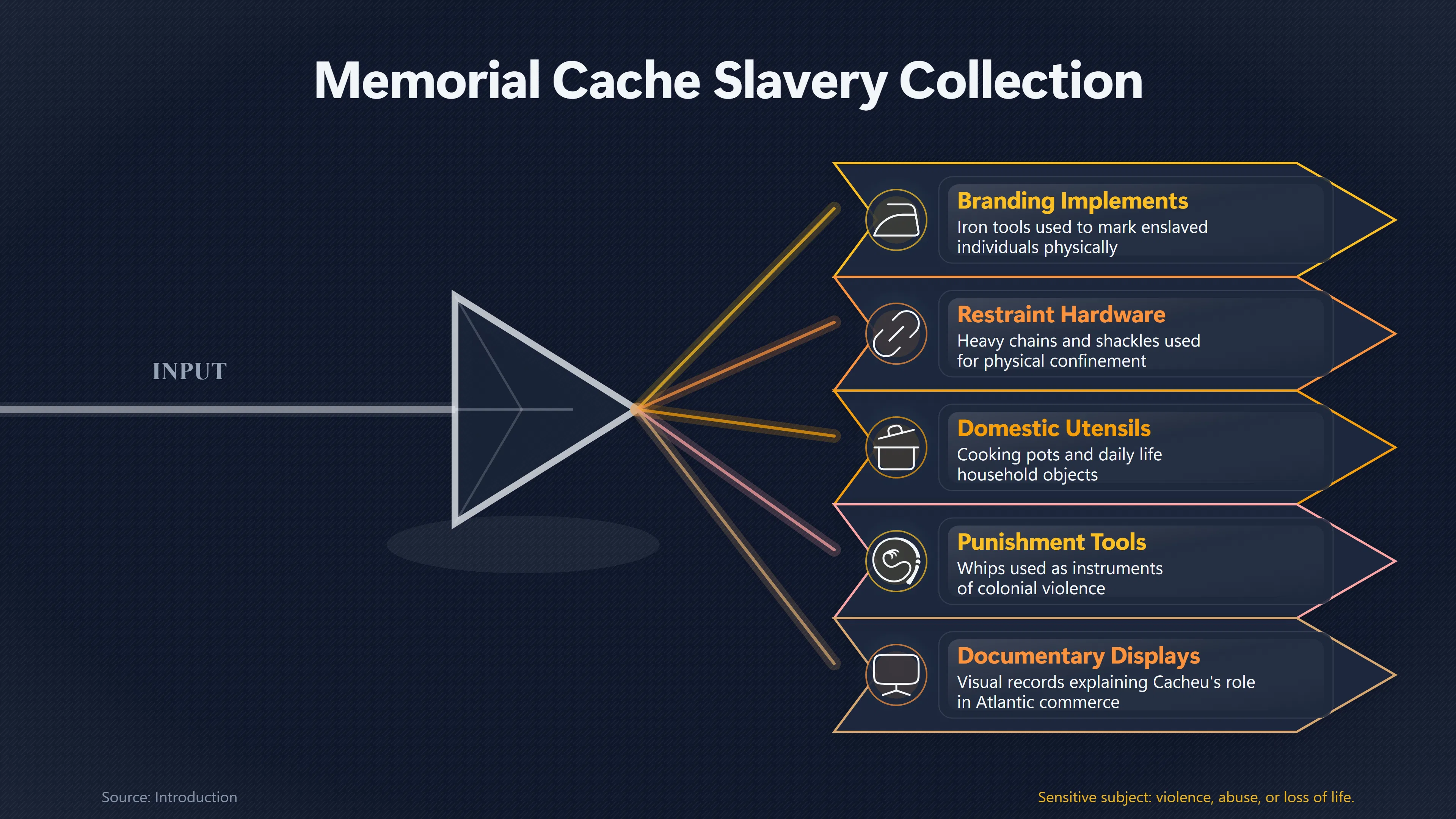
Its collection is deliberately modest but emotionally direct. Many exhibits were donated by local residents and include:
- iron branding implements used to mark enslaved people;
- chains and restraints;
- whips;
- cooking pots, utensils and domestic objects associated with daily life around the slave trade;
- documentary displays explaining Cacheu’s role within Atlantic commerce.
The emphasis is not on rare masterpieces but on ordinary objects that expose the practical machinery of enslavement. Their local provenance also strengthens the memorial’s connection to community memory rather than distant collecting traditions.[UCCLA]uccla.ptInaugurado memorial de escravatura em Cacheu | UCCLAInaugurado memorial de escravatura em Cacheu | UCCLA…
The institution also serves educational purposes through exhibitions, research facilities and cultural programmes linking Guinea-Bissau with descendants of enslaved communities elsewhere in the Atlantic world. Organisers describe the memorial as a place for remembrance, reconciliation and dialogue rather than nationalist celebration.[Memorial Cache]memorialcacheu.orgMemorial Cache INSTITUCIONALMemorial Cache INSTITUCIONAL
Why the colonial statues remain broken
Only a short distance away, inside Cacheu Fort, visitors encounter one of the country’s most unusual collections: damaged Portuguese colonial statues that were removed from their former public settings after independence.
These sculptures were created during Portugal’s Estado Novo dictatorship, when monumental public art was used throughout the empire to project imperial authority and reinforce colonial ideology. Instead of being destroyed completely after Guinea-Bissau achieved independence in 1974, several statues were toppled, damaged and eventually gathered inside the fort. Their missing heads, broken limbs and weathered surfaces remain visible.[RCAAP]rcaap.ptAs Estátuas portuguesas, em exposição aguardando por um museu, no forte de Cacheu…
This creates an unusual form of preservation. The statues survive as historical artefacts but no longer function as monuments demanding public honour. Their relocation changes their meaning:
- they document colonial visual propaganda;
- they record the political rejection of Portuguese rule;
- their damaged condition itself has become historical evidence;
- they invite discussion about how difficult heritage should be preserved.
Rather than restoring them to their original appearance, authorities have largely allowed them to remain as they are. Scholars describe the collection as existing in a deliberately unresolved state—preserved for interpretation but stripped of its original commemorative role.[RCAAP]rcaap.ptAs Estátuas portuguesas, em exposição aguardando por um museu, no forte de Cacheu…
This approach differs from countries that either reinstall controversial monuments or remove them entirely. In Cacheu, the broken statues become museum objects without being rehabilitated as symbols of colonial pride.

A landscape where two histories meet
The memorial and the displaced statues reinforce one another because they occupy the same historical setting.
Cacheu Fort itself was a centre of Portuguese military and commercial power, closely connected with the slave trade that passed through the region. Visitors therefore move through a landscape where buildings, museum collections and damaged monuments all speak about different aspects of the same colonial system.[RCAAP]rcaap.ptAs Estátuas portuguesas, em exposição aguardando por um museu, no forte de Cacheu…
The experience is unusual because no single exhibit dominates. Instead, meaning emerges from the relationship between place and objects:
- the memorial centres the experiences of enslaved Africans;
- the fort represents colonial administration and military control;
- the broken statues reveal what happened when imperial authority collapsed;
- together they show how modern Guinea-Bissau has chosen to remember rather than erase this difficult past.
For travellers interested in unusual heritage, this combination is more thought-provoking than a conventional historical museum. The site’s most striking artefacts are not rare treasures but monuments that have lost their original political purpose.
Visiting a difficult and informally managed site
Visitors should expect a heritage complex rather than a polished international museum. Opening arrangements may vary, and access is sometimes dependent on local staff availability or organised visits. Facilities remain relatively simple compared with larger museums elsewhere in West Africa.[Mimesis Journals]mimesisjournals.comOpen source on mimesisjournals.com.
Those who visit should allow time to explore both the memorial and the fort. Seeing only one misses the broader story. The memorial explains the human consequences of the Atlantic slave trade, while the fort’s damaged statuary demonstrates how Guinea-Bissau has physically reinterpreted the symbols of Portuguese colonial rule instead of restoring or completely erasing them.
Within Guinea-Bissau’s wider landscape of unusual collections, Cacheu stands apart because its most memorable exhibits are inseparable from the moral questions they raise. The preserved tools of slavery and the broken monuments of empire are not displayed as curiosities alone, but as material evidence of a history that remains intentionally unsettled.

Amazon book picks
Further Reading
Books and field guides related to Why Cacheu Keeps Its Colonial Statues Broken. Use these as the next step if you want deeper reading beyond the article.
The Slave Trade
In a balanced approach to an explosive subject, a history professor portrays the rise, apogee, and decline of the slave trade, exposing i...
The Scramble For Africa
In 1880 the continent of Africa was largely unexplored by Europeans. Less than thirty years later, only Liberia and Ethiopia remained unc...
Saltwater Slavery: A Middle Passage from Africa to American D...
This bold, innovative book promises to radically alter our understanding of the Atlantic slave trade, and the depths of its horrors. Step...
The Atlantic Slave Trade
A volume in the Problems in World History series, this book features a variety of secondary-source essays that are carefully edited for b...
eBay marketplace picks
Marketplace Samples
Live-tested eBay searches with available results related to this page.
Selected fromhistory wall art oneBay.co.uk.


Endnotes
1.
Source: uccla.pt
Title: Inaugurado memorial de escravatura em Cacheu | UCCLA
Link:https://www.uccla.pt/noticias/inaugurado-memorial-de-escravatura-em-cacheu
Source snippet
Inaugurado memorial de escravatura em Cacheu | UCCLA...
2.
Source: rcaap.pt
Link:https://www.rcaap.pt/detail.jsp?id=oai%3Ajournals.ap2.pt%3Aarticle%2F1002
Source snippet
As Estátuas portuguesas, em exposição aguardando por um museu, no forte de Cacheu...
3.
Source: rcaap.pt
Title: RCAA P
Link:https://www.rcaap.pt/detail.jsp?id=oai%3Ajournals.wisethorough.com%3Aarticle%2F1002&locale=en
4.
Source: memorialcacheu.org
Title: Memorial Cache INSTITUCIONAL
Link:https://memorialcacheu.org/institucional/
5.
Source: mimesisjournals.com
Link:https://mimesisjournals.com/ojs/index.php/ec/article/view/1960
6.
Source: journals.wisethorough.com
Link:https://journals.wisethorough.com/index.php/BBDS/article/view/1080
Source snippet
Portuguese statues, on display awaiting a museum, in the fort of Cacheu: Visit to Guinea-Bissau and the Memorial of Slavery and Slave Tra...
7.
Source: digitalcommons.fiu.edu
Link:https://digitalcommons.fiu.edu/record/13964
8.
Source: en.wikivoyage.org
Link:https://en.wikivoyage.org/wiki/Cacheu
9.
Source: memorialcacheu.org
Title: centro de estudos e pesquisas
Link:https://memorialcacheu.org/centro-de-estudos-e-pesquisas/
Additional References
10.
Source: researchgate.net
Link:https://www.researchgate.net/publication/388554195_As_estatuas_portuguesas_em_exposicao_aguardando_por_um_museu_no_forte_de_Cacheu_Visita_a_Guine-Bissau_e_ao_Memorial_da_escravatura_e_trafico_negreiro_de_Cacheu
Source snippet
ResearchGate(PDF) As Estátuas portuguesas, em exposição aguardando por um museu, no forte de Cacheu.: Visita a Guiné-Bissau e ao Memorial...
11.
Source: unesco.org
Link:https://www.unesco.org/en/articles/aapravasi-ghat-how-unesco-world-heritage-site-keeps-memory-indentured-labour-alive
Source snippet
September 9, 2025 — AAPRAVASI GHAT: HOW A UNESCO WORLD HERITAGE SITE KEEPS THE MEMORY OF INDENTURED LABOUR ALIVE Between 1834 and 1920, o...
Published: September 9, 2025
12.
Source: researchgate.net
Link:https://www.researchgate.net/publication/387894303_The_Portuguese_statues_on_display_awaiting_a_museum_in_the_fort_of_Cacheu
Source snippet
* January 2025 DOI:10.48619/bbds.v5i1.1080 Authors: Paulo Tiago Cabeça * Universidade de Évora...
Published: January 2025
13.
Source: youtube.com
Title: A Walkthrough Of the Elmina Castle
Link:https://www.youtube.com/watch?v=zJi9OBWsMSI
Source snippet
Cacheu Slavery Memorial Guinea Bissau Old Slave Port, Cacheu Guinea-Bissau 🇬🇼 Temdri World...
14.
Source: youtube.com
Title: Dr. Jeremy Levitt: The Gorée Memorial and Museum
Link:https://www.youtube.com/watch?v=x3CjE-UaxSU
Source snippet
A Walkthrough Of the Elmina Castle - West African Slave Trade History, Ghana...
15.
Source: gettyimages.pt
Link:https://www.gettyimages.pt/detail/fotografia-de-not%C3%ADcias/series-of-statues-stand-in-the-fort-of-cacheu-fotografia-de-not%C3%ADcias/987071278
16.
Source: dspace.uevora.pt
Link:https://dspace.uevora.pt/rdpc/handle/10174/37695
17.
Source: repositorio.iscte-iul.pt
Link:https://repositorio.iscte-iul.pt/handle/10071/21575
18.
Source: repositorio.iscte-iul.pt
Link:https://repositorio.iscte-iul.pt/handle/10071/7450
19.
Source: youtube.com
Title: Exploring the Historic Island of Gorée, Senegal
Link:https://www.youtube.com/watch?v=hc_qXosZBNg
Source snippet
Dr. Jeremy Levitt: The Gorée Memorial and Museum...