Within Strange Honduras
Why Comayagua's Sacred Statues Can Feel Uncanny
Comayagua's religious collections preserve lifelike saints, sorrowful Virgins and fragile ritual objects whose sacred purpose can appear eerie in a museum.
On this page
- How devotional figures were made emotionally lifelike
- What changes when sacred objects enter museum cases
- How fire and restoration shaped the surviving collection
Page outline Jump by section
Introduction
Comayagua’s colonial religious collections are among the most unusual visitor experiences in Honduras because they preserve objects that were never created as museum pieces. The carved saints, sorrowful Virgins, crucifixes, embroidered vestments and silver liturgical treasures in the city’s Museum of Colonial Religious Art were designed for worship, public processions and prayer rather than detached observation. Once displayed behind glass, their remarkable realism can feel unexpectedly uncanny. Faces seem to return a visitor’s gaze, painted tears remain fixed in expressions of grief, and life-sized sculptures retain the emotional intensity that once formed part of religious ceremonies rather than exhibitions.[CATA]visitcentroamerica.comCATAComayagua, the best preserved colonial historic center of HondurasCATAComayagua, the best preserved colonial historic center of Honduras
Unlike a cabinet of curiosities assembled for spectacle, Comayagua’s collection reflects the devotional life of colonial Honduras. The museum therefore offers a rare chance to understand how sacred art changes when its original religious setting is replaced by museum interpretation, while also revealing how fire, theft and restoration have shaped what survives today.[Petit Futé]petitfute.esPetit FutéMUSEO DE ARTE RELIGIOSO COLONIALMuseo - Comayagua - Honduras…
Why the statues can feel unsettling
The Museum of Colonial Religious Art, housed within the historic Episcopal complex in Comayagua, is the only museum in Honduras dedicated entirely to colonial religious art. Its collection includes sculptures, paintings, liturgical silver, embroidered vestments, manuscripts and devotional objects dating largely from the seventeenth to nineteenth centuries.[wikipedia.org]WikipediaMuseo Colonial de Arte ReligiosoMuseo Colonial de Arte Religioso
For many visitors, the most striking exhibits are the carved wooden sculptures of Christ, the Virgin Mary and saints. Their appearance reflects a long Spanish colonial tradition of sacred imagery intended to provoke empathy rather than admiration for artistic technique alone. Artists used painted glass eyes, carefully modelled skin tones, naturalistic hair and expressive gestures to encourage worshippers to identify emotionally with biblical suffering and compassion. Seen in a quiet gallery rather than a candlelit church, these same qualities can produce an unexpectedly eerie effect.
The emotional realism is particularly noticeable in representations of the Virgin of Sorrows, crucified Christ and other Passion scenes. Rather than idealised figures, they present grief, exhaustion and physical suffering with remarkable directness. Their purpose was devotional, not theatrical, but modern museum visitors often interpret the same realism through a different cultural lens shaped by horror films, wax museums and historical curiosity.
How devotional figures were made emotionally lifelike
Colonial sculptors working across Spanish America followed artistic traditions that blended European Baroque styles with regional workshops and local craftsmanship. Comayagua’s collection illustrates this wider artistic world while preserving objects that served churches throughout colonial Honduras.[colonialart.org]colonialart.orgMuseo Colonial de Arte Religioso — Colonial ArtMuseo Colonial de Arte Religioso — Colonial Art
Several features explain why these figures appear unusually lifelike:
- Expressive facial modelling created individual emotions rather than generic expressions.
- Layered polychrome paint imitated living skin, bruises and wounds.
- Real textiles and jewellery dressed sculptures according to the liturgical calendar or particular feast days.
- Processional use meant many statues were designed to be viewed from close range as they passed through crowded streets rather than from distant church altars.
- Replacement garments and ornaments allowed communities to continue interacting with the same sacred figure over generations.
These objects therefore accumulated histories beyond their manufacture. Repairs, repainting and changing devotional fashions became part of their biographies, making each sculpture both an artwork and a living participant in religious tradition.

What changes when sacred objects enter museum cases
The museum presents these works primarily as cultural heritage, yet their religious meaning has not disappeared. Many pieces remain recognisable to practising Catholics as objects that once occupied active churches or formed part of Holy Week ceremonies.[CATA]visitcentroamerica.comCATAComayagua, the best preserved colonial historic center of HondurasCATAComayagua, the best preserved colonial historic center of Honduras
That creates an unusual experience compared with many art museums. Visitors are asked to appreciate craftsmanship, conservation and history while standing before objects that were intended to inspire prayer. Removing them from churches also changes how they are seen:
- dramatic lighting replaces candlelight;
- explanatory labels replace sermons or ritual;
- protective display cases prevent physical interaction;
- conservation priorities take precedence over regular ceremonial use.
Rather than diminishing their power, this shift often makes their craftsmanship easier to examine. Delicate embroidery, carved anatomical detail and silverwork that might once have been overlooked during processions become visible as artistic achievements in their own right.
At the same time, the museum avoids presenting these works as supernatural curiosities. Their emotional impact comes from historical devotional practice rather than claims of miracles or paranormal activity.
How fire and restoration shaped the surviving collection
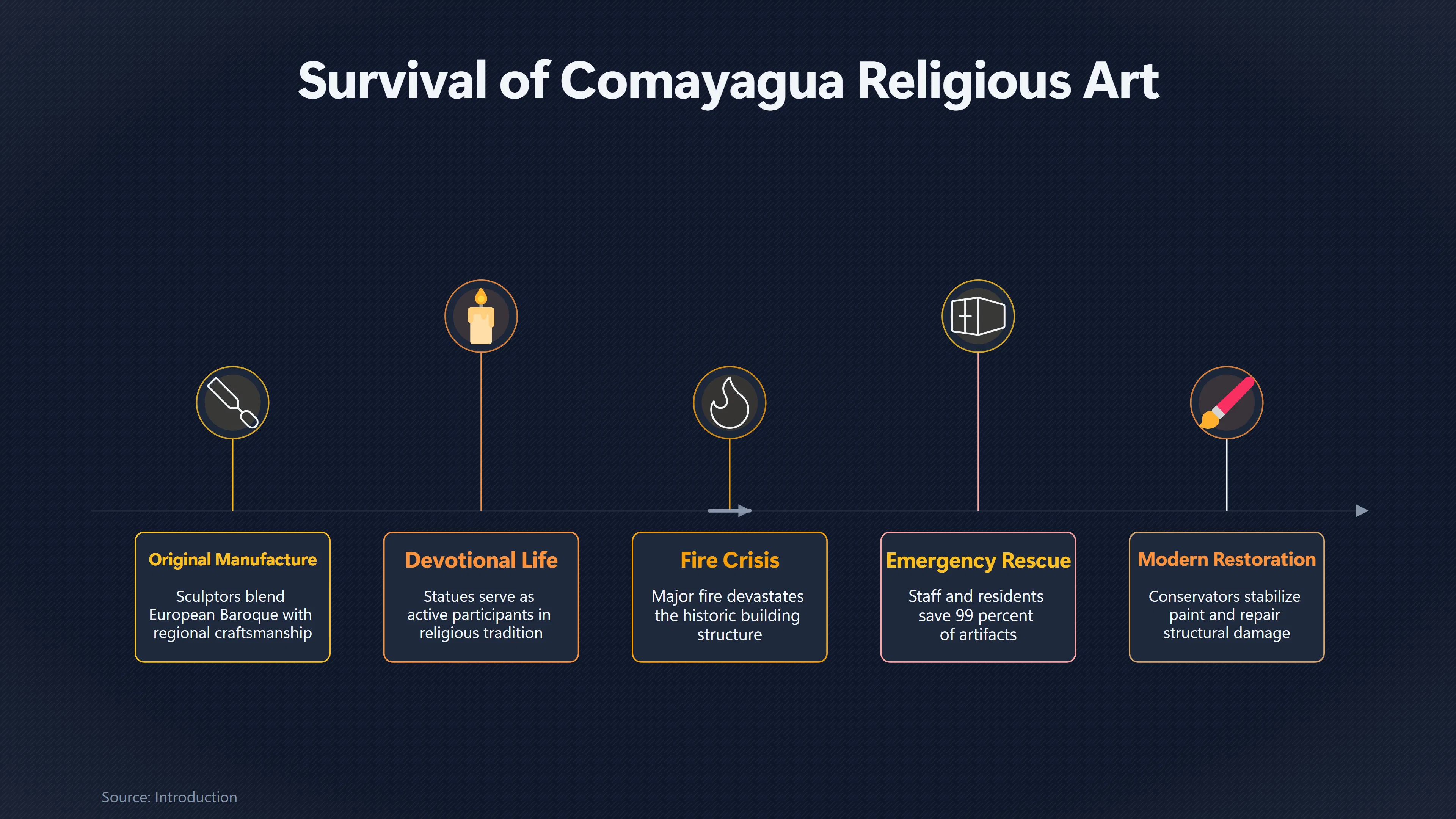
One of the defining stories behind today’s displays is survival. The museum has suffered repeated losses through theft and, most dramatically, a major fire in April 2009 that devastated much of the historic building. Although the adobe walls remained standing, the structure itself was largely destroyed. Museum staff, church authorities and local residents managed to rescue the overwhelming majority of the collection before flames could consume it. Reports at the time estimated that roughly 99 per cent of the artefacts survived, although the building required extensive reconstruction.[wikipedia.org]WikipediaMuseo Colonial de Arte ReligiosoMuseo Colonial de Arte Religioso
The museum reopened after several years with restored exhibition spaces that met conservation requirements while allowing rescued sculptures, paintings and silver objects to return to public display.[www.elheraldo.hn]elheraldo.hnwww.elheraldo.hn Reabren exposiciones del Museo de Arte Religiosoexposiciones del Museo de Arte Religioso…
Restoration has inevitably altered parts of the collection. Conservators have stabilised paint layers, repaired structural damage and improved environmental protection without attempting to erase every sign of age. Small cracks, worn surfaces and evidence of previous repairs remain visible on many pieces, reminding visitors that these are survivors rather than perfect recreations.
The nearby restoration of important cathedral furnishings, including the eighteenth-century retable of the Señor de Salamé, further demonstrates the continuing effort to preserve Comayagua’s religious heritage rather than simply display it as a finished historical collection.[www.laprensa.hn]laprensa.hnwww.laprensa.hn Restauran el retablo del Señor de Salamé en Comayaguael retablo del Señor de Salamé en ComayaguaMarch 27, 2013…
Why Comayagua matters within Honduras’ curiosity culture
Honduras has relatively few museums devoted to unusual or uncanny subjects, making Comayagua distinctive for a different reason. Its religious collections demonstrate how ordinary devotional objects can appear extraordinary when viewed outside their original setting.
The city itself reinforces that experience. During Holy Week, Comayagua becomes one of Honduras’ principal centres of Catholic celebration, famous for elaborate coloured sawdust carpets and processions. The museum’s sculptures therefore belong to a broader living tradition rather than an isolated historical display. Visitors can understand them both as museum artefacts and as products of rituals that continue to shape the city’s identity.[CATA]visitcentroamerica.comCATAComayagua, La Antañona, el casco histórico colonial mejor conservadoCATAComayagua, La Antañona, el casco histórico colonial mejor conservado
Within Honduras’ landscape of unusual collections, Comayagua stands apart because its uncanniness comes not from myths, monsters or hoaxes but from the powerful emotional realism of sacred art. The museum preserves objects created to bridge the human and the divine, and although they now sit behind protective glass, they retain much of the intensity that once made them central to public acts of faith.
Amazon book picks
Further Reading
Books and field guides related to Why Comayagua's Sacred Statues Can Feel Uncanny. Use these as the next step if you want deeper reading beyond the article.

The Power of Images
This book was ground-breaking for its time because of Freedberg's insistence on a new? approach to the study of images that focused on wr...
The Story of Art
Exquisite cloth-bound edition of the classic art-history text - the ideal gift for every art connoisseur and student For more than 70 yea...
Christian Art
First published 2007. Subjects: Christelijke kunst, Symbolism in art, Christian art and symbolism, Iconografie.
The Image of the Black in Western Art
"A pioneering work in the field of art history, The Image of the Black in Western Art is a comprehensive series of ten books which offers...
eBay marketplace picks
Marketplace Samples
Live-tested eBay searches with available results related to this page.
Selected fromreligious figure decor oneBay.co.uk.
Endnotes
1.
Source: visitcentroamerica.com
Title: CATAComayagua, the best preserved colonial historic center of Honduras
Link:https://www.visitcentroamerica.com/en/visit/comayagua/
2.
Source: Wikipedia
Title: Museo Colonial de Arte Religioso
Link:https://es.wikipedia.org/wiki/Museo_Colonial_de_Arte_Religioso
3.
Source: elheraldo.hn
Title: www.elheraldo.hn Reabren exposiciones del Museo de Arte Religioso
Link:https://www.elheraldo.hn/honduras/reabren-exposiciones-del-museo-de-arte-religioso-LKEH612768
Source snippet
exposiciones del Museo de Arte Religioso...
4.
Source: colonialart.org
Title: Museo Colonial de Arte Religioso — Colonial Art
Link:https://colonialart.org/archives/locations/honduras/departamento-de-comayagua/ciudad-de-comayagua/museo-colonial-de-arte-religioso
5.
Source: colonialart.org
Title: Honduras — Colonial Art
Link:https://colonialart.org/archives/locations/honduras
6.
Source: laprensa.hn
Title: www.laprensa.hn Restauran el retablo del Señor de Salamé en Comayagua
Link:https://www.laprensa.hn/sociales/restauran-el-retablo-del-senor-de-salame-en-comayagua-GYLP376572
Source snippet
el retablo del Señor de Salamé en ComayaguaMarch 27, 2013...
Published: March 27, 2013
7.
Source: visitcentroamerica.com
Title: CATAComayagua, La Antañona, el casco histórico colonial mejor conservado
Link:https://www.visitcentroamerica.com/visitar/comayagua/
8.
Source: elheraldo.hn
Title: Comayagua reconstruye su historia religiosa
Link:https://www.elheraldo.hn/honduras/comayagua-reconstruye-su-historia-religiosa-DOEH565071
9.
Source: laprensa.hn
Title: Reabrirá sus puertas palacio episcopal de Comayagua
Link:https://www.laprensa.hn/honduras/reabrira-sus-puertas-palacio-episcopal-de-comayagua-OCLP342927
10.
Source: laprensa.hn
Title: Llamados a cooperar
Link:https://www.laprensa.hn/espectaculos/llamados-a-cooperar-ABLP530550
11.
Source: laprensa.hn
Title: Una lección del pasado
Link:https://www.laprensa.hn/honduras/una-leccion-del-pasado-HYLP518186
12.
Source: honduras.com
Title: museo de comayagua
Link:https://www.honduras.com/aprende/cultura/patrimonios/museo-de-comayagua/
13.
Source: honduras.com
Link:https://www.honduras.com/aprende/cultura/patrimonios/museo-arqueologico-de-comayagua-patrimonio-cultural-de-honduras/
14.
Source: petitfute.es
Title: Petit FutéMUSEO DE ARTE RELIGIOSO COLONIAL
Link:https://www.petitfute.es/v52901-comayagua/c1173-visites-points-d-interet/c958-musee/286768-museo-de-arte-religioso-colonial.html
Source snippet
Museo - Comayagua - Honduras...
15.
Source: visitcentroamerica.com
Title: Reapertura del Museo de Comayagua en Honduras
Link:https://www.visitcentroamerica.com/sala-prensa/actualidad/reapertura-del-museo-de-comayagua-en-honduras/
Source snippet
Sala de prensaApril 20, 2024 — Inicio Actualidad Reapertura del Museo de Comayagua en Honduras * Actualidad * Honduras REAPERTURA DEL MUS...
Published: April 20, 2024
16.
Source: visitcentroamerica.com
Title: The Museum of Comayagua Reopens in Honduras
Link:https://www.visitcentroamerica.com/sala-prensa/en/lastest-news/the-museum-of-comayagua-reopens-in-honduras/
Source snippet
Sala de prensaApril 20, 2024 — THE MUSEUM OF COMAYAGUA REOPENS IN HONDURAS 20 April 2024 Image: Museo-Comayagua-Honduras-exterior The Mus...
Published: April 20, 2024
Additional References
17.
Source: youtube.com
Title: Comayagua Cathedral – The Clock That Traveled Through Time
Link:https://www.youtube.com/watch?v=fNKeHq2xGJ4
Source snippet
Comayagua Colonial Religious Art Museum Honduras Museo de arte religioso en Comayagua, una joya...
18.
Source: youtube.com
Title: La ciudad MÁS FELIZ que he visitado! | Comayagua, Honduras
Link:https://www.youtube.com/watch?v=_5b_q4Wb6YY
Source snippet
Comayagua Cathedral – The Clock That Traveled Through Time...
19.
Source: afehc-historia-centroamericana.org
Link:https://www.afehc-historia-centroamericana.org/index_action_fi_aff_id_2137.html
20.
Source: fodors.com
Link:https://www.fodors.com/world/mexico-and-central-america/honduras/western-honduras/places/comayagua/things-to-do/sights
21.
Source: youtube.com
Title: Documental Museo de arte religioso
Link:https://www.youtube.com/watch?v=x33uoNWdgew
Source snippet
Museo Colonial de Arte Religioso | Comayagua...
22.
Source: youtube.com
Title: ARTE COLONIAL HONDUREÑO
Link:https://www.youtube.com/watch?v=X5HFJzuC8j8
Source snippet
La ciudad MÁS FELIZ que he visitado! | Comayagua, Honduras...
23.
Source: studocu.com
Title: Informe sobre Museos de Comayagua: Antropología y Arte Religioso
Link:https://www.studocu.com/latam/document/universidad-nacional-autonoma-de-honduras/historia-de-honduras/informe-museos/34348250
24.
Source: ihah.hn
Title: Museo de Comayagua – IHAHMUSEO DE COMAYAGUA * Image: comayagua2
Link:https://ihah.hn/museo-de-comayagua/
25.
Source: espaciohonduras.net
Title: Comayagua colonial: historia, arquitectura y tradiciones vivas
Link:https://www.espaciohonduras.net/lugares-turisticos-y-culturales-de-honduras/comayagua-colonial-historia-arquitectura-y-tradiciones-vivas
26.
Source: hondurastips.hn
Title: Museo de Arte Religioso: una joya histórica de Comayagua
Link:https://www.hondurastips.hn/2018/08/27/museo-de-arte-religioso-una-joya-historica-de-comayagua/