Within Uncanny Uzbekistan
Why Ancient Uzbekistan Preserved Bones and Amulets
Bone containers and amulet cases reveal how death, purity and spiritual protection were expressed in pre-modern Central Asia.
On this page
- How ossuaries fitted Zoroastrian funerary practice
- Chilpyk and the landscape of exposure rites
- When jewellery also served as protective magic
Page outline Jump by section
Introduction
Ancient Uzbekistan preserves some of Central Asia’s most intriguing evidence for how people understood death, spiritual danger and supernatural protection. Rather than burying whole bodies immediately, some pre-Islamic communities collected cleaned bones in decorated clay containers known as ossuaries, reflecting religious ideas about purity and the proper relationship between the dead and the natural world. Alongside these funerary objects, museums display jewellery, pendants and small personal ornaments that were not simply decorative but were believed to protect their wearers from illness, misfortune or hostile spiritual forces. Together, these artefacts reveal that ancient belief systems survive not only in monumental ruins but also in the intimate objects people carried, wore and entrusted with their dead.[iccu.uz]iccu.uzArtifact: Ossuary | Islamic Civilization Center in UzbekistanArtifact: Ossuary | Islamic Civilization Center in Uzbekistan
How ossuaries fitted Zoroastrian funerary practice
One of the most unusual archaeological collections in Uzbekistan consists of clay ossuaries from ancient Khorezm and neighbouring regions. These containers held the cleaned bones of the deceased after an earlier stage of funerary ritual. Modern visitors often mistake them for ordinary urns or coffins, but they belonged to a very different understanding of death.
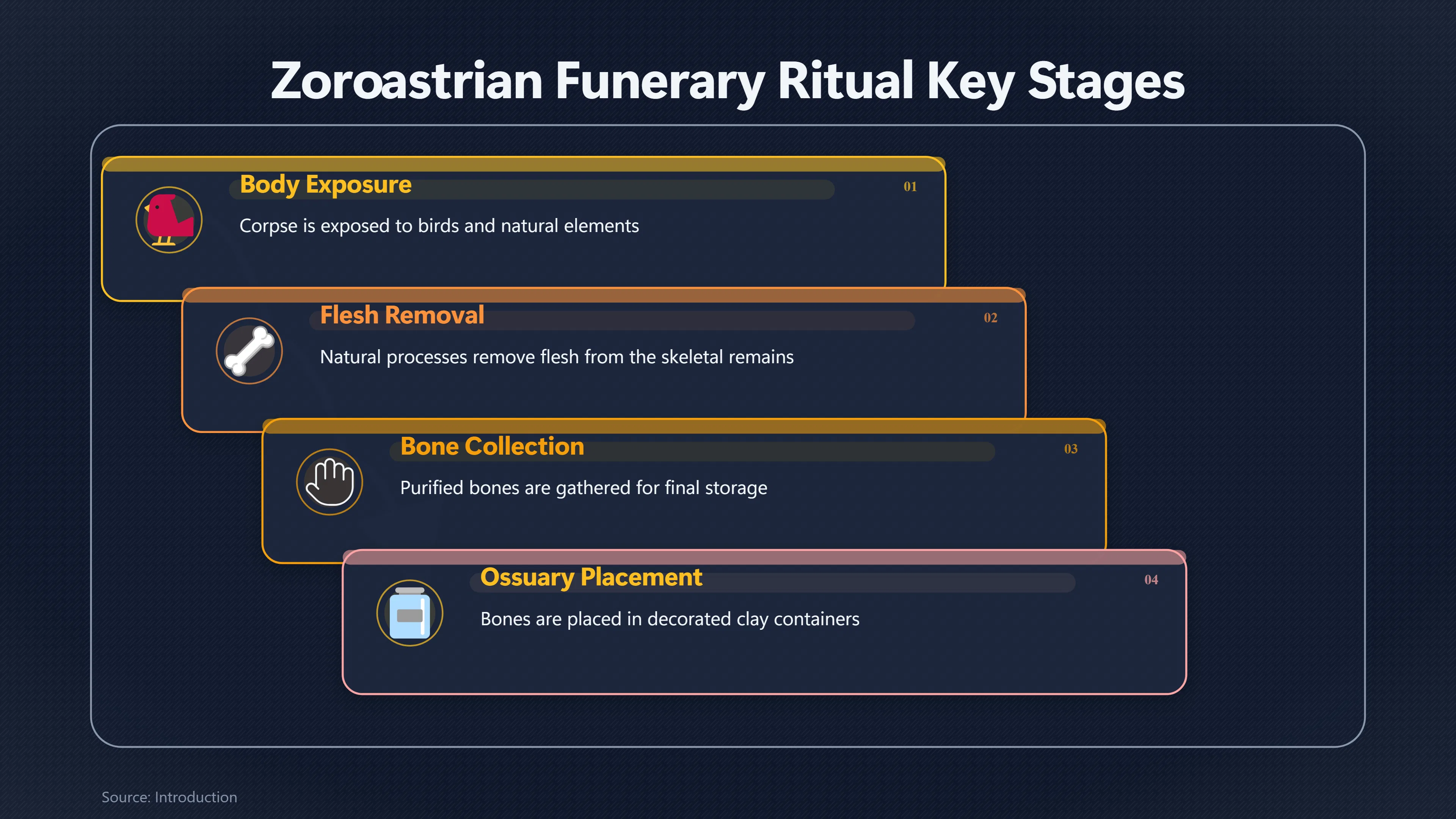
In the Zoroastrian tradition, a dead body was considered capable of polluting the sacred elements of earth, water and fire. Rather than placing a corpse directly into the ground, communities exposed it until birds and natural processes removed the flesh. Only afterwards were the purified bones gathered and placed inside specially made ossuaries, which could then be stored in family burial places or dedicated structures. This sequence was intended to preserve ritual purity rather than to dramatise death.[meros.uz]meros.uzChilpykApril 23, 2015…
The surviving containers are far from plain. Some are rectangular, while others imitate miniature buildings with arched façades, columns or sculpted human figures. Relief decoration sometimes depicts priests, ceremonial scenes or symbolic motifs associated with ideas of renewal and the continuation of existence after death. Their artistic quality reminds visitors that they were meaningful ritual objects rather than simple storage vessels.[iccu.uz]iccu.uzArtifact: Ossuary | Islamic Civilization Center in UzbekistanArtifact: Ossuary | Islamic Civilization Center in Uzbekistan
Museums in Uzbekistan, including the State Museum of History of Uzbekistan and the Savitsky Museum in Nukus, preserve some of the largest collections of these ossuaries. Display cases therefore represent the final stage of a much longer ritual process that originally involved exposure, bone collection and carefully managed remembrance.[society.uz]society.uzOpen source on society.uz.
Chilpyk and the landscape of exposure rites
No site explains this funerary system better than Chilpyk in Karakalpakstan. Rising above the surrounding plain on a natural hill, the circular mud-brick structure is widely interpreted as a dakhma, or “Tower of Silence”, where bodies were exposed before their bones were collected.
The monument’s elevated position was practical as well as symbolic. Exposure to birds and the elements formed part of a ritual intended to avoid contaminating the earth with decaying flesh. Archaeological investigations around the monument have uncovered clay and stone ossuaries, reinforcing the connection between the tower and the secondary burial of cleaned bones. Today, several of those finds are preserved in museums in Nukus and Tashkent, allowing visitors to connect the landscape with the artefacts displayed indoors.[meros.uz]meros.uzChilpykApril 23, 2015…
Although Chilpyk is frequently presented to tourists as a mysterious “Tower of Silence”, archaeologists remain careful about separating evidence from later storytelling. The site’s identification as a Zoroastrian funerary monument is supported by its form, associated finds and regional burial traditions, but many details of the ceremonies carried out there remain impossible to reconstruct with certainty. The monument is therefore both a powerful heritage site and a reminder that archaeological interpretation is necessarily incomplete.[UNESCO World Heritage Centre]whc.unesco.orgWorld Heritage Centre Chilpik the Tower of SilenceUNESCO World Heritage CentreChilpik the Tower of Silence - UNESCO Centre du patrimoine mondial…
When jewellery also served as protective magic
Death rituals formed only one side of ancient protective belief. Everyday life also involved objects intended to guard the living from unseen dangers.
Many ornaments excavated from ancient settlements in Uzbekistan had practical and symbolic roles at the same time. Pendants, beads, metal plaques and decorated jewellery were often worn because their materials, shapes or images were believed to offer protection against illness, bad fortune or harmful supernatural forces. Modern museums frequently display these pieces as examples of craftsmanship, but their original owners probably understood them as active forms of spiritual defence.
Animal imagery appears repeatedly in Central Asian material culture. Camels, birds and powerful creatures could carry meanings linked to divine protection, strength or renewal. A remarkable example is the camel-shaped ossuary preserved in the Savitsky Museum, whose decorative symbols have been linked by researchers to Khorezmian royal and mythological traditions. While it functioned as a funerary container rather than personal jewellery, it demonstrates how symbolic animals could bridge ideas of protection, identity and the afterlife.[society.uz]society.uzOssuary in the form of reclining camel found in Anka-kalaOssuary in the form of reclining camel found in Anka-kala
Protective objects also remind visitors that ancient religion was rarely divided neatly into separate categories of “magic” and “faith”. What modern observers describe as amulets or magical jewellery often formed an ordinary part of religious life, expressing confidence that properly made objects could help maintain harmony between human beings, ancestors and the unseen world.
Why museums can hide the original meaning
Displaying ossuaries and protective ornaments in museum cases inevitably changes how they are understood. A beautifully decorated ossuary can appear to be an artistic ceramic sculpture unless its ritual purpose is explained. Likewise, necklaces or pendants may seem to be purely decorative unless visitors learn that they were intended to defend their owners spiritually as well as socially.
This makes interpretation especially important in Uzbekistan’s archaeological museums. The most effective displays place these artefacts within the wider landscape of ancient Khorezm, showing how exposure sites such as Chilpyk, family ossuaries and protective personal objects formed parts of the same cultural system. Instead of isolated curiosities, they become evidence of a coherent worldview in which death, purity and protection were closely connected.
For travellers interested in Uzbekistan’s stranger heritage, these collections are valuable precisely because they avoid sensationalism. They reveal that practices which may seem unusual today were once practical expressions of deeply held beliefs about the relationship between people, nature and the sacred—a perspective that shaped everyday life across parts of Central Asia for many centuries before Islamic burial traditions became dominant.[society.uz]society.uzOpen source on society.uz.
Amazon book picks
Further Reading
Books and field guides related to Why Ancient Uzbekistan Preserved Bones and Amulets. Use these as the next step if you want deeper reading beyond the article.
The Silk Roads
The No. 1 Sunday Times and international bestseller - a major reassessment of world history in light of the economic and political renais...
Zoroastrians: Their Religious Beliefs and Practices
This book traces the continuous history of the faith from the time it was preached by Zoroaster down to the present day - a span of about...
The Golden Bough
The work of Sir James G. Frazer (1854-1941) ranged widely across classics, cultural history, folklore and literary criticism as well as a...
The Oxford History of the Ancient Near East
This groundbreaking, five-volume series offers a comprehensive, fully illustrated history of Egypt and Western Asia (the Levant, Anatolia...
eBay marketplace picks
Marketplace Samples
Example marketplace items related to this page. Use the search link to explore similar finds on eBay.
Selected fromancient artifact replica oneBay.co.uk.
Endnotes
1.
Source: iccu.uz
Title: Artifact: Ossuary | Islamic Civilization Center in Uzbekistan
Link:https://iccu.uz/en/news/313
2.
Source: society.uz
Link:https://society.uz/news/detail/news/1065
3.
Source: tadqiqot.uz
Link:https://tadqiqot.uz/index.php/history/user/setLocale/en_US?source=%2Findex.php%2Fhistory%2Farticle%2Fview%2F5146
4.
Source: meros.uz
Link:https://www.meros.uz/en/object/shilpiq-qala
Source snippet
ChilpykApril 23, 2015...
Published: April 23, 2015
5.
Source: whc.unesco.org
Title: World Heritage Centre Chilpik the Tower of Silence
Link:https://whc.unesco.org/fr/listesindicatives/6902/
Source snippet
UNESCO World Heritage CentreChilpik the Tower of Silence - UNESCO Centre du patrimoine mondial...
6.
Source: tadqiqot.uz
Link:https://tadqiqot.uz/index.php/history/article/view/5457
Source snippet
September 3, 2022 — ИСТОРИЯ ЗОРОАСТРИЙСКИХ АРТЕФАКТОВ ГОСУДАРСТВЕННОГО МУЗЕЯ ИСТОРИИ УЗБЕКИСТАНА АВТОРЫ * Дилафруз Курбанова * Зилола Шод...
Published: September 3, 2022
7.
Source: society.uz
Title: Ossuary in the form of reclining camel found in Anka-kala
Link:https://society.uz/news/detail/news/894
8.
Source: society.uz
Title: V. Savitskiy includes the items related to diffe
Link:https://society.uz/news/detail/news/895
Source snippet
Chest-like ossuary from Tok KalaNovember 27, 2023 — Image CHEST-LIKE OSSUARY FROM TOK KALA 27 NOV 2023, 15:14 The archaeological collecti...
Published: November 27, 2023
9.
Source: society.uz
Link:https://society.uz/news/detail/news/425
Source snippet
15 AUG 2023, 12:03 Earl...
10.
Source: karakalpakstan.travel
Link:https://karakalpakstan.travel/media-and-resources/media-and-resources-41/
Source snippet
Dakhma Shylpyk: The Riddle of the Ancient Khorezm Civilization and the Symbol of the Cultural Heritage of Karakalpakstan...
Additional References
11.
Source: jstage.jst.go.jp
Link:https://www.jstage.jst.go.jp/article/jorient1962/40/1/40_1_73/_article/-char/en
Source snippet
Ossuaries (Bone-receptacles of Zoroastrians) Unearthed in Chinese TurkestanSeptember 30, 1997 — The Ossuaries (Bone-receptacles of Zoroas...
Published: September 30, 1997
12.
Source: youtube.com
Title: Off the Beaten Path in Karakalpakstan: Mysteries of Mizdakhan Necropolis
Link:https://www.youtube.com/watch?v=jmjpWD8RdyM
Source snippet
Secrets of Mizdakhan: The most MYSTICAL place in Uzbekistan?...
13.
Source: youtube.com
Title: Chilpik Kala: The Ancient Zoroastrian Tower of Silence in Karakalpakstan
Link:https://www.youtube.com/watch?v=2EIWqp4pO7I
Source snippet
Chilpik Dakhma: The Ancient Zoroastrian Tower of Silence...
14.
Source: youtube.com
Title: Chilpik Dakhma: The Ancient Zoroastrian Tower of Silence
Link:https://www.youtube.com/watch?v=TAq1_6curkA
Source snippet
Off the Beaten Path in Karakalpakstan: Mysteries of Mizdakhan Necropolis...
15.
Source: youtube.com
Title: Secrets of Mizdakhan: The most MYSTICAL place in Uzbekistan?
Link:https://www.youtube.com/watch?v=rMqOrdfdFA8
Source snippet
Discovering Khorezm: The Ancient Heart of Uzbekistan...
16.
Source: otpusk.uz
Title: Khorezm – country of a thousand fortresses
Link:https://otpusk.uz/en/uzbekistan/sights/khorezm
17.
Source: youtube.com
Title: Discovering Khorezm: The Ancient Heart of Uzbekistan
Link:https://www.youtube.com/watch?v=SKr4te4tbzU