Within Curious Burundi
Can a Sacred Grove Be a Museum?
Royal groves, trees and former court sites preserve political and ritual memory without relying on conventional museum cases.
On this page
- Royal capitals hidden in the landscape
- Trees, processions and succession rites
- How open air heritage changes the idea of collecting
Page outline Jump by section
Introduction
Burundi has few purpose-built museums devoted to unusual history, yet some of its most remarkable “collections” are not housed in buildings at all. Across former royal landscapes, sacred groves, venerable trees and ceremonial clearings preserve political memory, ritual knowledge and dynastic history in the open air. Rather than displaying labelled artefacts in glass cases, these places use living trees, pathways and carefully maintained spaces to record where kings were enthroned, where processions halted and where royal authority was renewed. In that sense, they function as open-air archives: landscapes that preserve memory through place rather than objects. This makes them one of the country’s most distinctive forms of heritage, sitting somewhere between archaeology, sacred geography and living cultural tradition.[UNESCO World Heritage Centre]whc.unesco.orgUNESCO World Heritage CentreLes paysages naturels sacrés de Muramvya, de Mpotsa et de Nkiko-Mugamba - UNESCO Centre du patrimoine mondial…

Can a Sacred Grove Be a Museum?
A conventional museum gathers objects into a controlled environment. Burundi’s sacred groves work in almost the opposite way. The “collection” remains where history unfolded, and the surrounding landscape becomes part of the exhibit.
Many of these sites are associated with the former Burundian monarchy, whose authority was expressed through ritual movement across hills, forests and royal compounds. Trees were deliberately planted to mark important moments in the life of a king, while certain groves became enduring reminders of succession, blessing and political legitimacy. Visitors are therefore not looking at reconstructed history but at landscapes whose significance lies in their continuity.[UNESCO World Heritage Centre]whc.unesco.orgUNESCO World Heritage CentreLes paysages naturels sacrés de Muramvya, de Mpotsa et de Nkiko-Mugamba - UNESCO Centre du patrimoine mondial…
Unlike archaeological ruins where walls and buildings dominate interpretation, these places often appear deceptively simple. A cluster of old ficus trees, dragon trees or protective erythrinas may be the most visible evidence of what was once a royal capital. Understanding the site depends less on spectacular architecture than on knowing why those trees stand exactly where they do.
Royal Capitals Hidden in the Landscape
One of the most unusual aspects of Burundi’s royal heritage is that many former capitals survive primarily as sacred vegetation rather than monumental remains.
According to Burundi’s UNESCO Tentative List documentation, every king established royal residences whose traces today are often identified by groups of long-lived trees, especially ficus, dragon trees and erythrinas. These surviving groves mark the locations of former royal compounds, which originally contained residences, cattle enclosures, granaries, ritual spaces and administrative courts. The built structures, largely constructed from plant materials, disappeared over time, while the symbolic trees endured.[UNESCO World Heritage Centre]whc.unesco.orgUNESCO World Heritage CentreLes paysages naturels sacrés de Muramvya, de Mpotsa et de Nkiko-Mugamba - UNESCO World Heritage CentreMay 9…
This changes how visitors experience the past. Instead of entering reconstructed palace rooms, they read a landscape where living vegetation preserves the outline of vanished political centres. The trees become historical markers every bit as important as stone foundations would be elsewhere.
The proposed UNESCO listing for the Royal Residence of Gishora illustrates this approach. Although famous for its royal drum sanctuary, the residence is also enclosed by traditional sacred trees that historically protected and defined the royal domain. The preservation of both ritual space and surrounding vegetation forms part of the site’s claimed authenticity.[UNESCO World Heritage Centre]whc.unesco.orgWorld Heritage Centre Résidence Royale de GishoraUNESCO World Heritage CentreRésidence Royale de Gishora - UNESCO World Heritage Centre…
Trees, Processions and Succession Rites
The royal groves were never isolated monuments. They formed stages along carefully choreographed ceremonies that confirmed a new ruler’s legitimacy.
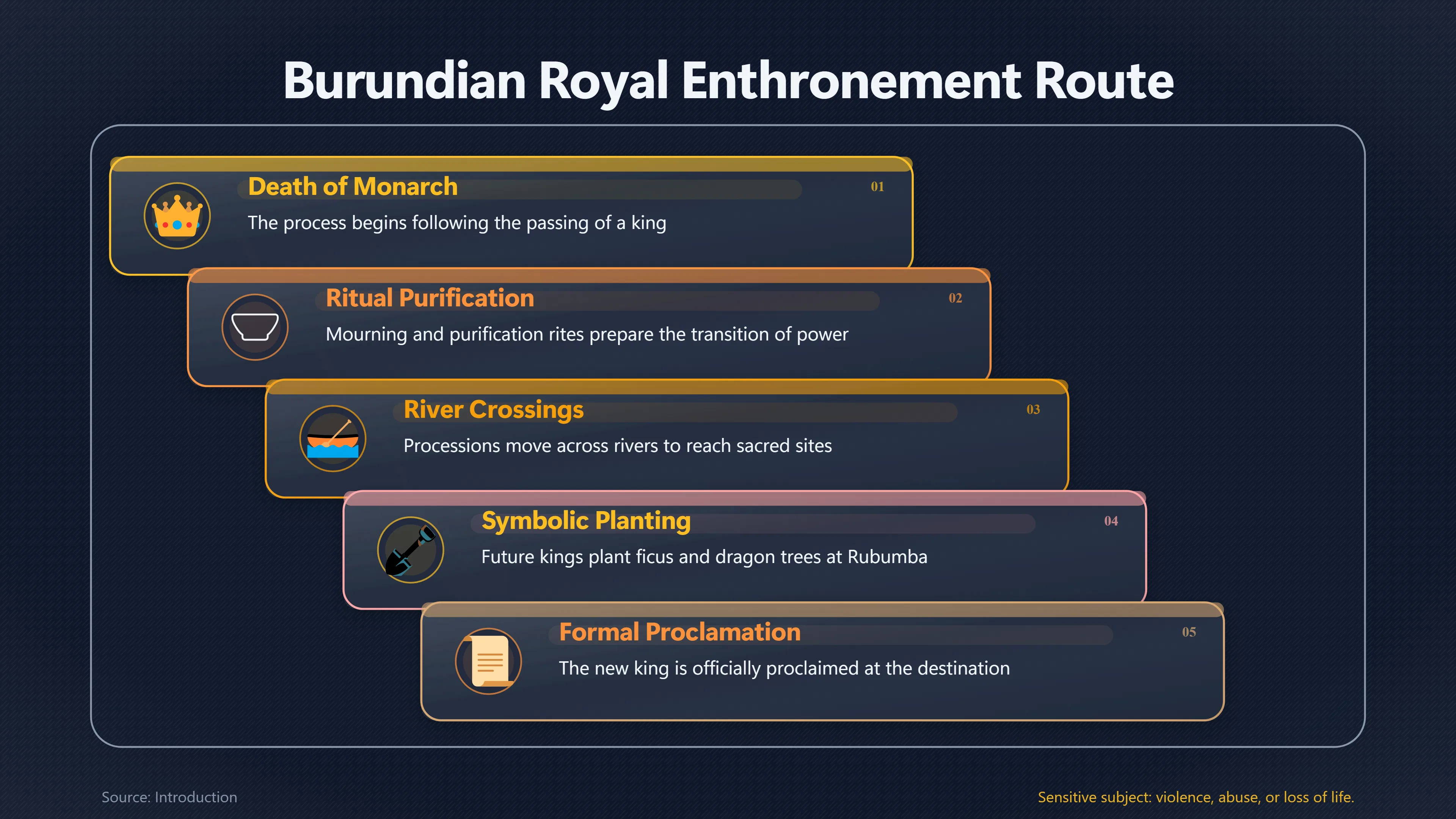
UNESCO’s description of Burundi’s sacred landscapes records an elaborate enthronement route beginning after the death of a monarch. Mourning, ritual purification, crossings of rivers and ceremonial stops all preceded the formal proclamation of the new king. At key points along the journey, sacred trees were planted, creating living memorials that remained visible long after the ceremony itself had ended.[UNESCO World Heritage Centre]whc.unesco.orgUNESCO World Heritage CentreLes paysages naturels sacrés de Muramvya, de Mpotsa et de Nkiko-Mugamba - UNESCO Centre du patrimoine mondial…
The route included locations such as Mwihangarizo, Rubumba, Kivyeyi and Mbuye. At Rubumba, the future king planted symbolic trees including ficus, dragon trees and erythrinas before continuing towards later ritual stations. Burundi’s tourism authority still presents these groves as surviving reminders of successive monarchs, describing them as enduring symbols of the permanence of the kingdom.[Tourisme Burundi]tourisme.gov.biTourisme Burundi Cultural Tourism – TourismTourisme Burundi Cultural Tourism – Tourism
The importance of these trees was therefore historical as well as spiritual. They marked specific acts performed by identifiable rulers rather than serving simply as sacred woodland.

How Open-Air Heritage Changes the Idea of Collecting
Seen through the lens of unusual collections, Burundi’s sacred groves challenge familiar ideas about what museums preserve.
Instead of collecting portable objects, these landscapes collect associations:
- former royal capitals identified through surviving sacred trees;
- ceremonial routes linking multiple locations into a historical narrative;
- ritual planting that transformed living vegetation into historical evidence;
- places where oral tradition explains features that might otherwise appear ordinary.
The archive is therefore distributed rather than concentrated. Visitors gain the fullest understanding by moving through several connected sites rather than examining a single display.
This also explains why oral interpretation remains so important. A grove without explanation may resemble any other patch of woodland, yet local historical knowledge transforms it into evidence of royal succession, political authority and ceremonial practice. In this sense, guides, ritual custodians and community memory remain part of the “collection” itself rather than merely interpreting it afterwards.[UNESCO World Heritage Centre]whc.unesco.orgUNESCO World Heritage CentreLes paysages naturels sacrés de Muramvya, de Mpotsa et de Nkiko-Mugamba - UNESCO Centre du patrimoine mondial…
What Visitors Should Expect
Travellers expecting formal museum infrastructure may be surprised.
Most sacred royal landscapes consist of hillsides, trees, reconstructed traditional structures or ceremonial spaces rather than galleries filled with labelled artefacts. Interpretation varies considerably between locations, and much depends on local guides or cultural custodians. Some sites, such as Gishora, receive visitors more regularly because of their continuing association with the famous royal drummers, while others remain primarily heritage landscapes whose significance is understood through history rather than spectacle.[UNESCO World Heritage Centre]whc.unesco.orgWorld Heritage Centre Résidence Royale de GishoraUNESCO World Heritage CentreRésidence Royale de Gishora - UNESCO World Heritage Centre…
Respect is especially important because many places retain ceremonial meaning beyond tourism. They are not simply historical parks but locations where cultural identity, memory and traditional authority continue to carry significance for local communities.
Why These Landscapes Matter in Burundi’s Curiosity Heritage
For readers interested in unusual collections, Burundi’s sacred groves demonstrate that a country’s most distinctive archive may exist without display cases or museum labels.
They preserve an exceptionally rare form of political history in which trees, pathways and ceremonial spaces perform the work that monuments, inscriptions or palace museums fulfil elsewhere. Rather than preserving the possessions of kings, they preserve the settings in which kingship itself was enacted.
Within Burundi’s wider landscape of unusual heritage—which includes royal drums, ethnographic collections and reconstructed traditional compounds—these sacred groves stand apart because the collection is alive. The trees continue to grow, the landscapes continue to be visited and, in places such as Gishora, ritual traditions remain intertwined with the historic setting, making the archive both historical and living at the same time.[UNESCO World Heritage Centre]whc.unesco.orgWorld Heritage Centre Résidence Royale de GishoraUNESCO World Heritage CentreRésidence Royale de Gishora - UNESCO World Heritage Centre…
Amazon book picks
Further Reading
Books and field guides related to Can a Sacred Grove Be a Museum?. Use these as the next step if you want deeper reading beyond the article.
Sacred Ecology
Dr Berkes approaches traditional ecological knowledge as a knowledge-practice-belief complex. This complex considers four interrelated le...

Places of the Imagination: Media, Tourism, Culture
First published 2011. Subjects: Social aspects, Culture and tourism, Tourism, Television programs, Literary landmarks.
Landscape and Memory
"Opening a radically new and original path into history, Simon Schama explores the scenery of our Western culture, both real landscapes a...
eBay marketplace picks
Marketplace Samples
Live-tested eBay searches with available results related to this page.
Selected fromAfrican heritage art oneBay.co.uk.

Endnotes
1.
Source: whc.unesco.org
Link:https://whc.unesco.org/fr/listesindicatives/5143/
Source snippet
UNESCO World Heritage CentreLes paysages naturels sacrés de Muramvya, de Mpotsa et de Nkiko-Mugamba - UNESCO Centre du patrimoine mondial...
2.
Source: whc.unesco.org
Title: World Heritage Centre Résidence Royale de Gishora
Link:https://whc.unesco.org/en/tentativelists/6927
Source snippet
UNESCO World Heritage CentreRésidence Royale de Gishora - UNESCO World Heritage Centre...
3.
Source: whc.unesco.org
Link:https://whc.unesco.org/en/tentativelists/5143/
Source snippet
UNESCO World Heritage CentreLes paysages naturels sacrés de Muramvya, de Mpotsa et de Nkiko-Mugamba - UNESCO World Heritage CentreMay 9...
5.
Source: whc.unesco.org
Link:https://whc.unesco.org/fr/listesindicatives/6927/
Source snippet
Ce lieu est une résidence royale qui a été fondée par le roi Ntare Rugamba dans la première mo...
7.
Source: whc.unesco.org
Link:https://whc.unesco.org/en/list/1022/
8.
Source: ich.unesco.org
Title: ritual dance of the royal drum 00989
Link:https://ich.unesco.org/en/RL/ritual-dance-of-the-royal-drum-00989
10.
Source: tourisme.gov.bi
Title: Tourisme Burundi Cultural Tourism – Tourism
Link:https://tourisme.gov.bi/en/cultural-tourism/
11.
Source: gishoradrumsanctuary.com
Link:https://gishoradrumsanctuary.com/heritage/
Source snippet
Heritage - Gishora Drum Sanctuary BurundiJuly 28, 2025 — HERITAGE The Sacred Legacy of Burundi’s Royal Drums The Gishora Drum Sanctuary i...
Published: July 28, 2025
12.
Source: tourisme.gov.bi
Link:https://tourisme.gov.bi/tourisme-culturel/
13.
Source: geognos.com
Link:https://geognos.com/en/place/burundi
Additional References
14.
Source: culturalheritageonline.com
Title: Gishora Drum Sanctuary, Burundi
Link:https://culturalheritageonline.com/places/gishora-drum-sanctuary-burundi/
Source snippet
CHOJune 12, 2026 — GISHORA DRUM SANCTUARY, BURUNDI By Cultural Heritage Online / 2026-06-12 Image: Gishora Drum...
Published: June 12, 2026
15.
Source: youtube.com
Title: The Royal Drummers of Burundi | Gishora Drum Sanctuary | Gitega
Link:https://www.youtube.com/watch?v=KoLnc9pGQls
Source snippet
Burundi's timeless drumming tradition thrives through generations...
16.
Source: youtube.com
Title: I Explored the Ancient Royal Site Every Burundian Learns About in School
Link:https://www.youtube.com/watch?v=hRhg4dLKYEk
Source snippet
Burundi Folklore The Drum That Knew Who Would Die...
17.
Source: youtube.com
Title: Burundi’s timeless drumming tradition thrives through generations
Link:https://www.youtube.com/watch?v=TIM9-SUB1_Q
Source snippet
Burundi Travel Documentary | Africa's Hidden Treasure...
18.
Source: youtube.com
Title: Burundi Folklore The Drum That Knew Who Would Die
Link:https://www.youtube.com/watch?v=Q6jb8Fynfts
Source snippet
The Royal Drummers of Burundi | Gishora Drum Sanctuary | Gitega...
19.
Source: burunditravel.bi
Link:https://burunditravel.bi/en/linvestiture-dun-roi-au-burundi-un-rituel-traditionnel-et-sacre/
20.
Source: burundi-forum.org
Title: Les paysages naturels sacrés de Muramvya, de Mpotsa et de Nkiko-Mugamba
Link:https://burundi-forum.org/32079/les-paysages-naturels-sacres-de-muramvya-de-mpotsa-et-de-nkiko-mugamba/
21.
Source: isanganiro.org
Title: Buryenda n’est plus, Karyenda non plus. Une perte?
Link:https://isanganiro.org/2015/11/10/buryenda-nest-plus-karyenda-non-plus-une-perte/
22.
Source: thecivilizationarchive.com
Title: Origins: The Genesis of a Highland Kingdom
Link:https://thecivilizationarchive.com/civilization/burundi-kingdom/chapter/1
23.
Source: youtube.com
Title: Burundi Travel Documentary | Africa’s Hidden Treasure
Link:https://www.youtube.com/watch?v=802Wud6Jicw