Within Curious Chad
Were Chad's Sao Ancestors Really Giants?
Sao objects sit between archaeology, giant folklore and a modern struggle over looting, provenance and cultural ownership.
On this page
- Terracotta figures and giant traditions
- Gaoui's palace museum and living pottery
- Looting, provenance and the trade in Sao objects
Page outline Jump by section
Introduction
The ancient Sao are among Chad’s most intriguing historical communities because they exist simultaneously in archaeology, oral tradition and modern heritage politics. Excavations around the Lake Chad basin have uncovered remarkable terracotta sculptures, pottery, metalwork and fortified settlements, while local stories remember the Sao as giants of extraordinary strength who built great cities before disappearing from history. Rather than dismissing one tradition in favour of the other, museums and heritage sites in Chad often present both side by side, allowing visitors to see how archaeological evidence and living memory continue to shape each other.[UNESCO World Heritage Centre]whc.unesco.orgWorld Heritage Centre Lake Chad Cultural Landscape (NigeriaUNESCO World Heritage CentreLake Chad Cultural Landscape (Nigeria) - UNESCO World Heritage CentreNovember 7, 2018…
The result is one of Chad’s most distinctive forms of curiosity culture. Sao artefacts are admired as masterpieces of ancient craftsmanship, collected as archaeological treasures and, unfortunately, targeted by looters and the international antiquities market. At the same time, debates over ownership, provenance and cultural identity mean that these objects remain far more than museum pieces: they are symbols of ancestry, national heritage and contested history.
Were Chad’s Sao Ancestors Really Giants?
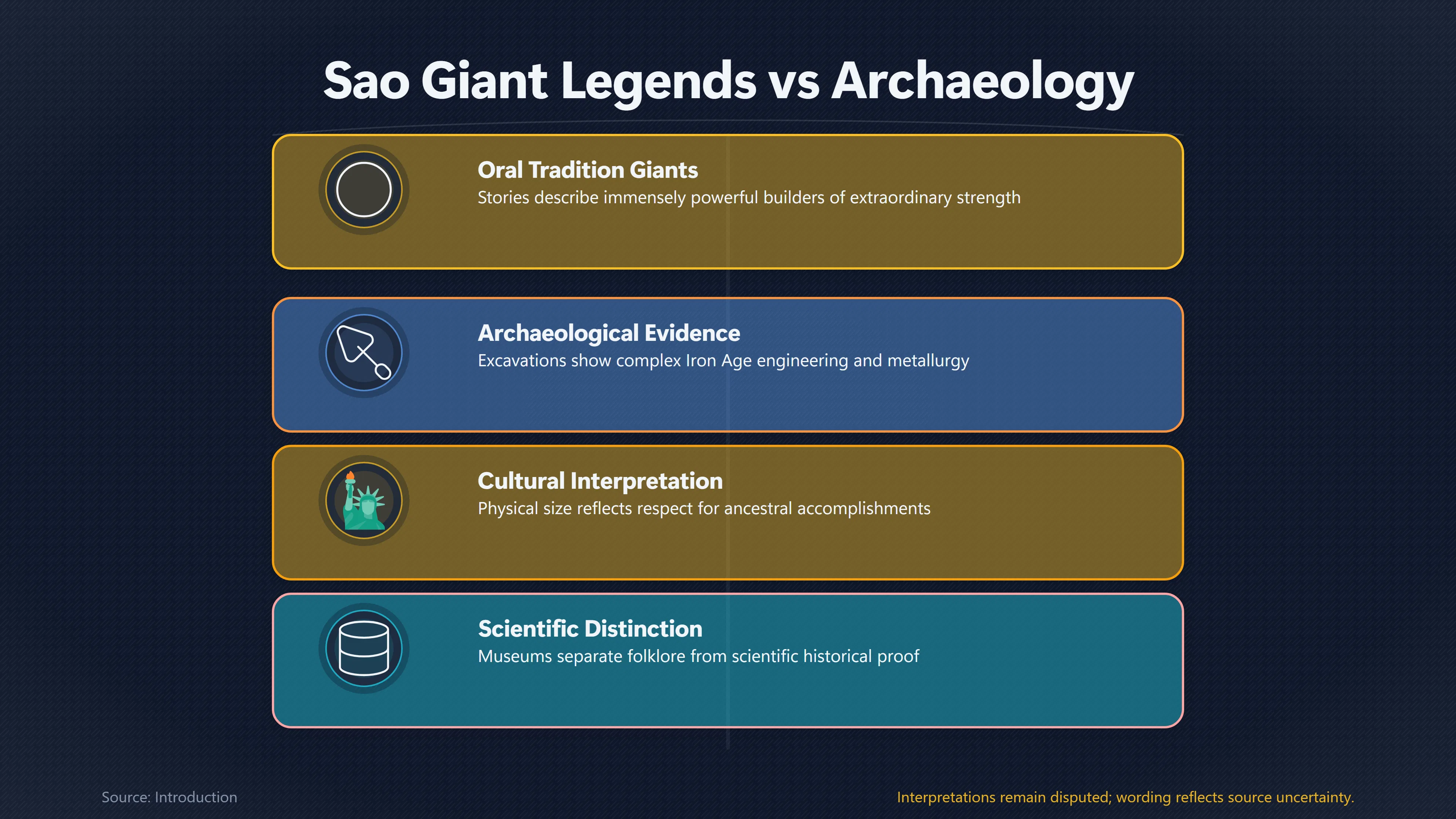
Stories describing the Sao as giants are deeply rooted across the Lake Chad region. In local oral traditions they are remembered as immensely powerful builders capable of extraordinary feats, with some tales portraying them as physically larger than later populations. These traditions survived long after the Sao political communities disappeared and remain especially strong among groups such as the Kotoko, many of whom regard themselves as descendants of the ancient civilisation.[RFI]rfi.frTchad [Série 3/3]: à Gaoui, personne n’oublie le peuple SaoTchad [Série 3/3]: à Gaoui, personne n’oublie le peuple Sao - Reportage Afrique - RFIOctober 16, 2021…
Archaeology, however, provides no evidence that the Sao were literally giants. Excavated cemeteries, settlements and artefacts point instead to complex Iron Age societies whose achievements came from skilled engineering, agriculture, fishing and metallurgy rather than unusual human stature. Scholars generally interpret the giant stories as a familiar pattern in oral history: powerful ancestral peoples become remembered as physically larger than life, expressing respect for their accomplishments rather than recording biological fact.[Wikipedia]WikipediaSao civilisationSao civilisation
The legends nevertheless matter because they shape how many visitors first encounter Sao heritage. The fascination with “giants” draws attention to genuine archaeological discoveries, but responsible museums increasingly distinguish between folklore and scientific interpretation rather than presenting the legends as historical proof.
Terracotta Figures and Giant Traditions
The Sao are often described as the “civilisation of terracotta” because of the extraordinary quantity and quality of ceramic sculpture recovered from sites around southern Lake Chad. Archaeologists have uncovered expressive human heads, complete figures, animals, decorated vessels and ritual objects, alongside sophisticated copper, bronze and iron artefacts. Many sculptures date from the later centuries of Sao development, although the broader cultural tradition extends over many centuries.[International Council of Museums]icom.museumInternational Council of Museums Sao terracottaInternational Council of MuseumsSao terracotta - International Council of Museums - International Council of Museums…
These sculptures are unusual because they are both highly individual and technically accomplished. Faces often display scarification patterns, elaborate hairstyles or jewellery that may reflect social identity, while animal figures suggest symbolic or ceremonial functions. Many pieces were recovered from archaeological mounds that appear to have contained ritual deposits rather than ordinary domestic rubbish, making their original purpose difficult to reconstruct with certainty.[International Council of Museums]icom.museumInternational Council of Museumsthe looting of African archaeological objectsInternational Council of Museumsthe looting of African archaeological objects
For visitors, the terracottas create an interesting tension. They are frequently displayed beside explanations of Sao legends, encouraging comparisons between myth and material evidence. A finely modelled human head may inspire stories about giant ancestors, yet archaeologists interpret it primarily as evidence for artistic traditions, ritual practice and everyday life within an organised society.

Gaoui’s Palace Museum and Living Pottery
A short distance from N’Djamena, the former sultan’s palace at Gaoui offers one of the most distinctive places to encounter Sao heritage. The village itself is closely associated with traditions that identify it as an important Sao centre, and local memory continues to celebrate the ancient inhabitants as legendary giants. The palace museum preserves archaeological finds alongside historical objects connected with later Kotoko rulers, illustrating how different layers of regional history overlap.[Wikipedia]WikipediaOpen source on wikipedia.org.
Gaoui is also known for its continuing pottery traditions. This matters because the site presents heritage as something still practised rather than simply excavated. Visitors can see contemporary ceramic production while also viewing ancient terracotta forms, making it easier to understand how clay working has remained central to communities around Lake Chad even though styles and purposes have changed over many centuries.[Wikipedia]WikipediaOpen source on wikipedia.org.
The museum therefore functions less as a conventional archaeological gallery than as a meeting point between living craft traditions, oral history and excavated objects. The giant stories are not treated simply as tourist entertainment but as part of the community’s cultural memory, existing alongside archaeological interpretation rather than replacing it.
Looting, Provenance and the Trade in Sao Objects
The greatest modern challenge facing Sao heritage is not deciding whether giant legends are literally true but protecting the archaeological record itself.
Sao terracottas have long attracted collectors because they are visually striking, comparatively portable and internationally recognisable. This demand has encouraged illegal excavation and the removal of objects from archaeological sites across Chad, Cameroon and Nigeria. Once artefacts lose their documented archaeological context, researchers also lose crucial information about dating, ritual use and the societies that produced them.[International Council of Museums]icom.museumInternational Council of Museumsthe looting of African archaeological objectsInternational Council of Museumsthe looting of African archaeological objects
The International Council of Museums includes Sao terracottas and bronzes on its Red List of vulnerable African cultural objects. The list is not a catalogue of stolen artefacts but a warning that such pieces are at high risk of illicit trafficking and should receive careful scrutiny in the art market. It highlights the widespread distribution of Sao material across three modern countries and notes that many objects appear to derive from ancient ritual contexts.[International Council of Museums]icom.museumInternational Council of Museums Sao terracottaInternational Council of MuseumsSao terracotta - International Council of Museums - International Council of Museums…
Questions of provenance therefore accompany almost every important Sao sculpture outside controlled excavations. Museums increasingly emphasise documented excavation histories and lawful acquisition, while collectors face greater expectations to demonstrate that objects were exported legally and ethically. These debates have become part of the objects’ modern history, adding another layer to their significance.
Why Sao Heritage Remains Contested
The Sao are difficult to fit into a single historical narrative because archaeology, national identity and local tradition do not always ask the same questions.
Researchers debate the precise development of Sao societies and caution that “Sao” may describe a broad archaeological tradition rather than one unified kingdom extending unchanged across a millennium. Oral traditions, meanwhile, preserve memorable stories of giant ancestors whose achievements helped explain impressive earthworks, walls and ancient ruins. Heritage authorities often emphasise both perspectives, recognising folklore as an important cultural inheritance without presenting it as archaeological evidence.[Wikipedia]WikipediaSao civilisationSao civilisation
The heritage is also shared across modern political borders. Archaeological sites and descendant communities extend through Chad, Cameroon and Nigeria, making the Sao part of a wider Lake Chad cultural landscape rather than the exclusive inheritance of any single nation. UNESCO’s tentative World Heritage documentation likewise presents the civilisation as central to the long-term cultural history of the lake and highlights continuing traditions among descendant communities.[UNESCO World Heritage Centre]whc.unesco.orgWorld Heritage Centre Lake Chad Cultural Landscape (NigeriaUNESCO World Heritage CentreLake Chad Cultural Landscape (Nigeria) - UNESCO World Heritage CentreNovember 7, 2018…
For travellers interested in Chad’s unusual collections, this combination of ancient sculpture, legendary giants and ongoing debates over ownership makes Sao heritage one of the country’s most compelling examples of how archaeology becomes part of living culture. The fascination lies not in proving that giants once walked the shores of Lake Chad, but in understanding how remarkable artefacts continue to inspire stories, identity and arguments over the past long after the civilisation that created them disappeared.
Amazon book picks
Further Reading
Books and field guides related to Were Chad's Sao Ancestors Really Giants?. Use these as the next step if you want deeper reading beyond the article.
The Archaeology of Africa: Food, Metals and Towns
Africa has a vibrant past. It emerges from this book as the proud possessor of a vast and highly complicated interweaving of peoples and...
The Oxford History of Ancient Egypt
The Oxford History of Ancient Egypt describes the emergence and development of the distinctive civilization of the ancient Egyptians, fro...

Looted: The Battle over the Stolen Treasures of the Ancient W...
First published 2009. Subjects: Art thefts, Cultural property, Art, ancient, New York Times reviewed.
eBay marketplace picks
Marketplace Samples
Live-tested eBay searches with available results related to this page.
Selected fromSahara wall art oneBay.co.uk.

Endnotes
1.
Source: whc.unesco.org
Title: World Heritage Centre Lake Chad Cultural Landscape (Nigeria)
Link:https://whc.unesco.org/en/tentativelists/6360
Source snippet
UNESCO World Heritage CentreLake Chad Cultural Landscape (Nigeria) - UNESCO World Heritage CentreNovember 7, 2018...
Published: November 7, 2018
2.
Source: Wikipedia
Title: Sao civilisation
Link:https://en.wikipedia.org/wiki/Sao_civilisation
3.
Source: rfi.fr
Title: Tchad [Série 3/3]: à Gaoui, personne n’oublie le peuple Sao
Link:https://www.rfi.fr/fr/podcasts/reportage-afrique/20211016-tchad-s%C3%A9rie-3-3-%C3%A0-gaoui-personne-n-oublie-le-peuple-sao
Source snippet
Tchad [Série 3/3]: à Gaoui, personne n’oublie le peuple Sao - Reportage Afrique - RFIOctober 16, 2021...
Published: October 16, 2021
4.
Source: Wikipedia
Link:https://en.wikipedia.org/wiki/Gaoui
5.
Source: whc.unesco.org
Title: World Heritage Centre Paysage culturel du Lac Tchad (Chad)
Link:https://whc.unesco.org/en/tentativelists/6361
Source snippet
UNESCO World Heritage CentrePaysage culturel du Lac Tchad (Chad) - UNESCO World Heritage Centre...
6.
Source: whc.unesco.org
Link:https://whc.unesco.org/en/tentativelists/6368/
Source snippet
culturel du Lac Tchad (Cameroon) - UNESCO World Heritage CentreDecember 7, 2018 — PAYSAGE CULTUREL DU LAC TCHAD (CAMEROON) Cameroon Date...
Published: December 7, 2018
8.
Source: whc.unesco.org
Link:https://whc.unesco.org/fr/listesindicatives/6360
10.
Source: icom.museum
Title: International Council of Museums Sao terracotta
Link:https://icom.museum/en/object/sao-terracotta/
Source snippet
International Council of MuseumsSao terracotta - International Council of Museums - International Council of Museums...
11.
Source: icom.museum
Title: International Council of Museumsthe looting of African archaeological objects
Link:https://icom.museum/wp-content/uploads/2019/03/Red-List-Africa-English-and-French.pdf
12.
Source: icom.museum
Title: Sao terracotta
Link:https://icom.museum/es/object/sao-terracotta/
Additional References
13.
Source: youtube.com
Title: Sleep Story: Sao Civilization & Ancient Lake Chad Mysteries ASMR
Link:https://www.youtube.com/watch?v=QRtZFtvBHKk
Source snippet
The Heart of Africa: Ancient Empires, Fossils, and Wonders of Chad - Lost Civilizations&Rich History...
14.
Source: youtube.com
Title: The Heart of Africa: Ancient Empires, Fossils, and Wonders of Chad
Link:https://www.youtube.com/watch?v=z8Kw0wMX0yA
Source snippet
The Ancient Civilization Made Up Of Giants...
15.
Source: universalis.fr
Title: Encyclopædia Universalis SAO | Histoire
Link:https://www.universalis.fr/encyclopedie/sao/
Source snippet
Encyclopædia UniversalisSAO | Histoire - Encyclopédie Universalis...
16.
Source: youtube.com
Title: Sao Culture | A Forgotten African Civilization
Link:https://www.youtube.com/watch?v=jEfQg2n4dms
Source snippet
Musee National N'Djamena (National Museum) in N'Djamena, Chad...
17.
Source: youtube.com
Title: The Ancient Civilization Made Up Of Giants
Link:https://www.youtube.com/watch?v=2lCln8bueeA
Source snippet
Sao Culture | A Forgotten African Civilization...
18.
Source: historyrise.com
Title: The Sao Civilization of the Chad Basin | History Rise
Link:https://historyrise.com/article/the-sao-civilization-of-the-chad-basin/
19.
Source: youtube.com
Title: Musee National N’Djamena (National Museum) in N’Djamena, Chad
Link:https://www.youtube.com/watch?v=aUjJBcTilV0