Within Curious Comoros
Can Comoros' Old Towns Be Museums?
Comoros' old medinas preserve mosques, tombs, palaces and street patterns that function like open-air collections still embedded in daily life.
On this page
- Medinas shaped by the western Indian Ocean
- Sacred buildings, tombs and inherited objects
- Preservation, access and living heritage
Page outline Jump by section
Introduction
Comoros has relatively few conventional museums, but some of its most important “collections” are entire historic towns. The old sultanate centres preserve layers of architecture, sacred places, royal residences, family heirlooms and urban traditions that remain embedded in everyday life rather than displayed behind glass. Walking through these districts is less like visiting an archaeological park and more like entering a living archive where houses are still occupied, mosques still host worship, tombs remain places of respect and ceremonial spaces continue to shape community life.
This makes the old medinas one of the country’s most distinctive forms of public heritage. Instead of separating historic objects from the people who use them, Comorian towns preserve them in their original setting. The result is a rare blend of architecture, memory and living custom that helps explain why the Historic Sultanates of Comoros have been on UNESCO’s Tentative List since 2007 and remain the focus of ongoing conservation work.[UNESCO World Heritage Centre]whc.unesco.orgWorld Heritage Centre Sultanats Historiques des ComoresUNESCO World Heritage CentreSultanats Historiques des Comores - UNESCO World Heritage CentreJanuary 31, 2007…
Can Comoros’ Old Towns Be Museums?
The answer is both yes and no. They are not museums in the formal sense. There are no admission desks, labelled display cases or carefully separated exhibition galleries. Yet they perform many of the same functions.
The historic quarters preserve evidence of centuries of political authority, trade across the western Indian Ocean, religious life and local craftsmanship. Narrow streets, monumental gateways, carved doors, public squares, royal palaces, defensive walls and old mosques collectively tell stories that would normally be spread across several museum galleries. Instead, they remain part of functioning neighbourhoods.[UNESCO World Heritage Centre]whc.unesco.orgWorld Heritage Centre Sultanats Historiques des ComoresUNESCO World Heritage CentreSultanats Historiques des Comores - UNESCO World Heritage CentreJanuary 31, 2007…
This creates a different visitor experience. Rather than looking at preserved artefacts, visitors encounter heritage in use. Children play in lanes that follow medieval street plans, families occupy former noble houses, and religious buildings continue to serve the communities that originally built them.
Medinas Shaped by the Western Indian Ocean
The historic towns developed through centuries of contact with East Africa, the Swahili coast, Arabia and the wider Indian Ocean trading world. Their architecture reflects these connections without simply copying any single regional style.
UNESCO’s proposed Historic Sultanates include five principal urban centres:
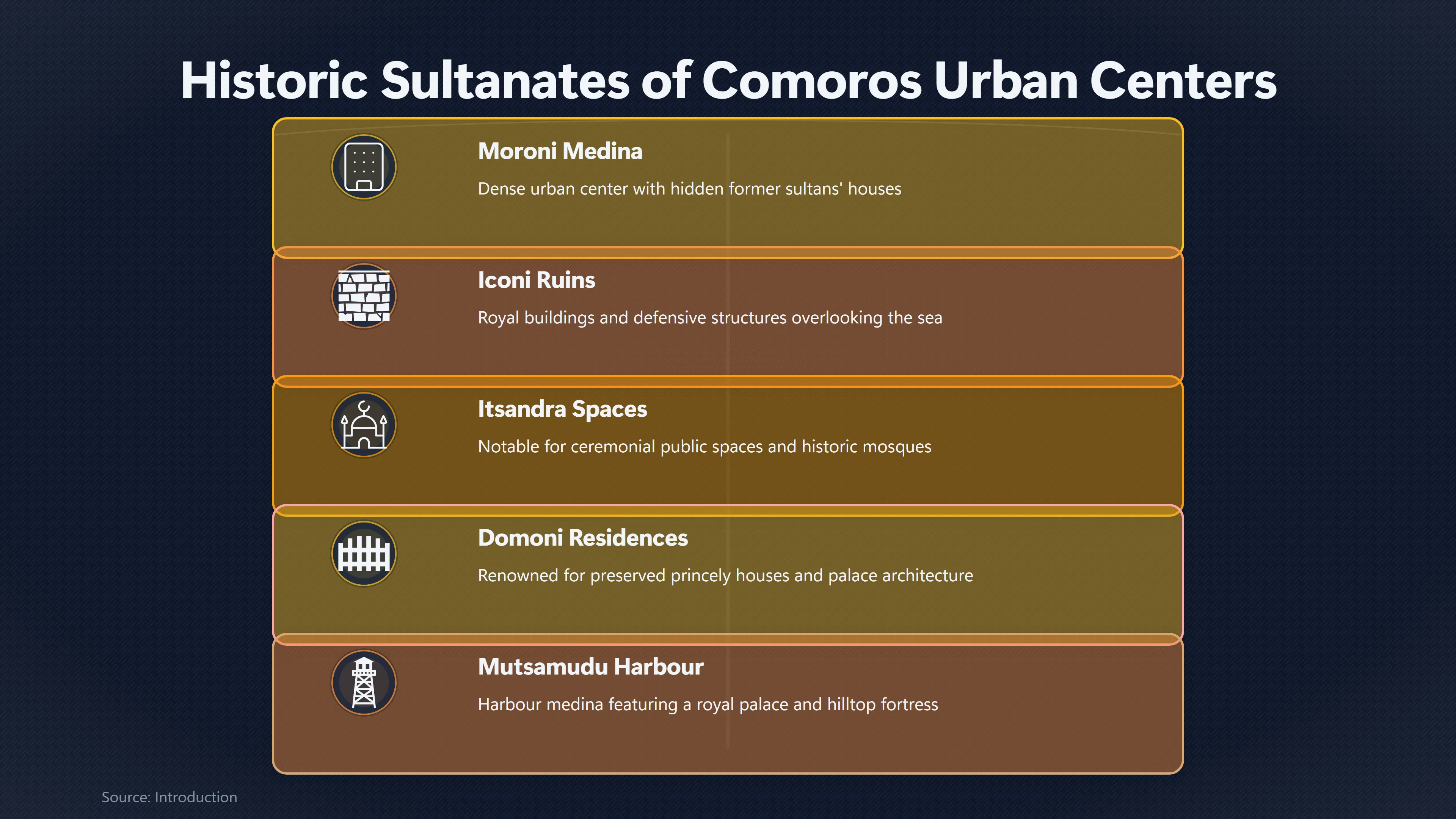
- Moroni, whose dense medina still contains former sultans’ houses hidden among tightly packed multi-storey buildings.
- Iconi, where ruins of royal buildings and defensive structures overlook the sea.
- Itsandra, once an important political centre, notable for its ceremonial public spaces and historic mosques.
- Domoni on Anjouan, renowned for its preserved princely houses and palace architecture.
- Mutsamudu, whose harbour medina, royal palace and hilltop fortress illustrate the island’s maritime history.[UNESCO World Heritage Centre]whc.unesco.orgWorld Heritage Centre Sultanats Historiques des ComoresUNESCO World Heritage CentreSultanats Historiques des Comores - UNESCO World Heritage CentreJanuary 31, 2007…
Although each town has its own character, they share recognisable features:
- exceptionally narrow winding streets;
- coral-stone houses built closely together;
- carved wooden doors and decorative niches;
- neighbourhood mosques;
- public gathering squares;
- palaces and elite residences;
- tombs of rulers and religious figures.
Together these elements form an open-air collection documenting several centuries of urban life in the Comorian sultanates.[UNESCO World Heritage Centre]whc.unesco.orgWorld Heritage Centre Sultanats Historiques des ComoresUNESCO World Heritage CentreSultanats Historiques des Comores - UNESCO World Heritage CentreJanuary 31, 2007…
Sacred Buildings, Tombs and Inherited Objects
Unlike many archaeological sites, the historic quarters are not frozen in time. Their most important buildings remain active parts of religious and family life.
Historic mosques continue to function as places of worship rather than monuments. Mausoleums associated with respected religious figures remain places where local people pay their respects. Former royal residences often stay within the descendants of historic families rather than becoming state museums. This continuity means many significant objects—such as carved doors, painted ceilings, architectural decoration, manuscripts and ceremonial furnishings—are still kept within their original social setting instead of being transferred into public collections.[UNESCO World Heritage Centre]whc.unesco.orgWorld Heritage Centre Sultanats Historiques des ComoresUNESCO World Heritage CentreSultanats Historiques des Comores - UNESCO World Heritage CentreJanuary 31, 2007…
Domoni offers particularly strong examples. UNESCO’s documentation describes princely houses, medieval palace remains and later royal buildings that still retain painted ceilings and decorative wall niches, illustrating how architecture itself functions as a historical record.[UNESCO World Heritage Centre]whc.unesco.orgWorld Heritage Centre Sultanats Historiques des ComoresUNESCO World Heritage CentreSultanats Historiques des Comores - UNESCO World Heritage CentreJanuary 31, 2007…
Mutsamudu likewise preserves a remarkable combination of urban features. Its Royal Palace of the Ujumbe sits within a tightly woven street network of stone buildings, while the nearby citadel and surviving defensive structures reveal the military and commercial importance of the port during the sultanate period.[UNESCO World Heritage Centre]whc.unesco.orgUNESCO World Heritage CentreWorld Heritage Centre - Reviving the Palais royal de l’Ujumbé in Mutsamudu, Comoros…

Why These Towns Feel Like Collections Rather Than Ruins
Most archaeological sites gradually become separated from everyday life. Comoros’ historic sultanate towns largely avoided that process.
Instead of displaying isolated masterpieces, the towns preserve relationships between different kinds of heritage:
- architecture connected to social hierarchy;
- mosques connected to continuing religious practice;
- public squares linked to civic ceremonies;
- family houses preserving inherited craftsmanship;
- tombs maintaining local memory;
- street layouts reflecting centuries-old patterns of movement.
This gives visitors a broader understanding than an individual museum object often can. A carved doorway gains additional meaning when it remains attached to the house and neighbourhood for which it was created.
The experience also requires greater sensitivity. Visitors are entering residential communities rather than heritage parks. Photography, access to religious buildings and movement through private areas should always respect local customs.

Preservation, Access and Living Heritage
The qualities that make these towns unusual also create conservation challenges.
Because they remain inhabited, repairs must balance modern housing needs with protection of historic fabric. New construction, environmental wear, changing building materials and limited conservation funding all place pressure on centuries-old structures. Some monuments have already disappeared or were altered during the colonial period and subsequent urban development.[UNESCO World Heritage Centre]whc.unesco.orgWorld Heritage Centre Sultanats Historiques des ComoresUNESCO World Heritage CentreSultanats Historiques des Comores - UNESCO World Heritage CentreJanuary 31, 2007…
Recognising these pressures, UNESCO and Comorian institutions have supported several major initiatives. A detailed architectural inventory documented hundreds of historic elements across multiple towns, including streets, palaces, houses, mosques and public spaces, creating an essential record for future conservation. Later projects focused on preparing management plans and strengthening protection for the Historic Sultanates as a potential World Heritage nomination.[UNESCO World Heritage Centre]whc.unesco.orgUNESCO World Heritage CentreInventory and cultural mapping of Sultanate’s architectural and urban heritage - UNESCO World Heritage Centre…
At the same time, UNESCO has worked with Comorian authorities on safeguarding intangible cultural heritage, recognising that preserving traditions, skills and community knowledge is as important as protecting buildings themselves. Living practices give meaning to the architecture and help explain why these towns cannot simply become static museum pieces.[ICH UNESCO]ich.unesco.orgUNESCO Intangible Cultural HeritageJanuary 16, 2020…
Why They Matter Within Comoros’ Curiosity Heritage
For travellers interested in unusual collections, Comoros demonstrates that a country’s most fascinating “museum” need not occupy a single building.
The historic sultanate towns preserve an unusually complete combination of urban form, religious life, family memory and political history that still functions within ordinary daily life. Their significance lies not in isolated treasures but in the survival of an entire cultural landscape where buildings, objects, rituals and stories continue to reinforce one another.
In a country where formal museum infrastructure remains limited, these medinas act as living collections—places where history has not been removed from its original context but continues to shape the streets, homes and communities that inherited it.
Amazon book picks
Further Reading
Books and field guides related to Can Comoros' Old Towns Be Museums?. Use these as the next step if you want deeper reading beyond the article.
The ^AIndian Ocean in World History
The Indian Ocean in World History explores the cultural exchanges that took place in this region from ancient to modern times. Alpers exp...
The Past is a Foreign Country - Revisited
A completely updated new edition of David Lowenthal's classic account of how we reshape the past to serve present needs.
Architecture and Power in Africa
Two of the most ambitious religious edifices of the 20th century are the Our Lady of Peace Basilica in the West African country of the Iv...

Uses of Heritage
First published 2006. Subjects: Material culture, Group identity, Performance art.
eBay marketplace picks
Marketplace Samples
Live-tested eBay searches with available results related to this page.
Selected fromAfrican heritage poster oneBay.co.uk.

Endnotes
1.
Source: whc.unesco.org
Title: World Heritage Centre Sultanats Historiques des Comores
Link:https://whc.unesco.org/en/tentativelists/5109/
Source snippet
UNESCO World Heritage CentreSultanats Historiques des Comores - UNESCO World Heritage CentreJanuary 31, 2007...
Published: January 31, 2007
2.
Source: unesco.org
Title: Comoros prepares a management and conservation plan for the Historic
Link:https://www.unesco.org/en/articles/comoros-prepares-management-and-conservation-plan-historic-sultanats-comoros
Source snippet
November 18, 2020 — COMOROS PREPARES A MANAGEMENT AND CONSERVATION PLAN FOR THE HISTORIC SULTANATS OF COMOROS Chirazienne Mosque ©DGAC Co...
Published: November 18, 2020
3.
Source: whc.unesco.org
Link:https://whc.unesco.org/en/news/1261
Source snippet
UNESCO World Heritage CentreInventory and cultural mapping of Sultanate’s architectural and urban heritage - UNESCO World Heritage Centre...
4.
Source: whc.unesco.org
Link:https://whc.unesco.org/en/activities/1479/
Source snippet
UNESCO World Heritage CentreWorld Heritage Centre - Reviving the Palais royal de l’Ujumbé in Mutsamudu, Comoros...
5.
Source: ich.unesco.org
Link:https://ich.unesco.org/en/news/comoros-makes-significant-strides-to-ensure-the-safeguarding-of-living-heritage-13250
Source snippet
UNESCO Intangible Cultural HeritageJanuary 16, 2020...
Published: January 16, 2020
6.
Source: unesco.org
Link:https://www.unesco.org/en/articles/stitching-heritage-unesco-supports-safeguarding-living-heritage-comoros?hub=66969
Source snippet
February 18, 2026 — STITCHING HERITAGE: UNESCO SUPPORTS SAFEGUARDING OF LIVING HERITAGE IN COMOROS “Our intangible cultural heritage cons...
Published: February 18, 2026
7.
Source: unesco.org
Title: Comoros establishes a National Committee for Intangible Cultural
Link:https://www.unesco.org/en/articles/comoros-establishes-national-committee-intangible-cultural-heritage
8.
Source: whc.unesco.org
Link:https://whc.unesco.org/fr/listesindicatives/5109/
9.
Source: whc.unesco.org
Link:https://whc.unesco.org/en/statesparties/km/
10.
Source: whc.unesco.org
Link:https://whc.unesco.org/en/list/498
12.
Source: ich.unesco.org
Title: comoros KM
Link:https://ich.unesco.org/en/state/comoros-KM
13.
Source: whc.unesco.org
Link:https://whc.unesco.org/en/list/116/
Additional References
14.
Source: lagazettedescomores.com
Link:https://lagazettedescomores.com/soci%C3%A9t%C3%A9/patrimoine-mondial-de-l%E2%80%99unesco-10680.html
Source snippet
June 13, 2022 — PATRIMOINE MONDIAL DE L’UNESCO: POUR L’INSCRIPTION DES SULTANATS DES COMORES DANS LA LISTE DU PATRIMOINE MONDIAL * 13/06/...
Published: June 13, 2022
15.
Source: youtube.com
Title: The Palaces of Anjouan: Secrets of the Ancient Sultans Finally Revealed
Link:https://www.youtube.com/watch?v=I9uzJ-ervE4
Source snippet
Unveiling Moroni's Medina: Dive into Comoros' Vibrant Culture...
16.
Source: youtube.com
Title: Unveiling Moroni’s Medina: Dive into Comoros’ Vibrant Culture
Link:https://www.youtube.com/watch?v=y5iMQtuIh-Y
Source snippet
Final Decisive Step for Comorian Heritage...
17.
Source: delegationdescomores.org
Link:https://www.delegationdescomores.org/culture/
18.
Source: patrimoinedescomores.com
Link:https://www.patrimoinedescomores.com/les-medinas
19.
Source: shh.mpg.de
Link:https://www.shh.mpg.de/308075/Boivin-Archaeology-of-the-Comoros
20.
Source: youtube.com
Title: UNESCO delegation visits the Mutsamudu medina
Link:https://www.youtube.com/watch?v=7pplXdcRksQ
Source snippet
Voice of the Comoros: Veri Piya (All in Green)...
21.
Source: youtube.com
Title: Final Decisive Step for Comorian Heritage
Link:https://www.youtube.com/watch?v=ThOr3zDRN5U
Source snippet
UNESCO delegation visits the Mutsamudu medina...
22.
Source: unesco-hist.org
Title: Inventory and cultural mapping of Sultanate’s architectural and urban heritage
Link:https://www.unesco-hist.org/index.php?id=633&r=en%2Farticle%2Finfo
23.
Source: youtube.com
Title: Voice of the Comoros: Veri Piya (All in Green)
Link:https://www.youtube.com/watch?v=Yt9xfPRciCk