Within Curious Guinea
Who Carved Guinea's Buried Stone Figures?
Mysterious stone figures found during farming and mining carry both an unknown ancient history and later lives as ancestral or spirit objects.
On this page
- Where the figures are found and what they look like
- Why their makers, dates and original uses remain uncertain
- How later communities gave the discoveries new meanings
Page outline Jump by section
Introduction
Across the forested borderlands of Guinea, Sierra Leone and Liberia, farmers and miners have occasionally uncovered small carved stone figures while clearing fields, digging wells or working the soil. These objects are among West Africa’s most enduring archaeological mysteries. Although they are often grouped with the better-known nomoli figures of Sierra Leone, Guinea has its own related tradition of stone carvings, especially those associated with the Kissi people. Their original makers, age and purpose remain uncertain, yet many of the figures acquired new lives after their discovery, becoming ancestral objects, ritual protectors or symbols believed to promote fertile harvests. Rather than belonging to a single lost civilisation, they represent a family of related stone sculptures whose archaeological context was largely lost because most were found accidentally rather than through controlled excavation.[cambridge.org]cambridge.orgCambridge University Press & AssessmentThe Stone Sculptures of the Upper Guinea Coast* | History in Africa | Cambridge CoreMay 13, 2014…

Who carved Guinea’s buried stone figures?
The greatest mystery is not that the figures exist, but that they usually appear without the archaeological evidence that would explain them. Most were recovered from cultivated land, stream beds or mining areas long after they had become separated from any original settlement, burial or shrine.
In Guinea, many examples come from the Kissi region near the border with Sierra Leone. Similar discoveries have also been reported among neighbouring Mende communities, suggesting that the tradition crossed modern national boundaries. The carvings are usually made from soft steatite (soapstone), which is relatively easy to shape but survives well underground.[Cambridge University Press & Assessment]cambridge.orgCambridge University Press & AssessmentThe Stone Sculptures of the Upper Guinea Coast* | History in Africa | Cambridge CoreMay 13, 2014…
Scholars have debated their origins for more than a century. One influential interpretation argues that the figures were created by peoples known in early European accounts as the Sapes, who occupied parts of the Upper Guinea Coast before later migrations. This remains a hypothesis rather than an established fact because there are few securely excavated examples that can be dated directly.[Cambridge University Press & Assessment]cambridge.orgCambridge University Press & AssessmentNomoli | The Journal of African History | Cambridge Core…
The absence of reliable archaeological contexts is the central obstacle. Because many figures were discovered individually by chance, archaeologists cannot easily reconstruct the settlements, rituals or social systems that originally surrounded them.
Where the figures are found and what they look like
Unlike statues displayed in museums after planned excavations, these carvings often entered public awareness through ordinary agricultural work. Farmers turning over fields, clearing new farmland or digging wells occasionally encountered them buried beneath the soil.
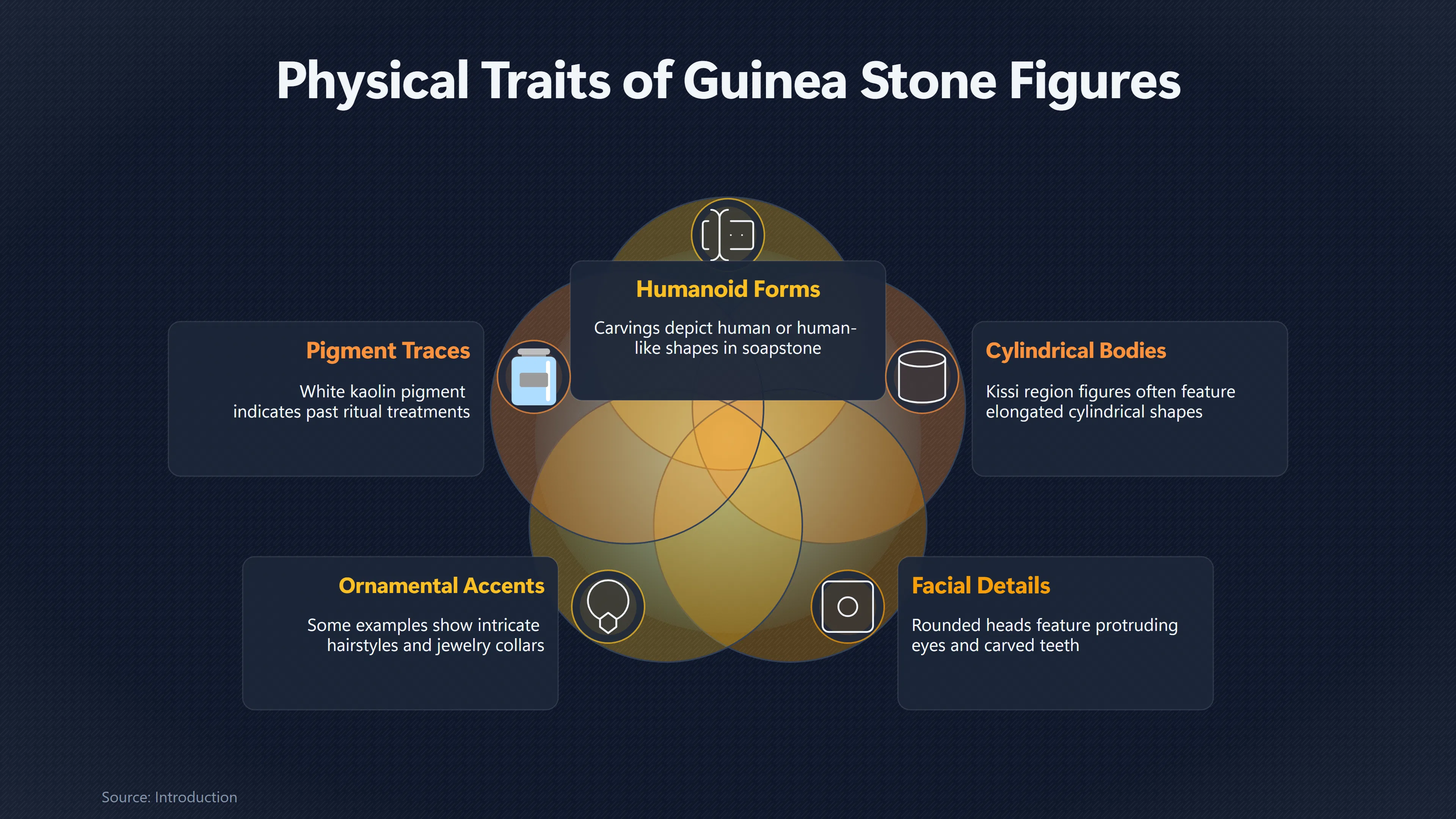
Common characteristics include:
- Human or human-like forms carved from soapstone.[britishmuseum.org]britishmuseum.orgSource details in endnotes.
- Rounded heads with pronounced facial features.
- Cylindrical bodies, particularly among figures associated with the Kissi region.
- Carefully carved hairstyles, jewellery or collars on some examples.
- Sizes ranging from small hand-held figures to larger sculptures.
Museum collections preserve examples showing crossed hands, protruding eyes, carefully carved teeth and traces of white kaolin pigment, indicating that at least some figures continued to receive ritual treatment long after they were unearthed.[si.edu]africa.si.eduNational Museum of African Art Male figure | National Museum of African ArtNational Museum of African Art Male figure | National Museum of African Art
Researchers generally distinguish several related sculptural traditions across the Upper Guinea Coast. The famous nomoli figures dominate southeastern Sierra Leone, while the Kissi area of Guinea is associated with cylindrical soapstone figures often called pomdo or pomtan. A third related group consists mainly of carved stone heads rather than complete figures. These categories overlap geographically and stylistically rather than forming completely separate traditions.[Cambridge University Press & Assessment]cambridge.orgCambridge University Press & AssessmentThe Stone Sculptures of the Upper Guinea Coast* | History in Africa | Cambridge CoreMay 13, 2014…
Why their original purpose remains uncertain
Despite decades of study, there is still no consensus about why these sculptures were first made.
Several factors limit certainty:
- Few excavated examples. Most pieces lack their original archaeological setting.
- Little direct dating. Proposed dates often rely on stylistic comparison rather than laboratory dating.
- Changing meanings over time. Communities that found the figures may not have inherited the beliefs of the people who carved them.
- Regional diversity. Similar-looking sculptures may have served different purposes across different societies.
Researchers have proposed that some figures were ancestral images, ritual guardians or commemorative sculptures. Others may have been associated with religious shrines or political authority. None of these interpretations can yet be demonstrated conclusively for the entire group.[Cambridge University Press & Assessment]cambridge.orgCambridge University Press & AssessmentThe Stone Sculptures of the Upper Guinea Coast* | History in Africa | Cambridge CoreMay 13, 2014…
This uncertainty makes the carvings unusual within Guinea’s archaeological heritage. Their mystery comes not from sensational claims about vanished civilisations but from the genuine lack of evidence needed to connect them confidently with specific historical communities.
How later communities gave the discoveries new meanings
Although their original function remains unknown, the figures did not remain meaningless after being rediscovered.
Among Kissi, Mende and neighbouring communities, unearthed stone figures were frequently understood as belonging to earlier inhabitants of the landscape or to powerful ancestral spirits. Rather than treating them simply as curiosities, people incorporated them into living ritual traditions.[National Museum of African Art]africa.si.eduNational Museum of African Art Male figure | National Museum of African ArtNational Museum of African Art Male figure | National Museum of African Art
Historical and museum records describe several later uses:
- Placing figures on ancestral shrines.
- Making offerings and sacrifices to them.
- Using them in agricultural rituals intended to encourage successful harvests.
- Employing them in oath-taking or divination.
- Treating them as protective spiritual objects for particular communities or initiates.
These later practices should not automatically be assumed to reflect the sculptures’ original purpose. Instead, they illustrate how communities can reinterpret ancient objects whose creators have long disappeared. An artefact recovered from a field became part of a new religious and social landscape, acquiring fresh meanings without preserving a complete memory of its first one.[cambridge.org]cambridge.orgCambridge University Press & AssessmentNomoli | The Journal of African History | Cambridge Core…

Why the figures matter in Guinea’s curiosity landscape
For visitors interested in Guinea’s unusual heritage, these stone figures occupy a distinctive place between archaeology, folklore and museum collecting.
They are unusual because they combine three different histories:
- An archaeological mystery, since their creators remain unidentified.
- A living cultural story, because communities continued to use many of the discoveries in ritual life.
- A museum story, as examples now appear in collections across Africa, Europe and North America, often far from the landscapes where they were found.[britishmuseum.org]britishmuseum.orgBritish Museumfigure | British MuseumBritish Museumfigure | British Museum
Unlike spectacular monuments or famous ruins, Guinea’s buried stone figures are remarkable precisely because they emerged unexpectedly from ordinary farmland. Each discovery connected present-day communities with an unknown past while creating new traditions of interpretation. Their enduring fascination lies not in supernatural claims but in the rare combination of genuine archaeological uncertainty and well-documented cultural reuse, making them one of the most intriguing categories of unusual objects associated with Guinea and the wider Upper Guinea Coast.
Amazon book picks
Further Reading
Books and field guides related to Who Carved Guinea's Buried Stone Figures?. Use these as the next step if you want deeper reading beyond the article.

The Archaeology of Africa: Food, Metals and Towns
Africa has a vibrant past. It emerges from this book as the proud possessor of a vast and highly complicated interweaving of peoples and...
African Archaeology: A Critical Introduction
A landmark introduction to the archaeology of Africa that challenges misconceptions & claims about Africa’s past and teaches students how...
The Art of the Baga: The Nalu and Their Neighbors
First published 1996. Subjects: Arts, Baga, Arts, Black, Baga (African people), Baga Arts, Black Arts.
eBay marketplace picks
Marketplace Samples
Live-tested eBay searches with available results related to this page.
Selected fromarchaeology collectible oneBay.co.uk.
Endnotes
1.
Source: cambridge.org
Link:https://www.cambridge.org/core/journals/history-in-africa/article/abs/stone-sculptures-of-the-upper-guinea-coast/CB3CECBB91AB9D1EE26091BD3036DA3E
Source snippet
Cambridge University Press & AssessmentThe Stone Sculptures of the Upper Guinea Coast* | History in Africa | Cambridge CoreMay 13, 2014...
Published: May 13, 2014
2.
Source: cambridge.org
Link:https://www.cambridge.org/core/journals/journal-of-african-history/article/abs/nomoli/FA25A3EAE9D80C1C3A7DD93B043A4DAC
Source snippet
Cambridge University Press & AssessmentNomoli | The Journal of African History | Cambridge Core...
3.
Source: cambridge.org
Title: The Nomoli of Mende Country | Africa | Cambridge Core
Link:https://www.cambridge.org/core/journals/africa/article/abs/nomoli-of-mende-country/425D3B75F3E17DDF9FADC01458E84406
Source snippet
August 21, 2012 — THE NOMOLI OF MENDE COUNTRY Published online by Cambridge University Press: 21 August 2012 Stanley Brown * * * Article...
Published: August 21, 2012
4.
Source: cambridge.org
Title: History in Africa: Volume 20
Link:https://www.cambridge.org/core/journals/history-in-africa/volume/78F1443BB7D089E3C515D93D905A0AEE
5.
Source: cambridge.org
Title: The Journal of African History: Volume 11
Link:https://www.cambridge.org/core/journals/journal-of-african-history/volume/3339D444D7B1E59CF6B88DF4C59C4CC6
6.
Source: cambridge.org
Link:https://www.cambridge.org/core/journals/journal-of-african-history/most-cited?pageNum=48
7.
Source: youtube.com
Title: Stone Sculptures
Link:https://www.youtube.com/watch?v=wxy4ht3WYTk
Source snippet
SAAM Collection Close Up Episode 20...
8.
Source: africa.si.edu
Title: National Museum of African Art Male figure | National Museum of African Art
Link:https://africa.si.edu/collection/object/nmafa
9.
Source: britishmuseum.org
Title: British Museumfigure | British Museum
Link:https://www.britishmuseum.org/collection/object/E_Af1970
10.
Source: si.edu
Title: Smithsonian Institution Figure | Smithsonian Institution
Link:https://www.si.edu/object/figure%3Anmafa
11.
Source: africa.si.edu
Title: selected artwork
Link:https://africa.si.edu/collection/selected-artwork/2173
12.
Source: si.edu
Title: male figure:nmafa 2005 6 55
Link:https://www.si.edu/object/male-figure%3Anmafa
13.
Source: africa.si.edu
Title: selected artwork
Link:https://africa.si.edu/collection/selected-artwork/2174
14.
Source: africa.si.edu
Link:https://africa.si.edu/collection/object/nmafa
15.
Source: africa.si.edu
Link:https://africa.si.edu/collection/object/nmafa
16.
Source: si.edu
Link:https://www.si.edu/object/figure%3Anmafa
17.
Source: britishmuseum.org
Link:https://www.britishmuseum.org/collection/object/E_Af1963
18.
Source: britishmuseum.org
Link:https://www.britishmuseum.org/collection/object/E_Af1904
Additional References
19.
Source: commons.wikimedia.org
Link:https://commons.wikimedia.org/wiki/File%3AMale_figure%2C_Undetermined_peoples%2C_used_by_Kissi_peoples%2C_Guinea%2C_Possibly_16th_to_17th_century%2C_Stone%2C_pigment_%282922769899%29.jpg
Source snippet
wikimedia.orgFile:Male figure, Undetermined peoples, used by Kissi peoples, Guinea, Possibly 16th to 17th century, Stone, pigment (292276...
20.
Source: metmuseum.org
Title: Nomoli and Pomdo Stone Figures of Upper Guinea
Link:https://www.metmuseum.org/ja/essays/nomoli-pomdo-stone-figures
Source snippet
The Metropolitan Museum of ArtOctober 2, 2025 — NOMOLI AND POMDO STONE FIGURES OF UPPER GUINEA The stone figures of the Upper Guinea coas...
Published: October 2, 2025
21.
Source: youtube.com
Title: Black Contributions HIDDEN in the British Museum
Link:https://www.youtube.com/watch?v=giNhDITYfPc
Source snippet
This selection of videos provides direct context on the stone carvings (known regionally as Nomoli or Pomdo) unearthed in fields across G...
22.
Source: tandfonline.com
Link:https://www.tandfonline.com/doi/abs/10.1080/00043079.1971.10789264
Source snippet
Note on the Stone Nomoli Figures of Sierra Leone: The Art Bulletin: Vol 53, No 3October 30, 2014 — Image: Publication Cover The Art Bulle...
Published: October 30, 2014
23.
Source: youtube.com
Title: Nomoli statuettes, Sapi, Kissi, Mende, Pondo, iridium
Link:https://www.youtube.com/watch?v=YtDXbReMNas
Source snippet
The Nomoli Figurines – Visitors from Another Age?...
24.
Source: commons.wikimedia.org
Link:https://commons.wikimedia.org/wiki/File%3AMale_head%2C_Undetermined_peoples%2C_used_by_Mende_peoples%2C_Sierra_Leone%2C_15th_to_17th_century%2C_Stone_%282922769673%29.jpg
25.
Source: sierraleoneheritage.org
Link:https://sierraleoneheritage.org/glossary/nomoli
26.
Source: sierraleoneheritage.org
Link:https://sierraleoneheritage.org/item/SLNM.1971.02.07/nomoli
27.
Source: sierraleoneheritage.org
Link:https://www.sierraleoneheritage.org/item/SLNM.1965.37.01/nomoli
28.
Source: youtube.com
Title: The Nomoli Figurines – Visitors from Another Age?
Link:https://www.youtube.com/watch?v=f91phffOYPk
Source snippet
Black Contributions HIDDEN in the British Museum...