Within Curious Benin
Why Dahomey's Kings Became Lions and Sharks
Abomey's palaces preserve royal objects, bas-reliefs and hybrid animal symbols that express Dahomean power, ancestry and resistance.
On this page
- How royal animals encoded power
- Sacred objects inside the palace museum
- Colonial removal and the return of royal treasures
Page outline Jump by section
Introduction
The Royal Palaces of Abomey are not simply the remains of a former African kingdom. They are one of Benin’s most remarkable places for understanding how political power, spiritual belief and visual symbolism merged into a single royal language. Within the palace walls, kings expressed their authority through carved bas-reliefs, ceremonial objects and distinctive animal emblems that acted almost like personal coats of arms. Today, the palace museum also tells another story: the removal of royal treasures during the French conquest of 1892 and the internationally significant return of 26 royal objects to Benin in 2021.[UNESCO World Heritage Centre]whc.unesco.orgWorld Heritage Centre Royal Palaces of AbomeyUNESCO World Heritage CentreRoyal Palaces of Abomey - UNESCO World Heritage Centre…

For visitors interested in unusual collections rather than conventional art museums, Abomey offers something distinctive. Many objects are understood not merely as historical artefacts but as symbols of royal ancestors whose political and spiritual significance continues to resonate in modern Benin.
Why Dahomey’s Kings Became Lions and Sharks
The rulers of the Kingdom of Dahomey developed a sophisticated visual system in which every king adopted distinctive symbols that appeared on palace walls, ceremonial objects, royal standards and official regalia. These were not decorative mascots. They communicated authority, personal achievements, dynastic identity and religious legitimacy to subjects in a society where visual storytelling was often more important than written records.[UNESCO World Heritage Centre]whc.unesco.orgWorld Heritage Centre Royal Palaces of AbomeyUNESCO World Heritage CentreRoyal Palaces of Abomey - UNESCO World Heritage Centre…
Walking through the palace complex, visitors encounter dozens of painted clay bas-reliefs depicting these royal emblems. Each ruler used different imagery that reflected particular events or qualities associated with his reign.
Among the best-known examples are:
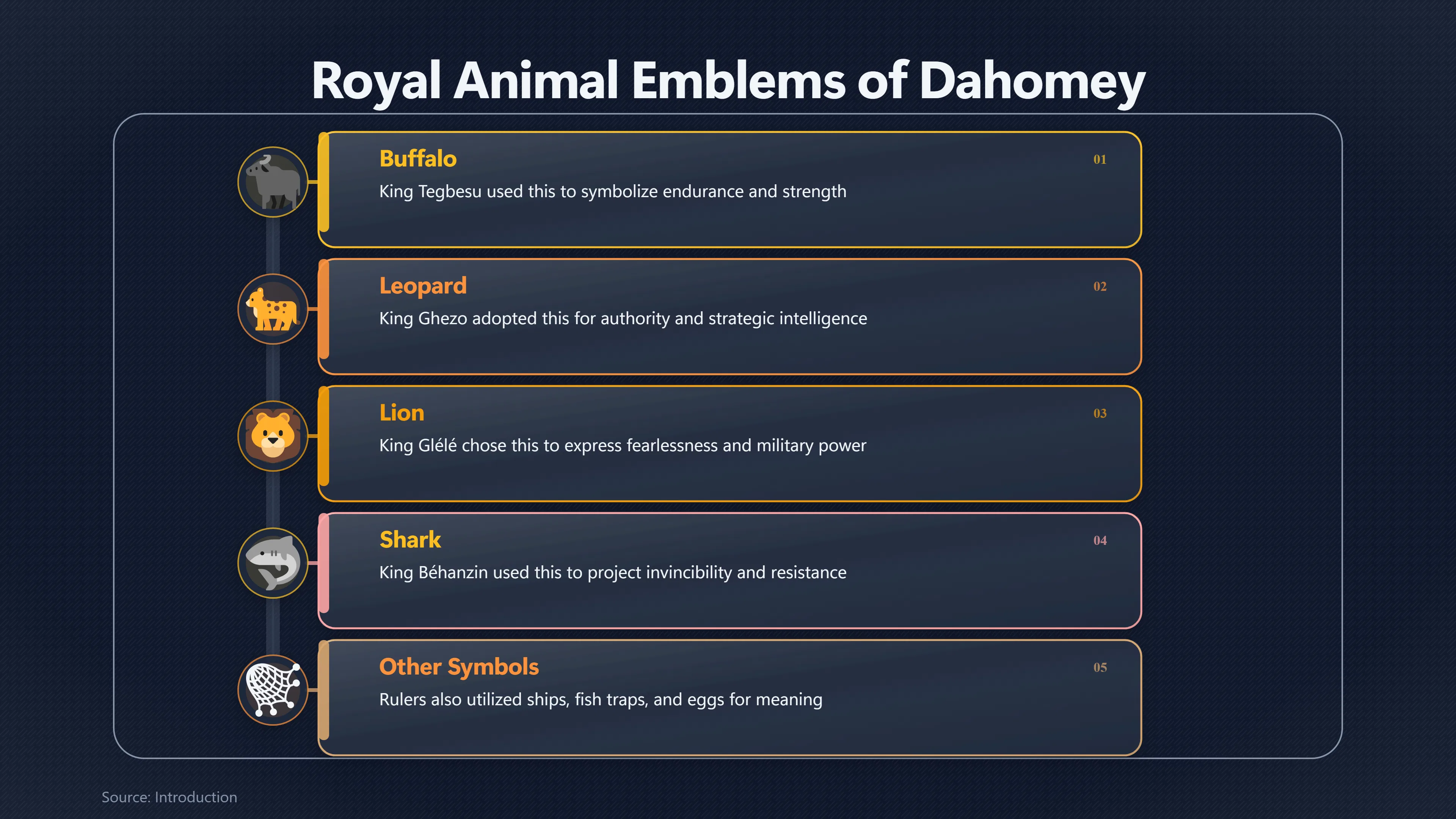
- The buffalo of King Tegbesu, symbolising endurance and formidable strength.
- The leopard of King Ghezo, representing royal authority, strategic intelligence and dominance.
- The lion of King Glélé, expressing fearlessness and military power.
- The shark, closely associated with King Béhanzin, whose image projected invincibility and mastery even beyond the land, while also reflecting the king’s reputation for resistance during the French invasion.
- Other rulers adopted symbols such as ships, fish traps or eggs, each carrying political and spiritual meanings rather than simple naturalistic references.[Visit Abomey]visitabomey.comOpen source on visitabomey.com.
These animals therefore functioned less like family crests and more like condensed political statements. Seeing a lion or shark carved into palace walls immediately identified the king whose authority shaped that part of the complex.
How royal animals encoded power
One reason the Abomey palaces feel so unusual is that animals appear everywhere while almost never functioning as ordinary wildlife illustrations.
The bas-reliefs combine humans, weapons, mythical scenes and animals into carefully structured historical narratives. Rather than depicting literal events, they often express ideas about kingship:
- courage shown through predators;
- resilience through powerful wild animals;
- military victories through symbolic scenes;
- spiritual protection through hybrid imagery linking rulers with supernatural forces.
Because the palace served simultaneously as royal residence, administrative headquarters, ceremonial centre and sacred space, these symbols reinforced authority wherever courtiers, diplomats and visiting rulers moved through the complex. UNESCO describes the palaces not only as the political heart of the kingdom but also as repositories of its artistic traditions and royal treasures.[UNESCO World Heritage Centre]whc.unesco.orgWorld Heritage Centre Royal Palaces of AbomeyUNESCO World Heritage CentreRoyal Palaces of Abomey - UNESCO World Heritage Centre…
This symbolism also explains why many surviving objects can appear mysterious in museum displays. A carved throne, ceremonial staff or palace door often includes repeated animal motifs whose meaning only becomes clear when understood alongside the biography of the king who commissioned it.
Sacred objects inside the palace museum
Today the Historical Museum of Abomey occupies the former palaces of Kings Ghezo and Glélé. Rather than presenting anonymous archaeological finds, the museum preserves objects directly connected with royal ceremonies and government.[UNESCO World Heritage Centre]whc.unesco.orgWorld Heritage Centre Royal Palaces of AbomeyUNESCO World Heritage CentreRoyal Palaces of Abomey - UNESCO World Heritage Centre…
Visitors can encounter:
- royal thrones;
- ceremonial sceptres known as recades;
- weapons and military equipment;
- ritual and religious objects;
- palace bas-reliefs preserved in situ;
- royal statues and carved architectural elements.
The museum’s atmosphere differs from many ethnographic museums because much of the collection remains physically embedded within the original palace environment. Courtyards, gateways and decorated earthen walls still frame the artefacts much as they did during the kingdom’s final decades.
Local guides often explain not only the historical function of individual pieces but also the oral traditions attached to them, helping visitors understand why certain objects remain culturally sensitive rather than simply antique works of art.[Visit Abomey]visitabomey.comOpen source on visitabomey.com.
Colonial removal and the return of royal treasures
The palace’s most emotionally powerful exhibits may be those that disappeared for more than a century.
When French forces conquered Abomey in 1892 during the Franco-Dahomean War, numerous royal treasures were seized and transported to France. These included ceremonial statues, palace doors, thrones, sceptres and other objects associated with the kingdom’s rulers. Many entered French museum collections, particularly the Musée du Quai Branly in Paris.[visitabomey.com]visitabomey.comOpen source on visitabomey.com.
After decades of diplomatic requests, France formally returned 26 royal objects to Benin in 2021. The restitution became one of the most internationally recognised examples of cultural repatriation in Africa and formed part of broader cooperation that also includes conservation work at the Royal Palaces and the development of new museum facilities.[UNESCO]unesco.orgUNESCO's action to promote new forms of agreement and cooperation for…
Among the returned works were major royal sculptures, ceremonial objects and architectural pieces that had long served as symbols of Dahomey’s monarchy. Their return transformed the visitor experience. Rather than viewing replicas or empty display spaces, visitors can once again encounter original objects in the country from which they were taken.
The return remains partial. Benin continues to seek the restitution of additional royal objects still held abroad, making the palace museum not only a historical site but also an active participant in international debates over colonial collections and museum ethics.[UNESCO]unesco.orgUNESCO's action to promote new forms of agreement and cooperation for…
Why the palaces matter within Benin’s curiosity landscape
For travellers interested in unusual collections, Abomey stands apart because its curiosities are inseparable from living cultural memory.
Unlike a cabinet of oddities assembled for entertainment, the palace museum preserves symbols that once exercised real political authority. A shark statue was never simply an artistic representation of marine life; it embodied a king’s identity. A lion carved into a palace wall declared power, ancestry and legitimacy. Even the famous bas-reliefs functioned as historical records long before they became museum exhibits.
This combination of monumental earthen architecture, symbolic animals, sacred royal possessions and internationally debated restitution gives the Royal Palaces of Abomey a distinctive place within Benin’s heritage. They demonstrate how objects can be simultaneously works of art, historical documents, sacred possessions and enduring symbols of national identity.[unesco.org]whc.unesco.orgWorld Heritage Centre Royal Palaces of AbomeyUNESCO World Heritage CentreRoyal Palaces of Abomey - UNESCO World Heritage Centre…
Amazon book picks
Further Reading
Books and field guides related to Why Dahomey's Kings Became Lions and Sharks. Use these as the next step if you want deeper reading beyond the article.
African Vodun: Art, Psychology, and Power
Throughout, Blier pushes African art history to a new height of cultural awareness that recognizes the complexity of traditional African...
The Brutish Museums
New York Times 'Best Art Books' 2020 'Essential' – Sunday Times 'Brilliantly enraged' - New York Review of Books 'A real game-changer'– E...
eBay marketplace picks
Marketplace Samples
Example marketplace items related to this page. Use the search link to explore similar finds on eBay.
Selected fromBenin souvenir oneBay.co.uk.
Current eBay listing
Benin Collage Fridge Magnet: Cute Handmade Travel Souvenir Gift
Current eBay listing
BENIN ✳ SOUVENIR TOURIST HOLIDAY ✳ LARGE FRIDGE MAGNET ✳ GREAT GIFT
Current eBay listing
Benin Collage Fridge Magnet: Cute Handmade Travel Souvenir Gift
Endnotes
1.
Source: whc.unesco.org
Title: World Heritage Centre Royal Palaces of Abomey
Link:https://whc.unesco.org/en/list/323
Source snippet
UNESCO World Heritage CentreRoyal Palaces of Abomey - UNESCO World Heritage Centre...
2.
Source: unesco.org
Link:https://www.unesco.org/en/fight-illicit-trafficking/agreement-and-cooperation-return-and-restitution?hub=416
Source snippet
UNESCO's action to promote new forms of agreement and cooperation for...
3.
Source: articles.unesco.org
Link:https://articles.unesco.org/sites/default/files/medias/fichiers/2023/06/Provisional%20programme%20New%20forms%20of%20agreements%20and%20cooperation%20in%20the%20field%20of%20return%20and%20restitution%20of%20cultural%20property.pdf
Source snippet
UNESCO ArticlesNew forms of agreements and cooperation in the field of return and...
4.
Source: whc.unesco.org
Link:https://whc.unesco.org/en/list/323/documents/
5.
Source: whc.unesco.org
Link:https://whc.unesco.org/en/decisions/7719/
6.
Source: whc.unesco.org
Link:https://whc.unesco.org/fr/soc/4058/
7.
Source: whc.unesco.org
Link:https://whc.unesco.org/en/statesparties/bj/
9.
Source: visitabomey.com
Link:https://visitabomey.com/en/heritage/places/musee-historique-abomey
10.
Source: visitabomey.com
Link:https://visitabomey.com/en/heritage/places
11.
Source: unesco.emb-japan.go.jp
Link:https://www.unesco.emb-japan.go.jp/htm/abomey.htm
Additional References
12.
Source: washingtonpost.com
Title: After more than a century, a tearful return for the looted treasures of Abomey
Link:https://www.washingtonpost.com/world/interactive/2021/after-more-than-century-tearful-return-looted-treasures-abomey/
Source snippet
The Washington PostNovember 11, 2021 — AFTER MORE THAN A CENTURY, A TEARFUL RETURN FOR THE LOOTED TREASURES OF ABOMEY By Rick Noack | Nov...
Published: November 11, 2021
13.
Source: artnewspaper.fr
Title: Le « trésor d’Abomey » restitué au Bénin
Link:https://www.artnewspaper.fr/2021/10/28/le-tresor-dabomey-restitue-au-benin
Source snippet
The Art NewspaperOctober 28, 2021 — LE « TRÉSOR D’ABOMEY » RESTITUÉ AU BÉNIN LA RESTITUTION OFFICIELLE PAR LA FRANCE DES VINGT-SIX PIÈCES...
Published: October 28, 2021
14.
Source: dw.com
Title: Les Trés
Link:https://www.dw.com/fr/b%C3%A9nin-restittution-doeuvres-dart-abomey/a-59782790
Source snippet
26 œuvres d'art spoliées de retour au Bénin – DW – 10/11/2021November 10, 2021 — 26 ŒUVRES D'ART SPOLIÉES DE RETOUR AU BÉNIN Rodrigue Gué...
Published: November 10, 2021
15.
Source: ft.com
Link:https://www.ft.com/content/af133939-e6da-411b-9404-217d2a6ae6a2
Source snippet
Entre los objetos saqueados se incluyeron cetros, estatuas y puertas ornamentadas que posteriormente fueron exhibidas en el Musée du Quai...
16.
Source: expertisefrance.fr
Link:https://www.expertisefrance.fr/en/projects/feasibility-study-preservation-and-development-heritage-site-abomey
17.
Source: archeologie.culture.gouv.fr
Link:https://archeologie.culture.gouv.fr/monde/fr/palais-royaux-abomey
18.
Source: youtube.com
Title: Benin: Abomey 10 palaces and 1,050 artefacts
Link:https://www.youtube.com/watch?v=6YEhsSACILc
Source snippet
The Rise and Fall of the Kingdom of Dahomey...
19.
Source: theworld.org
Link:https://theworld.org/stories/2020/01/14/france-returns-artifacts-benin-amid-growing-call-restitution-african-art
20.
Source: archeologie.culture.gouv.fr
Title: culture.gouv.fr Les palais royaux d’Abomey | Archéologie | culture.gouv.fr Bénin
Link:https://archeologie.culture.gouv.fr/fr/palais-royaux-abomey
21.
Source: youtube.com
Title: An emotional exhibition of Benin’s returned royal treasures • FRANCE 24 English
Link:https://www.youtube.com/watch?v=151zunaFMzY
Source snippet
Dahomey Trailer #1 (2024)...