Where the Philippines Keeps Its Strangest Things
The Philippines does not have a single, nationally prominent “museum of the strange”. Its curiosity culture is scattered across mountain burial sites, university cabinets, private war collections, repurposed prisons, devotional displays and highly commercial themed attractions.
Page outline Jump by section
Introduction
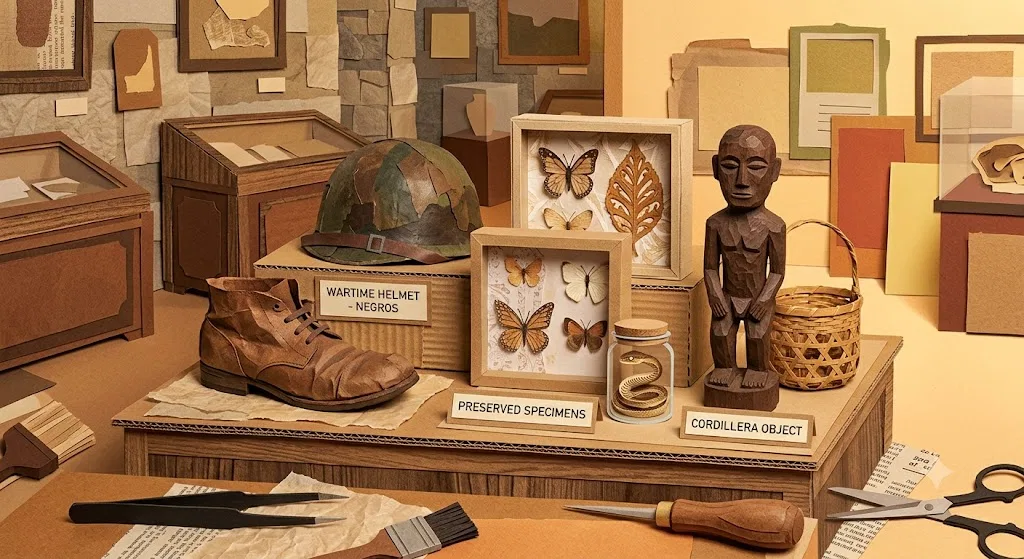
The strongest examples include the Kabayan burial caves and site museum in Benguet, where Indigenous mummified remains are treated as ancestors rather than mere archaeological specimens; the University of Santo Tomas Museum, whose natural-history collections retain the atmosphere of an old teaching cabinet; the Marikina Shoe Museum, where local craft history competes with the notoriety of Imelda Marcos’s footwear; and the family-run Cata-al war museum in Negros Oriental. Together, they show that strange collections in the Philippines are usually rooted in living community memory, colonial history, religion or private collecting rather than in staged paranormal entertainment.[nationalmuseum.gov.ph]nationalmuseum.gov.phNational Museum of the Philippines Kabayan Burial CavesAlso on exhibit are ethnographic objects, mostly of the Ibaloy ethnolinguistics group and some…Read more…
Where the Philippines’ strangest collections are found
The country’s unusual heritage is geographically dispersed. Metro Manila contains old institutional collections and specialist museums, while the Cordillera highlands preserve mortuary traditions that cannot be separated from Indigenous authority and sacred landscapes. Provincial museums frequently occupy unexpected buildings, including prisons, water tanks and private homes. This makes the Philippine scene less like a neat circuit of “weird museums” and more like a network of objects whose meanings change according to who owns, displays or venerates them.
Several broad types stand out:
- Ancestral and mortuary collections, especially the mummies and burial objects of Benguet.
- Historic cabinets of natural and religious curiosities, led by the University of Santo Tomas Museum.
- Private collections turned public, such as family war relics and Christmas memorabilia.
- Politically charged object displays, most famously the shoes associated with Imelda Marcos.
- Carceral and military heritage, where former prisons, fortifications and battlefield finds are converted into museums.
- Folklore landscapes without a formal museum, particularly places commercially associated with monsters, healing or magic.
The distinction matters. A mummy displayed by a community museum, a shell casing found on a battlefield and a Santa Claus figurine assembled for family tourism may all look “odd” to an outsider, but they carry very different levels of cultural sensitivity, documentary rigour and commercial purpose.
The Kabayan mummies: ancestors, not horror exhibits
The Kabayan Burial Caves in Benguet are the country’s most important uncanny heritage complex. Mummified human remains survive in caves and rock shelters associated with the Ibaloi people, while the National Museum’s Kabayan site museum displays one mummy alongside ethnographic material from Ibaloi and Kalanguya communities. The burial caves were declared National Cultural Treasures in 1973 and are managed as both archaeological heritage and a continuing Indigenous cultural landscape.[nationalmuseum.gov.ph]nationalmuseum.gov.phNational Museum of the Philippines Kabayan Burial CavesAlso on exhibit are ethnographic objects, mostly of the Ibaloy ethnolinguistics group and some…Read more…
Their popular nickname, “fire mummies”, refers to preservation methods involving prolonged drying and exposure to smoke. Oral accounts and scientific interpretations have not always agreed on every stage of the process, including the precise preservatives used or the dates when the custom flourished. Researchers have therefore treated sweeping claims about the mummies’ great age with caution. The safest interpretation is that deliberate mummification formed part of a socially important mortuary tradition in the Cordillera, rather than a mysterious lost technology.[Inquirer.net]newsinfo.inquirer.netorigins of benguet mummificationof Benguet mummification - News - Inquirer.netFebruary 19, 2013 — 19 Feb 2013 — Scientists from the National Museum sustain oral accounts…
For visitors, the important point is that these are not horror props. Recent conservation work describes the remains as enduring ancestors who retain spiritual and ritual importance for Ibaloi communities. Conservation involves environmental monitoring, physical protection and consultation with elders, not simply maintaining a visually dramatic exhibit. Some burial locations are restricted or kept discreet because of deterioration, theft and earlier looting.[copernicus.org]isprs-archives.copernicus.orgisprs archives XLVIII MISPRS ArchivesPreventive Conservation of the Kabayan Mummiesby FDP Reyes · 2025 — The Kabayan mummies, or meking, represent the ancestral…
The history of Apo Anno, a tattooed mummified ancestor, shows why display and ownership are sensitive. After being removed from his burial place, the body passed through exhibition and private hands before eventually being returned for reburial under protective arrangements. The case transforms the visitor’s question from “How was this body preserved?” to “Who has the right to display an ancestor?”[World Monuments Fund]wmf.orgOpen source on wmf.org.
A separate Ibaloi mummy is displayed at the Baguio Museum among wider Cordillera archaeological and ethnographic collections. Photography of the remains is prohibited, reinforcing the distinction between respectful viewing and souvenir hunting. The museum is visitor-facing, but the mummy should be approached as a culturally sensitive human presence rather than the equivalent of a fairground oddity.[Atlas Obscura]atlasobscura.comAtlas Obscura Ibaloi Fire Mummy in BaguioAtlas Obscura Ibaloi Fire Mummy in Baguio
An old-fashioned cabinet inside a university
The University of Santo Tomas Museum in Manila offers a different form of strangeness: the survival of the encyclopaedic university cabinet. Formally established in 1869, it grew from the requirement that major colleges maintain natural-history teaching collections. Its holdings combine zoological specimens, ethnographic objects, coins, medals, religious images, Asian decorative arts and paintings.[UST Museum]ustmuseum.ust.edu.phUST MuseumUST Museum - University of Santo TomasMost of the collection dates back to 1869. The University of Santo Tomas Museum, consider…
This mixture gives the museum the texture of an older world in which art, anatomy, mineralogy, ethnography and sacred objects were not always separated into specialised institutions. The curiosities are academically grounded rather than paranormal, but the experience can resemble a historic cabinet of wonders: preserved animals and scientific specimens share an institutional story with devotional sculpture, university regalia and papal memorabilia.
Its credibility is comparatively strong because the collection belongs to a long-established university and developed partly for teaching. That does not make every old label or classification timeless. Like other colonial-era natural-history and ethnographic collections, its objects emerged from systems that categorised nature and cultures through European academic frameworks. What makes it valuable today is precisely this double role: it preserves specimens and artworks while also revealing how knowledge was assembled in the Spanish colonial Philippines.
The Marikina Shoe Museum and a disputed political symbol
The Marikina Shoe Museum is often described simply as the home of Imelda Marcos’s shoes. That is accurate but incomplete. The institution was created to document Marikina’s footwear industry, local craftsmanship and the city’s identity as a centre of shoemaking. Its displays also include footwear associated with politicians, public figures and foreign cultures.[Philippine Information Agency]pia.gov.phph first ladies grace renowned marikina shoe museumPhilippine Information AgencyPH First Ladies grace renowned Marikina Shoe Museum10 Jul 2024 — Founded in 2001, the Marikina Shoe Museum i…
Nevertheless, the Marcos shoes dominate public interest. More than 700 pairs from the former first lady’s collection were placed on display when the museum opened in 2001, turning an everyday object into evidence of political excess, celebrity image-making and national memory.[BBC Partners]wspartners.bbc.comPartners Imelda Marcos's famous shoe collectionPartners Imelda Marcos's famous shoe collection
This creates an interpretive problem. Displayed without enough historical explanation, the shoes can become glamorous curiosities detached from the dictatorship, corruption allegations and economic inequality with which they are associated. Framed critically, however, they can show how material objects acquire political power. A shoe is simultaneously a product of Marikina craftsmanship, a personal fashion item, a confiscated or transferred state-held object and an international shorthand for conspicuous consumption.
Visitors should therefore expect a specialist local-history museum with one overwhelmingly famous subsection, not a comprehensive museum of the Marcos period. Its strangeness lies less in the number of shoes than in the unstable meaning of the collection: industrial heritage and political spectacle occupy the same rooms.
Private obsessions made public
Cata-al’s battlefield collection
The Cata-al World War II Museum in Valencia, Negros Oriental, is one of the clearest Philippine examples of a private collection becoming a public attraction. Built by a father-and-son collecting effort, it contains weapons, helmets, shells, bombs, equipment and other wartime material reportedly recovered from areas connected with fighting on Negros. It is family-run rather than a large state institution, and visits have traditionally depended on donations or modest local arrangements.[dumaguete.com]dumaguete.comCata-al Memorial MuseumCata-al Memorial Museum
Its appeal comes from density and proximity. Objects that would be carefully isolated in display cases at a national military museum can appear as an accumulated landscape of rusted machinery and battlefield debris. Personal narration adds immediacy, particularly when the collectors connect an object to a local discovery site or remembered wartime story.
That intimacy also affects how the collection should be read. A privately assembled trove may preserve objects that would otherwise have been scrapped, but provenance, identification and conservation can vary. Visitors should distinguish between an object’s physical authenticity and the certainty of the story attached to it. A genuine Japanese helmet, for example, does not automatically prove every claimed detail about where it was found or who wore it. The museum is best understood as local memory collected from the ground up, not as the final scholarly authority on the Pacific War.
Christmas every day at Casa Santa
Casa Santa Museum in Antipolo turns a private festive collection into an immersive commercial attraction. The collection began in 1994, opened to visitors in 2004 and has expanded to more than 3,700 Santa Claus and Christmas-related objects from different countries. The operator openly describes the process by which a personal hobby developed into a business.[Casa Santa Museum]casasantamuseum.comCasa Santa Museum About Us | Tours | Casa Santa Museum AntipoloCasa Santa Museum About Us | Tours | Casa Santa Museum Antipolo
Unlike the mummies or war relics, Casa Santa does not trade on death, trauma or contested archaeology. Its oddity comes from scale and repetition: one seasonal figure multiplied across rooms, styles and national traditions. Additional staged environments, including a toy-factory section, make it closer to an attraction built around a collection than a conventional research museum.[Casa Santa Museum]casasantamuseum.comOpen source on casasantamuseum.com.
Its curation is primarily family-oriented and experiential. Visitors should expect decorative abundance, themed photography and festive storytelling rather than a critical history of Saint Nicholas, consumer culture or the global Christmas industry. Even so, it is a useful example of how collecting becomes tourism: an ordinary household enthusiasm crosses a threshold where quantity, display design and ticketed access turn it into a public curiosity.
Prisons and unlikely museum buildings
Museo Sugbo in Cebu City occupies the former provincial prison known historically as Cárcel de Cebú. Constructed during the Spanish colonial period and used for various forms of incarceration into the late twentieth century, the complex became a provincial museum after prisoners were transferred elsewhere. It reopened to the public in August 2025 following a period of closure and redevelopment.[Wikipedia]WikipediaMuseo SugboMuseo Sugbo
The site is unusual because the building itself is the strongest exhibit. Coral-stone walls, cells and enclosed courtyards shape how visitors encounter galleries on Cebu’s archaeology, politics, colonial experience and wartime history. Unlike a purpose-built museum, the former gaol carries traces of confinement that cannot be neutralised by display panels.
Its transformation also raises a common question about prison museums: does the interpretation give sufficient attention to prisoners, punishment and state violence, or does the dramatic architecture merely provide atmosphere? Museo Sugbo’s wide historical remit means that it is not solely a museum of imprisonment. Visitors seeking a detailed social history of incarceration may therefore find the building more evocative than the collection. Even so, its reuse places colonial government, revolution, Japanese occupation and post-war provincial power inside a setting where authority was physically enforced.
Ang Panublion Museum in Roxas City offers a gentler but equally striking example of adaptive reuse. It occupies a circular structure built as a municipal water tank in 1910. The museum now preserves local historical and cultural material, converting a piece of civic infrastructure into what its name describes as a guardian of precious things. PANUBLION MUSEUM
Folklore, monsters and the museum that is missing
Philippine folklore is rich in shape-shifters, witches, ghosts, giants and other supernatural beings, yet the country has relatively few permanent, professionally curated museums devoted specifically to them. This absence is notable because places such as Capiz and Siquijor are already marketed through associations with monsters, sorcery, folk healing and spiritual practice.
Capiz has long been stereotyped as the home of a feared shape-shifting creature in Philippine folklore. Modern tourism repeatedly uses, disputes or jokes about that reputation, but Roxas City’s main heritage museum is a local-history institution rather than a dedicated monster museum. The continued controversy over monster imagery in public celebrations shows that folklore branding is not culturally neutral: some residents see commercial potential, while others see an insulting provincial stereotype.[aswangproject.com]aswangproject.comTHE ASWANG PROJECTThe truth about the ASWANG in CapizTHE ASWANG PROJECTThe truth about the ASWANG in Capiz
Siquijor presents a similar tension. The island is associated in popular travel culture with healers, herbal practice and magic, but these traditions generally appear through festivals, guided experiences, private consultations and tourism narratives rather than through a major collection-based museum. Treating every healer as an occult performer would flatten distinct practices into a visitor-friendly fantasy.
The lack of a formal folklore museum also affects credibility. Stories are often transmitted through tourism articles, television features, social media and oral accounts, where legend and reported fact easily merge. A well-curated institution could document regional variations, historic sources, colonial demonisation, healing traditions and modern popular culture without declaring supernatural claims true. Until such a museum exists, visitors should treat monster and witchcraft tourism as a living field of storytelling and identity politics, not as a stable collection of verified paranormal evidence.
How to judge an unusual Philippine collection
The most memorable Philippine curiosity sites require different standards of interpretation. A practical assessment begins with four questions.
Who controls the objects? National and university museums generally have formal conservation systems, while private collections may depend heavily on one family’s knowledge and resources. Indigenous ancestral remains require an additional question: whether descendant communities participate in decisions about access, display and care.
What kind of claim is being made? “This object was recovered on Negros” is a provenance claim. “This object belonged to a named soldier” is a more specific and harder claim. “This province is inhabited by supernatural creatures” belongs to folklore or tourism unless supported as a study of belief rather than literal evidence.
Is the setting educational, devotional or commercial? Casa Santa is openly entertainment-led, while Kabayan is a protected ancestral landscape. The Marikina Shoe Museum combines civic heritage with political memory. Confusing these categories can make a commercial attraction appear scholarly or make a sacred site seem like themed entertainment.
What is absent from the label? Political objects need political context; battlefield relics need provenance; human remains need ethical interpretation; colonial collections need explanation of how objects were acquired and classified. The most responsible visit is not the one that rejects wonder, but the one that asks what kind of wonder is being produced.
Why these collections matter
The Philippines’ strangest collections are compelling because they resist a single definition of “weird”. The Kabayan mummies are extraordinary, but their deepest meaning lies in ancestry, conservation and cultural authority. The University of Santo Tomas preserves the encyclopaedic habits of an old teaching museum. Marikina’s shoes turn fashion into an argument about craft, power and memory. Cata-al’s weapons show how a private search for wartime remnants can become a community archive, while Casa Santa demonstrates how collecting enthusiasm can be commercialised without pretending to be academic.
The country’s curiosity culture is therefore strongest where objects sit between categories: sacred remains that are also protected heritage, prison architecture used for civic education, household collections transformed into attractions, and folklore that generates tourism without settling into a formal museum. These places matter not because they prove supernatural mysteries, but because they reveal what Filipinos have chosen to preserve, what outsiders have labelled strange, and how display can turn an ancestor, shoe, shell casing or festive ornament into a contested piece of public history.
Amazon book picks
Further Reading
Books and field guides related to Where the Philippines Keeps Its Strangest Things. Use these as the next step if you want deeper reading beyond the article.
The Past Is a Foreign Country
A completely updated new edition of David Lowenthal's classic account of how we reshape the past to serve present needs.
eBay marketplace picks
Marketplace Samples
Live-tested eBay searches with available results related to this page.
Selected fromPhilippines art print oneBay.co.uk.


Endnotes
1.
Source: newsinfo.inquirer.net
Title: origins of benguet mummification
Link:https://newsinfo.inquirer.net/361561/origins-of-benguet-mummification
Source snippet
of Benguet mummification - News - Inquirer.netFebruary 19, 2013 — 19 Feb 2013 — Scientists from the National Museum sustain oral accounts...
Published: February 19, 2013
2.
Source: researchgate.net
Link:https://www.researchgate.net/publication/396188285_Preventive_Conservation_of_the_Kabayan_Mummies_Surveying_and_Environmental_Monitoring_to_Save_the_Mummies
3.
Source: Wikipedia
Title: UST Museum of Arts and Sciences
Link:https://en.wikipedia.org/wiki/UST_Museum_of_Arts_and_Sciences
4.
Source: wspartners.bbc.com
Title: Partners Imelda Marcos’s famous shoe collection
Link:https://wspartners.bbc.com/episode/w3ct5yk0
5.
Source: dumaguete.com
Title: Cata-al Memorial Museum
Link:https://dumaguete.com/valencia-negros-oriental/cata-al-memorial-museum/
6.
Source: Wikipedia
Title: Museo Sugbo
Link:https://en.wikipedia.org/wiki/Museo_Sugbo
7.
Source: aswangproject.com
Title: THE ASWANG PROJECTThe truth about the ASWANG in Capiz
Link:https://www.aswangproject.com/aswang-in-capiz/
8.
Source: Wikipedia
Title: Marikina Shoe Museum
Link:https://en.wikipedia.org/wiki/Marikina_Shoe_Museum
9.
Source: Wikipedia
Title: Kabayan Mummies
Link:https://en.wikipedia.org/wiki/Kabayan_Mummies
10.
Source: Wikipedia
Title: Witchcraft in the Philippines
Link:https://en.wikipedia.org/wiki/Witchcraft_in_the_Philippines
11.
Source: nationalmuseum.gov.ph
Title: National Museum of the Philippines Kabayan Burial Caves
Link:https://www.nationalmuseum.gov.ph/our-museums/regional-area-and-site-museums/kabayan-burial-caves/
Source snippet
Also on exhibit are ethnographic objects, mostly of the Ibaloy ethnolinguistics group and some...Read more...
12.
Source: ustmuseum.ust.edu.ph
Link:https://ustmuseum.ust.edu.ph/
Source snippet
UST MuseumUST Museum - University of Santo TomasMost of the collection dates back to 1869. The University of Santo Tomas Museum, consider...
13.
Source: pia.gov.ph
Title: ph first ladies grace renowned marikina shoe museum
Link:https://pia.gov.ph/news/ph-first-ladies-grace-renowned-marikina-shoe-museum/
Source snippet
Philippine Information AgencyPH First Ladies grace renowned Marikina Shoe Museum10 Jul 2024 — Founded in 2001, the Marikina Shoe Museum i...
14.
Source: atlasobscura.com
Title: cataal world war ii museum
Link:https://www.atlasobscura.com/places/cataal-world-war-ii-museum
Source snippet
Atlas ObscuraCata-al World War II Museum in Valencia30 Jun 2017 — A vast personal collection of World War II artifacts unearthed over man...
15.
Source: isprs-archives.copernicus.org
Title: isprs archives XLVIII M 9 2025 1281 2025
Link:https://isprs-archives.copernicus.org/articles/XLVIII-M-9-2025/1281/2025/isprs-archives-XLVIII-M-9-2025-1281-2025.pdf
Source snippet
ISPRS ArchivesPreventive Conservation of the Kabayan Mummiesby FDP Reyes · 2025 — The Kabayan mummies, or meking, represent the ancestral...
16.
Source: wmf.org
Link:https://www.wmf.org/projects/kabayan-mummy-caves
17.
Source: atlasobscura.com
Title: Atlas Obscura Ibaloi Fire Mummy in Baguio
Link:https://www.atlasobscura.com/places/ibaloi-mummy
18.
Source: historyhit.com
Title: the marikina shoe museum
Link:https://www.historyhit.com/locations/the-marikina-shoe-museum/
19.
Source: dumagueteinfo.com
Title: We are Dumaguete Info CATA-AL WORLD WAR II MUSEUM
Link:https://dumagueteinfo.com/attractions/listing/cata-al-world-war-ii-museum/
20.
Source: casasantamuseum.com
Title: Casa Santa Museum About Us | Tours | Casa Santa Museum Antipolo
Link:https://casasantamuseum.com/about-us/
21.
Source: thepoortraveler.net
Title: casa santa museum antipolo
Link:https://www.thepoortraveler.net/casa-santa-museum-antipolo/
22.
Source: casasantamuseum.com
Link:https://casasantamuseum.com/
23.
Source: cebu.gov.ph
Title: museo sugbo reopens with unveiling of cultural property and provincial marker
Link:https://www.cebu.gov.ph/2383/museo-sugbo-reopens-with-unveiling-of-cultural-property-and-provincial-marker/
24.
Source: angpanublionmuseum.weebly.com
Title: PANUBLION MUSEUM
PANUBLION MUSEUM
Link:https://angpanublionmuseum.weebly.com/
25.
Source: roxascity.gov.ph
Link:https://roxascity.gov.ph/the-heritage-walk-roxas-citys-9-cultural-gems/
26.
Source: mb.com.ph
Title: roxas city s aswang float sparks debate
Link:https://mb.com.ph/2025/4/6/roxas-city-s-aswang-float-sparks-debate
27.
Source: atlasobscura.com
Link:https://www.atlasobscura.com/things-to-do/philippines/museums
28.
Source: atlasobscura.com
Link:https://www.atlasobscura.com/lists/the-ultimate-list-of-wonderfully-specific-museums
29.
Source: atlasobscura.com
Link:https://www.atlasobscura.com/things-to-do/philippines
30.
Source: atlasobscura.com
Link:https://www.atlasobscura.com/things-to-do/japan/museums
31.
Source: atlasobscura.com
Link:https://www.atlasobscura.com/things-to-do/greece/museums
32.
Source: atlasobscura.com
Link:https://www.atlasobscura.com/things-to-do/philippines/mummies
33.
Source: atlasobscura.com
Title: san juan philippines
Link:https://www.atlasobscura.com/things-to-do/san-juan-philippines
34.
Source: atlasobscura.com
Title: 10 weirdest best places
Link:https://www.atlasobscura.com/users/biky1212/lists/10-weirdest-best-places
35.
Source: atlasobscura.com
Link:https://www.atlasobscura.com/places/museum-marikina
36.
Source: facebook.com
Link:https://www.facebook.com/nationalmuseumofthephilippines/photos/visit-the-nm-kabayanone-of-the-cordillera-site-museums-the-national-museum-in-ka/954706574553661/
37.
Source: facebook.com
Link:https://www.facebook.com/casasantamuseum/
38.
Source: facebook.com
Title: Casa Santa Museum (@casasantamuseum)
Link:https://www.facebook.com/casasantamuseum/photos/
39.
Source: weblinks.nationalmuseum.gov.ph
Title: FY 2024 Annual Report
Link:https://weblinks.nationalmuseum.gov.ph/wp-content/uploads/2026/02/03115539/FY-2024-Annual-Report.pdf
40.
Source: nationalmuseum.gov.ph
Link:https://www.nationalmuseum.gov.ph/our-museums/national-museum-of-natural-history/
41.
Source: weblinks.nationalmuseum.gov.ph
Title: NMP Updated Visitor Guidelines as of March 2023 2
Link:https://weblinks.nationalmuseum.gov.ph/wp-content/uploads/2023/03/29084900/NMP-Updated-Visitor-Guidelines-as-of-March-2023-2.pdf
Published: March 2023
42.
Source: talapamana.ncca.gov.ph
Title: ncca.gov.ph Cultural Property Database
Link:https://talapamana.ncca.gov.ph/index.php/talapamana/cultural-property-database/talapamana
43.
Source: tripadvisor.com
Title: National Museum of the Philippines The NM Kabayan Burial Caves Site Museum (NMP
Link:https://www.tripadvisor.com/LocationPhotoDirectLink-g2223296-i779759126-Kabayan_Benguet_Province_Cordillera_Region_Luzon.html
44.
Source: tripadvisor.com
Title: Casa Santa Museum
Link:https://www.tripadvisor.com/Attraction_Review-g1026427-d9842465-Reviews-Casa_Santa_Museum-Antipolo_City_Rizal_Province_Calabarzon_Region_Luzon.html
45.
Source: tripadvisor.com
Title: Museo Sugbo
Link:https://www.tripadvisor.com/Attraction_Review-g298460-d1806181-Reviews-Museo_Sugbo-Cebu_City_Cebu_Island_Visayas.html
46.
Source: airial.travel
Title: casa santa museum ls Jy26k D
Link:https://airial.travel/attractions/philippines/antipolo/casa-santa-museum-lsJy26kD
47.
Source: philippinestudies.uk
Link:https://philippinestudies.uk/mapping/tours/show/24
48.
Source: museums.gov.ph
Link:https://museums.gov.ph/baguio-mansion-tour-form/
49.
Source: filipiknow.net
Title: national museum of the philippines
Link:https://filipiknow.net/national-museum-of-the-philippines/
50.
Source: forevervacation.com
Link:https://forevervacation.com/manila/marikina-shoe-museum
51.
Source: cebujournalism.ph
Link:https://cebujournalism.ph/archives/10782
52.
Source: tripzilla.ph
Title: casa santa museum
Link:https://www.tripzilla.ph/casa-santa-museum/9812
53.
Source: gmanetwork.com
Link:https://www.gmanetwork.com/news/scitech/science/388998/ust-showcases-oldest-zoological-museum-collection-in-the-philippines/story/
54.
Source: gmanetwork.com
Link:https://www.gmanetwork.com/regionaltv/features/109984/important-cultural-property-marker-of-carcel-de-cebu-unveiled/story/
Additional References
55.
Source: youtube.com
Title: Cata-al World War II Museum, Valencia, Negros Oriental
Link:https://www.youtube.com/watch?v=0aQ_2hVyIGg
Source snippet
Solving the Mystery of the Philippines' Fire Mummies This video explores the ancient mummification traditions and high-altitude burial ca...
56.
Source: youtube.com
Title: Why Aussie Students are Trying to Save These Ancient Mummies
Link:https://www.youtube.com/watch?v=UfO5pxLseII
Source snippet
Imelda Marcos' Shoe Collection & More | Marikina Shoe Museum...
57.
Source: link.springer.com
Link:https://link.springer.com/rwe/10.1007/978
Source snippet
Fire Mummies of the Kabayan Region of Benguet Province...19 Nov 2021 — This chapter describes the Fire Mummy tradition of the Ib...
58.
Source: youtube.com
Title: Solving the Mystery of the Philippines’ Fire Mummies
Link:https://www.youtube.com/watch?v=rebYflT9tes
Source snippet
Why Aussie Students are Trying to Save These Ancient Mummies...
59.
Source: facebook.com
Link:https://www.facebook.com/abscbnNEWS/posts/fire-mummies-idineklarang-national-cultural-treasures-psm/1548879687287282/
60.
Source: viator.com
Link:https://www.viator.com/en-HK/blog/Witchy-Haunts-Around-the-World/l93857
61.
Source: facebook.com
Link:https://www.facebook.com/ghumnekijagah.official/posts/-13-witchy-haunts-around-the-world-mystical-history-folklore-from-infamous-witch/934282765788516/
62.
Source: facebook.com
Link:https://www.facebook.com/larskrutak/posts/apo-anno-is-an-700-year-old-mummy-from-highland-benguet-province-n-philippines-o/1159053312445379/
63.
Source: facebook.com
Link:https://www.facebook.com/ONENewsPH/posts/baguio-museums-the-mummyvisitors-can-catch-a-glimpse-of-a-real-mummy-in-the-bagu/1526199084452639/
64.
Source: facebook.com
Link:https://www.facebook.com/ONENewsPH/videos/baguio-museums-mummy/1065217080783556/