Within Mozambique Curiosities
Are Mozambique Island's Treasures Sacred or Colonial
Palace rooms, church silver and devotional carvings make Mozambique Island a layered museum landscape of faith, empire and trade.
On this page
- Inside the Palace of Sao Paulo collections
- Sacred art transformed into museum heritage
- Whose history the island's museums foreground
Page outline Jump by section
Introduction
Mozambique Island is unusual because its most intriguing collections are not gathered in a single curiosity museum. Instead, they are spread across former palaces, churches and colonial institutions where devotional objects, royal furnishings and imperial artefacts have been preserved in the very buildings that once gave them meaning. The result is a layered museum landscape in which Christian sacred art, Portuguese colonial administration and Indian Ocean trade intersect rather than stand apart. Visitors are not simply looking at isolated exhibits: they are moving through spaces where religious practice, political authority and global commerce once overlapped. This combination makes the island one of Mozambique’s richest destinations for anyone interested in unusual heritage, particularly where sacred objects have become museum collections and colonial architecture has become an exhibit in its own right.[UNESCO World Heritage Centre]whc.unesco.orgWorld Heritage Centre Island of MozambiqueUNESCO World Heritage CentreIsland of Mozambique - UNESCO World Heritage Centre…

Inside the Palace of São Paulo collections
The former Palace of São Paulo is one of the island’s principal museum spaces. Built during the seventeenth century as a Jesuit college before later becoming the residence of Portuguese governors, it now preserves interiors and collections intended to evoke the administrative world of colonial Mozambique rather than functioning as an ordinary art gallery.[Wikipedia]WikipediaIsland of MozambiqueIsland of Mozambique
Unlike many colonial buildings that survive only as shells, the palace contains decorative arts and furnishings linked to the island’s role within the Portuguese Empire. Visitors encounter furniture, porcelain, paintings, ceremonial rooms and imported decorative objects from Portugal alongside pieces reflecting wider Indian Ocean connections with Goa, Arabia, India and China. These collections illustrate that Mozambique Island was never merely an African outpost but a cosmopolitan trading station where European, African and Asian influences mixed through commerce and empire.[Mozambique High Commission]mozambiquehighcommission.org.ukMozambique High Commission NampulaMozambique High CommissionNampula - High Commission for the Republic of Mozambique to the United Kingdom of Great Britain and Northern Ir…
The building itself is arguably the most significant exhibit. Walking through its courtyards, reception rooms and verandas reveals how colonial government operated within an architectural setting adapted to tropical conditions while drawing heavily on Portuguese traditions. UNESCO regards the palace as part of the exceptional urban fabric that justified the island’s World Heritage inscription, where administrative, religious and commercial buildings collectively illustrate centuries of cultural exchange.[UNESCO World Heritage Centre]whc.unesco.orgWorld Heritage Centre Island of MozambiqueUNESCO World Heritage CentreIsland of Mozambique - UNESCO World Heritage Centre…
Sacred art transformed into museum heritage
One of the island’s most distinctive collections is the Museum of Sacred Art, housed in the former Church and Hospital of the Holy House of Mercy. This transformation is significant in itself. Objects that were originally created for worship now occupy a museum where they are interpreted as historical and artistic treasures rather than solely as devotional items.[artis-on.letras.ulisboa.pt]artis-on.letras.ulisboa.ptDe Hospital da Misericórdia a Museu de Arte Sacra da Ilha de Moçambique (séc. XVI-1969) | ARTis ONJuly 31, 2016…
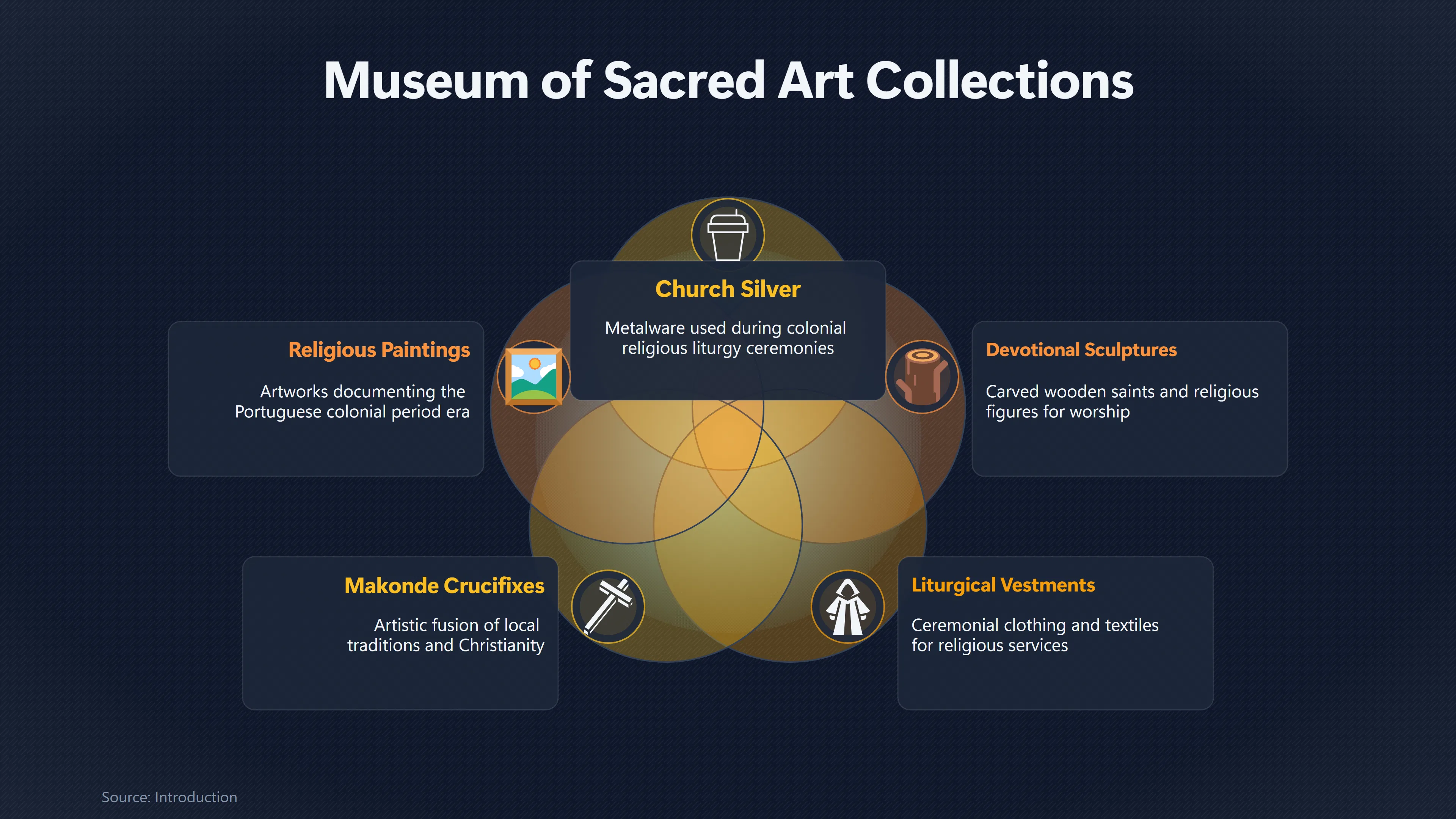
The collection includes:
- Church silver used in colonial liturgy.
- Carved wooden saints and devotional sculptures.
- Religious paintings from the Portuguese colonial period.
- Liturgical vestments and ceremonial objects.
- Ivory and wooden crucifixes, including a celebrated Makonde crucifix that reflects the meeting of local artistic traditions and imported Christianity.[Wikipedia]WikipediaIsland of MozambiqueIsland of Mozambique
For visitors interested in unusual collections, the fascination lies less in individual masterpieces than in their changing role. These objects were once active participants in religious ceremonies. Today they are preserved behind display cases, inviting comparison between their original spiritual function and their modern status as museum heritage.
The museum therefore occupies an unusual position between living faith and historical interpretation. Some visitors approach the collection as religious art, others as evidence of colonial history, while art historians also value it as documentation of cultural exchange between Europe and East Africa.[artis-on.letras.ulisboa.pt]artis-on.letras.ulisboa.ptDe Hospital da Misericórdia a Museu de Arte Sacra da Ilha de Moçambique (séc. XVI-1969) | ARTis ONJuly 31, 2016…
Are these treasures sacred, colonial or both?
The island’s collections resist simple classification because most objects belong simultaneously to several histories.
A silver chalice, for example, can be understood as:
- A Christian liturgical object.
- A work of colonial craftsmanship.
- Evidence of Indian Ocean trade networks that supplied precious materials.
- Part of Mozambique’s national cultural heritage.
Likewise, carved crucifixes may reflect Catholic iconography while also incorporating African artistic traditions. Rather than presenting a straightforward story of Portuguese influence, the collections demonstrate how imported religion became reshaped by local craftsmen and communities.[artis-on.letras.ulisboa.pt]artis-on.letras.ulisboa.ptDe Hospital da Misericórdia a Museu de Arte Sacra da Ilha de Moçambique (séc. XVI-1969) | ARTis ONJuly 31, 2016…
This ambiguity is what distinguishes Mozambique Island from conventional colonial museums. The displays reveal adaptation and exchange as much as domination, even while acknowledging that many objects originated within unequal systems of imperial power.
Whose history do the island’s museums foreground?
The museums naturally foreground the architectural and institutional legacy of Portuguese rule because they occupy surviving colonial buildings and preserve collections created within colonial churches and government residences. Visitors therefore encounter governors, bishops, missionaries and imperial administration more readily than the everyday experiences of enslaved people, African merchants or Swahili communities who also shaped the island’s history.[UNESCO World Heritage Centre]whc.unesco.orgWorld Heritage Centre Island of MozambiqueUNESCO World Heritage CentreIsland of Mozambique - UNESCO World Heritage Centre…
Modern heritage interpretation increasingly places these collections within a broader Indian Ocean context. UNESCO emphasises that the island’s significance comes not from Portuguese architecture alone but from centuries of interaction among Bantu, Swahili, Arab, Persian, Indian and European peoples. The urban landscape itself records these overlapping influences through its buildings, construction methods and neighbourhoods.[UNESCO World Heritage Centre]whc.unesco.orgWorld Heritage Centre Island of MozambiqueUNESCO World Heritage CentreIsland of Mozambique - UNESCO World Heritage Centre…
This wider perspective changes how the museum collections are understood. Rather than isolated remnants of European empire, they become material evidence of one of the Indian Ocean’s most important crossroads, where goods, beliefs, artistic styles and political authority circulated across continents.
Why the island matters within Mozambique’s curiosity landscape
For travellers seeking Mozambique’s more unusual heritage, Mozambique Island offers something distinct from anatomical collections, ethnographic displays or archaeological sites elsewhere in the country. Its curiosity lies in the preservation of complete historical environments where palaces, churches, museums and streets together function as a living archive.
The Palace of São Paulo and the Museum of Sacred Art demonstrate how museum collections can emerge from historic buildings rather than being assembled inside modern galleries. Sacred silver, devotional carvings and colonial interiors remain closely tied to the spaces for which they were created, giving visitors an unusually direct sense of how faith, governance and global trade once intersected on a small island that influenced maritime history far beyond the coast of Mozambique.[unesco.org]whc.unesco.orgWorld Heritage Centre Island of MozambiqueUNESCO World Heritage CentreIsland of Mozambique - UNESCO World Heritage Centre…
Amazon book picks
Further Reading
Books and field guides related to Are Mozambique Island's Treasures Sacred or Colonial. Use these as the next step if you want deeper reading beyond the article.
A History of Mozambique
This book summarizes five hundred years of the history of the societies that exist within the area that became Mozambique in 1891. It als...
The Fortunes of Africa: A 5,000-Year History of Wealth, Greed...
In this vast and vivid panorama of history, Martin Meredith, bestselling author of The State of Africa, follows the fortunes of Africa ov...
The Looting Machine
One of Financial Times' Books of the Year, 2015 The trade in oil, gas, gems, metals and rare earth minerals wreaks havoc in Africa. Durin...
The Indian Ocean
In this stimulating and authoritative overview, Michael Pearson reverses the traditional angle of maritime history and looks from the sea...
eBay marketplace picks
Marketplace Samples
Live-tested eBay searches with available results related to this page.
Selected fromcolonial architecture print oneBay.co.uk.
Endnotes
1.
Source: whc.unesco.org
Title: World Heritage Centre Island of Mozambique
Link:https://whc.unesco.org/en/list/599/
Source snippet
UNESCO World Heritage CentreIsland of Mozambique - UNESCO World Heritage Centre...
2.
Source: unesco.org
Title: Saving urban landscapes: the Island of Mozambique | UNESCO
Link:https://www.unesco.org/en/articles/saving-urban-landscapes-island-mozambique
Source snippet
Saving urban landscapes: the Island of Mozambique | UNESCO...
3.
Source: Wikipedia
Title: Island of Mozambique
Link:https://en.wikipedia.org/wiki/Island_of_Mozambique
4.
Source: whc.unesco.org
Title: World Heritage Centre UNESCO World Heritage Centre
Link:https://whc.unesco.org/en/documents/111404
Source snippet
UNESCO World Heritage CentreUNESCO World Heritage Centre - Document - Inner court of the Palácio de São Paulo, Museum of the Island of Mo...
5.
Source: artis-on.letras.ulisboa.pt
Link:https://artis-on.letras.ulisboa.pt/index.php/aio/article/view/97
Source snippet
De Hospital da Misericórdia a Museu de Arte Sacra da Ilha de Moçambique (séc. XVI-1969) | ARTis ONJuly 31, 2016...
Published: July 31, 2016
6.
Source: unesco.org
Title: ilhamuseu begins coastal renaturalization works
Link:https://www.unesco.org/en/articles/ilhamuseu-begins-coastal-renaturalization-works
Source snippet
April 2, 2025 — ILHAMUSEU BEGINS COASTAL RENATURALIZATION WORKS These works mark the first phase of the construction of IlhaMuseu...
Published: April 2, 2025
7.
Source: whc.unesco.org
Link:https://whc.unesco.org/en/list/1573/
8.
Source: whc.unesco.org
Link:https://whc.unesco.org/en/documents/111402
9.
Source: whc.unesco.org
Link:https://whc.unesco.org/en/documents/120170
10.
Source: whc.unesco.org
Title: tool image bootstrap.cfm
Link:https://whc.unesco.org/include/tool_image_bootstrap.cfm?id=111404
11.
Source: whc.unesco.org
Link:https://whc.unesco.org/en/list/599/gallery/
12.
Source: unesco.org
Link:https://www.unesco.org/en/countries/mz
13.
Source: en.unesco.org
Link:https://en.unesco.org/silkroad/underwater-cultural-heritage-themes/museum
14.
Source: mozambiquehighcommission.org.uk
Title: Mozambique High Commission Nampula
Link:https://www.mozambiquehighcommission.org.uk/nampula.html
Source snippet
Mozambique High CommissionNampula - High Commission for the Republic of Mozambique to the United Kingdom of Great Britain and Northern Ir...
15.
Source: nmaahc.si.edu
Link:https://nmaahc.si.edu/mozambique
16.
Source: lam.co.mz
Link:https://www.lam.co.mz/en/Destinos-Nacionais/Nampula
Additional References
17.
Source: mustseespots.com
Link:https://www.mustseespots.com/mozambique/articles/uncovering-the-treasures-of-the-island-of-mozambique-unesco-site/
Source snippet
January 28, 2026 — Image: Mozambique Published on January 28, 2026 UNCOVERING THE TREASURES OF THE ISLAND OF MOZAMBIQUE (UNESCO SITE) Ste...
Published: January 28, 2026
18.
Source: mol-africa.com
Link:https://www.mol-africa.com/media-items/blog/2025-09-24-mol-ilha-de-mocambique.html
Source snippet
September 24, 2025 — Image by MOL Mozambique 09/24/2025 ILHA DE MOÇAMBIQUE: A UNESCO WORLD HERITAGE ISLAND BRIDGING AFRICA AND ASIA Ilha...
Published: September 24, 2025
19.
Source: youtube.com
Title: The Entire History of the Portuguese Empire
Link:https://www.youtube.com/watch?v=9P7szJRlbxk
Source snippet
Island of Mozambique Palace of Sao Paulo museum Ilha de Mozambique, Africa Smile So...
20.
Source: youtube.com
Title: Fort Sao Sebastiao
Link:https://www.youtube.com/watch?v=WJaTPdtxLB8
Source snippet
The Story of the São José Shipwreck - Full Version...
21.
Source: youtube.com
Title: Ilaha de Mozambique
Link:https://www.youtube.com/watch?v=dN5Ni2bP0gM
Source snippet
Fort Sao Sebastiao - Mozambique - Beginning of an Portuguese Era...
22.
Source: hpip.org
Link:https://hpip.org/pt/heritage/details/40
23.
Source: hpip.org
Link:https://hpip.org/en/heritage/details/40
24.
Source: iexplore.com
Link:https://www.iexplore.com/articles/travel-guides%2Fafrica%2Fmozambique%2Fattractions
25.
Source: hpip.org
Link:https://hpip.org/en/Contents/Place/553
26.
Source: youtube.com
Title: The Story of the São José Shipwreck
Link:https://www.youtube.com/watch?v=HhJUEOQzYDg
Source snippet
The Entire History of the Portuguese Empire...