Where Does Pakistan Keep Its Strangest Objects?
Pakistan does not have a large, clearly labelled circuit of occult, cryptid or medical-oddity museums.
Page outline Jump by section
Where Pakistan’s strangest collections are found
Pakistan’s unusual museums are rarely designed as theatrical “museums of the weird”. Most belong to one of four more serious traditions: government museums preserving archaeology or natural history; ethnographic institutions documenting living communities; military and police museums preserving weapons and official records; and private collections assembled by families or individual specialists.
That distinction matters. A visitor looking for monsters, witchcraft tableaux or haunted objects may find little comparable to the commercial oddity museums of Europe or North America. Pakistan’s uncanny material is usually embedded in mainstream collections, where a disturbing anatomical sculpture, ritual object, giant animal specimen or disputed antiquity appears amid broader displays. Even international offbeat-travel directories identify only a very small number of Pakistani museums as explicitly “unusual”, notably the Kalasha Dur Museum and the restored Sethi House.[Atlas Obscura]atlasobscura.comOpen source on atlasobscura.com.
The strongest examples are therefore not curiosities because they are frivolous. They are unusual because they preserve things that are rare, culturally sensitive, physically startling or difficult to interpret. Their displays can raise questions about who collected an object, whether it was donated or removed from its original setting, whether a ritual tradition is being represented accurately, and whether a museum label reflects scholarship, state identity or tourist expectation.
The giant whale shark in Islamabad
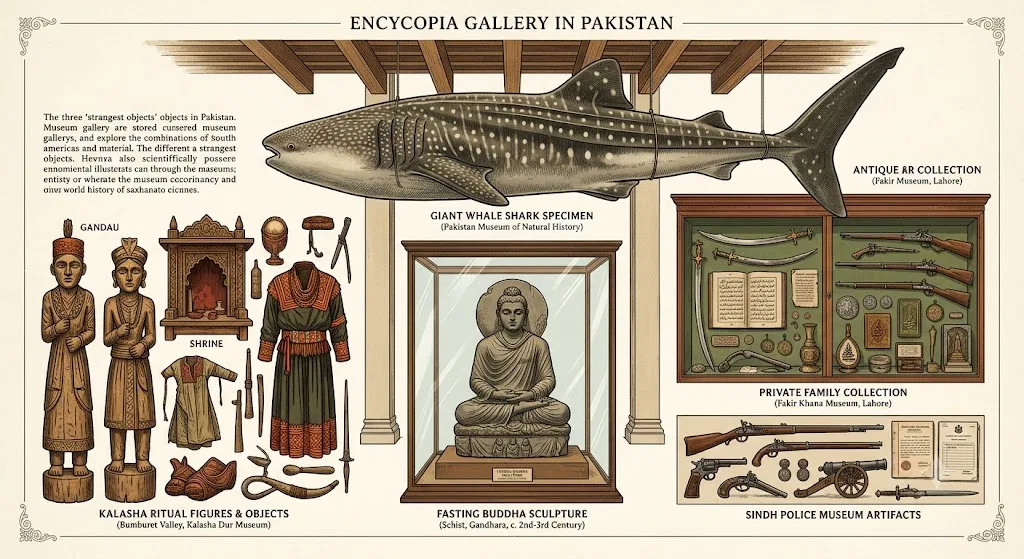
The most immediately spectacular oddity is at the Pakistan Museum of Natural History in Islamabad. Its centrepiece is a preserved whale shark measuring about 40 feet, or 12 metres, which reportedly weighed roughly 16 tonnes when recovered. The museum describes it as the largest recorded specimen of its kind, although claims of global superlatives should be treated cautiously unless they are supported by a current scientific comparison.[Pakistan Museum of Natural History]pmnh.gov.pkPakistan Museum of Natural HistoryExhibitsThe displayed whale shark specimen is about 40 feet long and weighed approximately 16 tones at…
The animal was found off Pakistan’s Arabian Sea coast in 2012 and transported from Karachi to Islamabad for preservation. Contemporary reporting described the logistical difficulty, smell and physical condition of the carcass as its skin and bones arrived at the museum. It later became a public exhibit supported by the Pakistan Science Foundation and UNESCO.[The Express Tribune]tribune.com.pknatural history preserved whale shark to go on displayThe Express TribuneNatural history: Preserved whale shark to go on display26 Jun 2012 — The whale shark, which was found dead, on Februar…
For visitors, the fascination lies partly in scale. Whale sharks are the world’s largest living fish, and seeing one as a full-sized preserved body is very different from encountering a skeleton, photograph or model. The display sits within galleries on zoology, palaeontology, geology and the ancient Tethys Ocean, so it is interpreted primarily as a scientific specimen rather than a sideshow object. The museum also exhibits fossils, minerals, reconstructed prehistoric environments and a whale skeleton.[Pakistan Museum of Natural History]pmnh.gov.pkPakistan Museum of Natural HistoryExhibitsThe displayed whale shark specimen is about 40 feet long and weighed approximately 16 tones at…
The specimen also exposes the practical difficulty of preserving very large animals in countries where specialist conservation resources may be limited. Earlier reports and secondary accounts have raised concerns about deterioration and repeated repairs. That does not make the object less significant, but it means visitors should expect a preserved research specimen with a complicated conservation history, not the seamless finish of a newly manufactured exhibition model.[Wikipedia]WikipediaPakistan Museum of Natural HistoryPakistan Museum of Natural History
Folk belief, ritual life and endangered traditions
Kalasha Dur Museum
The Kalasha Dur Museum in Bumburet Valley is one of Pakistan’s most distinctive cultural collections. Opened in 2005 with support from Greek volunteers and development organisations, it was created partly from concern that traditional objects were disappearing from Kalash households as ways of life changed. Its holdings include clothing, jewellery, weapons, tools, musical instruments, domestic utensils and carved figures associated with the Kalash and neighbouring Hindu Kush communities.[Atlas Obscura]atlasobscura.comAtlas Obscura Kalasha Dur Museum in BrunAtlas ObscuraKalasha Dur Museum in BrunAugust 7, 2024 — 7 Aug 2024 — Among the items on display are statuettes, weapons, musical instrume…
What makes the museum unusual is the relationship between displayed objects and a living religious culture. The Kalash are a small indigenous community whose seasonal festivals, ritual practices and sacred spaces differ markedly from those of Pakistan’s Muslim majority. The museum complex reportedly includes a reconstructed shrine associated with a protective local deity, alongside a cultural school, library and craft-training facilities. It is therefore more than a room of old costumes: it combines preservation, education, community identity and tourism.[Wikipedia]WikipediaKalasha Dur MuseumKalasha Dur Museum
Visitors should resist treating the collection as evidence of a frozen “lost tribe”. Some early publicity linked the Kalash to the armies of Alexander the Great, but such origin stories have often been repeated more confidently in tourism writing than the historical and genetic evidence warrants. The museum is most valuable when understood as a record of local material culture and community-led preservation, not as proof of a romantic ancient-European ancestry.
The collection’s provenance is also mixed. Some objects were donated locally, while others were purchased or exchanged by volunteers, including pieces that had already entered antique markets in Peshawar and Chitral. That collecting history is important because an ethnographic museum can protect vulnerable heritage while simultaneously removing objects from their everyday ritual setting.[Wikipedia]WikipediaKalasha Dur MuseumKalasha Dur Museum
Lok Virsa and the staging of folklore
Islamabad’s Lok Virsa Heritage Museum provides a broader view of Pakistan’s folk traditions. It uses reconstructed interiors, figures, textiles, jewellery, musical instruments, architecture and craft displays to present communities from across the country. It also maintains a substantial research library and recorded archive devoted to folklore, music, anthropology and traditional heritage.[salampakistan.gov.pk]salampakistan.gov.pkOpen source on salampakistan.gov.pk.
For readers interested in strange history, the most relevant material is not necessarily a single supernatural object. It is the museum’s attempt to give physical form to oral traditions, shrine culture, music and regional belief. Its Sufis and Shrines Hall, for example, uses images of saints, musicians and sacred sites to interpret devotional traditions that remain central to popular religious life.[Wikipedia]WikipediaLok Virsa MuseumLok Virsa Museum
This is curated folklore rather than an occult museum. Visitors should expect state-supported cultural interpretation, often emphasising continuity, harmony and shared national heritage. The result can be visually rich and accessible, but displays of “living culture” inevitably simplify traditions that are internally diverse, disputed and constantly changing. Lok Virsa matters because it preserves the songs, stories and material settings through which beliefs survive, even when it does not isolate ghosts, spirits or magical practices as separate attractions.
Private cabinets and objects of intense devotion
Fakir Khana Museum in Lahore is the closest Pakistan comes to a historic cabinet of curiosities. Housed in a family residence inside the Walled City, it has welcomed visitors since the early twentieth century and remains under the stewardship of the Fakir family. Its collections include manuscripts, miniature paintings, coins, porcelain, textiles, carved ivory, religious art, weapons, carpets, calligraphy and objects associated with the Sikh court of Maharaja Ranjit Singh.[Google Arts & Culture]artsandculture.google.comOpen source on google.com.
The setting is fundamental to the experience. This is not a neutral modern gallery but a layered domestic interior in which family history, political service, connoisseurship and inherited objects remain intertwined. Estimates of the collection’s size vary, commonly ranging above 20,000 pieces, so precise totals should be treated as approximate rather than fixed catalogue figures.[Wikipedia]WikipediaFakir KhanaFakir Khana
Among the more curiosity-cabinet-like elements are miniature paintings executed with extreme precision, old arms, devotional objects and relic-like possessions whose significance depends on association with rulers, saints or family ancestors. The museum’s official gallery categories include relics, prayer beads, weapons, manuscripts and Islamic art alongside ceramics and textiles.[Fakirkhana]fakirkhana.comOpen source on fakirkhana.com.
Its credibility is strongest as a genuine historic family collection, but interpretation can be personal and access may be less predictable than at a large state museum. Visitors should confirm arrangements in advance rather than assume continuous walk-in opening. Fakir Khana is compelling precisely because it sits between home, archive, shrine-like treasury and public museum.

Bodies, crime and the unsettling side of official museums
Pakistan’s medical colleges maintain anatomy, pathology and forensic teaching museums containing preserved specimens, models, slides and human anatomical material. These are real collections of medical oddities in the broad sense, but they are generally educational facilities inside secure campuses rather than tourist attractions. Institutions including CMH Lahore Medical College, Jinnah Medical College and other medical schools describe departmental museums intended for students and professional teaching.[edu.pk]cmhlahore.edu.pkOpen source on edu.pk.
That limited access is important. Online lists sometimes make university “museums” sound publicly visitable when they are actually laboratories or teaching rooms. Anyone researching medical history in Pakistan should distinguish between an institution possessing specimens and one offering public admission, interpretation and ethical information about how human material was obtained.
Crime and punishment are more visible at the Sindh Police Museum in Karachi. Opened in 2019 inside the historic police headquarters, it preserves uniforms, weapons, medals, communication equipment, photographs, administrative orders and early police records. Reported highlights include nineteenth-century guns, Talpur-era cannons, old first-information reports and documents concerning public order.[sindhpolice.gov.pk]sindhpolice.gov.pkSindh PoliceSindh Police
The museum is unusual less because it displays notorious criminals than because it turns the bureaucratic machinery of policing into material history. Old registers, firearms and communication devices show how colonial systems of surveillance and law enforcement developed and were inherited by the post-independence state. Because it is located within police premises, prospective visitors should check current access requirements rather than treat it as an ordinary roadside attraction.
The Fasting Buddha and other unsettling antiquities
Lahore Museum’s celebrated Fasting Buddha is one of Pakistan’s most visually arresting museum objects. Carved in grey schist in ancient Gandhara, probably around the second or third century, it depicts Siddhartha Gautama during a period of extreme asceticism before enlightenment. The sculptor rendered protruding ribs, hollow cheeks, tendons and veins with extraordinary anatomical detail.[Impart]imp-art.orgfasting siddhartha lahore museumfasting siddhartha lahore museum
The figure can appear almost corpse-like to an unprepared visitor, but it is not a sculpture of death. It represents the failure of self-starvation as a route to spiritual understanding. Its unsettling realism serves a religious narrative: physical extremity is shown as a stage that must be abandoned before the Buddha discovers a balanced path.
The object is also a reminder that Pakistan’s archaeological museums preserve major Buddhist collections, particularly from Gandhara, even though the country’s present-day population is overwhelmingly Muslim. Lahore Museum was once popularly described as a “house of marvels”, and its Gandharan galleries remain central to its international reputation.[CARC]carc.ox.ac.ukOpen source on ox.ac.uk.
Similar collections at Taxila, Peshawar, Swat and other regional museums contain reliquaries, bodhisattvas, guardian figures and narrative carvings that can feel uncanny when removed from ruined monasteries and arranged in modern cases. Their interest lies not in supernatural claims but in the collision of Greek-influenced bodily realism, Buddhist symbolism, archaeological excavation and colonial-era systems of classification.
Pakistan’s mummy hoax
The most extraordinary episode in Pakistan’s modern curiosity history began in 2000, when police recovered what appeared to be the mummy of an ancient Persian princess. The body lay in a decorated coffin and stone sarcophagus, accompanied by inscriptions and gold-coloured ornament. Initial claims connected the woman to the family of the Persian king Xerxes, prompting international interest and competing suggestions that the remains belonged to Pakistan, Iran or Afghanistan. United Nations Office on Drugs and Crime[unodc.org]unodc.orgOpen source on unodc.org.
The discovery soon unravelled. Experts identified historical inconsistencies in the inscriptions and burial style, while investigators found modern materials and evidence of recent workmanship. Scientific examination concluded that the woman had died in modern times, probably during the 1990s, and may have suffered a fatal neck injury. The supposedly ancient mummy was therefore not merely a forged artefact but potentially the body of an unidentified victim. United Nations Office on Drugs and Crime+2Science[unodc.org]unodc.orgOpen source on unodc.org.
The case is significant because it shows how archaeological desire can overwhelm caution. The object offered everything likely to generate excitement: royalty, an unknown mummification tradition, precious ornament, cross-border ownership and a potentially rewritten chapter of Persian history. Those same features should have triggered more scepticism. Egyptian-style mummification, Persian inscriptions and a Greek form of a royal name had been combined into an artefact designed to satisfy popular expectations rather than historical consistency.[Archaeology Magazine]archive.archaeology.orgOpen source on archaeology.org.
The mummy was examined at the National Museum of Pakistan, but it should not be treated as a normal permanent visitor attraction. Its importance lies in the documented investigation and its implications for trafficking, authentication and museum ethics. The United Nations Office on Drugs and Crime now presents it as a cultural-property crime case, making it one of the clearest Pakistani examples of a spectacular object transformed by forensic scrutiny from “treasure” into evidence. United Nations Office on Drugs and Crime[unodc.org]unodc.orgOpen source on unodc.org.
A related question persists in Pakistan’s museums: what should institutions do with seized or counterfeit antiquities? In 2018, the National Museum discussed displaying genuine and forged objects together so that visitors could see how experts distinguish them. Museum officials said that a large group of confiscated pieces included both authentic artefacts and many modern sculptures. Such a display, properly labelled, could turn the country’s forgery problem into a valuable public lesson rather than quietly hiding it in storage.[Arab News]arabnews.comArab News Real or fake: National Museum of Pakistan plans to displayArab News Real or fake: National Museum of Pakistan plans to display

What visitors should expect
Pakistan’s strange-collection landscape rewards preparation more than spontaneity. Large institutions such as Lahore Museum, Lok Virsa and the Pakistan Museum of Natural History are recognisably public museums, but smaller family, police, university and regional collections may require advance contact, identification or local assistance. Published opening information can become outdated, particularly where museums share government, military, educational or residential premises.
The most useful distinctions are:
- Public scientific spectacle: the whale shark and fossil displays at the Pakistan Museum of Natural History.
- Living folklore and ritual culture: Kalasha Dur and Lok Virsa. * Private cabinet of curiosities: Fakir Khana Museum.[artsandculture.google.com]artsandculture.google.comSource details in endnotes. * Crime and state archives: the Sindh Police Museum.[Wikipedia]WikipediaSindh Police MuseumSindh Police Museum
- Anatomical collections: mainly medical teaching institutions rather than tourist museums.
- Uncanny archaeological art: the Fasting Buddha and Gandharan collections.
- Hoax and forensic history: the Persian princess mummy case and confiscated counterfeit antiquities.
Pakistan’s museums are strongest when the visitor looks beyond labels such as “ancient”, “tribal”, “sacred” or “rare”. The whale shark raises questions about conservation; Kalasha Dur about preserving living culture; Fakir Khana about private ownership and inherited memory; police archives about colonial power; Gandharan sculpture about changing religious landscapes; and the mummy case about how museums decide what is true. That mixture of wonder, devotion, evidence and doubt gives Pakistan a distinctive place within the world’s curiosity culture.
Amazon book picks
Further Reading
Books and field guides related to Where Does Pakistan Keep Its Strangest Objects?. Use these as the next step if you want deeper reading beyond the article.
The Indus Civilization: A Contemporary Perspective
First published 2002. Subjects: Indus civilization, Indus-beschaving.
Pakistan: A Hard Country
In the past decade Pakistan has become a country of immense importance to its region, the United States, and the world. With almost 200 m...

The Art and Architecture of the Indian Subcontinent
First published 1986. Subjects: Sri Lankan Art, Indic Art, Art, Sri Lankan, Nepali Art, Art, Nepali.
Our Women Are Free: Gender and Ethnicity in the Hindukush
An exploration of the lives of women among the Kalasha, a tiny, vibrant community in Pakistan's North West Frontier Province
eBay marketplace picks
Marketplace Samples
Live-tested eBay searches with available results related to this page.
Selected fromPakistan art print oneBay.co.uk.
Endnotes
1.
Source: Wikipedia
Title: Pakistan Museum of Natural History
Link:https://en.wikipedia.org/wiki/Pakistan_Museum_of_Natural_History
2.
Source: Wikipedia
Title: Kalasha Dur Museum
Link:https://en.wikipedia.org/wiki/Kalasha_Dur_Museum
3.
Source: Wikipedia
Title: Lok Virsa Museum
Link:https://en.wikipedia.org/wiki/Lok_Virsa_Museum
4.
Source: artsandculture.google.com
Link:https://artsandculture.google.com/partner/fakir-khana-museum
5.
Source: fakirkhana.com
Link:https://fakirkhana.com/
6.
Source: Wikipedia
Title: Fakir Khana
Link:https://en.wikipedia.org/wiki/Fakir_Khana
7.
Source: sindhpolice.gov.pk
Title: Sindh Police
Link:https://sindhpolice.gov.pk/spm/PSP-Message/eyJpdiI6IjFXbVZqbGdJU3RzSFVWWlMzMUVLQWc9PSIsInZhbHVlIjoiUktzTXloZGhJTThQZXc5NmVnTExXUT09IiwibWFjIjoiNTFmZTdiY2JhYjkwOWEyNzc5NTAzNGM3MWU0NmQyN2YzMmU5Yzk4YmM0YzA5ODQ4YzgwYTBhNmExYjJhNmRjMCIsInRhZyI6IiJ9/detail
8.
Source: Wikipedia
Title: Sindh Police Museum
Link:https://en.wikipedia.org/wiki/Sindh_Police_Museum
9.
Source: carc.ox.ac.uk
Link:https://www.carc.ox.ac.uk/XDB/DMS/9781803272337-8.pdf
10.
Source: archive.archaeology.org
Link:https://archive.archaeology.org/0101/etc/persia.html
11.
Source: Wikipedia
Link:https://eo.wikipedia.org/wiki/Dosiero%3AStuffed_Whale_Shark_at_the_Pakistan_Museum_of_Natural_History%2C_Islamabad.jpg
12.
Source: Wikipedia
Title: Relics of Muhammad
Link:https://en.wikipedia.org/wiki/Relics_of_Muhammad
13.
Source: Wikipedia
Title: Crime Museum
Link:https://en.wikipedia.org/wiki/Crime_Museum
14.
Source: Wikipedia
Title: Persian Princess
Link:https://en.wikipedia.org/wiki/Persian_Princess
15.
Source: museum.west-midlands.police.uk
Link:https://museum.west-midlands.police.uk/
16.
Source: met.police.uk
Link:https://www.met.police.uk/police-forces/metropolitan-police/areas/about-us/about-the-met/met-museums-archives/
17.
Source: artsandculture.google.com
Link:https://artsandculture.google.com/search/partner?project=wonders-of-pakistan
18.
Source: artsandculture.google.com
Title: Qg Gcg Qazjovxxg
Link:https://artsandculture.google.com/asset/fasting-siddhartha/QgGcgQazjovxxg?hl=en
19.
Source: youtube.com
Title: Kalasha Dur Museum
Link:https://www.youtube.com/watch?v=2fih6-ct3XQ
Source snippet
Discover Sethi House Museum Peshawar...
20.
Source: youtube.com
Title: Discover Sethi House Museum Peshawar
Link:https://www.youtube.com/watch?v=xkkv941R5eg
Source snippet
Fakir Khana Museum: Asia's oldest private museum...
21.
Source: youtube.com
Title: Fakir Khana Museum: Asia’s oldest private museum
Link:https://www.youtube.com/watch?v=1bBKQarhgvU
Source snippet
TAXILA MUSEUM | A Documentary of Taxila Museum| Buddha’s Gandhara Collection...
22.
Source: atlasobscura.com
Link:https://www.atlasobscura.com/things-to-do/pakistan/museums
23.
Source: pmnh.gov.pk
Link:https://pmnh.gov.pk/exhibits
Source snippet
Pakistan Museum of Natural HistoryExhibitsThe displayed whale shark specimen is about 40 feet long and weighed approximately 16 tones at...
24.
Source: tribune.com.pk
Title: natural history preserved whale shark to go on display
Link:https://tribune.com.pk/story/399134/natural-history-preserved-whale-shark-to-go-on-display
Source snippet
The Express TribuneNatural history: Preserved whale shark to go on display26 Jun 2012 — The whale shark, which was found dead, on Februar...
25.
Source: atlasobscura.com
Title: Atlas Obscura Kalasha Dur Museum in Brun
Link:https://www.atlasobscura.com/places/kalasha-dur-museum
Source snippet
Atlas ObscuraKalasha Dur Museum in BrunAugust 7, 2024 — 7 Aug 2024 — Among the items on display are statuettes, weapons, musical instrume...
Published: August 7, 2024
26.
Source: salampakistan.gov.pk
Link:https://www.salampakistan.gov.pk/where-to-go/category/art-and-culture/location/lok-virsa-heritage-museum
27.
Source: matrixmag.com
Title: fakir khana museum lahore
Link:https://matrixmag.com/fakir-khana-museum-lahore/
28.
Source: cmhlahore.edu.pk
Link:https://cmhlahore.edu.pk/courses/anatomy-museum/
29.
Source: jmc.edu.pk
Link:https://jmc.edu.pk/museums/
30.
Source: arabnews.com
Link:https://www.arabnews.com/node/2467956/pakistan
31.
Source: imp-art.org
Title: fasting siddhartha lahore museum
Link:https://imp-art.org/articles/fasting-siddhartha-lahore-museum/
32.
Source: unodc.org
Link:https://www.unodc.org/cld/case-law-doc/traffickingculturalpropertycrimetype/pak/2001/the_persian_mummy_case.html
33.
Source: science.org
Link:https://www.science.org/content/article/modern-mummy-mystery
34.
Source: arabnews.com
Title: Arab News Real or fake: National Museum of Pakistan plans to display
Link:https://www.arabnews.com/node/1246646/lifestyle
35.
Source: youtube.com
Link:https://www.youtube.com/watch?v=4tDzXQvrluc
36.
Source: nlp.gov.pk
Title: PNB 2020 Eng
Link:https://nlp.gov.pk/downloads/Pakistan%20National%20Bibliography1947-2017/The%20Pakistan%20National%20Bibliography%202020/PNB_2020_Eng.pdf
37.
Source: nlp.gov.pk
Title: PNB 2017 (English)
Link:https://nlp.gov.pk/downloads/Pakistan%20National%20Bibliography1947-2017/The%20Pakistan%20National%20Bibliography%202017/The%20Pakistan%20National%20Bibliography%202017%20%28English%29/PNB%202017%20%28English%29.pdf
38.
Source: facebook.com
Link:https://www.facebook.com/TDCPOfficial/posts/fakir-khana-is-a-private-museum-and-house-located-in-lahore-pakistan-owned-by-th/918889380280994/
39.
Source: smdc.edu.pk
Link:https://smdc.edu.pk/museum/
40.
Source: archives.sindhculture.gov.pk
Title: sindhculture.gov.pk List of English Books in Library Collection
Link:https://archives.sindhculture.gov.pk/collection-of-english-books/
41.
Source: archives.sindhculture.gov.pk
Link:https://archives.sindhculture.gov.pk/articles/
42.
Source: tripadvisor.co.uk
Title: PAKISTA N MUSEUM OF NATURAL HISTORY
Link:https://www.tripadvisor.co.uk/Attraction_Review-g293960-d7698477-Reviews-Pakistan_Museum_of_Natural_History-Islamabad_Islamabad_Capital_Territory.html
43.
Source: tripadvisor.com
Title: Fakir Khana Museum Lahore
Link:https://www.tripadvisor.com/Attraction_Review-g295413-d10096340-Reviews-Fakir_Khana_Museum_Lahore-Lahore_Punjab_Province.html
44.
Source: fazaiamedical.edu.pk
Title: Department of Pathology
Link:https://fazaiamedical.edu.pk/departments/pathology
45.
Source: aimh.gov.pk
Title: 12 Bugle Trumpet Winter 2024
Link:https://www.aimh.gov.pk/wp-content/uploads/2025/04/12-Bugle-Trumpet-Winter-2024.pdf
46.
Source: instagram.com
Link:https://www.instagram.com/lokvirsaofficial/?hl=en
47.
Source: sahs.cmhlmc.com
Link:https://sahs.cmhlmc.com/museums/
48.
Source: atlasobscura.com
Link:https://www.atlasobscura.com/lists/the-ultimate-list-of-wonderfully-specific-museums
49.
Source: induscaravan.com
Title: fasting buddha
Link:https://www.induscaravan.com/blog/tag/fasting-buddha/
50.
Source: mmc.edu.pk
Title: About us
Link:https://mmc.edu.pk/aboutus.php
51.
Source: saadzuberi.com
Title: Fakir Khana
Link:https://saadzuberi.com/2015/03/fakir-khana/
52.
Source: police.gov.hk
Link:https://www.police.gov.hk/museum/en/
53.
Source: skzmdc.edu.pk
Link:https://skzmdc.edu.pk/anatomy/
54.
Source: wmc.edu.pk
Link:https://wmc.edu.pk/wp-content/uploads/2023/10/Anatomy-Museum.pdf
55.
Source: tribune.com.pk
Link:https://tribune.com.pk/story/429285/gandhara-relics-seized-artefacts-fake-but-%E2%80%98pieces-of-art%E2%80%99-to-still-get-museum-display
Additional References
56.
Source: brecorder.com
Title: largest whale shark for public display at pmnh 201307241214308
Link:https://www.brecorder.com/news/4111970/largest-whale-shark-for-public-display-at-pmnh-201307241214308
Source snippet
Business RecorderLargest whale shark for public display at PMNH24 Jul 2013 — The specimen believed to be unique due to its size in the wo...
57.
Source: dawn.com
Title: Whale of an exhibit lands in Islamabad
Link:https://www.dawn.com/news/696291/whale-of-an-exhibit-lands-in-islamabad-2
Source snippet
Whale of an exhibit lands in Islamabad - Pakistan17 Feb 2012 — The whale shark found dead in the Arabian Sea by fishermen earlier thi...
58.
Source: popularmechanics.com
Title: persian princess mummy fraud
Link:https://www.popularmechanics.com/science/a71871648/persian-princess-mummy-fraud/
Source snippet
Following a CT scan and autopsy, the body was revealed to be that of a woman who died in 1996, likely from a broken neck, suggesting foul...
59.
Source: youtube.com
Title: Hindu, Buddhist and Jain Gallery, Lahore Museum
Link:https://www.youtube.com/watch?v=W5s7kiIH4do
Source snippet
Lahore Museum Fasting Buddha Gandhara collection Pakistan Pakistan's Best Kept Secret - Lahore Museum. Trailer anwar akhtar...
60.
Source: youtube.com
Title: TAXILA MUSEUM | A Documentary of Taxila Museum| Buddha’s Gandhara Collection
Link:https://www.youtube.com/watch?v=ou-tNYwEGJA
Source snippet
Hindu, Buddhist and Jain Gallery, Lahore Museum...
61.
Source: facebook.com
Link:https://www.facebook.com/arabnewspk/posts/watch-sindh-police-museum-in-pakistans-karachi-pays-homage-to-the-provincial-pol/718032753820568/
62.
Source: academia.edu
Link:https://www.academia.edu/7529099/The_mystery_of_the_Persian_mummy_original_or_fake
63.
Source: nhm.ac.uk
Link:https://www.nhm.ac.uk/visit/weird-objects-in-the-museum.html
64.
Source: facebook.com
Link:https://www.facebook.com/lahoremuseumofficial/posts/after-his-visit-thomas-harrison-spoke-with-lahore-museum-digital-and-shared-how-/1187343750204785/
65.
Source: aku.edu
Link:https://www.aku.edu/mcpk/bbs/Pages/teaching-research-laboratories.aspx