Where Honduras Keeps Its Strangest Heritage
Honduras does not have a well-documented circuit of dedicated witchcraft, cryptid or occult museums. Its strongest strange-museum material lies elsewhere: in ancient burial caves, reconstructed Maya temples, devotional collections, privately assembled insect displays and archaeological exhibitions where legend, national identity and scientific evidence meet.
Page outline Jump by section
Introduction
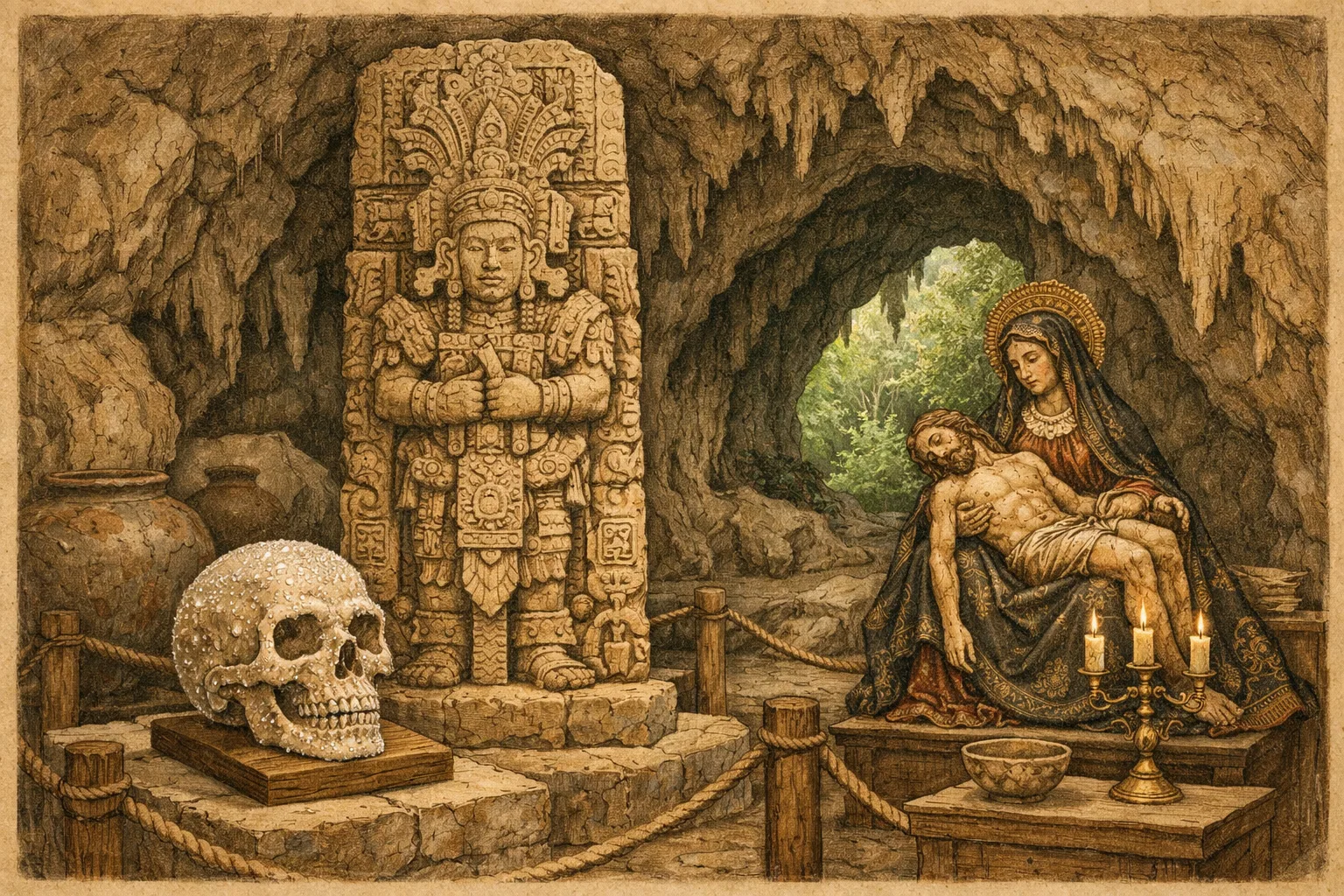
The outstanding example is the Talgua cave complex, popularly associated with “glowing skulls”. Copán’s Sculpture Museum offers a different kind of uncanniness: original monuments removed from the open ruins for protection and a brilliantly coloured reconstruction of a buried temple. Comayagua preserves colonial reliquaries, mourning figures and church treasures, while the so-called White City shows how archaeological discoveries can be transformed into mystery, spectacle and temporary public display. Together, these places reveal how Honduras preserves unusual heritage without always labelling it as strange.
The cave of the glowing skulls
The Talgua Caves, near Catacamas in the department of Olancho, are the closest Honduras comes to a classic archaeological mystery attraction. The site combines a limestone cave, an underground river, a protected burial complex and a small interpretive museum. It is managed as an eco-archaeological park by the Honduran Institute of Anthropology and History, rather than as a commercial horror attraction.[Ihah]ihah.hnParque Eco Arqueológico Cuevas de TalguaParque Eco Arqueológico Cuevas de Talgua… La Cueva del Río Talgua se encuentra en la sierr…
Its famous name comes from human bones coated with crystalline mineral deposits. Water passing through the limestone left a film of calcite on some remains, causing them to glitter when illuminated. “Glowing” therefore describes a natural reflective effect, not phosphorescence, radiation or anything supernatural. The scientific importance of the discovery is more substantial than the nickname: Talgua was one of the first pre-Hispanic burial caves in Honduras to receive systematic archaeological investigation.[RedHonduras]redhonduras.hnRed Honduras Talgua Caves Natural MonumentSome of the bones have been preserved by a layer of glowing calcium, deposited for almost a millennium by water that still seeps through…
The burial chamber contained secondary interments, meaning that bodies had apparently decomposed elsewhere before selected bones were gathered and placed in the cave. Accounts of the research describe bundles of remains and associated offerings rather than intact bodies laid out in tombs. This makes the cave evidence of a carefully organised funerary system, although the identity and political organisation of the people who used it remain less easily defined than those of the Maya rulers at Copán.[RedHonduras]redhonduras.hnRed Honduras Talgua Caves Natural MonumentSome of the bones have been preserved by a layer of glowing calcium, deposited for almost a millennium by water that still seeps through…
Visitors should not expect to walk freely among exposed human remains. Access is controlled, and the most sensitive archaeological areas are protected from routine tourism. The visitor experience instead combines a guided cave walk with explanations, photographs or reproductions connected to the burial discovery. That distinction matters: Talgua is a genuine mortuary site whose popular nickname can sound sensational, but its public interpretation is fundamentally archaeological.
The tension between the name and the evidence is part of its appeal. The “glowing skulls” phrase has made Talgua memorable far beyond Honduras, yet the real story concerns mineral chemistry, ancient ritual and the ethical protection of human remains. It is an unusual attraction precisely because the scientific explanation does not make it less uncanny.
Copán’s museum of originals and replicas
Copán is Honduras’s best-known archaeological site, but its Sculpture Museum is unusually relevant to curiosity culture. It functions partly as a protective refuge for original monuments that visitors may assume are still standing outside. Since the late 1990s, selected sculptures have been transferred indoors to reduce deterioration, with replicas installed in their former positions at the archaeological site. UNESCO describes this as a conservation measure rather than an attempt to deceive visitors.[UNESCO World Heritage Centre]whc.unesco.orgWorld Heritage Centre UNESCO World Heritage CentreUNESCO World Heritage CentreUNESCO World Heritage Centre - Decision - 17 COM XSOC: Maya Site of Copan (Honduras)… The original sculptu…
This creates a revealing reversal of normal museum expectations. Outside, amid the ruins, some apparently ancient objects are modern copies. Inside the museum, the weathered carvings are the originals. The arrangement exposes one of archaeology’s recurring dilemmas: whether an object is more “authentic” when it remains in its historical location or when it is removed from that location to survive.
Copán is especially vulnerable because its sculpture is central to its importance. UNESCO notes the exceptional quality of the site’s carved monuments and its Hieroglyphic Stairway, whose more than 1,800 glyphs form the longest known Maya inscription. The ruins also face erosion, biological growth, earthquakes and pressure from nearby development.[UNESCO World Heritage Centre]whc.unesco.orgWorld Heritage Centre Maya Site of CopanUNESCO World Heritage CentreMaya Site of Copan - UNESCO World Heritage Centre…
The museum’s most spectacular feature is the full-scale reconstruction of the temple known as Rosalila. The original structure was preserved inside a later building, following the Maya practice of enlarging ceremonial architecture by building over earlier temples. The reconstruction restores the kind of strong red, green, yellow and white decoration that weathered stone ruins no longer show. Rather than presenting the Maya world as bare grey masonry, it gives visitors a sense of the brilliant surfaces, masks and symbolic forms that once dominated the city.
Rosalila is not an ancient building moved into a gallery. It is an interpretive reconstruction based on archaeological evidence. That makes it closer to a three-dimensional scholarly argument than a conventional artefact. Its value lies in helping visitors imagine something the protected original cannot safely provide: the visual impact of a complete ceremonial façade.
The museum therefore contains several layers of authenticity at once:
- original sculptures removed from their outdoor settings;
- replicas placed among the ruins;
- fragments used to reconstruct lost decorative schemes;
- and a full-scale modern version of an ancient temple that remains buried within the Acropolis.
For readers interested in mystery objects or disputed museum practice, this is one of Honduras’s richest sites. Nothing is presented as supernatural, yet the visitor is continually required to ask what is original, what has been replaced and how confidently archaeologists can rebuild a vanished appearance.
Sacred objects in Comayagua
Comayagua’s religious collections offer a different form of strangeness: devotional objects whose emotional force can be difficult to separate from their artistic value. The city’s Museum of Colonial Religious Art preserves paintings, vestments, metalwork, sculptures and church furnishings associated with Catholic worship. The collection includes sorrowful Virgins, crucifixion imagery, saints dressed or adorned for ritual use and objects made to be carried, touched or displayed during religious festivals.[Ihah]ihah.hnarte colonial en metalArte Colonial en Metal23 Oct 2022 — Acetre Museo de Arte Religioso Comayagua. Bandeja iglesia San Antonio de Oriente F.M.. Caja de ra…
These are not occult objects, and treating them as macabre curiosities alone would distort their purpose. Many were created as instruments of devotion. Their realism, wounds, glass eyes, wigs, clothing and jewellery were intended to make sacred figures emotionally immediate. In a museum case, however, the same features can appear eerie, theatrical or even mannequin-like to visitors unfamiliar with colonial Catholic visual culture.
The museum is administered in connection with the Diocese of Comayagua and occupies a historical religious setting. It is therefore neither a neutral storehouse nor a purely commercial attraction. The objects sit between living belief, church history and heritage tourism.
The collection also illustrates how fragile unusual religious heritage can be. A major fire in 2009 severely damaged the museum building, although most of the collection was reportedly rescued; the restored museum reopened several years later. The episode is a useful reminder that collections of wood, fabric, paper, wax, paint and metal can survive centuries of political change yet remain vulnerable to a single disaster.[Wikipedia]WikipediaMuseo Colonial de Arte ReligiosoMuseo Colonial de Arte Religioso
Nearby, the Museum of Comayagua broadens the story through archaeology from the Comayagua Valley, including material associated with Lenca communities and regional settlement. Founded in 1940, it grew from a private museum into a state-managed institution.[Ihah]ihah.hnOpen source on ihah.hn.
Taken together, the two museums show how pre-Hispanic objects and colonial devotional objects are often separated into different institutions even though local history did not divide so neatly. Indigenous traditions, Catholic imagery, festival masks and regional folklore influenced one another. Honduras’s strange-history landscape is therefore better understood through these overlaps than through a search for a single museum explicitly devoted to magic.
Ciudad Blanca: when archaeology becomes legend
Few Honduran subjects demonstrate the unstable boundary between museum evidence and adventure mythology as clearly as Ciudad Blanca, the White City. For generations, stories described a great settlement hidden in the forests of La Mosquitia, sometimes embellished as a “City of the Monkey God”. Explorers, journalists and film-makers helped merge scattered ruins, Indigenous knowledge, colonial reports and modern expedition stories into the idea of one fabulous lost city.
Archaeologists generally reject the simple version of that story. The region contains numerous archaeological sites rather than one proven metropolis matching every element of the legend. Even reporting sympathetic to recent expeditions has acknowledged that specialists no longer regard Ciudad Blanca as a single identifiable city in the traditional adventure-story sense.[National Geographic]nationalgeographic.comOpen source on nationalgeographic.com.
Airborne laser scanning, usually called lidar, revealed patterns beneath the forest canopy that were consistent with extensive human settlement. Ground investigation subsequently documented plazas, earthworks and caches of carved stone objects. More than 200 sculptures and vessels were reported from one investigated location, including animal imagery and ceremonial stone containers.[National Geographic]nationalgeographic.comOpen source on nationalgeographic.com.
The discoveries were real, but their presentation became controversial. Critics argued that “lost city” headlines overlooked earlier scholarship and the knowledge of local and Indigenous communities. Members of the expedition responded that they had not claimed to have identified the legendary White City itself. Both sides nevertheless agreed that the archaeology of La Mosquitia deserved serious research and stronger protection.[nationalgeographic.com]nationalgeographic.comOpen source on nationalgeographic.com.
For the public, this material has been easier to encounter through exhibitions than through travel to the remote sites. A 2025 exhibition in Tegucigalpa presented heritage from the City of the Jaguar and Layasangni through themes including nature, archaeology, ancestral worldviews and Indigenous peoples. It was a temporary cultural-centre exhibition, not evidence that visitors could tour the excavation itself.[Honduras.com]honduras.comOpen source on honduras.com.
Ciudad Blanca matters to Honduras’s curiosity culture because it shows how objects acquire several identities at once. A carved vessel can be archaeological evidence, a symbol of national pride, a museum exhibit and a prop in a “lost civilisation” narrative. Responsible interpretation requires preserving the excitement while discarding the assumption that a dramatic nickname is the same thing as a proven historical conclusion.
Insects, bones and private collecting
Not all of Honduras’s unusual collections are state archaeological institutions. San Pedro Sula has developed a more eclectic museum landscape, including its Museum of Anthropology and History and privately assembled natural-history collections.
The anthropology museum presents pre-Columbian material, colonial history and regional objects, and advertises a virtual tour as well as physical exhibitions. Images and collection descriptions indicate that human skeletal material forms part of its archaeological interpretation. Such displays can attract visitors interested in death or medical oddities, but their curatorial purpose is to explain ancient communities rather than to create a cabinet of horrors.[museohnsps.wixstudio.com]museohnsps.wixstudio.comHome | Museo-San Pedro SulaHome | Museo-San Pedro Sula
The city has also been associated with a butterfly and insect museum built around a large private collection. Visitor accounts consistently describe densely arranged specimens from Honduras and other parts of the world rather than a large institutional natural-history museum. Because independent attractions may change their opening arrangements, travellers should confirm access directly rather than assume regular public hours.[Tripadvisor]tripadvisor.comAttractions g292016 Activities c49 t161 HondurasAttractions g292016 Activities c49 t161 Honduras
Private insect collections occupy an interesting middle ground. They can be scientifically informative, visually spectacular and highly personal, reflecting decades of one collector’s choices. At the same time, publicly available information about provenance, cataloguing standards and conservation is often thinner than it is for university or national collections. Visitors may therefore encounter an impressive display without the detailed labels, ecological context or collection history expected in a larger scientific museum.
That informality is part of the attraction. Rows of butterflies, beetles and oversized tropical insects reproduce the atmosphere of an old-fashioned cabinet of natural curiosities more closely than most Honduran archaeological museums do.
What Honduras does not appear to have
Available institutional directories and current museum listings provide little reliable evidence for an active Honduran museum devoted specifically to witchcraft, UFOs, cryptids, spiritualism, medical deformities or famous hoaxes. Claims for such attractions should be treated cautiously unless they can be tied to a named institution, current address and recent visitor information. Honduras’s documented unusual heritage is strong enough without inventing a supernatural museum circuit.[Ihah]ihah.hnFortalezas Coloniales. Fortaleza San… Museo Villa Roy, Barrio Buenos Aires, Tegucigalpa. Tel. 2263-7385. info…Read more…
Folklore certainly exists beyond museum walls. Honduran traditions include supernatural warnings, shape-changing or frightening beings, religious processions, masked dances and stories that vary between regions. Yet much of this heritage remains in oral storytelling, festivals, literature and community practice rather than in permanent object-based exhibitions. A folklore performance or local legend is not automatically a museum collection.
This absence is informative. Honduras’s curiosity culture is dominated by archaeology and sacred heritage because those are the areas in which unusual material has been most formally collected and interpreted. The uncanny appears through burial chambers, fragmented gods, ritual figures and jungle discoveries rather than through purpose-built paranormal attractions.
Why these collections matter
Honduras’s strangest collections repeatedly ask who controls the meaning of an object. At Talgua, human remains must be protected from spectacle even as the “glowing skulls” name attracts attention. At Copán, original sculptures are moved indoors while replicas inherit their places among the ruins. In Comayagua, devotional figures pass between worship and museum display. In La Mosquitia, archaeological objects are pulled between scientific interpretation and the marketable fantasy of a lost city.
They also expose the practical pressures behind museum curation. Honduras’s cultural heritage faces looting, environmental damage, fire, humidity, erosion and limited institutional resources. Removing an object from its setting may save it, but it also changes how it is understood. Reproducing a temple may make ancient colour visible, but it introduces modern interpretation. Turning a legend into an exhibition may draw public interest, but it can overpower Indigenous histories and previous research.
For travellers seeking genuinely strange museums in Honduras, the most rewarding approach is therefore not to look only for labels such as “occult” or “oddities”. The country’s most distinctive experiences are places where evidence and imagination remain visibly in tension: mineral-coated bones behind a protected cave passage, original Maya sculpture sheltered from the weather, richly dressed sacred figures removed from ritual settings, and jungle artefacts displayed beneath the long shadow of a city that probably never existed in the form promised by legend.
Amazon book picks
Further Reading
Books and field guides related to Where Honduras Keeps Its Strangest Heritage. Use these as the next step if you want deeper reading beyond the article.
The Lost City of the Monkey God
Since the days of conquistador Hernán Cortés, rumours have circulated about a lost city of immense wealth hidden deep in the Honduran int...

1491
Mann shows how a new generation of researchers equipped with novel scientific techniques have come to previously unheard-of conclusions a...
The Archaeology of Ancient Mexico and Central America
This reference is devoted to the pre-Columbian archaeology of the Mesoamerican culture area, one of the six cradles of early civilization...
eBay marketplace picks
Marketplace Samples
Live-tested eBay searches with available results related to this page.
Selected fromarchaeology collectible oneBay.co.uk.
Endnotes
1.
Source: ihah.hn
Link:https://ihah.hn/parque-eco-arqueologico-cuevas-de-talgua/
Source snippet
Parque Eco Arqueológico Cuevas de TalguaParque Eco Arqueológico Cuevas de Talgua... La Cueva del Río Talgua se encuentra en la sierr...
2.
Source: ihah.hn
Link:https://ihah.hn/
Source snippet
Fortalezas Coloniales. Fortaleza San... Museo Villa Roy, Barrio Buenos Aires, Tegucigalpa. Tel. 2263-7385. info...Read more...
3.
Source: redhonduras.hn
Title: Red Honduras Talgua Caves Natural Monument
Link:https://redhonduras.hn/en/tourism/talgua-caves-natural-monument/
Source snippet
Some of the bones have been preserved by a layer of glowing calcium, deposited for almost a millennium by water that still seeps through...
4.
Source: whc.unesco.org
Title: World Heritage Centre UNESCO World Heritage Centre
Link:https://whc.unesco.org/en/decisions/3294/
Source snippet
UNESCO World Heritage CentreUNESCO World Heritage Centre - Decision - 17 COM XSOC: Maya Site of Copan (Honduras)... The original sculptu...
5.
Source: whc.unesco.org
Title: World Heritage Centre Maya Site of Copan
Link:https://whc.unesco.org/en/list/129
Source snippet
UNESCO World Heritage CentreMaya Site of Copan - UNESCO World Heritage Centre...
6.
Source: ihah.hn
Title: arte colonial en metal
Link:https://ihah.hn/arte-colonial-en-metal/
Source snippet
Arte Colonial en Metal23 Oct 2022 — Acetre Museo de Arte Religioso Comayagua. Bandeja iglesia San Antonio de Oriente F.M.. Caja de ra...
7.
Source: ihah.hn
Link:https://ihah.hn/pinturas/
Source snippet
Pinturas15 Oct 2022 — Cristo Negro iglesia La Merced, Comayagua. Cuadro bordado con hilo de oro Museo de Arte Religioso Comayagua. Do...
8.
Source: ihah.hn
Title: esculturas de bulto
Link:https://ihah.hn/esculturas-de-bulto/
9.
Source: Wikipedia
Title: Museo Colonial de Arte Religioso
Link:https://es.wikipedia.org/wiki/Museo_Colonial_de_Arte_Religioso
10.
Source: ihah.hn
Link:https://ihah.hn/museo-de-comayagua/
11.
Source: Wikipedia
Title: Museum of Comayagua
Link:https://en.wikipedia.org/wiki/Museum_of_Comayagua
12.
Source: honduras.com
Link:https://www.honduras.com/guias/cultura/exposicion-huellas-ancestrales-de-ciudad-blanca-en-el-centro-cultural-de-espana/
13.
Source: museohnsps.wixstudio.com
Title: Home | Museo-San Pedro Sula
Link:https://museohnsps.wixstudio.com/museo-de-historia/en
14.
Source: tripadvisor.com
Title: Attractions g292016 Activities c49 t161 Honduras
Link:https://www.tripadvisor.com/Attractions-g292016-Activities-c49-t161-Honduras.html
15.
Source: ihah.hn
Link:https://ihah.hn/category/museos/
16.
Source: Wikipedia
Link:https://en.wikipedia.org/wiki/List_of_museums_in_Honduras
17.
Source: ihah.hn
Link:https://ihah.hn/ihah/
18.
Source: ihah.hn
Link:https://ihah.hn/parque-arqueologico-copan/
19.
Source: ihah.hn
Title: parque eco arqueologico cuevas de talgua 3
Link:https://ihah.hn/parque-eco-arqueologico-cuevas-de-talgua-3/
20.
Source: ihah.hn
Link:https://ihah.hn/category/eventos/
21.
Source: cdihh.ihah.hn
Link:https://cdihh.ihah.hn/revistayaxkin/2010/RYAXKI~4.PDF
22.
Source: cdihh.ihah.hn
Title: hnfechamientos por radiocarbono provenientes de copan
Link:https://cdihh.ihah.hn/revistayaxkin/1977-02/FechamientosporRadiocarbonoProvenientesdeCopan.pdf
23.
Source: ihah.hn
Link:https://ihah.hn/proyecto-seguridad-y-educacion-para-la-proteccion-del-patrimonio-cultural-de-honduras-4/
24.
Source: cdihh.ihah.hn
Link:https://cdihh.ihah.hn/revistayaxkin/2000/ElPara%C3%ADso.pdf
25.
Source: ihah.hn
Link:https://ihah.hn/parque-arqueologico-el-puente/
26.
Source: ihah.hn
Title: mision y vision
Link:https://ihah.hn/mision-y-vision/
27.
Source: ihah.hn
Title: LOGROS DEL IHAH EN EL 2023
Link:https://ihah.hn/wp-content/uploads/2024/01/LOGROS-DEL-IHAH-EN-EL-2023.pdf
28.
Source: ihah.hn
Link:https://ihah.hn/el-museo-de-comayagua-inaugura-la-exposicion-temporal-antiguos-sitios-arqueologicos-en-comayagua/
29.
Source: cdihh.ihah.hn
Title: hn EXCAVACIO N Y RESTAURACION DE UN PALACIO
Link:https://cdihh.ihah.hn/revistayaxkin/1985_01_02/ExcavacionyRestauraciondeunPalaciodelaNoblezaMayadeCopan.pdf
30.
Source: ihah.hn
Title: mobiliario religioso
Link:https://ihah.hn/mobiliario-religioso/
31.
Source: cdihh.ihah.hn
Link:https://cdihh.ihah.hn/revistayaxkin/2009_02/Ryaxkin2009_02HaciaLaDefinici%C3%B3nDeUnaPol%C3%ADticaEstatalDeProtecci%C3%B3nDelPatrimonioCulturalEnHonduras_ElCasoDeLaArqueo.pdf
32.
Source: cdihh.ihah.hn
Link:https://cdihh.ihah.hn/revistayaxkin/198902/ApuntesSobreCop%C3%A1nNo7_ElPrimerGobernanteEnLaEstela24%28David%20Stuart%29.pdf
33.
Source: ihah.hn
Link:https://ihah.hn/category/trafico-ilicito/
34.
Source: ihah.hn
Link:https://ihah.hn/acondicionamiento-y-promocion-cultural-y-turistica-de-losparques-arqueologicos-de-el-puente-y-copan-ruinas-enel-departamento-de-copan-y-las-cuevas-de-talgu/
35.
Source: ihah.hn
Title: informe proyecto renovacion museo de comayagua
Link:https://ihah.hn/informe-proyecto-renovacion-museo-de-comayagua/
36.
Source: honduras.com
Link:https://www.honduras.com/aprende/historia/geografia/la-curiosa-ciudad-blanca-honduras/
37.
Source: honduras.com
Link:https://www.honduras.com/aprende/historia/las-cuevas-de-talgua-monumento-natural-de-honduras/
38.
Source: honduras.com
Link:https://www.honduras.com/guias/familiares/museo-del-aire-de-honduras/
39.
Source: honduras.com
Title: museo de entomologia
Link:https://www.honduras.com/aprende/cultura/patrimonios/museo-de-entomologia/
40.
Source: honduras.com
Title: museo de comayagua
Link:https://www.honduras.com/aprende/cultura/patrimonios/museo-de-comayagua/
41.
Source: museum.unesco.org
Title: VM HN 25 006 Tabernacle door
Link:https://museum.unesco.org/stolen-objects/VM-HN-25-006_Tabernacle_door/
42.
Source: whc.unesco.org
Link:https://whc.unesco.org/en/list/129/documents/
43.
Source: unesco.org
Title: Agreement providing for the foundation of a National Museum in Copán
Link:https://www.unesco.org/en/cultnatlaws/agreement-providing-foundation-national-museum-copan
44.
Source: whc.unesco.org
Link:https://whc.unesco.org/en/statesparties/hn
45.
Source: museohnsps.wixstudio.com
Link:https://museohnsps.wixstudio.com/museo-de-historia/en/blank
46.
Source: museohnsps.wixstudio.com
Link:https://museohnsps.wixstudio.com/museo-de-historia/blank
47.
Source: tripadvisor.ca
Title: Attractions g292016 Activities c49 t161 Honduras
Link:https://www.tripadvisor.ca/Attractions-g292016-Activities-c49-t161-Honduras.html
48.
Source: tripadvisor.ca
Title: Attractions g292016 Activities c49 Honduras
Link:https://www.tripadvisor.ca/Attractions-g292016-Activities-c49-Honduras.html
49.
Source: tripadvisor.com
Title: Attractions g292016 Activities c49 Honduras
Link:https://www.tripadvisor.com/Attractions-g292016-Activities-c49-Honduras.html
50.
Source: nationalgeographic.com
Link:https://www.nationalgeographic.com/adventure/article/150302-honduras-lost-city-monkey-god-maya-ancient-archaeology
51.
Source: smithsonianmag.com
Link:https://www.smithsonianmag.com/smart-news/amazing-ruins-long-lost-city-discovered-honduras-180954447/
52.
Source: nationalgeographic.com
Link:https://www.nationalgeographic.com/history/article/160112-honduras-lost-city-archaeology
53.
Source: nationalgeographic.com
Link:https://www.nationalgeographic.com/adventure/article/160113-honduran-lost-city-archaeology
54.
Source: nationalgeographic.com
Link:https://www.nationalgeographic.com/animals/article/160209-honduras-lost-city-archaeology-discovery-jaguar-sculptures-photos
55.
Source: nationalgeographic.com
Link:https://www.nationalgeographic.com/history/article/150313-lost-city-honduras-protected-conservation-archaeology
56.
Source: smithsonianmag.com
Link:https://www.smithsonianmag.com/smart-news/did-recent-expedition-really-discover-lost-city-honduras-180954559/
57.
Source: nationalgeographicla.com
Link:https://www.nationalgeographicla.com/historia/2017/12/ciudad-perdida-descubierta-en-la-selva-tropical-de-honduras
58.
Source: tripadvisor.co.uk
Title: Attractions g292016 Activities c49 Honduras
Link:https://www.tripadvisor.co.uk/Attractions-g292016-Activities-c49-Honduras.html
59.
Source: evmuseography.wordpress.com
Title: museums in honduras
Link:https://evmuseography.wordpress.com/tag/museums-in-honduras/
60.
Source: nationalgeographic.com
Link:https://www.nationalgeographic.com/magazine/article/lost-city-mosquitia-honduras-monkey-god
Additional References
61.
Source: researchgate.net
Link:https://www.researchgate.net/publication/237430293_GIS_applied_to_bioarchaeology_An_example_from_the_Rio_Talgua_Caves_in_Northeast_Honduras
62.
Source: atlasobscura.com
Link:https://www.atlasobscura.com/things-to-do/honduras/museums
63.
Source: rietberg.ch
Link:https://rietberg.ch/en/linked/honduras
64.
Source: min.hn
Link:https://min.hn/index.php/
65.
Source: identitaet-und-erbe.org
Link:https://www.identitaet-und-erbe.org/veranstaltungen/bodies-made-of-corn-and-the-stones-that-grind-it-the-museum-for-national-identity-of-honduras-as-a-site-of-legitimisation-of-constructed-collective-memories-inclusion-and-exclusion-national-myths-a/
66.
Source: internationalparks.org
Link:https://www.internationalparks.org/honduras/Cuevas%20de%20Talgua
67.
Source: pagepressjournals.org
Link:https://www.pagepressjournals.org/jbr/article/download/10199/9664/55162
68.
Source: facebook.com
Link:https://www.facebook.com/groups/TheEntomologyGroup/posts/10154620753723393/
69.
Source: ancient-origins.net
Link:https://www.ancient-origins.net/news-history-archaeology/hundreds-intriguing-artifacts-unearthed-ancient-white-city-ruins-honduras-020738
70.
Source: asu.edu.eg
Link:https://www.asu.edu.eg/331/page