Within Strange Russia
When Russian Folklore Becomes a Museum
Small Russian museums transform household spirits, witches and forest beings into crafted figures while preserving local folklore.
On this page
- The Uglich museum of myths and superstitions
- How makers give oral traditions a physical form
- Private museums, credibility and visitor expectations
Page outline Jump by section
Introduction
Russia’s most distinctive folklore museums are often not grand state institutions but small, privately created collections where traditional beliefs are transformed into life-sized characters, reconstructed interiors and immersive storytelling. Rather than displaying archaeological artefacts or academic archives, these museums give physical form to creatures that originally existed only in oral tradition: household spirits, witches, forest beings and other figures passed down through folktales and village beliefs. They occupy an unusual place between heritage, art installation and visitor attraction. Their value lies less in proving that supernatural beings were believed to exist than in preserving how people imagined them, feared them and incorporated them into everyday life.[Wikipedia]WikipediaRussian folkloreRussian folklore
Among the best-known examples is the Museum of Myths and Superstitions of the Russian People in Uglich, which illustrates how private collectors have helped preserve strands of folklore that receive relatively little attention in larger historical museums. It also shows why visitors should approach these collections as carefully curated interpretations of folklore rather than as historical reconstructions claiming absolute authenticity.[Культура.РФ]culture.ruадрес и т. д. на официальном сайте Культура.РФ…
The Uglich Museum of Myths and Superstitions
The Museum of Myths and Superstitions of the Russian People in Uglich, in Russia’s historic Golden Ring region, is one of the country’s best-known examples of a private folklore museum. Opened in 2001, it was created by artists and folklore enthusiasts Diana and Alexander Golunov (with Diana also working under the artistic name Daria Chuzhaya). Instead of filling display cases with ancient objects, they built an environment populated by life-sized handmade figures representing creatures familiar from Russian folktales and popular belief.[Advantour]advantour.comMuseum of Myth and SuperstitionMuseum of Myth and Superstition - the Most Mysterious Museum of Uglich…
Visitors encounter figures including:
- Baba Yaga, the ambiguous witch who can either aid or threaten travellers.
- The household spirit traditionally believed to protect a family’s home.[occult-world.com]occult-world.comSource details in endnotes.
- Marsh, field and forest beings associated with particular landscapes.
- Demonic figures, vampires and other supernatural creatures from regional legends.
- Mythical birds and spirits drawn from medieval and folk traditions.[culture.ru]culture.ruадрес и т. д. на официальном сайте Культура.РФ…
The museum deliberately recreates dark wooden interiors rather than brightly lit gallery spaces. Costumes, domestic objects, talismans and reconstructed ritual settings encourage visitors to imagine how supernatural beliefs fitted into everyday rural life. Guided tours explain seasonal customs, folk celebrations, old healing practices, divination traditions and oral stories alongside the figures themselves.[Культура.РФ]culture.ruадрес и т. д. на официальном сайте Культура.РФ…
How oral traditions become physical characters
One of the most interesting features of these private museums is that they must invent visual forms for beings that were never standardised. Russian folklore was transmitted primarily through spoken stories, and descriptions often varied between regions and storytellers. Ethnographic records collected during the nineteenth and early twentieth centuries preserve multiple, sometimes contradictory, versions of many spirits.[Wikipedia]WikipediaRussian folkloreRussian folklore
Museum creators therefore work as both artists and interpreters. They typically combine:
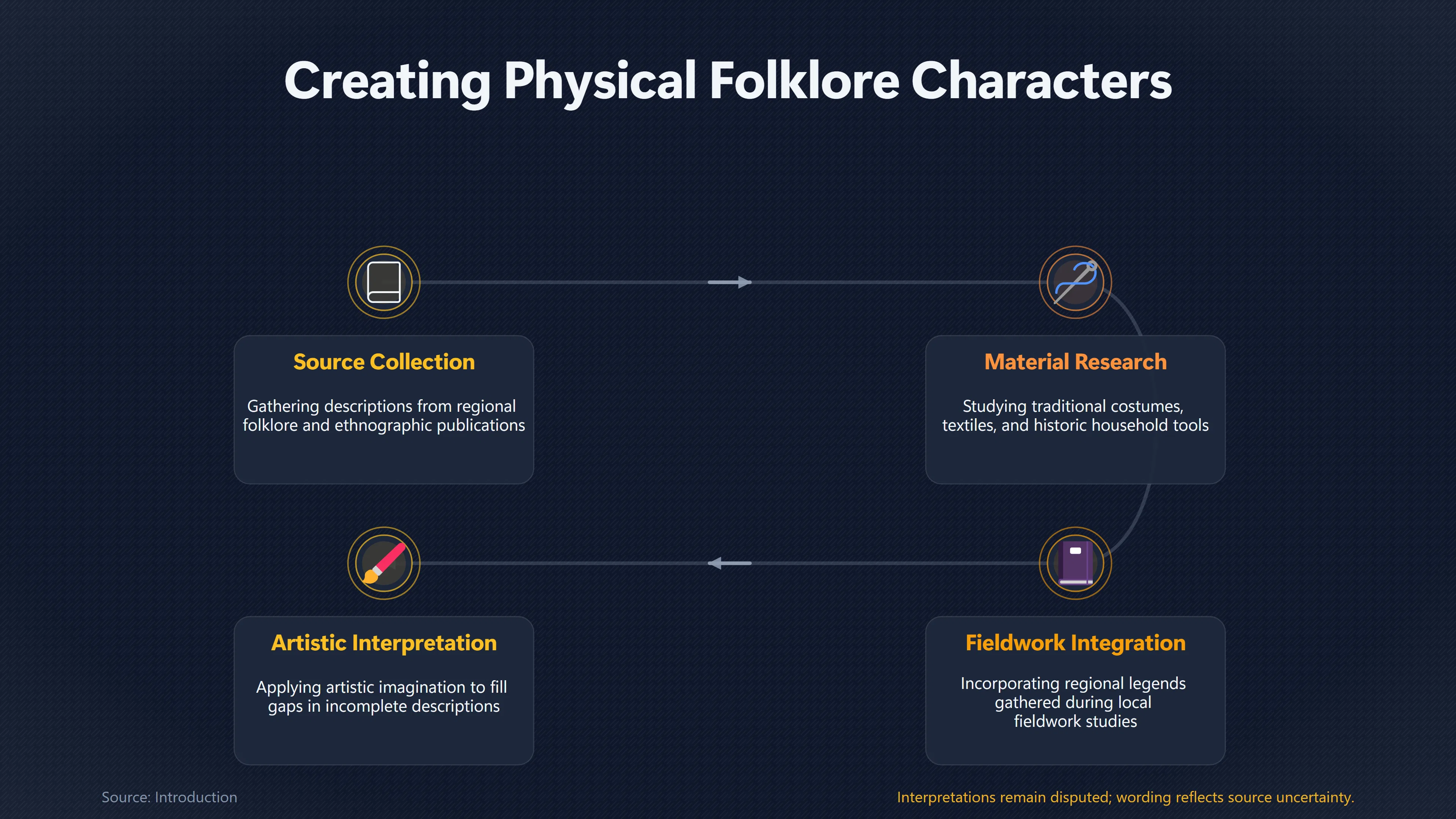
- Descriptions found in folklore collections and ethnographic publications.
- Traditional costume and textile research.
- Historic household tools and furniture.
- Regional legends gathered during fieldwork.
- Artistic imagination where historical descriptions are incomplete.[advantour.com]advantour.comMuseum of Myth and SuperstitionMuseum of Myth and Superstition - the Most Mysterious Museum of Uglich…
The result is not a claim that these beings “really looked” a particular way. Instead, the figures provide memorable visual anchors for stories that otherwise survive only in words.
This approach also makes complex folklore easier for family audiences to understand. A visitor may remember a carefully modelled household spirit or forest creature long after forgetting an academic explanation of rural belief systems.

Why private museums preserve subjects larger museums often overlook
Large Russian state museums generally present folklore through ethnographic collections, manuscripts, costumes or archaeological finds. Their emphasis is documentation rather than dramatic reconstruction.
Private museums have greater freedom to build immersive environments. Because they are usually created by artists, collectors or enthusiasts rather than government institutions, they can devote entire exhibitions to subjects that would occupy only a small section of a conventional museum.[Advantour]advantour.comMuseum of Myth and SuperstitionMuseum of Myth and Superstition - the Most Mysterious Museum of Uglich…
These museums also preserve aspects of intangible heritage:
- Local ghost stories.
- Household superstitions.
- Protective charms and amulets.
- Seasonal rituals.
- Oral legends associated with particular villages or regions.
- Folk interpretations of familiar fairy-tale characters.[proehal.ru]proehal.ruМузей мифов и суеверий русского народа | УгличМузей мифов и суеверий русского народа | Углич
In this sense, the handmade figures are only one part of the collection. The accompanying stories, guided explanations and reconstructed settings are equally important exhibits.
Credibility and visitor expectations
Visitors should distinguish carefully between folklore, ethnography and historical evidence.
The creatures displayed are not archaeological discoveries or reconstructions based on physical remains. They are artistic interpretations rooted in documented folk traditions. Museums such as the Uglich collection generally explain legends, beliefs and customs rather than arguing that supernatural beings literally existed.[Культура.РФ]culture.ruадрес и т. д. на официальном сайте Культура.РФ…
Similarly, references to ancient healing methods, protective objects or divination practices should be understood as elements of historical culture rather than endorsements of their effectiveness. These museums preserve belief systems, not scientific knowledge.[proehal.ru]proehal.ruМузей мифов и суеверий русского народа | УгличМузей мифов и суеверий русского народа | Углич
Their credibility therefore lies in accurately communicating the richness of traditional folklore while acknowledging that oral traditions changed across regions and generations.
Why these museums matter within Russia’s curiosity culture
Private folklore museums occupy a distinctive position within Russia’s landscape of unusual collections. Unlike scientific museums displaying preserved specimens or historical museums preserving documented artefacts, they collect something much harder to exhibit: imagination itself.
By transforming invisible household spirits, witches and forest beings into crafted figures, these museums preserve forms of cultural memory that might otherwise survive only in specialist books or fading oral traditions. Their displays reveal how earlier generations explained misfortune, protected their homes, interpreted nature and gave personality to the unseen forces they believed surrounded everyday life.[Wikipedia]WikipediaRussian folkloreRussian folklore
Within Russia’s broader tradition of curiosity museums, they demonstrate that unusual collections need not depend on rare physical objects. Sometimes the collection consists of carefully crafted characters that allow visitors to step inside a world once sustained entirely through storytelling.
Amazon book picks
Further Reading
Books and field guides related to When Russian Folklore Becomes a Museum. Use these as the next step if you want deeper reading beyond the article.
The Uses of Enchantment: The Meaning and Importance of Fairy...
Winner of the National Book Award and National Book Critics Circle Award "A charming book about enchantment, a profound book about fairy...
The Hero with a Thousand Faces
Traces the concept of heroes and places Christ in that category along with myths and folk heroes.
The Russian Folktale
Translates and contextualizes Vladimir Propp's later work The Russian Folktale.
Russian Fairy Tales
A richly illustrated collection of Russian folk tales: Tsar Saltan; Vasilisa the Beautiful; Maria Morevna; The Feather of Finist the Falc...
eBay marketplace picks
Marketplace Samples
Live-tested eBay searches with available results related to this page.
Selected fromfantasy collectible oneBay.co.uk.
Endnotes
1.
Source: Wikipedia
Title: Russian folklore
Link:https://en.wikipedia.org/wiki/Russian_folklore
2.
Source: culture.ru
Link:https://www.culture.ru/institutes/13625/muzei-mifov-i-sueverii-russkogo-naroda
Source snippet
адрес и т. д. на официальном сайте Культура.РФ...
3.
Source: advantour.com
Title: Museum of Myth and Superstition
Link:https://www.advantour.com/russia/uglich/museum-of-myths.htm
Source snippet
Museum of Myth and Superstition - the Most Mysterious Museum of Uglich...
4.
Source: proehal.ru
Title: Музей мифов и суеверий русского народа | Углич
Link:https://proehal.ru/uglich/muzej-mifov-i-sueverij/
5.
Source: votpusk.ru
Title: Музей мифов и суеверий русского народа описание и фото
Link:https://www.votpusk.ru/article/attractions/rossiya-zolotoe-kolco/uglich/muzei_mifov_i_sueverii_russkogo_naroda-a
Source snippet
Россия - Золотое Кольцо: Углич...
6.
Source: advantour.com
Link:https://www.advantour.com/rus/russia/uglich/museum-of-myths.htm
7.
Source: youtube.com
Title: Russian Folklore
Link:https://www.youtube.com/watch?v=IdDo6poM_7Q
Source snippet
Spooky Research: Slavic folklore's Domovoi, the Protective House Spirit...
Additional References
8.
Source: londonmuseum.org.uk
Title: Lauderdale House: Witchcraft relics hidden in the wall | London Museum
Link:https://www.londonmuseum.org.uk/blog/lauderdale-house-witchcraft-relics-hidden-in-the-wall/
Source snippet
October 15, 2024 — 15 October 2024 — By Harriet Sweet-Escott, Mariarosa Spanu LAUDERDALE HOUSE: WITCHCRAFT RELICS HIDDEN IN THE WALL Imag...
Published: October 15, 2024
9.
Source: idemvmuzei.ru
Title: Музей мифов и суеверий русского народа в Угличе | Идём в музей
Link:https://idemvmuzei.ru/en/blog/muzej-mifov-i-sueverij-russkogo-naroda-v-uglice-1698357169
Source snippet
aгрегатор музеев, выставок и экскурсий.October 26, 2023 — Image: Museum of Myths and Superstitions of the Russian People in Uglich Octobe...
Published: October 26, 2023
10.
Source: youtube.com
Title: Baba Yaga Is Older Than You Think: The True Story of the Slavic Witch
Link:https://www.youtube.com/watch?v=xE5uEHqi8oU
Source snippet
Every Mythical Creature from Slavic Folklore Explained in 19 Minutes...
11.
Source: youtube.com
Title: Spooky Research: Slavic folklore’s Domovoi, the Protective House Spirit
Link:https://www.youtube.com/watch?v=63pbaxt9mjg
Source snippet
Leshy: The Slavic Lord of the Forest | Monstrum...
12.
Source: komandirovka.ru
Title: Музей Мифов и суеверий русского народа, Углич
Link:https://www.komandirovka.ru/sights/uglich/muzey-mifov-i-sueveriy-russkogo-naroda/
Source snippet
KomandirovkaМузей Мифов и суеверий русского народа, Углич...
13.
Source: tur-ray.ru
Title: uglich muzei
Link:https://tur-ray.ru/uglich-muzei.html
Source snippet
От сыра и суеверий до тюрьмы и водки: Топ-7 музеев УгличаApril 3, 2026 — ОТ СЫРА И СУЕВЕРИЙ ДО ТЮРЬМЫ И ВОДКИ: ТОП-7 МУЗЕЕВ УГЛИЧА Обновл...
Published: April 3, 2026
14.
Source: youtube.com
Title: Leshy: The Slavic Lord of the Forest | Monstrum
Link:https://www.youtube.com/watch?v=v6s-jnfBxD0
Source snippet
Baba Yaga Is Older Than You Think: The True Story of the Slavic Witch...
15.
Source: slav-museum.ru
Link:https://slav-museum.ru/in-english/
16.
Source: occult-world.com
Link:https://occult-world.com/domovik/
17.
Source: visityaroslavia.ru
Link:https://visityaroslavia.ru/en/places/1847