Within Strange Serbia
How Did a Skull Tower Become a Shrine?
The Skull Tower transformed an Ottoman warning built from severed heads into one of Serbia's most powerful memorials.
On this page
- The Battle of Cegar and the tower's construction
- What visitors see inside the chapel
- How terror became a symbol of resistance
Page outline Jump by section
Introduction
The Skull Tower in Niš is one of Europe’s most unsettling historic monuments because its walls contain genuine human skulls. Built by Ottoman authorities after the Battle of Čegar in 1809 as a warning against rebellion, it was intended to spread fear across the Balkans. Instead, over the following century, it was transformed into one of Serbia’s most important memorials to sacrifice and national resistance. Today the tower stands inside a chapel, where visitors encounter not a theatrical display of death but a carefully preserved monument whose meaning has been radically reversed. It is unusual not simply because it incorporates human remains, but because it demonstrates how the same physical object can move from an instrument of political terror to a place of remembrance and reflection.[National Museum Niš]narodnimuzejnis.rsNational Museum NišSkull Tower Monument – National Museum NišNational Museum NišSkull Tower Monument – National Museum Niš
How Did a Skull Tower Become a Shrine?
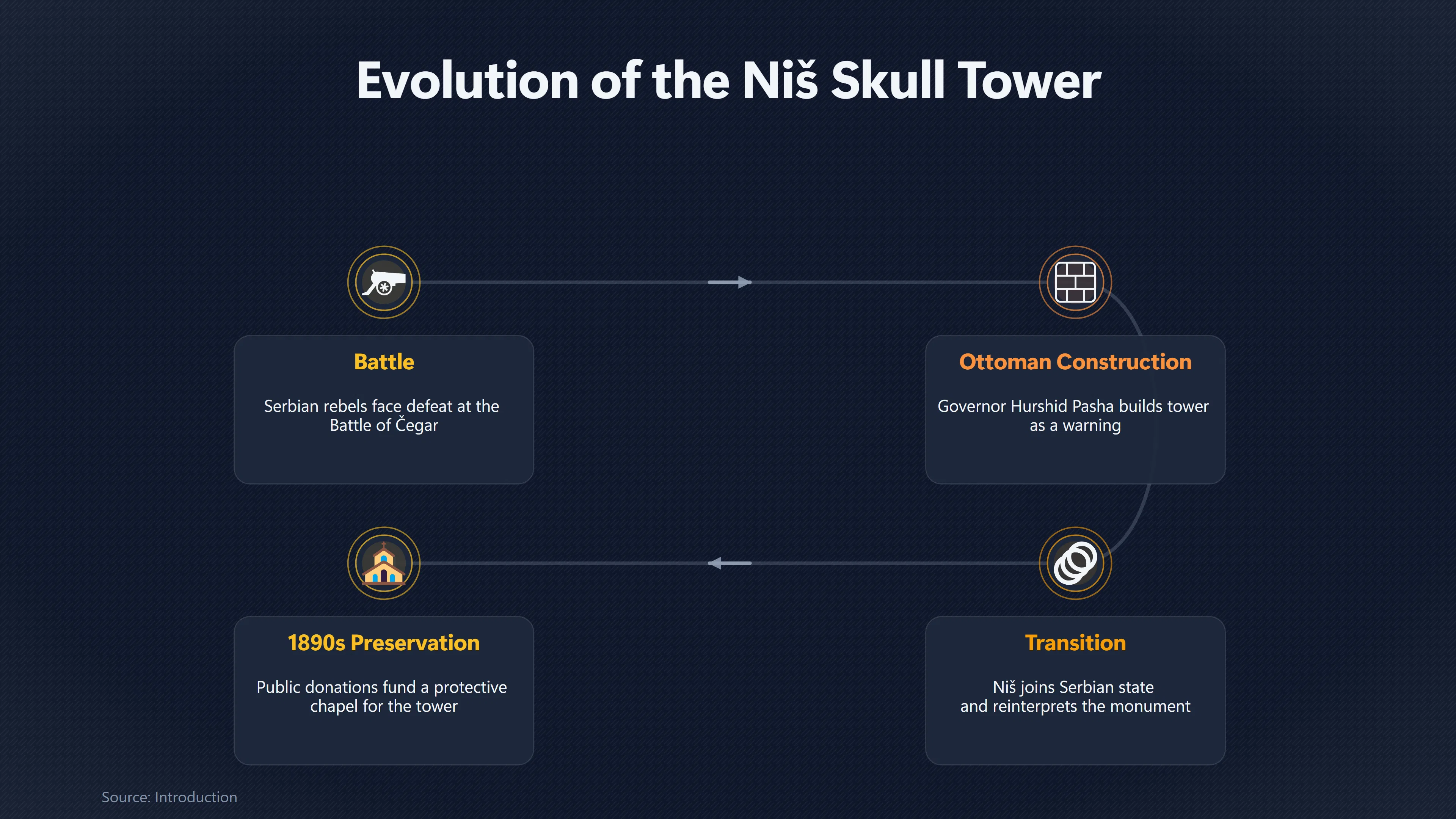
Unlike ossuaries, where bones are arranged for religious commemoration, the Skull Tower originated as an act of intimidation. Following the Serbian defeat at the Battle of Čegar during the First Serbian Uprising, Ottoman governor Hurshid Pasha ordered the heads of fallen Serbian rebels to be removed. Their scalps were reportedly sent to Constantinople as proof of victory, while the skulls were built into a roadside tower on the route towards the imperial capital. Contemporary accounts and the National Museum in Niš state that around 952 skulls were originally embedded in the structure.[National Museum Niš]narodnimuzejnis.rsNational Museum NišSkull Tower Monument – National Museum NišNational Museum NišSkull Tower Monument – National Museum Niš
The monument’s location mattered as much as its construction. Positioned beside a major road, it was designed to confront travellers with the consequences of resistance. Rather than commemorating the dead, it displayed the power of the Ottoman state through the bodies of its enemies.
Yet this intended message did not survive unchanged. During the nineteenth century, especially after Niš became part of the Serbian state in 1878, the tower was reinterpreted as evidence of the rebels’ courage rather than their defeat. What had been created as an imperial warning gradually became a patriotic memorial. This reversal is the defining feature of Skull Tower and explains why it occupies such a distinctive place in Serbia’s heritage.[National Museum Niš]narodnimuzejnis.rsNational Museum NišSkull Tower Monument – National Museum NišNational Museum NišSkull Tower Monument – National Museum Niš
The Battle of Čegar and the Tower’s Construction
The story of the tower cannot be separated from the final moments of the Battle of Čegar. Serbian forces under Stevan Sinđelić were surrounded by a much larger Ottoman army near Niš. According to the long-established historical account, when defeat became inevitable and capture threatened, Sinđelić fired into his own gunpowder magazine, killing himself, many of his fighters and numerous Ottoman soldiers in a massive explosion. Although details of the battle have been debated by historians, the explosion itself forms the central event in Serbian historical memory.[National Museum Niš]narodnimuzejnis.rsNational Museum NišSkull Tower Monument – National Museum NišNational Museum NišSkull Tower Monument – National Museum Niš
The tower that followed was constructed from the skulls of the dead rebels. Human remains were fixed into a square masonry structure approximately four metres high, with skulls facing outward so they could be seen from every direction. This was not an improvised pile of remains but a deliberately engineered public monument whose architecture amplified its psychological impact.[National Museum Niš]narodnimuzejnis.rsNational Museum NišSkull Tower Monument – National Museum NišNational Museum NišSkull Tower Monument – National Museum Niš
Many of the skulls disappeared over time. Relatives are believed to have secretly removed some for proper burial, weather damaged others, and the structure itself deteriorated during decades of exposure. Consequently, modern visitors see only a small fraction of the original display.[National Museum Niš]narodnimuzejnis.rsNational Museum NišSkull Tower Monument – National Museum NišNational Museum NišSkull Tower Monument – National Museum Niš

What Visitors See Inside the Chapel
The Skull Tower is no longer exposed to the elements. After the Ottoman withdrawal from Niš, local efforts to preserve the monument culminated in the construction of a protective chapel in the 1890s, funded through public donations. The chapel fundamentally changed the visitor experience by placing the tower within a memorial setting rather than leaving it as a roadside relic.[National Museum Niš]narodnimuzejnis.rsNational Museum NišSkull Tower Monument – National Museum NišNational Museum NišSkull Tower Monument – National Museum Niš
Inside, visitors encounter the surviving section of the original tower with dozens of skulls still visible within the masonry. According to the National Museum in Niš, only 58 skulls remain today. One skull, traditionally identified as belonging to Stevan Sinđelić, is displayed separately. While this identification has become part of the site’s interpretation, individual attributions from the battle should be treated cautiously because definitive forensic proof is lacking.[National Museum Niš]narodnimuzejnis.rsNational Museum NišSkull Tower Monument – National Museum NišNational Museum NišSkull Tower Monument – National Museum Niš
The atmosphere differs markedly from that of a conventional museum gallery. There are explanatory panels and memorial features, but the central exhibit is the original structure itself. Visitors are looking directly at authentic human remains preserved within the fabric of a nineteenth-century monument rather than replicas or reconstructed displays.
How Terror Became a Symbol of Resistance
The changing interpretation of Skull Tower illustrates how memorials can acquire meanings that contradict the intentions of those who created them.
During Ottoman rule, the tower represented state authority, punishment and deterrence. After Serbian independence, those same skulls came to symbolise sacrifice for national freedom. The material object never changed, but the cultural narrative surrounding it was completely transformed.
An important milestone in this shift came through the writings of the French author Alphonse de Lamartine, who visited the tower during his travels in the Balkans. Deeply moved by what he saw, he urged that the monument be preserved because it testified to the price paid for freedom rather than simply displaying brutality. His account helped frame the tower as a memorial deserving respect rather than fear.[National Museum Niš]narodnimuzejnis.rsNational Museum NišSkull Tower Monument – National Museum NišNational Museum NišSkull Tower Monument – National Museum Niš
This transformation explains why the site remains significant within Serbia’s landscape of unusual heritage. Unlike many places displaying human remains, its purpose is not anatomical education, religious devotion or archaeological curiosity. Instead, the remains function as historical witnesses whose political meaning has evolved across two centuries.

Why Skull Tower Matters in Serbia’s Curiosity Culture
Among Serbia’s unusual heritage sites, Skull Tower occupies a unique position because it combines authentic human remains with a well-documented historical narrative. It is neither a cabinet of curiosities nor a collection assembled for spectacle. Instead, the monument forces visitors to confront how violence can be preserved, interpreted and remembered.
Its significance also lies in its authenticity. The skulls are not symbolic representations but the remains of identifiable participants in a specific historical conflict. That gives the site an emotional weight that differs from reconstructed battlefield museums or artistic memorials.
The tower also demonstrates an important principle found across many countries’ difficult heritage sites: monuments created to celebrate domination can eventually become memorials to those they were meant to intimidate. In Serbia, that reversal has made Skull Tower not only one of the country’s most unusual historical attractions but also one of its most powerful reflections on the meaning of human remains in public memory.[National Museum Niš]narodnimuzejnis.rsNational Museum NišSkull Tower Monument – National Museum NišNational Museum NišSkull Tower Monument – National Museum Niš
Amazon book picks
Further Reading
Books and field guides related to How Did a Skull Tower Become a Shrine?. Use these as the next step if you want deeper reading beyond the article.

The Penguin Book of Vampire Stories
/Alan Ryan, editor Collected here are 32 stories featuring the frightening creature--the vampire. Just in time for Halloween, this charac...
The Balkans: Nationalism, War, and the Great Powers,
From the bestselling author of McMafia and DarkMarket comes this unique and lively history of Balkan geopolitics since the early nineteen...
The Invention of Tradition
Rating: 4.5/5 from 16 Google Books ratings
This book explores examples of this process of invention and addresses the complex interaction of past and present in a fascinating study...
A History of the Balkans
The Balkans have often been a flashpoint of conflict in European history. The recent civil war has torn the country apart and the region...
eBay marketplace picks
Marketplace Samples
Live-tested eBay searches with available results related to this page.
Selected fromEuropean landmark art oneBay.co.uk.


Endnotes
1.
Source: serbian.travel
Title: Niš City Guide: Fortress, Skull Tower & Nightlife
Link:https://serbian.travel/nis
Source snippet
June 30, 2026 — Southern Serbia city guide NIŠ TRAVEL GUIDE: FORTRESS, MEDIANA AND THE SOUTH OF SERBIA A practical guide to Serbia’s thir...
Published: June 30, 2026
2.
Source: serbia.travel
Title: When in Niš
Link:https://www.serbia.travel/en/stories-items/when-in-nis/
3.
Source: narodnimuzejnis.rs
Title: National Museum NišSkull Tower Monument – National Museum Niš
Link:https://narodnimuzejnis.rs/en/o-muzeju/objekti/cele-kula/
4.
Source: discoverserbia.org
Title: Skull Tower
Link:https://discoverserbia.org/en/museums/skull-tower
5.
Source: srna.rs
Title: STEVAN SINĐELIĆ
Link:https://www.srna.rs/en/novost/1401039/stevan-sindjelic–an-explosion-for-eternal-glory
Source snippet
STEVAN SINĐELIĆ - AN EXPLOSION FOR ETERNAL GLORYMay 30, 2026 — 30.05.2026 Image: Time10:14:00 STEVAN SINĐELIĆ - AN EXPLOSION FOR E...
Published: May 30, 2026
6.
Source: srpskikod.org
Title: The Skull Tower | Srpski Kod
Link:https://www.srpskikod.org/en/first-level/uprising/the-skull-tower
Source snippet
Built as a memorial to the Serbian rebels in the early 19^{th} century, made of their skulls. It is in Niš, on the erstwhile Constantinop...
7.
Source: narodnimuzejnis.rs
Title: Они су на периферији Ниша, на путу који води ка Цариграду, одлучили да под
Link:https://narodnimuzejnis.rs/o-muzeju/objekti/cele-kula/
Source snippet
Ћеле-кула – Народни музеј НишImage: Народни музеј Ниш ЋЕЛЕ-КУЛА После Чегарске битке Турци су желели да се на најсвирепији начин освете с...
8.
Source: narodnimuzejnis.rs
Title: Oni su na periferiji Niša, na putu koji vodi ka Carigr
Link:https://narodnimuzejnis.rs/RS/%D1%9B%D0%B5%D0%BB%D0%B5-%D0%BA%D1%83%D0%BB%D0%B0/
Source snippet
Ćele-kula – Narodni muzej NišImage: Ćele-kula Medijana Image: Ćele-kula ĆELE-KULA Posle Čegarske bitke Turci su želeli da se na najsvirep...
9.
Source: narodnimuzejnis.rs
Link:https://narodnimuzejnis.rs/en/
10.
Source: narodnimuzejnis.rs
Link:https://narodnimuzejnis.rs/fr/%D1%9B%D0%B5%D0%BB%D0%B5-%D0%BA%D1%83%D0%BB%D0%B0/
11.
Source: narodnimuzejnis.rs
Link:https://narodnimuzejnis.rs/en/category/%D0%BE%D0%B1%D1%98%D0%B5%D0%BA%D1%82%D0%B8/
12.
Source: narodnimuzejnis.rs
Link:https://narodnimuzejnis.rs/en/o-muzeju/istorijat-muzeja/
13.
Source: narodnimuzejnis.rs
Link:https://narodnimuzejnis.rs/en/za-posetioce/radno-vreme/
14.
Source: islamicheritage.co.za
Link:https://islamicheritage.co.za/skull-tower/
Additional References
15.
Source: commons.wikimedia.org
Title: Other resolutions: 320 × 213 pixels | 640 × 427 pixels
Link:https://commons.wikimedia.org/wiki/File%3ASkull_Tower_%E2%80%94_%C4%86ele-kula_01.jpg
Source snippet
wikimedia.orgFile:Skull Tower — Ćele-kula 01.jpg - Wikimedia CommonsAugust 18, 2023 — FILE:SKULL TOWER — ĆELE-KULA 01.JPG * File * Discus...
Published: August 18, 2023
16.
Source: youtube.com
Title: Nis Serbia | Tower of Skulls | Concentration camp | Nis Fortress
Link:https://www.youtube.com/watch?v=crQhLEwSFTg
Source snippet
This webinar video on Tower of skulls, tower of stories: Bioarch analysis of Ćele-Kula provides direct bioarchaeological context on the h...
17.
Source: youtube.com
Title: Tower of skulls, tower of stories: Bioarch analysis of Ćele-Kula
Link:https://www.youtube.com/watch?v=M-u1n0NmF1k
Source snippet
The scariest monument in world - SKULL TOWER / City of Niš, Serbia, Europe...
18.
Source: arheo.rs
Link:https://arheo.rs/en/muzej/association-for-academic-development/
19.
Source: youtube.com
Link:https://www.youtube.com/watch?v=_-U4LnKyNLM
Source snippet
Nis Serbia | Tower of Skulls | Concentration camp | Nis Fortress...
20.
Source: youtube.com
Title: The scariest monument in world
Link:https://www.youtube.com/watch?v=bxJin7gvRpI
Source snippet
Ćele kula - Skull Tower, Niš Serbia...
21.
Source: klubputnika.org
Title: 1640 nis
Link:https://www.klubputnika.org/servis/odredista/juzna/1640-nis
Source snippet
godine, počelo je oslobađanje Srbije od turske vlasti, a jedna od najznačajnijih bitaka u...
22.
Source: youtube.com
Title: Ćele kula
Link:https://www.youtube.com/watch?v=Erkod88eQsU
Source snippet
Tour of Nis, Serbia # 5... Skull Tower...
23.
Source: nisandbyzantium.org.rs
Title: ĆELE KULAImage: CELE KULA
Link:https://www.nisandbyzantium.org.rs/manastiri_i_crkve_grada_nisa/engleski/cele%20kula.html
24.
Source: spomenicisrbije.rs
Title: ЋЕЛЕ КУЛА У НИШУ
Link:https://www.spomenicisrbije.rs/objekat/cele-kula-u-nisu/