Where Armenia Keeps Its Strangest Treasures
Armenia does not have a large, clearly labelled network of witchcraft, cryptid, UFO or medical-oddity museums. Its strange-collection culture is subtler and, in many ways, more interesting.
Page outline Jump by section
Introduction
The essential distinction is between objects presented as archaeological or historical evidence and objects preserved because a religious community regards them as sacred. Armenia’s museums often place these categories close together without treating them as interchangeable. The result is a curiosity landscape shaped less by commercial “weird museums” than by deep traditions of manuscript preservation, Christian pilgrimage, archaeology, family collecting and imaginative reuse.
Why Armenia’s oddities rarely look like novelty museums
Armenia’s unusual collections tend to be serious institutions containing strange material rather than attractions built entirely around strangeness. The national tourism service promotes the Sergei Parajanov Museum as one of Yerevan’s most unusual cultural experiences, but it places it beside manuscript repositories, archaeological museums and regional collections rather than within a separate “dark tourism” or paranormal category.[Armenia Travel]armenia.travelThings To Do | Museum & GalleriesParajanov's unique art specimens, collages, graphics, dolls, and the house itself are among Ye…
This reflects the country’s history. Objects have often survived because they were kept by monasteries, transferred between Armenian communities, excavated from unusually dry caves, gathered by ethnographers or protected within private homes. A manuscript might function simultaneously as a text, an artwork, a national treasure and an object of devotion. A carved stone might begin as a prehistoric ritual monument, be reused in a later burial and eventually enter an archaeological display. The curious quality comes from these layered biographies rather than from theatrical presentation.
There is also a notable absence. Current institutional and tourism sources do not reveal a major dedicated Armenian museum of witchcraft, spiritualism, cryptids, UFOs or famous hoaxes. Visitors looking for that exact format are likely to be disappointed. Armenia’s strongest material instead concerns sacred relics, archaeological anomalies, folklore, outsider-like art and personal collecting.
Parajanov’s house of transformed objects
The Sergei Parajanov Museum in Yerevan is the clearest answer to the question, “What is Armenia’s strangest conventional museum?” It preserves the visual world of filmmaker and artist Sergei Parajanov through collages, assemblages, dolls, hats, drawings, film sketches, furniture and personal possessions. The museum’s official collection contains more than 1,700 objects, with reconstructed elements from his homes in Tbilisi and Kyiv included in its memorial rooms.[Sergey Parajanov Museum]sergey-parajanov.mus.ameum in c. YerevanThe basis of the museum collection constitute 1755 objects - assemblages, flat and three-dimensional collages, drawin…
Parajanov turned scraps, photographs, household objects, religious imagery, costume fragments and found materials into miniature theatrical worlds. Many of these works emerged during years when Soviet authorities imprisoned him or prevented him from making films. The museum therefore feels partly like an artist’s cabinet of curiosities and partly like an archive of creative resistance. His objects are not presented as occult artefacts, although masks, icons, dolls and symbolic figures can give some rooms a ritual or dreamlike atmosphere.[Parajanov-Vartanov Institute]parajanov.coms art works – assemblages, flat and three-dimensional collages,Vartanov InstituteSergei Parajanov MuseumFebruary 9, 2017 — A museum of his works – his graphics, dolls, collages, photographs…
What visitors should expect is density rather than orderly chronology. The pleasure lies in examining how familiar things have been recast: a discarded object becomes a character, a portrait becomes a reliquary-like construction, and a piece of domestic material becomes a stage set. The institution is carefully curated and well established, but Parajanov’s art deliberately resists straightforward explanation. Among Armenian collections, it comes closest to the spirit of a modern curiosity cabinet.
Relics at Holy Etchmiadzin: belief displayed as material history
The museums of the Mother See of Holy Etchmiadzin preserve church vestments, liturgical art, reliquaries and sacred objects belonging to the Armenian Apostolic Church. The most remarkable holdings are in the Alex and Marie Manoogian Treasury Museum, whose official description lists the Holy Lance of Geghard, a relic identified as a fragment of Noah’s Ark and reliquaries said to contain pieces of the True Cross.[Armenian Church]armenianchurch.orgArmenian ChurchMSoHE | Museums of the Mother SeeThe museums of the Mother See of Holy Etchmiadzin house numerous relics and sacred artifa…
These are not archaeological claims presented as scientifically demonstrated facts. They are devotional objects whose identities rest on church tradition, inherited attribution and centuries of veneration. The Church describes the lance as the spear associated with the piercing of Christ’s side, while the Noah’s Ark fragment belongs to a tradition in which an angel gave a piece of the vessel to Saint Jacob after preventing him from climbing Mount Ararat.[I Confess With Faith]shnorhali.comOpen source on shnorhali.com.
That distinction matters. A visitor can examine the craftsmanship, age and documented history of a reliquary without accepting that its contents have the supernatural or biblical origin attributed to them. For believers, however, the object is not merely illustrative: it is a physical connection with sacred history.
The treasury is therefore one of Armenia’s most compelling unusual collections. It shows how an object can operate on several levels at once—as metalwork, church property, national heritage, pilgrimage focus and testimony to belief. It is neither a commercial mystery attraction nor a neutral archaeological gallery. Its curatorial authority is ecclesiastical, and its central claims are religious.
Matenadaran: books as treasures, talismans and survivors
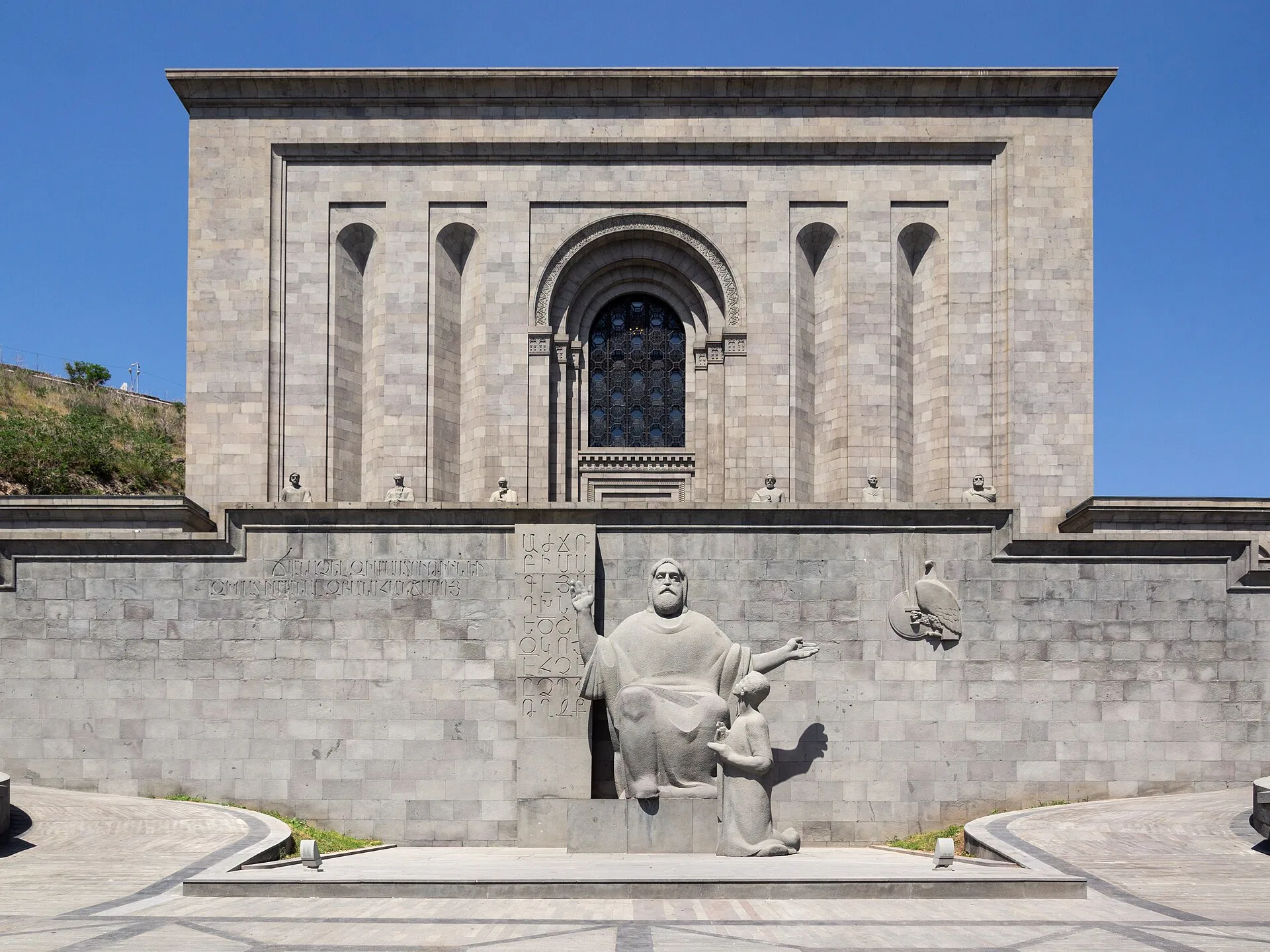
Yerevan’s Matenadaran is a research institute, archive and museum devoted to manuscripts. Its exhibitions cover the development of Armenian book culture from the early medieval period onwards, including illuminated religious works and texts concerned with history, medicine, astronomy, philosophy, law and other subjects. UNESCO describes the collection as encompassing almost every field of Armenian medieval science and culture.[ՄԱՏԵՆԱԴԱՐԱՆ]matenadaran.amՄԱՏԵՆԱԴԱՐԱՆMuseum of The MatenadaranՄԱՏԵՆԱԴԱՐԱՆMuseum of The Matenadaran
The collection belongs in Armenia’s curiosity landscape because these books are unusually powerful physical objects. Some have ornate bindings, miniature paintings or complicated histories of rescue and migration. Others contain medical diagrams, cosmological ideas or accounts of subjects now separated into religion, science and folklore.
Certain manuscripts have also been treated as objects of veneration rather than simply as texts. Historical accounts describe Gospels being carried periodically to churches for worshippers, while one ancient Gospel has been used during presidential inaugurations.[Wikipedia]WikipediaOpen source on wikipedia.org. Such practices reveal that Armenian manuscript culture cannot be understood solely through modern library categories. A book may be read, exhibited, sworn upon, protected as national patrimony and approached as sacred matter.
The Matenadaran is highly credible as a scholarly institution, with conservation and research at the heart of its work. Its displays do not endorse every medieval medical, astrological or cosmological proposition as scientifically true. Instead, they preserve evidence of what people wrote, believed and transmitted. It is a good place to see the difference between documenting an old belief system and validating that belief system.
Archaeological objects stranger than legends
Armenia’s archaeology supplies some of the country’s most memorable genuine oddities. These are valuable precisely because their unusual qualities do not depend on tourist mythology.
The best-known example is the Areni-1 leather shoe, discovered in a cave in Vayots Dzor and dated to roughly 3500 BC. The History Museum of Armenia identifies it as a 5,500-year-old object from its archaeological collection. Its exceptional survival was helped by the cave’s dry conditions and by a layer of animal dung that sealed the deposit.[historymuseum.am]historymuseum.am5500 year old leather shoe5500 year old leather shoe
The shoe is striking because it looks recognisably functional rather than ceremonially exotic. It was made from a single piece of leather and still retained lacing and grass inside it. Researchers have debated whether the grass served as insulation or merely helped the shoe keep its shape. Its status as the oldest known complete leather shoe may change if an older example is discovered, but its dating and archaeological context are grounded in published research rather than folklore.[Wikipedia]WikipediaAreni-1 shoeAreni-1 shoe
A different kind of mystery surrounds Armenia’s prehistoric dragon stones: large carved stone monuments found mainly in high-altitude landscapes. They often carry images of fish or cattle and appear to have been connected with water, seasonal grazing grounds or ritual activity. Recent archaeological work has strengthened interpretations linking them to organised prehistoric ceremonial landscapes, but their exact meanings remain debated.[ScienceDirect]sciencedirect.comOpen source on sciencedirect.com.
The word “dragon” can be misleading for visitors expecting carvings of winged monsters. The name comes from later cultural associations, while the monuments themselves are prehistoric stelae. Their interest lies in the tension between later folklore and archaeological analysis. Some were moved or reused in antiquity, including one found in association with a Bronze Age burial, showing that even ancient communities reinterpreted monuments inherited from earlier people.[ScienceDirect]sciencedirect.comOpen source on sciencedirect.com.
Together, the Areni shoe and the dragon stones show Armenia’s strongest form of evidence-based strangeness: ordinary-looking objects surviving for extraordinary lengths of time, and monumental objects whose original symbolic language remains only partly recoverable.
Domestic folklore and obsessive private collecting
Some of Armenia’s most intimate collections began not as state museums but as personal environments.
The house-museum of artist and ethnographer Lusik Aguletsi in Yerevan displays traditional clothing, belts, jewellery, domestic objects and other ethnographic material gathered and arranged within the setting of her home. After her death, the family residence became a full museum, preserving not only individual items but also her distinctive way of combining art, dress, household life and cultural memory.[mus.am]aguletsi.mus.amOpen source on mus.am.
This is less a frozen historical interior than an authored world. Aguletsi wore and promoted traditional Armenian dress in contemporary life, so the house blurs boundaries between ethnographic study, personal identity and creative revival. Its unusual quality comes from the collector’s presence: visitors are seeing Armenian material culture through one person’s deeply deliberate arrangement.
The Tumanyan Matchbox Label Museum in Lori offers a more playful version of private collecting. It is devoted to the graphic art and social history preserved on matchbox labels, turning a disposable commercial object into a miniature archive. Armenia’s tourism authority includes it among the country’s distinctive museums, while the attraction’s own material presents the labels as a colourful record of design, advertising and everyday life.[tumanyan.town]tumanyan.townOpen source on tumanyan.town.
Matchbox labels are ideal curiosity-cabinet material because their original purpose was so modest. Once assembled in large numbers, they reveal changing political symbols, technologies, animals, public campaigns and artistic fashions. The museum is small and specialised rather than academically comprehensive, but it is a genuine public-facing collection and one of Armenia’s clearest examples of collecting driven by fascination with an overlooked object.
Natural specimens, illusion rooms and commercial strangeness
The Natural History Museum of Armenia provides a more traditional form of oddity display: preserved animals, skins, skulls, shells, fossils, insects, herbarium specimens and geological material. Its history is itself unusual. The institution developed from a Soviet-era anti-religion museum before being reorganised around natural science, and it later reopened in a reconstructed building.[Wikipedia]WikipediaNatural History Museum of ArmeniaNatural History Museum of Armenia
Today, its value lies mainly in representing Armenia’s biodiversity rather than in exhibiting monsters or cryptids. Visitors should expect educational taxidermy and scientific specimens, not speculative creatures. Even so, natural-history displays inevitably carry the atmosphere of an older cabinet tradition, especially where preserved bodies, bones and collected specimens are densely arranged.
Armenia also has modern Museums of Illusions in Gyumri and Yerevan. These are interactive entertainment venues built around optical effects, perception puzzles and photograph-friendly installations. The operator explicitly presents the concept as a meeting point between science and entertainment.[Museum of Illusions Armenia]museumofillusions.amMuseum of Illusions Armenia About usMuseum of Illusions Armenia About us
They belong to the country’s unusual-attraction landscape, but they are different from collection museums. Most exhibits are designed experiences rather than rare historic objects. Their purpose is participatory amusement, not the preservation of Armenian folklore or mysterious artefacts. They are best understood as commercial science-entertainment attractions.
What is credible, contested or devotional?
Armenia’s strange collections become easier to interpret when their claims are divided into clear categories.
- Archaeologically documented: The Areni shoe, excavated objects and dragon stones are material finds studied through dating, context and comparison. Interpretations can change, but the objects and excavation evidence are real.
- Historically curated: Parajanov’s artworks, matchbox labels and ethnographic collections are authentic collection objects whose meanings depend on artistic, social or personal context.
- Devotional: The Holy Lance, Noah’s Ark fragment and True Cross relics are displayed within a living religious tradition. Their sacred identities are matters of faith and inherited attribution, not conclusions established by modern scientific testing.
- Folkloric or interpretive: Later stories attached to ancient stones, caves and sacred places may be culturally important without preserving a literal account of an object’s prehistoric origin.
- Commercial and interactive: Illusion museums produce unusual experiences but should not be confused with institutions holding rare historical collections.
This framework avoids two common mistakes. The first is dismissing every sacred or folkloric object as worthless because its supernatural identity cannot be proved. Such objects still reveal how communities preserve memory and authority. The second is repeating devotional traditions or tourist marketing as settled archaeological fact.
A practical route through Armenia’s curiosity culture
For a short visit, Yerevan contains the strongest concentration. The Parajanov Museum offers artistic eccentricity; the Matenadaran provides manuscript mysteries and material book culture; the History Museum of Armenia holds major archaeological finds; and the Aguletsi house shows a personal ethnographic world. The Natural History Museum and Museum of Illusions add scientific specimens and commercial perception games, although their aims are very different.
Holy Etchmiadzin, easily reached from Yerevan, is essential for understanding Armenian reliquaries and the relationship between national heritage and living belief. It should be approached as an active religious centre rather than merely as an unusual-object display.
Beyond the capital, the Matchbox Label Museum makes an appealing stop in Lori, while regional museums in places such as Goris and Yeghegnadzor preserve locally excavated idols, jewellery, ritual vessels, weapons and domestic material. Goris’s regional collection is particularly notable for a five-faced prehistoric idol associated with a possible pagan site, demonstrating how small provincial museums can hold objects stranger than those in more polished national galleries.[Armenia Travel]armenia.travelOpen source on armenia.travel.
Opening arrangements, gallery rotations and access to church treasures can change, so visitors should check the institution’s current official information before travelling. This is especially important for small private museums and displays inside functioning religious complexes.
What Armenia adds to the world of strange museums
Armenia’s contribution is not a parade of sensational paranormal attractions. It is a landscape in which strange objects have been preserved because they matter—to a church, a family, an artist, an archaeologist, a village or a nation.
Its finest collections repeatedly challenge modern categories. Parajanov’s discarded materials become art. A manuscript becomes both research evidence and a revered object. A fragment of wood becomes sacred through tradition. A leather shoe becomes extraordinary because it remained ordinary-looking for five and a half millennia. A prehistoric stone acquires dragons, water cults, burials and scholarly disputes across successive ages.
For travellers interested in curiosity culture, that is Armenia’s real attraction. The country does not isolate the uncanny in a novelty museum. It embeds it within art, worship, archaeology and everyday material life, asking visitors to decide not simply whether an object is “real”, but what kind of reality—scientific, historical, artistic, devotional or folkloric—it represents.
Amazon book picks
Further Reading
Books and field guides related to Where Armenia Keeps Its Strangest Treasures. Use these as the next step if you want deeper reading beyond the article.
The Art of Armenia
Though immediately recognizable in public discourse as a modern state in a political "hot zone," Armenia has a material history and visua...
The Armenians: Past and Present in the Making of National Ide...
A comprehensive introduction to the historical forces and recent social and political developments that have shaped today's Armenian peop...
A Concise History of the Armenian People
The first part of the study discusses the origins of the Armenians, the Urartian Kingdom, Armenia and the Achaemenid, Seleucid, Parthian,...
eBay marketplace picks
Marketplace Samples
Live-tested eBay searches with available results related to this page.
Selected fromArmenia travel poster oneBay.co.uk.

Endnotes
1.
Source: armenia.travel
Link:https://armenia.travel/things-to-do/museums-galleries/
Source snippet
Things To Do | Museum & GalleriesParajanov's unique art specimens, collages, graphics, dolls, and the house itself are among Ye...
2.
Source: armenia.travel
Link:https://armenia.travel/places-to-go/yerevan/
Source snippet
Yerevan: Armenia's Capital City Pulsing with Life & HistorySergey Parajanov's unique art specimens, collages, graphics, dolls, and the ho...
3.
Source: sergey-parajanov.mus.am
Link:https://sergey-parajanov.mus.am/en/
Source snippet
eum in c. YerevanThe basis of the museum collection constitute 1755 objects - assemblages, flat and three-dimensional collages, drawin...
4.
Source: parajanov.com
Title: ‘s art works – assemblages, flat and three-dimensional collages,
Link:https://parajanov.com/museum_info/
Source snippet
Vartanov InstituteSergei Parajanov MuseumFebruary 9, 2017 — A museum of his works – his graphics, dolls, collages, photographs...
Published: February 9, 2017
5.
Source: matenadaran.am
Title: ՄԱՏԵՆԱԴԱՐԱՆMuseum of The Matenadaran
Link:https://matenadaran.am/en/matenadaran/museum-and-gallery/museum-of-matenadaran/
6.
Source: unesco.org
Link:https://www.unesco.org/en/memory-world/mashtots-matenadaran-ancient-manuscripts-collection
7.
Source: Wikipedia
Link:https://en.wikipedia.org/wiki/Matenadaran
8.
Source: historymuseum.am
Title: 5500 year old leather shoe
Link:https://historymuseum.am/en/collections_type/5500-year-old-leather-shoe/
9.
Source: Wikipedia
Title: Areni-1 shoe
Link:https://en.wikipedia.org/wiki/Areni-1_shoe
10.
Source: sciencedirect.com
Link:https://www.sciencedirect.com/science/article/pii/S2352409X24002293
11.
Source: aguletsi.mus.am
Link:https://aguletsi.mus.am/en/
12.
Source: tumanyan.town
Link:https://www.tumanyan.town/museum
13.
Source: nerka.am
Link:https://nerka.am/matchbox
14.
Source: armenia.travel
Link:https://armenia.travel/articles/unique-museums/
15.
Source: Wikipedia
Title: Natural History Museum of Armenia
Link:https://en.wikipedia.org/wiki/Natural_History_Museum_of_Armenia
16.
Source: armenia.travel
Link:https://armenia.travel/destination/yeghegnadzor-regional-museum/
17.
Source: Wikipedia
Title: Local Lore Museum of Goris
Link:https://en.wikipedia.org/wiki/Local_Lore_Museum_of_Goris
18.
Source: tumanyan.am
Title: Hovhannes Toumanian Museum
Link:https://www.tumanyan.am/en
19.
Source: tumanyan.am
Title: Visit us
Link:https://www.tumanyan.am/en/museum/visit
20.
Source: Wikipedia
Link:https://en.wikipedia.org/wiki/Armenia
21.
Source: Wikipedia
Link:https://en.wikipedia.org/wiki/Mother%21
22.
Source: Wikipedia
Link:https://en.wikipedia.org/wiki/Vishapakar
23.
Source: Wikipedia
Link:https://en.wikipedia.org/wiki/Mother
24.
Source: armenia.travel
Link:https://armenia.travel/destination/treasury-house-museum/
25.
Source: armenia.travel
Title: the hidden gems exploring armenias non famous sites
Link:https://armenia.travel/articles/the-hidden-gems-exploring-armenias-non-famous-sites/
26.
Source: armenia.travel
Link:https://armenia.travel/de/places-to-go/shirak/
27.
Source: armenia.travel
Link:https://armenia.travel/destination/parajanov-museum/
28.
Source: armenia.travel
Link:https://armenia.travel/hy/destination/stepan-zoryan-house-museum/
29.
Source: armenia.travel
Link:https://armenia.travel/hy/destination/jermuk-art-gallery/
30.
Source: armenia.travel
Link:https://armenia.travel/hy/things-to-do/museums-galleries/
31.
Source: archaeology.org
Title: researchers solve mystery of armenias dragon stones
Link:https://archaeology.org/news/2025/09/22/researchers-solve-mystery-of-armenias-dragon-stones/
32.
Source: yerevan.am
Link:https://www.yerevan.am/en/allmuseums/museums/
33.
Source: yerevan.am
Link:https://www.yerevan.am/en/allmuseums/museums-of-yerevan/?page=1
34.
Source: yerevan.am
Link:https://www.yerevan.am/en/memorial-complex-tsitsernakaberd/
35.
Source: gyumri.am
Link:https://gyumri.am/place/museum-of-illusions/
36.
Source: russian-art.mus.am
Link:https://russian-art.mus.am/en/
37.
Source: modern-art-museum.mus.am
Link:https://modern-art-museum.mus.am/en/
38.
Source: karen-demirchyan.mus.am
Link:https://karen-demirchyan.mus.am/en/
39.
Source: tumanyan-museum.mus.am
Link:https://tumanyan-museum.mus.am/en/
40.
Source: aguletsi.mus.am
Link:https://aguletsi.mus.am/am/
41.
Source: aguletsi.mus.am
Link:https://aguletsi.mus.am/ru/
42.
Source: gallery.am
Link:https://www.gallery.am/en/visit
43.
Source: gallery.am
Link:https://www.gallery.am/en/collection
44.
Source: gallery.am
Link:https://www.gallery.am/en/
45.
Source: gallery.am
Link:https://www.gallery.am/en/gavar-art-gallery-after-hrachya-buniatyan
46.
Source: gallery.am
Link:https://www.gallery.am/en/about
47.
Source: tumanyan.am
Link:https://www.tumanyan.am/en/museum
48.
Source: tumanyan.am
Link:https://www.tumanyan.am/arm/museum/visit
49.
Source: historymuseum.am
Link:https://historymuseum.am/en/ethnographic-collection/
50.
Source: shop.historymuseum.am
Title: am About us
Link:https://shop.historymuseum.am/en/about-us/
51.
Source: historymuseum.am
Link:https://historymuseum.am/en/
52.
Source: historymuseum.am
Link:https://historymuseum.am/en/ethnography-department/
53.
Source: armenianchurch.org
Link:https://www.armenianchurch.org/en/Museums-at-the-Mother-See
Source snippet
Armenian ChurchMSoHE | Museums of the Mother SeeThe museums of the Mother See of Holy Etchmiadzin house numerous relics and sacred artifa...
54.
Source: armenianchurch.org
Link:https://www.armenianchurch.org/en/alex-marie-manoogian-museum/
55.
Source: shnorhali.com
Link:https://shnorhali.com/heritage/
56.
Source: armenianchurch.us
Link:https://armenianchurch.us/the-holy-lance-in-armenian-tradition-legend/
57.
Source: visityerevan.am
Link:https://www.visityerevan.am/places/details/421/en/
58.
Source: visityerevan.am
Link:https://visityerevan.am/blog/details/101/en/
59.
Source: museumofillusions.am
Title: Museum of Illusions Armenia About us
Link:https://museumofillusions.am/en/about-us/
60.
Source: museumofillusions.am
Link:https://museumofillusions.am/
61.
Source: armenianchurch.org
Title: MSo H E | Araratian Week
Link:https://www.armenianchurch.org/en/news/e-29-05-2026/12209
62.
Source: armenianchurch.org
Title: MSo H E | Celebration of the Feast of the Cathedral of Holy Etchmiadzin
Link:https://www.armenianchurch.org/en/news/celebration-of-the-feast-of-the-mother-see-of-holy-etchmiadzin/11859
63.
Source: armenianchurch.org
Title: feast of holy etchmiadzin on june 22
Link:https://www.armenianchurch.org/en/videos/feast-of-holy-etchmiadzin-on-june-22/5515
64.
Source: armenianchurch.org
Title: feast of saint hripsime and her companions on june 5
Link:https://www.armenianchurch.org/en/videos/feast-of-saint-hripsime-and-her-companions-on-june-5/4589
65.
Source: armenianchurch.org
Title: MSo H E | The relic of Patriarch Hakob Mtsbna in St. Hakob Church of Kanaker
Link:https://www.armenianchurch.org/en/videos/the-relic-of-patriarch-hakob-mtsbna-in-st-hakob-church-of-kanaker/4269
66.
Source: armenianchurch.org
Title: museums of the mother see will be open from january 2
Link:https://www.armenianchurch.org/en/news/museums-of-the-mother-see-will-be-open-from-january-2/10804
67.
Source: armenianchurch.org
Title: MSo H E | Holy Lance
Link:https://www.armenianchurch.org/en/videos/holy-lance/1834
68.
Source: armenianchurch.org
Title: MSo H E | Pilgrimage Day Geghard Monastery
Link:https://www.armenianchurch.org/en/videos/pilgrimage-day-geghard-monastery-2011/603
70.
Source: armenianchurch.org
Link:https://www.armenianchurch.org/en/mother-see
72.
Source: visityerevan.am
Link:https://visityerevan.am/places/details/70/en/
73.
Source: visityerevan.am
Link:https://www.visityerevan.am/browse/culture-museums-and-galleries/en/
74.
Source: visityerevan.am
Link:https://www.visityerevan.am/places/details/689/en/
75.
Source: visityerevan.am
Link:https://visityerevan.am/places/details/702/en/
76.
Source: visityerevan.am
Link:https://www.visityerevan.am/places/details/421/ru/
77.
Source: visityerevan.am
Link:https://www.visityerevan.am/places/details/708/en/
78.
Source: tripadvisor.com
Title: Tumanyan Matchbox Label Museum
Link:https://www.tripadvisor.com/Attraction_Review-g7060837-d23332154-Reviews-Tumanyan_Matchbox_Label_Museum-Tumanyan_Lori_Province.html
79.
Source: museumofillusions.am
Link:https://www.museumofillusions.am/gyumri
80.
Source: cdli.earth
Link:https://cdli.earth/collections/1522
81.
Source: instagram.com
Link:https://www.instagram.com/parajanovmuseum/?hl=en
82.
Source: wikiart.org
Title: Sergei Parajanov
Link:https://www.wikiart.org/en/sergei-parajanov
83.
Source: tripadvisor.co.uk
Link:https://www.tripadvisor.co.uk/Attraction_Review-g293932-d459843-Reviews-Matenadaran_The_Museum_of_Ancient_Manuscripts-Yerevan.html
84.
Source: GOV.UK
Link:https://www.gov.uk/foreign-travel-advice/armenia
85.
Source: freedomhouse.org
Link:https://freedomhouse.org/country/armenia
86.
Source: ysmu.am
Link:https://ysmu.am/en/applicant-guide/tangaranner/
87.
Source: en.wikivoyage.org
Link:https://en.wikivoyage.org/wiki/Tumanyan
88.
Source: dictionary.cambridge.org
Link:https://dictionary.cambridge.org/dictionary/english/mother
89.
Source: visitdebedcanyon.com
Link:https://visitdebedcanyon.com/shop/museums/
Additional References
90.
Source: arxiv.org
Link:https://arxiv.org/abs/2508.11324
91.
Source: youtube.com
Title: Armenia’s Archeological Site “Areni Cave”
Link:https://www.youtube.com/watch?v=78txnG7-DXk
Source snippet
History treasury Matenadaran Museum ancient manuscripts: A Journey Through Science, Religion...
92.
Source: parajanovmuseum.am
Title: about museum
Link:https://parajanovmuseum.am/about-museum/
Source snippet
Parajanov MuseumSergey Parajanov MuseumMuseum's main collection consists of 1766 exhibits, including flat and three-dimensional collages...
93.
Source: youtube.com
Title: The Vishapakar Stones: Armenia’s Strangest Megalithic Mystery
Link:https://www.youtube.com/watch?v=nKEPS7N0T9Y
Source snippet
Armenia's Archeological Site "Areni Cave"...
94.
Source: youtube.com
Title: Armenia’s Magnificent Repository of Manuscripts
Link:https://www.youtube.com/watch?v=3dKPl3OMQok
Source snippet
The Vishapakar Stones: Armenia's Strangest Megalithic Mystery...
95.
Source: civilnet.am
Link:https://civilnet.am/en/news/385283
Source snippet
A Look Inside Sergey Parajanov Museum11 Jul 2016 — The museum is home to 1,400 exhibits, including installations, collages, assem...
96.
Source: youtube.com
Title: The Most Unusual Museum in the World, Sergei Parajanov
Link:https://www.youtube.com/watch?v=Mc0yjuTgWEE
Source snippet
Armenia's Magnificent Repository of Manuscripts...
97.
Source: visitarmenia.travel
Link:https://www.visitarmenia.travel/en/museums/4
98.
Source: visitarmenia.travel
Link:https://visitarmenia.travel/en/museums/17
99.
Source: devmonitour.com
Link:https://devmonitour.com/en/st_location/treasures-of-echmiadzin-museum/