Within Equatorial Guinea Curiosities
Why So Much Equatoguinean Heritage Is Abroad
Thousands of Equatoguinean objects and hundreds of animal specimens now sit in Barcelona, making absence part of the country's museum story.
On this page
- What Barcelona museums hold
- How colonial officials, missionaries and dealers collected
- Why provenance and restitution questions matter
Page outline Jump by section
Introduction
One of the most unusual aspects of Equatorial Guinea’s museum story is not what visitors can see inside the country, but what they cannot. During Spanish colonial rule, thousands of ethnographic objects and large numbers of animal, botanical and geological specimens were removed to museums and scientific institutions in Spain, particularly Barcelona. Today these collections are far larger, better documented and more accessible than many comparable collections remaining in Equatorial Guinea itself.[Culture and History]cultureandhistory.revistas.csic.esCulture and HistoryAnthropology and image in colonial contexts: the scientific expedition to Spanish territories in the Gulf of Guinea (1…
For anyone interested in the country’s unusual heritage, this absence has become part of the story. Ritual carvings, ceremonial objects, hunting equipment, masks, household artefacts and scientific specimens collected from forests, villages and colonial expeditions now sit in European museums and research collections. They are valuable historical resources, but they also raise difficult questions about colonial collecting, ownership, representation and whether more of Equatorial Guinea’s heritage should eventually return.
Why so much Equatoguinean heritage is abroad
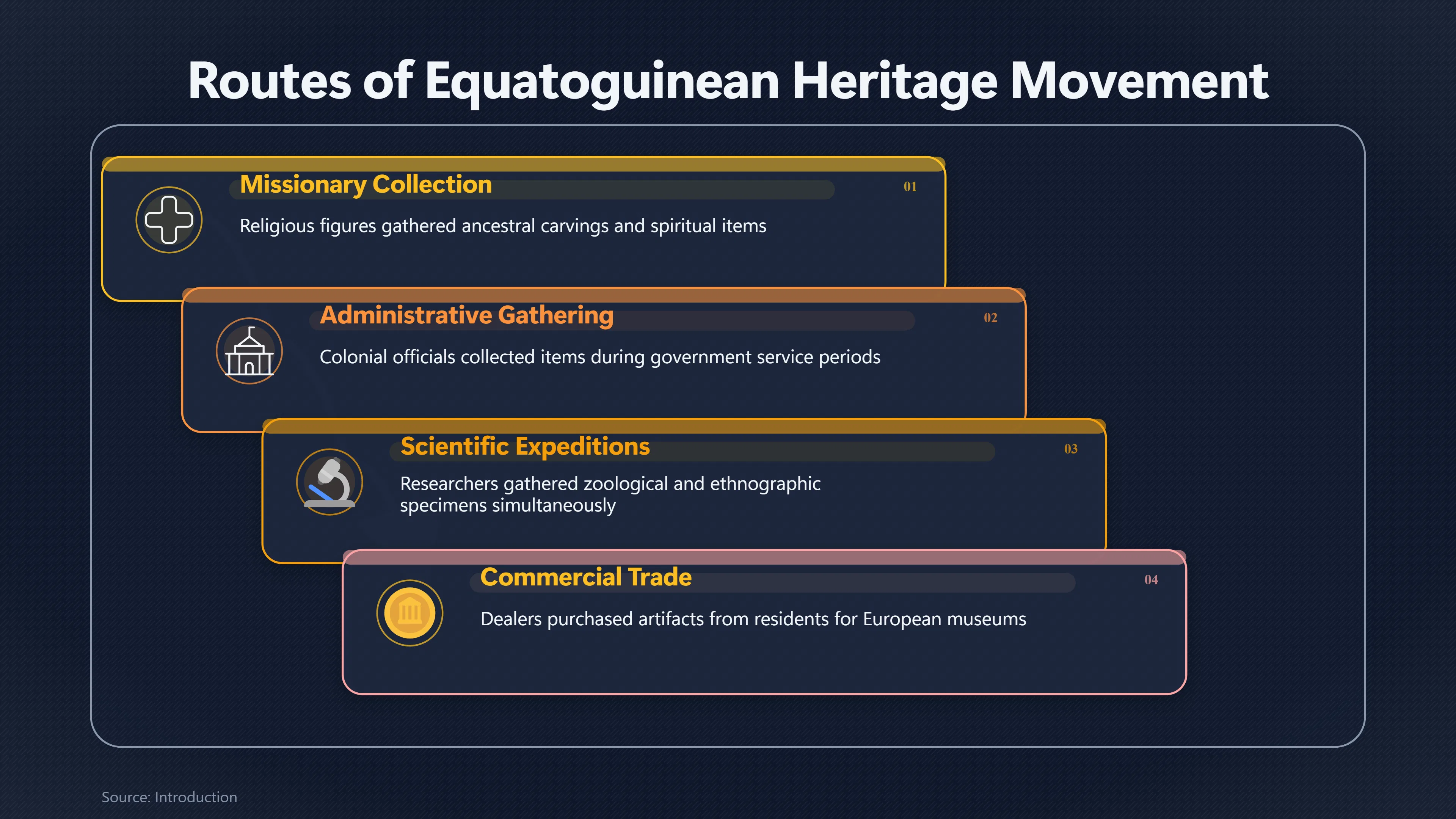
Unlike many African territories administered by Britain or France, Equatorial Guinea was governed by Spain until 1968. During the late nineteenth and twentieth centuries, colonial officials, missionaries, military officers, naturalists and museum expeditions actively collected objects for Spanish institutions.
The collecting had several overlapping purposes:
- documenting peoples regarded by colonial authorities as “traditional”;
- supplying ethnographic museums with examples of everyday and ceremonial life;
- gathering natural-history specimens for scientific research;
- demonstrating the economic and biological richness of Spain’s African colony;
- supporting anthropological studies carried out by colonial research organisations.
The collections were therefore never simply souvenirs. Many were assembled through organised expeditions backed by museums, universities and colonial agencies. Barcelona’s former Ethnological and Colonial Museum became one of the principal institutions receiving material from Spanish Guinea, particularly after official expeditions during the late 1940s and 1950s.[Culture and History]cultureandhistory.revistas.csic.esCulture and HistoryAnthropology and image in colonial contexts: the scientific expedition to Spanish territories in the Gulf of Guinea (1…
What Barcelona museums hold
Barcelona remains the city most closely associated with large Equatoguinean collections.
Ethnographic collections
The city’s ethnographic museums preserve substantial collections originating from Equatorial Guinea, including material from Fang, Bubi and other communities. These include:
- carved wooden figures;
- ritual and ceremonial objects;
- weapons and hunting equipment;
- musical instruments;
- jewellery and personal ornaments;
- baskets, pottery and domestic tools;
- textiles and everyday household items.
Many entered museum collections through colonial officials, missionaries or organised field expeditions rather than through local museums or community institutions.
The importance of these collections is historical as well as artistic. They document material culture that has sometimes disappeared or changed significantly over the past century, but they also reflect the selective interests of colonial collectors, who often preferred ritual, ceremonial or “exotic” objects over ordinary aspects of daily life.[Culture and History]cultureandhistory.revistas.csic.esCulture and HistoryAnthropology and image in colonial contexts: the scientific expedition to Spanish territories in the Gulf of Guinea (1…
Natural-history collections
Barcelona also houses one of Europe’s largest scientific collections containing material from Equatorial Guinea.
The Natural Sciences Museum of Barcelona holds more than four million specimens overall, with significant holdings originating from Equatorial Guinea across several zoological collections. Museum documentation specifically identifies important collections of mammals, birds, reptiles, molluscs and other specimens gathered during colonial expeditions. Museu de Ciències Naturals de Barcelona+2Museu de Ciències Naturals de Barcelona[museuciencies.cat]museuciencies.catMuseu de Ciències Naturals de BarcelonaIntroduction | Museu de Ciències Naturals de Barcelona…
These collections include:
- preserved mammals from Central African forests;
- bird skins and mounted specimens;
- reptiles preserved in alcohol;
- insects collected during scientific surveys;
- shells and freshwater molluscs;
- associated field notebooks and collecting records.
Many continue to be used for taxonomic research, biodiversity studies and historical comparisons of wildlife distributions.
How colonial officials, missionaries and dealers collected
The movement of Equatoguinean objects into European museums occurred through several different routes rather than a single organised programme.
Missionaries frequently assembled collections while establishing churches and schools. Religious objects, ancestral carvings and items connected with local spiritual practices were often removed as examples of customs that missionaries believed were disappearing or should be replaced by Christianity.
Colonial administrators also collected objects during government service. Some entered museums directly, while others passed through private hands before eventually being donated or sold.
Scientific expeditions formed another major source. Researchers gathered zoological specimens, plants, insects and ethnographic material simultaneously, treating both local cultures and local wildlife as subjects for systematic study. The 1948 scientific expedition to Spanish Guinea sponsored by Spanish institutions became especially influential in expanding Barcelona’s ethnographic collections and setting a pattern for further collecting during the 1950s.[Culture and History]cultureandhistory.revistas.csic.esCulture and HistoryAnthropology and image in colonial contexts: the scientific expedition to Spanish territories in the Gulf of Guinea (1…
Commercial dealers played a smaller but still important role, purchasing artefacts from collectors or colonial residents before placing them in European museums or private collections.
Why these collections matter today
The displaced collections present an unusual paradox.
On one hand, European museums have often preserved objects that might otherwise have been damaged, dispersed or lost during periods of political and economic change. Many collections have been professionally catalogued, photographed and increasingly digitised, making them available to researchers worldwide. The Natural Sciences Museum of Barcelona, for example, continues to expand online access to parts of its collections.[Bioexplora]bioexplora.catExplora la natura i també el museu | Museu de Ciències Naturals de BarcelonaBioexplora | Explora la natura i també el museu | Museu de Ciències Naturals de Barcelona…
On the other hand, preservation does not erase the circumstances under which many objects left Equatorial Guinea. Museum records frequently identify the collector but provide relatively little information about the communities from which objects originated or whether their removal involved meaningful local consent.
For Equatoguineans interested in their own cultural history, this can mean that important artefacts are easier to study in Barcelona than in Malabo or Bata.
Provenance and restitution questions
Unlike debates surrounding internationally famous collections such as the Benin Bronzes, Equatoguinean collections have received relatively limited public attention. There have been no equally prominent restitution campaigns, and relatively few objects have become symbols of international controversy.
Nevertheless, the same broader questions increasingly apply:
- How fully should museums investigate colonial-era acquisition histories?
- Which objects were legitimately purchased, and which may have been removed under unequal colonial conditions?
- Should digital access, long-term loans or shared exhibitions become more common?
- Are some culturally significant objects appropriate candidates for return?
Many museums have shifted towards more transparent provenance research rather than assuming older collecting practices were unproblematic. Spanish museums have also increasingly explored the colonial history behind their Equatoguinean collections through exhibitions examining how and why these objects entered European institutions.[Cultura]cultura.gob.esCultura IkundeIkunde - MUSEO NACIONAL DE ANTROPOLOGÍA | Ministerio de Cultura…
The absence has become part of the museum story
For visitors exploring Equatorial Guinea’s unusual heritage, the country’s museum landscape cannot be understood simply by looking inside its borders.
The absence of thousands of ethnographic artefacts and scientific specimens has itself become a defining feature of the country’s cultural history. Rather than one spectacular curiosity museum, Equatorial Guinea’s most remarkable “collection” is dispersed across European institutions, particularly in Barcelona, where ritual carvings, colonial photographs, preserved wildlife and everyday objects continue to shape how the former colony is studied and interpreted.
That makes these displaced collections more than archives of the past. They remain living records of colonial science, missionary activity, museum practice and changing attitudes towards cultural ownership. As museums place greater emphasis on provenance research and collaborative interpretation, the story increasingly shifts from simply displaying Equatoguinean objects to examining how they arrived in Europe, whose voices have been represented, and how those histories should be told in the future.
Amazon book picks
Further Reading
Books and field guides related to Why So Much Equatoguinean Heritage Is Abroad. Use these as the next step if you want deeper reading beyond the article.
The Brutish Museums: The Benin Bronzes, Colonial Violence and...
New York Times 'Best Art Books' 2020 'Essential' – Sunday Times 'Brilliantly enraged' - New York Review of Books 'A real game-changer'– E...
Africa's Struggle for Its Art: History of a Postcolonial Defeat
"A major new history of how, between 1965 and 1985, African nations sought the restitution of works of art stolen during the colonial per...
Decolonizing Museums: Representing Native America in National...
Museum exhibitions focusing on Native American history have long been curator controlled. However, a shift is occurring, giving Indigenou...
Possession: The Curious History of Private Collectors from An...
Whether it's the discovery of $1.6 billion in Nazi-looted art or the news that Syrian rebels are looting UNESCO archaeological sites to b...
eBay marketplace picks
Marketplace Samples
Live-tested eBay searches with available results related to this page.
Selected fromethnographic art oneBay.co.uk.
Endnotes
1.
Source: bcnroc.ajuntament.barcelona.cat
Link:https://bcnroc.ajuntament.barcelona.cat/jspui/handle/11703/120620
Source snippet
ceso libre y gratuito sus documentos digitales de difusión pública: Martínez de la Escalera en las colecciones del Museo de Ciencias Natu...
2.
Source: bioexplora.cat
Title: Explora la natura i també el museu | Museu de Ciències Naturals de Barcelona
Link:https://www.bioexplora.cat/en/open-collections
Source snippet
Bioexplora | Explora la natura i també el museu | Museu de Ciències Naturals de Barcelona...
3.
Source: barcelona.cat
Title: los objetos de ikunde
Link:https://www.barcelona.cat/museu-etnologic-culturesmon/es/noticias/los-objetos-de-ikunde
4.
Source: barcelona.cat
Title: historia del museu
Link:https://www.barcelona.cat/museu-etnologic-culturesmon/ca/el-museu/historia-del-museu
5.
Source: cultureandhistory.revistas.csic.es
Link:https://cultureandhistory.revistas.csic.es/index.php/cultureandhistory/article/view/263
Source snippet
Culture and HistoryAnthropology and image in colonial contexts: the scientific expedition to Spanish territories in the Gulf of Guinea (1...
6.
Source: museuciencies.cat
Title: Museu de Ciències Naturals de Barcelona
Link:https://museuciencies.cat/en/science/collections/introduction/
Source snippet
Introduction | Museu de Ciències Naturals de Barcelona...
7.
Source: museuciencies.cat
Link:https://museuciencies.cat/es/area-cientifica/colecciones/colecciones-zoologicas/vertebrados/
8.
Source: cultura.gob.es
Title: Cultura Ikunde
Link:https://www.cultura.gob.es/mnantropologia/colecciones/fondos-museogr-ficos-y-documentales/colecciones-viajeras/ikunde.html
Source snippet
Ikunde - MUSEO NACIONAL DE ANTROPOLOGÍA | Ministerio de Cultura...
9.
Source: cultura.gob.es
Title: Ikunde: memorias de la Guinea colonial, se prorroga
Link:https://www.cultura.gob.es/mnantropologia/museo/noticias/2017/ikumde.html
10.
Source: museuciencies.cat
Link:https://museuciencies.cat/es/area-cientifica/colecciones/colecciones-zoologicas/
11.
Source: museuciencies.cat
Link:https://museuciencies.cat/en/science/scientific-departments/mineralogy/
12.
Source: museuciencies.cat
Link:https://museuciencies.cat/en/science/collections/geological-collections/mineralogical/
13.
Source: museuciencies.cat
Link:https://museuciencies.cat/en/science/collections/zoological-collections/arthropods/
14.
Source: cultureandhistory.revistas.csic.es
Link:https://cultureandhistory.revistas.csic.es/index.php/cultureandhistory/article/download/263/806
15.
Source: cultura.gob.es
Title: Brazaletes Frang
Link:https://www.cultura.gob.es/mcerralbo/coleccion/coleccion0/antropologia2/brazaletes.html
16.
Source: cultura.gob.es
Title: African Collections
Link:https://www.cultura.gob.es/mnantropologia/en/colecciones/fondos-museogr-ficos-y-documentales/nuestra-coleccion/africa.html
Additional References
17.
Source: web.ub.edu
Link:https://web.ub.edu/web/facultat-geografia-historia/w/20260216-tr-african-t-s-un-projecte-pioner-clau-per-revisar-el-patrimoni-d-origen-colonial-dels-museus-catalans
Source snippet
ub.edu20260216-(Tr)african(t)s, un projecte pioner clau per revisar el patrimoni d’origen colonial dels museus catalans - Faculty of Geog...
18.
Source: lagdeguinea.com
Link:https://lagdeguinea.com/director-del-cicte-queremos-recuperar-la-independencia-cultural-que-perdimos-durante-la-colonia/
Source snippet
October 13, 2025 — DIRECTOR DEL CICTE: “QUEREMOS RECUPERAR LA INDEPENDENCIA CULTURAL QUE PERDIMOS DURANTE LA COLONIA” * Silvia Elá * 13 d...
Published: October 13, 2025
19.
Source: youtube.com
Title: Activist draws attention to looted African art through unconventional method
Link:https://www.youtube.com/watch?v=vzrhuVdOlrw
Source snippet
Returning colonial looted art to its countries of origin | DW Documentary...
20.
Source: youtube.com
Title: Returning colonial looted art to its countries of origin | DW Documentary
Link:https://www.youtube.com/watch?v=ZMkjajxXuQI
Source snippet
Reclaiming Africa's stolen treasures and why it matters | DW News...
21.
Source: youtube.com
Title: Reclaiming Africa’s stolen treasures and why it matters | DW News
Link:https://www.youtube.com/watch?v=5F6m5undTwM
Source snippet
Reclaiming African art from Western museums...
22.
Source: youtube.com
Title: Reclaiming African art from Western museums
Link:https://www.youtube.com/watch?v=qakKrieA4VY
Source snippet
Africa's stolen treasures: Time to give them back? | To The Point...
23.
Source: kjcc.org
Link:https://www.kjcc.org/news/gabinete-fang-a-project-about-memory-history-and-colonial-legacies-in-20th-and-21st-century
24.
Source: kjcc.org
Link:https://www.kjcc.org/event/gabinete-fang/
25.
Source: smb.museum
Link:https://www.smb.museum/en/museums-institutions/ethnologisches-museum/about-us/restitutions/
26.
Source: coca.antropologia.cat
Link:https://coca.antropologia.cat/comunicacio/a-qui-pertanyen-els-esperits-la-devolucio-de-7-cranis-del-muec-a-guinea-equatorial-el-1982/